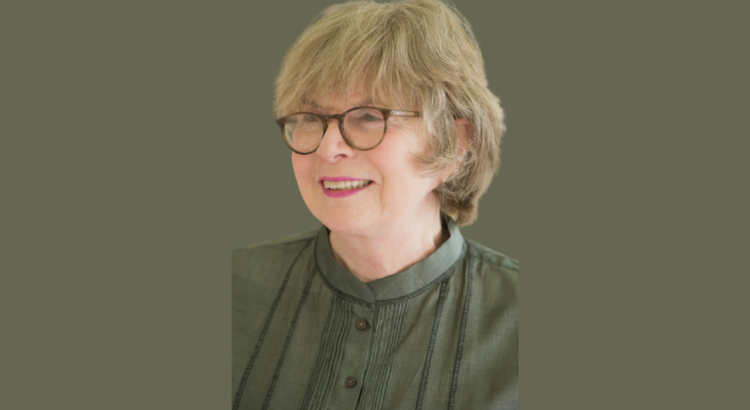
Street Food is the Glory of Indian Cuisine: Colleen Sen

Colleen Taylor Sen was lives on the North Side of Chicago with her husband Ashish Sen whom she met at a college dance in Toronto, her place of birth. She has written six books on Indian cuisine including  Feasts and Fasts: A History of Food in India, Turmeric: The Wonder Spice (with Helen Saberi), Street Food around the World: An Encyclopedia of Food and Culture (with Bruce Kraig) Curry: A Global History and  Food Culture in India.

Colleen says it is difficult to find authentic Bengali food even in India. Married to a Bengali, her favourite comfort food is Bengali lucchi chhechki, which is very simple: “lucchis (puris made with white flour) and fried onions and vegetables with a little pickle on the side. Whenever I would visit my in-laws in India, that would be the first thing I asked for,” says Colleen.

Her husband, Ashish Sen introduced her to Indian food. “He is a true gourmet and an excellent cook. I was also influenced by his late mother, Arati Sen, who was a well-known writer. She had a widely read column in the Bengali magazine Desh under the penname Srimati, edited a journal Manjuri and contributed articles to Illustrated Weekly. She wrote a lot about food. Unfortunately, she died fairly young but during the time I knew her she introduced me to several luminaries of the food world, including the late Kundan Lal of Moti Mahal fame.”


Colleen says she is fortunate to have many Indian friends, some of them much younger than her, “who have introduced me to foods and places I would never otherwise visit. This includes everything from humble street food shacks known only to restaurants specializing in regional cuisines. I also enjoy driving through the Indian countryside with my husband who speaks several languages. Once in Bastar I even sampled red any chutney.”

Author of several books on Indian cuisine as well as many blogs and videos, Colleen shows us that there is more to Indian street food than picking something up when one is in a hurry shopping around. There is deep attachment, anticipation and care that goes into the Indian street food experience. India’s best chefs are getting involved in street food too, creating recipes that capture the experience of eating the tasty and tangy Indian savories.  

 Asked about if India’s true culinary talent lies in its street food, she says “Street food is the glory of Indian cuisine and today top restaurants serve sophisticated -- and expensive -- takes on dishes like pani puri and chaat.  But other countries have an equally rich street food tradition – China, Mexico, Thailand, and Malaysia come to mind.  On the other hand, for cultural and social reasons, street food does not play a big role in Japan and France, for example.”

Colleen says that until fairly recently “Indian restaurants offered a standard fare: North India/Tandoori/Mughlai” food or South Indian vegetarian. It was impossible to find, for example, Bengali food even in India. Today big cities in India have restaurants serving Bengali, Bihari, Gujarati, Naga, Rajasthani, Hyderabadi, Kashmiri, and other regional cuisines. Still, there are gaps: finding Maharashtrian or Odisha cuisine, for example outside of their states.” She adds that in the United States there are very few restaurants serving regional Indian food.

Her book Pakoras, paneers and pappadums - A Guide to Indian restaurant Menus in the United States is a basic guide on Indian restaurants in the United States. She has not gone into regional variations of the title, but provides a list of places people can experience such fare. In a podcast she says that “The history of Indian food in America has been largely neglected, even though it is much older than Chinese American cuisine.”

She says the first Indian cooks arrived a decade after the founding of the Jamestown Colony in 1607 as servants to British “Nawabs” who came to America after making their fortunes. Curry recipes were featured in most 19th century cookbooks. She adds that America’s very first ‘bad boy’ celebrity chef was an Indian, Ranjit Smile, who hit the New York culinary scene in 1899 and made front page headlines with his exotic dishes and his frequent run-ins with the law. Faced with tightening immigration laws in the early 1900s, Indian farm workers in the Sacramento Valley married Mexican women and created a hybrid Indian-Mexican cuisine, including “Hindu pizza.” · In Chicago, the first Indian restaurant was the House of India (1963), followed by Bengal Lancers (1969) –15 years before the first restaurant on Devon Avenue. Listen to the podcast here: Currying Interest in Indian Cuisine From its Arrival in America to its Rise in Chicago by CulinaryHistory (soundcloud.com)

So how can Indian cooking become as lucrative as Chinese or Thai cuisine. Asked for her suggestions, Colleen, says that India’s strength is also the cause of its lack of popularity. “One reason Indian food isn’t more popular in the United States is the diversity and complexity of Indian food. In fact, can one really even talk about Indian food? There are dozens of regional and local cuisines and to make them popular, or even accessible, to diners would take a lot of education. Also, there is a common misconception that Indian food is too ‘hot’ for Western palates. I had two experiences recently with people who said they didn’t like Indian food – and then ate everything that was offered to them. (And the hottest meals I personally have ever eaten have been Thai and Chinese Sichuanese). Moreover, Americans don’t have any historical ties with India, as do the British, so India and its cuisine are essentially alien to them.”

Her book Curry – A Global History traces the journey of Curry.  The word curry has been used loosely for everything Indian. Says Colleen: “I think curry is a much-misunderstood word. The word used to have negative connotations as a creation of the British but today I see that it is becoming increasingly used even in India as a convenient way of referring to a dish with a gravy. Everyone pretty much knows what it means!”

Her book gives a “historical and descriptive account of a dish that has many incarnations. Colleen describes in detail the Anglo-Indian origins of curry and how this widely used spice has been adapted throughout the world. Exploring the curry universe beyond India and Great Britain, her chronicles include the elegant, complex curries of Thailand; the exuberant curry/rotis of the Caribbean; kari/raisu, Japan’s favorite comfort food; Indonesian gulais and rendang; Malaysia’s delicious Nonya cuisine; and exotic Western hybrids such as American curried chicken salad, German currywurst, and Punjabi-Mexican-Hindu pizza. She quotes excerpts from popular songs, literary works, historical and modern recipes, and illustrations depicting curry dishes and their preparations.

Indian chefs are at the vanguard of culinary innovation and change. But Colleen cautions that “it must be positive innovation, not just combining ingredients and techniques in a haphazard manner to create what is termed “fusion food’. Chefs like Thomas Zacharias, Pradeek Sadhu, Manish Mehotra, and the late Floyd Cardoz are part of an international network of chefs that learn from each other. Their menus feature innovative techniques, the use of local and sustainable ingredients, and elegant presentations. By the same token, chefs from top Western restaurants like Chicago’s Alinea are spending time in Indian kitchens. I believe we are seeing the emergence of a new international cuisine that incorporates the best from many traditions.”

Only Vedanta Can Eliminate the Root of All Worries – Self-ignorance: Felber

The conversation with Thomas Felber began with a question on what turned him to Vedanta. Nothing more profound. But his answer was.

Born in Vienna as the son of "extraordinary sacrificing parents," who lived and subtly taught him values that would open him up to new experiences and influences, Thomas says his inspiration towards Vedanta "was appointed to manifest, as it were, supervised by Isvara because all impulses, motivations, ideas, etc., are nothing but consequences of one's past tendencies (or vasanas in Vedantic parlance), gathered from previous births or experiences."

As a teenager, he became interested in Eastern wisdom teachings, especially the journey toward the essence of all spiritual thought and was initiated as a Kriya Yogi around the time. A short private but memorable conversation with Paramahamsa Hariharananda when he visited Austria and nudged him to search for more.

After completing the three-year course of Vedanta philosophy directed by Swami Parthasarathy, Vedanta Academy, Thomas began a self-study of different Vedantic texts and teachings from Swami Chinmayananda ji, Swami Dayananda ji, and Sri Sri Satchidanandendra Saraswati. A disciple of Dr. Swaminiji Svatmavidyananda he has embraced a life immersed in spreading the message of Shankara.

What inspired you to turn to Vedanta. What and who influenced you in the early part of your journey?

A beautiful question. According to Advaita Vedanta, one can metaphorically say, all inspirations reveal Lord's thoughts because every moment is only Bhagavan's moment. Thus, everything can be seen as an inspiration to deliberate upon and how it contributes to one's inner growth and thereby helps to recognize reality as it truly is and not as one thinks it is. Hence my inspiration towards Vedanta was appointed to manifest, as it were, supervised by Isvara because all impulses, motivations, ideas, etc., are nothing but consequences of one's past tendencies (or vasanas in Vedantic parlance), gathered from previous births or experiences. Regarding who influenced me in the early part, I have to begin with my parents, considered as one's first teachers, who taught me fundamental values like being thankful and developing a certain degree of empathy. But I also must admit that, as a young boy, I was more of a comedian instead of being associated with religious practices. However, there was always a thirst for knowledge and particularly enjoying scriptures.

Somehow, in high school, I fell in love with the concept of infinity, and only Bhagavan knows why. I questioned a lot, but most mysteries about God, infinity, truth, remained unanswered, so I had to find a way to solve these doubts. At those times, I nearly read a book in a week and tried to get suitable answers. However, most scientific, even philosophical content was not enough to dispel my ignorance about specific inquiries.

I cannot exactly recall, but when I was around 16, I visited a spiritual bookstore not far away from high school. I regularly acquired or inspected books about comparative mysticism from there, usually after school. Wisdom by great teachers like Sri Ramana Maharshi, Sri Ramakrishna, Swami Vivekananda, Meher Baba, including Upanishads up to Kriya Yoga, answered many challenging questions, so the spiritual treasury of India turned into an inspirational driving force. Interestingly, Adi Shankara remained hidden at that time, but I was pretty happy, coming in contact by reflecting upon and meeting new like-minded friends.

So, what inspired me to turn to Vedanta? I would say it was my lack of understanding of the mysteries of life or reality itself.

What is the connection between human psychology and Vedanta teachings that attract non Indians to it?

I don't see Vedanta associated with any specific culture or drawing a line between Indians and Non-Indians. Because as human beings, regardless of race, color, class, status, or gender, we all want or strive to be happy, being free without having any anxieties. Consequently, there is an interrelation between human psychology and the teachings of Vedanta that attracts everyone. However, the advantage of Vedanta compared to any other empirical science like psychology is that it is the only efficient, time-tested methodology that can eliminate the root of all worries, called self-ignorance.

Etymologically, Vedanta, as the end portion of the Vedas (jnana khanda), moreover, as the only means to recognize that Absolute, as Adi Shankara beautifully said: idaM tu paramArthatattvamadvaitaM vedAnteShveva vij~neyamityarthaH, "This knowledge of the highest non-dual Reality can be realized (recognized) through Vedanta alone" (Mandukya Upanishad Karika, 4.99), the term is undisputably related to the Vedic culture. As one dives into the depths of Vedantic wisdom, it is beyond any borders and at the same time unites people. That is the beauty of truth itself. As Swaminiji Svatmavidyananda once told me: "Vedanta is not opposed or against anything." To use a famous Vedantic illustration of water, waves, and the ocean: Water can neither exclude waves nor the ocean as essentially only water exists. Seeing waves and an ocean happens because we do not realize that self-evident water. Therefore worries, desires, and tensions arise repeatedly.

From a Western perspective, many people seem to be unhappy with their answers or beliefs because sooner or later, many realize what appears will eventually disappear. Now, in Vedanta and Buddhism, the term enlightenment or liberation became popular, hence attractive to follow something mystical, unusual. But what is often overlooked by many Western seekers is that the teachings of Vedanta are no escape routes, trying to bypass one's duties. One Vedantic teacher said: If one's mental maturity and discipline are not strong enough, the same old habitual thinking patterns and desires will repeat, regardless of being alone in the Himalayas or amidst a crowd.

In my humble opinion, it is natural why certain words trigger a longing to find an easy way out of one's miseries. Expressions like eternal, limitless, and absolute happiness can do that as they point indirectly towards our essential nature of what we already are and always have been. However, we think we are bound because we did not understand ourselves correctly, so we continuously strive or desire to be free, at least temporarily, either by pursuing more desires or avoiding certain circumstances.

Presently there are two current approaches to learning- one very simple, and easily assimilated. The other requires rigor, patience and dedication. Why have you chosen the harder path. Is it more intellectual than the relatively more accessible Bhakti marga.

I neither chose nor would I call jnana-marga or the path of knowledge a hard path per se. Undoubtedly, every human being has specific talents and abilities based upon his mental tendencies. For example, quantum physics for a scientist is less hard, possibly simple, than for someone with more inclinations towards composing music. According to Advaita Darshana, Bhakti Marga is considered more approachable because it always depends on the seeker's mind and his capacity to understand. According to Adi Shankara, Bhakti Marga, like Karma-Yoga, is about preparing one's mind to become qualified for the path of knowledge or jnana-marga.

However, it is also correct that both culminate in the full understanding of the ultimate Truth. It is like someone yearns to understand how physical laws work. One can worship a book about physics until he or she realizes that there is a need to open the book, study the words accompanied by a teacher, and eventually understand their essential meaning. Devotion or Bhakti-Marga is therefore not less worthy but serves indirectly towards liberation or moksha, the sole purpose of life.

The highest devotion or love is neither emotional nor based upon likes and dislikes. Because what is the dearest to all of us is always one's true Self, called Atman. It is that impersonal non-dual Self appearing as billion individual selves.

You have done enormous work on Shankara's works. You say in Germany and Austria, Vedanta has a small presence. How do you propose to spread it wider?

You are too kind. I do not see it as enormous. There are and were a lot of brilliant minds who did much more. I can only try to contribute to my own given abilities. Everything I did so far, all ideas which passed through my mind are because of Bhagavan. Therefore apparently, all work is Isvara's work alone. In countries like Germany, Austria, and other European countries, Vedanta is not taught exclusively so far as I'm informed. Some Vedantic lectures usually appear supplemental or mixed with Hatha Yoga trainings. As long as there is only minor awareness regarding Vedanta, I can only work upon various ideas, thereby making Advaita Vedanta's teachings more accessible to a broader audience. Thanks to modern technologies, there are many options available, such as speaking on popular video platforms, translating more Advaitic texts, or eventually opening a German-based institution solely devoted to Advaita Vedanta. Bhagavan knows!

What is it that is absent in present day European society which Sri Shankaras teachings offer?

What is absent is the capacity to think rightly, to discriminate between transient and permanent. This lack of correct thinking is universal, not related to any society. Hence Adi Shankara's teachings should be taught beginning in pre-school, designed according to mental readiness. What Advaita Vedanta indicates is universal, affects everyone's daily experiences. The western lifestyle is a lot about becoming someone or having something. Yet, sooner or later, a sense of incompleteness will persist regardless of wealth, status, or power.

Adi Shankara's teachings or Advaita Vedanta can solve this sense of incompleteness created by self-ignorance by offering a time-tested, proven methodology to understand oneself truly.

What is the approach Shankara offers you towards realizing your true self. At one point even the dependence on the guru has to go. Is one ever ready for that?

There is only one approach or method, called adhyAropApavAdA-nyAya appearing in different forms throughout sruti, Upanishads. As Adi Shankara himself stated in Gita 13.13 Bhashyam: tathA hi sampradAyavidAM vachanam — ‘adhyAropApavAdAbhyAM niShprapa~nchaM prapa~nchyate.a iti, “Those who know the right traditional method of teaching, stated as: "That which is devoid of all duality is described by (deliberate) superimposition (adhyaropa) and negation (apavada).”

And the teacher (Guru) who should be well-versed (shrotriya) in the scriptures, abiding in or better to say as Brahman without any trace of self-ignorance (brahmaniShTha), is a guiding light, supporting the student, however, from the student's point of view only. That is why a Guru remains as Guru as long as one is aware of differences, and in this case, respect, trust, and surrendering to one's Guru teachings are necessary.

Even concerning empirical knowledge, to understand something like Einstein's equation of E=mc^2, one has to surrender oneself to someone who knows, therefore eventually, one arrives at the same conclusion.

According to Advaita Darshana, the Lord Himself appears as Guru and as a student, as it were. The only seeming difference is that a Guru truly realized what IS, and the student has not. In the dawn of self-knowledge (aparoksha-anubhava), the guru-student relationship (Guru-shiShya-sambandha) completely dissolves, and Atman/Brahman, Truth Itself alone, shines forth.

You are building a huge body of work on Sanskrit and Vedanta. Are there seekers in the West who follow your work - are these individuals, institutions?

I am not aware of how many people followed or used the content for themselves or their purposes. Indeed, some appreciated it, but I assume many are not even aware of it. Advaita Vedanta often turns into a competitive play of words, even among so-called Advaitins. Competition, building fellowships, etc. those issues have nothing to do with the sole purport of dispelling one's self-ignorance.

What gaps are there in learning Vedanta for non-Indians. What would encourage more people to visit India?

I can only point to a few assumptions. First, the term "Vedanta" in many English translated books is associated with the term philosophy. Hence, it is often termed as "The Vedanta Philosophy," being one of six major schools of Indian philosophy. Now in the West, philosophical studies are usually linked with ideas about abstract and dry reasoning. That is one, perhaps one of the most significant barriers why common people stay away, even starting with Vedanta. Vedanta, as means, towards that all-pervading reality, is all-inclusive, covers the entire life, and can address issues beyond the empirical sphere. Consequently, it is the opposite of abstractness but dynamic and interrelated to everyone's experience.

Another gap could be learning the Sanskrit (sanskritam) language or becoming familiar with important terms and concepts, which involves time and daily commitment. Speaking of commitment, Vedanta also requires practice to strengthen one's capacity to think and inquire, preparing to understand the subtle truths as echoed in the Mahavakyas like Tat Tvam Asi. That is why Vedantic courses are around three years or longer. Hence, patience and moderation are needed, rare habits in Western materialistic-oriented societies. A few years ago, I recorded two lessons in German about a Vedantic text attributed to Adi Shankara and then asked for feedback. The content was not the problem, but the length of only one hour was for most listeners too long. Same I recognized in meditation classes of trying to sit for 30 minutes. The true purport of Vedanta must be simply and clearly explained adjusted to a Western audience. Then I am sure people will find a way to seek guidance from a traditional teacher and become perhaps motivated to join Vedantic courses in India.


What role do you see for yourself in the preservation of Vedanta?

To quote William Shakespeare: "All the world's a stage, And all the men and women merely players; They have their exits and their entrances." I play that role Bhagavan assigned to me, as it were. It seems undoubtedly related to Advaita Vedanta Darshana, especially regarding Germany or other countries in Europe. It covers many areas like translating other texts or Adi Shankara's works into German, or speaking about particular topics. Also, outside of Europe, there are several opportunities. Numerous spiritual treasures are still not translated, not even transliterated—moreover, new concordances, for example, on Sri Suresvara's works, are not available. Since last year, I have been working on a massively expanded version of Adi Shankara's encyclopedia, divided into hundreds of topics with thousands of Bhashyam references, including transliteration. There are much more concepts like building a scriptural archive solely devoted to Advaita Vedanta or a custom Prasthantrayi Bhasyam search engine for those who cannot read Devanagari. I regularly discuss specific topics with my teacher, Dr. Swaminiji Svatmavidyananda, and other great scholars. Even being only associated with Vedanta is joyful.

Can you share some of Shankara's insights that have inspired you the most.

I consider every line written by Adi Shankara as insightful. His works are more than masterful. Adi Shankara's way of arguing respectfully should be an ideal in modern debates. Furthermore, as often wrongly believed, Adi Shankara was not the founder of Advaita Vedanta. He was a masterful thinker, teacher, and writer. He restored what was nearly forgotten, not to develop a new faith but to make people aware of their ignorance and how the words of the early scriptures, sruti can dispel it. That's why he is also called Bhāṣyakāra, the great commentator. In his Bhasyham, there are references where he praised his Paramaguru Gauḍapādācārya, in other treatises, his Guru Govinda Bhagavatpada, and the entire traditional lineage of teachers (Sampradaya Guru Parampara). He clearly showed respect towards other teachers like Bhagavan Bādarāyaṇa, Upavarsah, and Jaimini. Perhaps the most striking insight is that a mastermind like Adi Shankara never considered anything his own but served for the benefit of society during his short period of physical presence. He did not write a single line about his personal life because all ascribed biographies were written centuries later. In my humble opinion, a true teacher does not even think for a moment about being a teacher but supports and dispels confusions, and Adi Shankara proved that to all of us!

Chanting Allows Yoga Teachers To Offer More to a Postural Practice: Shantala Sriramaiah

There is a new school of women chanters who are carrying forward the heritage of reciting Vedic mantras. Shantala Sriramaiah, born and raised in Bangalore, India is now teaching chanting to students from all over the world from her home in Brussels, Belgium through her institution www.VedaStudies.com. The sounds of these sacred mantras were her companions in her childhood and much of her inspiration comes from her mother Saroja, who taught chanting for over 30 years in their home.

Many will attest to the difficulty of getting the svaras just right. In a blog, Shantala asks – why do we have to chant these texts? “Can’t we just read them like any other book, read good translations and understand them and learn in that way?”

It would not be the same. “It would be like studying marine biology without ever observing an actual aquatic animal or reading amazing books on cutting hair without actually practicing. Like studying a book about swimming or cooking, but never ever getting in the water or preparing a dish, you don’t actually gain assimilated knowledge,” she writes.

Shantala says the Knowledge in the Vedas, “cannot be separated from the form of their mantras – rhythmic sounds in clever metrical poetry. The process of learning to chant these mantras is crucial in starting to understand and integrate its deep wisdom. When we chant the Vedas, we are forced to develop concentration, focus, excellent listening skills and will power. Without this practice-based approach, the Vedas will forever remain some esoteric mystical text of the ancients, meant for unknown Vedic rituals with little relevance to our everyday lives.”

 In this interview, Shantala speaks to CSP about her illustrious guru Sreenivasan Challakere and about the interest in chanting among non-Indians. Many are learning to chant now, some better than others, “partially due to our own Sādhana, but mostly because of what we come gifted with,” she says.

Your first initiation to Chanting, Sanskrit and Vedic Studies was at your home. How important is this samskara to appreciate and respect Vedic culture? Sri Sreenivasan ji always talks about this concept of Samskara. How do you inculcate samskara in non-Indians?

Personally, this has been very important to me, as I value the immersion I’ve had in this tradition growing up and feel a deep connection to my mother and family through my work. My work is my tribute to my mother. Equally, I admire the numerous students who have taken to this practice so beautifully and respectfully, even though from another culture. Guruji Sreenivasan ji is talking about Saṃskāras also from previous lifetimes. I see this in practice in our community of students who represent over 30 countries! Before Covid – it was easier to inculcate saṃskāra-s through various events, pūja-s in my home etc. It is more challenging on Zoom. Yet, I believe students, both Indian and non-Indian are able to see and experience the reverence with which to approach this practice. I express gratitude to my teachers and family for this strength.

Her late mother Saroja teaching a class in our living room in Bangalore.

It has been three decades of dedicated learning, chanting, and listening for you. Nowadays in a fast-paced culture, we expect to learn and master this knowledge through short certified courses. Do you think this has actually increased the number of people interested in Indian culture, or is it diluting it?

It is definitely a different time and certainly a very busy time for most of us. The idea of spending 30+ years on learning aspects of Indian culture without defined learning outcomes is unthinkable! I believe the short courses give valuable structured introductions to students, but true mastery will always require a consistent daily practice, under the guidance of a teacher, over a long period of time. There can never be a short cut to mastery. We need both – the short courses for accessible and structured studies along with opportunities for long term study. Intense effort on the part of both teacher and student will help not dilute this learning!

What is it about the Challakere Brother's style which makes it so authentic. They after all have an ancestral connect to Krishnamacharya parampara.

The Challakere Brothers are proficient in their understanding of the Prātiśākhyā-s – the texts which illustrate through its sūtras, how to recite the Veda. They are able to explain with great precision every syllable, every syllable or sound combination which can be very different from classical Sanskrit. They apply these rules consistently and masterfully in their chanting. Therefore, when you listen to their chanting, there is no doubt you are listening to something very divine. They are also generously passing on this knowledge to their students. You can say they follow and teach the yoga of the Ṛṣi-s!

What is the main reason that non_Indians wish to learn chanting? Is it usually at the beginning, middle or end of their Yoga or Ayurveda practice?

I have had students join me at different points in their yoga or Āyurveda journey. There are many reasons non-Indians wish to learn chanting:

  • A serious interest in developing a spiritual, devotional practice.
  • Having heard the chanting in āśrams or temples in India, an intense desire to learn to chant themselves.
  • To offer more than a postural practice as yoga teachers to their communities.
  • Many students want to learn for the sense of immediate well-being experienced through chanting.

I can list so many more reasons, but for the sake of brevity, those might be the ones that stand out! Some videos of my students chanting.

https://www.youtube.com/watch?v=3k75WxaLLEE&t=50s

https://www.youtube.com/watch?v=ddwsuL0V7X8&t=15s

What are the areas where they find the most difficulty? How do you tide over this?

Over the years of offering teachings to both Indians and non-Indians, I have found that the one big challenge for everyone, including Indians is with maintaining “svara” – the notes of Veda recitation. We work on this the most in our classes. It takes time and perseverance and a keen sense of hearing to develop this skill. There is no tiding over this one, we keep working! It is an on-going challenge!

The other challenge is with learning all the Vedic phonetic rules – the visarjanīya, anusvara changing sounds, the aspirated sounds etc. I have devised a system to help visually represent all these rules over the text provided so students can chant accurately without spending a lifetime learning these rules. An illustration for example: 

Do you teach chanting to children abroad? Why are their parents interested in their learning chanting?

I’m currently not teaching children although I receive many requests mainly from Indian parents, with the intention of not only exposing children to our culture and tradition but also because Vedic chanting makes one sharp!

Which are your favourite stotrams. What aspect of Indian culture is epitomised in them?

If you ask my students, they will tell you that I claim every Sūktam is my favorite. This is true. I am yet to encounter a Veda mantra that I like less than others. Each mantra and Sūktam energises, inspires and impels me towards more learning, more practice, more sharing and more creating. But for the sake of choosing, I love chanting the Rudram and Devī Sūktam. If Vedānta speaks gently about there being only One,  Rudram shows us in the most confrontational and powerful way what it means to assimilate that “oneness”. Devī Sūktam is just so beautiful to chant, the nuances in the “svara”, the “kampa”- the tremulous quality to the chanting, I can go on…

Are your students interested in learning more about the meaning and significance of the chants? Do they have preferences?

Everyone wants to learn the meaning and significance and it has been a blessing as my students push me to study harder myself. It is very important to my students to understand the purport of Veda mantras and the potential transformation possible through such an understanding. We know also that sādhana is needed, to develop that inner vision to allow the mantras to reveal their meaning to us in meaningful ways. So, we keep at it! I am a student myself in this journey.

(For more details visit: www.VedaStudies.com : self-paced courses, www.VedaBelgium.com : live events)

Ayurveda Contributing to Wholesome Living, Inner Peace, Strength Will Continue To Receive Acceptance World Over: Kottakal’s P K Warrier at 100

Nestled amidst the healing greenery of Kottakal in Malappuram district is the Arya Vaidya Sala, founded in 1902 by the late Vaidyaratnam P S Warrier. A 119 year old institution, it is tens of kilometers away from the nearest railway station of Tirur, and the nearest airport at Kozhikode. Year after year, people from all around the world wind through low hanging cashew-nut groves, thronging to this sanctified medical space.  This year on June 5th, the world marked the celebration of the 100th birthday of the founder’s nephew Vaidya Panniyampilly Krishna Warrier, who shaped the values and success of AVS over 70 years, after the mantle passed to him.

Vaidya P K Warrier guided the institution as its Chief Physician and Managing Trustee, after the demise of his elder brother in a plane crash. With several hospitals, Ayurvedic drug manufacturing, many illustrious clients, and scores of satisfied patients, AVS is now the hub of world-renowned Ayurveda practice.

Wishing him on his 100th birthday, Prime Minister Narendra Modi said, “An eminent Ayurveda practitioner, Dr P K Warrier’s indefatigable efforts have served to expand the outreach and popularity of Ayurveda within the country and across the world. His devotion and commitment to further the understanding of Ayurveda as a holistic system of medicine that promotes good health and wellness are admirable.”

Dr P.K. Warrier, say those close to him, is the very epitome of ‘right living combined with right attitude’. “He is also a shining example of how the wholesome combination of these would lead to attainment of productive and fruitful longevity. He lives almost fully abiding by the tenets of “Swasthavritha” in Ayurveda.” We are privileged to be granted this interview.

Adds a close relative, “His belief in right living is reflected in interactions and communication with his patients during consultation. He enquires about the routine of a patient from the time he wakes up to the moment he goes to bed. If he finds the lifestyle erroneous or not in compliance with the principles of right living, he tries to correct the same, along with the right amount of medication. Actually, even before doctors belonging to modern medicine universalized the principle of right life style, Dr Warrier began to propound this philosophy. In that and many other ways, he has been always futuristic and a visionary who travelled ahead of times.”

CSP wishes Vaidya P K Warrier on his 100th birthday. In this interview we ask him about the standing of Ayurveda today in the global health care scenario, and also the journey of AVS over the decades.

What in your opinion is the most important legacy of the Arya Vaidya Sala, Kottakkal, in its over hundred years of existence? What was the vision of Vaidyaratnam PS Warrier, which you took forward?

To present the legacy of our illustrious founder briefly would be like attempting to put an ocean into a capsule. However, I shall try to summarise some of the highlights of this legacy, which are our guiding lights, though I know that this will be a veritable misadventure:

Vaidyaratnam P S Warrier succeeded in setting up a good factory to manufacture genuine Ayurvedic medicines. This was indeed an unheard of and pioneering venture, atleast in this part of our country.

He was meticulous and conscientious in maintaining the quality of his products.

He could build a distribution network, which at that time was scarcely heard of, in the case of Ayurvedic medicines. His biographers record that he even exported his medicines to foreign countries like Singapore.

He took initiative to fight an epidemic, cholera, with innovative medical methodology and saved a whole village and adjoining areas from the clutches of that epidemic.

He rendered genuine Ayurvedic treatment services to people from near and far away places. Great personalities like Jayaprakash Narayan, were his patients. He even sent medicines for the personal use of Gandhiji.

He started the Ayurveda College in 1917, which was first of its kind in the Malabar region of Kerala. He started the Charitable Hospital in 1929 to render free Ayurvedic and Allopathic treatment and also to facilitate internship of Ayurveda College students.

He was meticulous in “updating” (that was always a favourite buzzword of his) his knowledge about his profession and all worldly and literary affairs.

He organized one of the biggest and most well-equipped drama troupe and later Kathakali group and was a literary and musical genius himself.

He started a temple of Lord Viswambhara in Kottakkal, in 1932 which was thrown open to the people belonging to all castes, creed, religion etc., which at that time was a revolutionary step. He gave moral and intellectual support to the Temple Entry Proclamation Movement, which attained fruition in 1936.

This, in short, a legacy encompassing industrial, intellectual, literary, philanthropic, inclusive greatness is our guiding light. What more I should say about this.

The vision of the Founder is clearly laid out in his will which is a unique document. The main components of this vision are: Preparation of Ayurvedic medicines, Sale of the same, treatment of patients, receiving from them compensation according to their capacity, to conduct research into Ayurveda with a view to make it more and more useful to the public.

He did his maximum during his time to take forward the institution, with a great sense of direction provided with this vision, utilizing the facilities and amenities available in his time. We, the personnel of Arya Vaidya Sala, are just trustees entrusted with the job of taking forward the institution on these lines. It is our mission to propel the institution forward towards fulfilling this vision, with the amenities and facilities available in these modern days of advanced technology.

How has the status of AVS changed since your youth when it was started as a village clinic? Today, you are producing pioneering cutting edge research in cancer treatment. What led to this exponential growth?

The inception of the nursing home along with the implementation of the technology in research and manufacturing were some of the important turning points. The expansion and development of our research activities into areas like Medicinal Plant Research, Product Development, Process related research, Quality Assurance, Clinical Research, Phyto-chemical and chemical profiling etc., are also major turning points. The starting of our Centre for Medicinal Plant Research and the inauguration of the same by the great APJ Abdul Kalam, are again all vital turning points.

As we have been conscientiously maintaining the quality of our medicines, through research and quality control measures and also have been maintaining the quality of our treatment services, the demand for the same has been ever increasing. To cater to this increasing demand, we expanded our sales network considerably. Presently we have a large network of sales outlets in India and some countries abroad. All this was made possible only by the aforementioned vision, which guided us always and the dedication of the different cadres of our employees.

At the age of 100 years, you are clearly a great brand ambassador for Ayurveda. What aspects of Ayurveda do you personally strongly practice in your daily life?

I wake up early in the morning and engage in exercise and Yoga. I read the Ashtanga Hridayam daily, get updated with the latest developments in socio-economic, political fields, read professional materials, attend to my administrative duties and policy making activities, attend to clinical activities, talk to executives and other people waiting for a hearing etc. My food is simple, light, but always very nutritious. I use very little medication, that too only if necessary.

As we stand at the crossroads of healthcare in India, in the midst of a global pandemic, there are calls to integrate Ayurveda and Allopathy. What are your ideas for such an integration?

Arya Vaidya Sala Kottakkal from the time of the founder, has always believed in utilizing the best of all the medical systems. The founder himself and all his descendants believed that all systems of medicine actually aim at the alleviation of the sufferings of ailing public.

My uncle, the founder, Vaidyaratnam P S Warrier, after his Ayurveda education in the traditional Gurukula system, got tutored by a great practitioner of Modern Medicine, Dr. Varghese, who was a Government Doctor. He thus had great admiration for Modern Medicine.

In the case of our institution, we have been resorting to the methodologies of modern science in conducting research. We are also using modern diagnostic tools for clinical management of ailments. We have well equipped clinical laboratories to facilitate such diagnosis. Our hospitals are all NABH accredited.

The expansion and development of our Research activities into areas like Medicinal Plant Research and standardization, Product Development, Process related research, Quality Assurance, Clinical Research, Phyto-chemical and chemical profiling etc., are all based on modern scientific principles. The starting of our Centre for Medicinal Plant Research and the inauguration of the same by the great APJ Abdul Kalam, were strong steps towards adopting scientific methodology for our R&D activities.

This has been recognized by the Government of India as a Centre of Excellence in the field of Standardization of Ayurvedic Medicines. This centre collaborates with premier Research Organizations in the country for various areas of research. Some of such organizations are: Department  of  Biotechnology, Indian  Council  of  Medicinal  Research, Department  of  Science  and  Technology, Indian  Institute  of  Technology,  Kharagpur, BARC, Department  of  Ayush,  etc., Manipal Institute of Higher Education and NIMHANS and Centre for Cellular & Molecular Biology, Hyderabad.

During the present pandemic situation, my studied advice is to make use of Ayurveda with utmost care and after in-depth studies. This approach brought out momentous research studies, conducted by a group of physicians and scientists of Arya Vaidya Sala, Kottakkal, that proved the anti-viral capabilities of many of the well-known classical products. This study got published in the reputed peer-reviewed scientific journal, Springer Nature and was adopted by National Institute of Health, USA under Nature Public Health Emergency Collection - “COVID 19 is an emerging, rapidly evolving situation”.

We are also using most modern scientific technology for Quality Assurance, like Herbas, High Power Thin Layer Chromatography etc. Further we are using Bio-technology techniques for creation of quality saplings and propagation of rare medicinal herbs. We have Allopathy and Ayurveda wings in our Charitable Hospital, working hand in hand.

I was very keen to start a Special OP (set up in the year 2000), attached to the Charitable Hospital, especially for lending Ayurvedic therapeutic help for cancer patients. The objective was to render advice for the right life style to prevent Cancer, ameliorate suffering among patients undergoing cancer treatment procedures like radiation therapy, Chemo-therapy etc. This special OP is open to patients/their relatives (in cases where the patients are not able to attend the OP) every day. About 40 to 50 patients, on an average, avail of free consultation and medicine supply facility daily. The clinical data compiled over last two decades is being subjected to research in collaboration with MVR Cancer Centre, which is a leading Cancer Hospital in Kerala and similar institutions.

So it is very evident that we believe in the principles of integration of scientific disciplines, in a very profound sense.

What were the early factors for Kerala becoming the hub for Ayurveda and attaining global recognition?

The practice of Ayurveda in Kerala, both with regard to medicines and treatment, has always been accepted as very genuine, effective and based on the classical principles of Ayurveda. Great contributions have been made in this by my great uncle and the eminent practitioners trained by him. I also acknowledge the great thinkers and clinicians in the field such as Ashtavaidya families, the rural and small time practitioners and highly accomplished genuine practitioners in the various localities of the state. Relatively moderate climactic conditions, year-round available of water and herbs, less turbulent socio-political ambience etc. might have also helped.

You have modernised Ayurveda education, streamlining it with contemporary health training standards. What elements of the traditional, gurukula system are retained in your colleges?

Even while adopting the most modern technology for research, diagnosis etc., we have always kept up the great values of maintaining the quality of our medicines and services, humaneness in our approach, philanthropic approach etc. We spend 45% of our incidental surpluses for charity, another 10% for the upkeep of the highly rated Ayurveda college and 45% for being ploughed back to the reserves of Arya Vaidya Sala. Thus, the profits do not go into the coffers of any individual or group. These values are passed on to the young students of Vaidyaratnam P.S. Warrier Ayurveda College, our young physicians and all our employees. Hence, we believe that the great values fostered by our forefathers are passed on to the young generation.

We are facing a shortage of resources - herbs and ingredients for Ayurveda medicines today? AVS cultivates is own herbs. What has been your strategy for self-reliance?

We are cultivating our medicinal herbs in an area of about 300 acres, as a measure for overcoming the shortage in supply of medicinal herbs. Besides this, as mentioned above, our CMPR is engaged in creating high quality saplings using modern techniques like biotechnology and distributing it to Self Help Groups like “Kudumbasri” in Kerala and other cultivators for propagating the medicinal plant species.

AVS is known for its high standards and quality of its products. What can other institutions learn in terms of best practices?

Quality, we believe, is always the result of high intentions, sincere effort, intelligent direction and skillful execution; it represents the wise choice of many alternatives.

We believe that under any trying circumstance, this wise choice should not be forgotten or abandoned. Just have a look around and you will easily see that the institutions or corporates do survive and more importantly grow, over a period of time, only if they hold on to high standards of quality and values. As mentioned, before we are always meticulous and conscientious in maintaining the high quality of our products and services.

What are your thoughts on the West adapting Yoga and Ayurveda in their societies?

The human race has great survival instincts and intelligence assisting it to surmount several threats to the overall health and well-being. Anything that is basically and genuinely good and meritorious will be accepted globally. Ayurveda and Yoga are branches of knowledge, developed in India with a global outlook. Therefore, I believe that the Indian thought of acceptance and tolerance, our positive Shastras like Ayurveda and Yoga, contributing to wholesome living, inner peace, strength etc. will continue to receive more and more acceptance world over.

(Inputs from Varsha Venkatraman)

The More I study Ancient Sources of Wisdom, the More I Notice How Deeply Connected They Are: Dimitra Eisterer

Dimitra Eisterer Petimeza’s first experience with Yoga was back in 2012 in Greece, when she first tried Heartfulness Meditation, a kind of Raja Yoga Meditation. Between 2013 and 2014, she practiced Hatha as well as Ashtanga Yoga Asana Practice (the system by Shri K. Pattabhi Jois) in a yoga studio in Athens run by Nikos Zografos. 

Keen on studying Philosophy - Ancient Greek as well as Eastern Philosophy (Indian, Chinese, etc.), Dimitra was fascinated about how a life of  ‘practicality’ was the end-goal of such traditions. She applied for a semester abroad to study Indian Philosophy and Sanskrit in the Kuppuswami Sastri Research Institute, affiliated with the University of Madras, where she was admitted. During this semester of studies in India, she not only studied Indic Philosophy and Sanskrit, but also attended and successfully completed two 200-hour Yoga Teacher Training Courses, a Hatha Yoga TTC recognized by Yoga Alliance and the Heartfulness Yoga TTC. 

She also taught Yoga Asanas in the Rutland Gate Yoga Studio in Chennai as a part of her practice to become a Yoga Instructor. After this semester abroad, in 2018, she was admitted into the Master Studies of Philosophy in the University of Vienna. As a part of interest module of her Master studies, she chose to attend the Introductory Sanskrit course (Beginner Level) of the University of Vienna. 

In this interview, she ties in various aspects of Yoga's spread in Europe as well as its links with ancient Greece.

You are doing an academic study of ancient civilizations which were the beginnings of all of our knowledge. Do you see how they are similar?  

I am amazed that the more I study these ancient sources of wisdom, the more I notice how deeply connected they are. They are expressing themselves with different words but this doesn't mean that they don't refer to the same thing. My master's thesis is on the ancient Chinese philosopher Zhuangzi, whom very few people know, even though he was very central in the development of the Daoist movement in China. His descriptions seem influenced by Yoga. He describes exactly how the Yoga of the mind works.  I did some work on Plato which had descriptions of the last hours of Socrates. Socrates was arrested because he had many political opponents, and his philosophy found resistance.  It describes the last hours of Socrates in his prison cell and he is speaking to his disciples. He speaks about the soul, what binds the soul to this material world and how you can be free from the bonds of pleasure and pain. The similarities are amazing. Language ofcourse is a central aspect in philosophy so I'm trying my best to learn Sanskrit. I'm a Greek so ancient Greek is not so difficult to study for me.

My vision is to compare these three kinds of Philosophies - Ancient Greek, Indian, Chinese - to discover the commonalities between these ancient thinkers. What interests me from the Indic Philosophical Thought are the Vedas, Upanishads (Vedānta) as well as Samkhya and Yoga Philosophy. Therefore, I would like in the future, if possible, to study texts coming from these darśanas such as the Yoga Vāsiṣṭha, Yoga Sūtras by Patañjali, Bhagavad Gita, etc., or commentaries on such tests like the commentary of Vyasa on Patanjali's Yoga Sutras, Yoga Bhashya, or different other commentaries by Adi Shankara such as the Brahma Sūtras, his commentaries on different Upanishads and so on and so forth. In addition, I would like to proceed with learning Sanskrit.  

How much education and inquiry can be done in universities abroad. You have visited India and you know how it is taught here. Suppose one didn't have that opportunity, are there departments available for you to pursue your studies in Sanskrit or yoga?

In the University of Vienna there is the Department of South Asian studies where Sanskrit lessons are given and lessons on the history and culture of South Asia. You can even study Buddhist texts from Sanskrit or Pali. Anything you can imagine can be learnt. The problem is that, and I have discussed this many times with many of my peers, if feels that the essence of the text is escaping. It is more like a  Philology study which means taking a text and translating, even if they don't grasp what the author means. They don't mind so much about the practical implications, they are more immersed in an intellectual approach, which of course has huge advantages but it's extremely limited if you compare it to the field of direct experience.

What is the attitude towards yoga practitioners in these institutions and among the general public?  

This is how our universities have developed historically as institutions. As you know,  Western culture is very much orientated towards the intellect in a pure abstract manner, many times totally deviating from experience. So, in many cases, it can even be a hindrance to study these knowledge systems here in the West. I faced these blocks personally when I attended my first Master class in Athens, when my Professor was shocked when he realized that I practiced yoga. He looked at me suspiciously because often people have a lot of misunderstandings about Yoga. It is not that practitioners mystify yoga, it is just that some people see yoga as ‘hocus-pocus’ as they have not tried it.  

When I was studying this ancient Chinese philosopher, there were many Western philosophers studying him too, but there many of us felt that we were reading this ancient philosopher through our own lens of understanding. Not really trying to find out what was significant for this philosopher, and why does he write the way he does? We prefer to take our own scheme of understanding and try to explain the work of these philosophers from our own point of view, so completely missing the point of these great people.

Historically there was a lot of room for interpretations of the main texts. But in the last century some interpretations by Western scholars have at times sabotaged Indian interests. What are your thoughts on this?   

I can definitely understand what you mean. On the other hand I really appreciate  that there were scholars from England and Germany. Some centuries ago they took the effort to go to India or to Greece to study the ancient texts. While their translations may not have been perfect, it did raise the interest to get into a dialogue with ancient texts that were maybe even neglected by most of the world. I believe we can  take the positive aspect, on the one hand, and on the other I suggest that scholars of all these ancient civilisations should start researching their own heritage as we have a linguistic affinity with our culture. 

So I think it's the responsibility of the Greeks to go deeper and to try to maybe to bring to light some aspects of our culture which have not been understood properly by Germans or by Italians. I am really happy to see that India is also very alive at this moment, there is a lot of enthusiasm among Indians themselves to study their texts, which is very nice.  But of course we shouldn't forget that these texts are a common cultural heritage for all humanity. We have a common responsibility towards this inheritance.  

Datta Prasad: The Greeks have done a lot of work with the physical body like we have in India. Both cultures emphasized physical discipline. Do you see any of those practices connecting with the asana practice? Visually, they way they perform, in a rhythmic manner, seems similar to the way asanas are done.  

As far as I can see, bodily exercise in Greece was generally incorporated as a way of life. Society would encourage youth to train and there were very big festivals, where they could show their progress. But it was not so much integrated as a part of the philosophy, or as a part of the philosophical practice. The Stoics had many contemplative practices similar to Dharana or visualisation where they try to feel that they are part of the whole. Then there were the Pythagoreans from the 6 Century BC and they were very well known for their strict dietary regimen. But I would not say these regimens or physical exercises played such a central role in Greek philosophy as Yoga did in Indian philosophy.  

India has an unbroken line of transmitting knowledge. The Sanskrit that is spoken and learnt today is exactly the same as it was millenia ago. Maybe this continuity has benefitted yoga and other traditions 

Yes, and this tradition was also kept alive orally. The meaning of the Vedas is connected to the sound. I had this wonderful opportunity from Indic Academy to attend this very beautiful Vedic chanting course and I found it so fascinating. That Vedas have been kept alive along with their meaning through the sound and the oral tradition, for thousands of years. Usually,  you don't find an oral tradition being so long lasting. I, at least, have not heard of any other historical example.

Could you describe your chanting experience? What was the most difficult part and what was the most exciting part?

Since I had some training in Sanskrit already, it was not so difficult for me to pronounce the syllables. So I just let myself dive into this sound experience and connect the sound with meaning, so it felt like a transformative energy. Our teacher Shantala has a great modern approach to teaching. She would explain the meaning and this helped us a lot to understand what we are doing. A kind of Sahaja Pranayama develops, if you really allow yourself to go deep into the meaning when the breath happens as it should. And this was really the first time that I experienced this.

Learning live from a teacher, especially in chanting, is critical for doing it the right way. What was your experience about this?

I agree with you. If you learn something the wrong way, it takes much more time and energy to unlearn and learn it the right way. In Yoga, it can also lead to injuries if you don't apply the right technique. It may not be about more effort but better technique. Actually, this is one of the most common questions that comes up in the Yoga courses me and my husband offer (he is also a meditation trainer and yoga teacher.) One of the main questions that people ask is what kind of yoga can they try in their daily life. Which school to follow as there is so much offering available now. This is nice, and not necessarily bad, because in the past, you would have to go up to the Himalayas to find a yoga teacher. Now you have everything with one click. But since I am a Yogini of the heart, I feel people should find out what is good for them and what feels right.   

How old is your and your husband's practice in Vienna? Are the people who come to you non-Indians, is there a certain demographic profile?

Actually, we are a part of a Heartfulness meditation yoga Center in Vienna.  There are plenty of  other yoga teachers and also meditation trainers that are offering their services. I would say that in Austria and in Heartfulness, there are not so many youngsters. It's amazing however, how if you go out into the streets in Vienna, you will find, especially in the City Center a different yoga studio in every corner. I mean there are so many different schools from different cultures, because there are a lot of people who are interested in practicing Yoga. In my country Greece too, while several years ago people were a little skeptical about practicing yoga or meditation, but now that Yoga is connected with benefits people are turning towards it. A lot of the scientific research conducted in universities and the hospitals show that Yoga is connected with benefits for the body, mind and soul and so people are turning to it more.

Is meditation separate from yoga for you? You have also done multiple courses in yoga. If you have already reached a state of some samadhi, why do you need to explore more?

This is an interesting question. Actually I came to yoga asanas and pranayama after I experienced meditation and I realized that yoga is very good for physical health and also for detoxing the body. The wonderful thing about heartfulness is that you begin with meditation but it doesn’t mean that the other limbs of yoga do not bother you. They develop naturally through meditation. We need to take care of the physical body because if I cannot sit for meditation, if I feel uncomfortable, then I cannot meditate so the whole purpose is lost. 

The special thing about the Heartfulness system is that it basically begins from the seven steps of Pathanjali upto Dhyana and then it works through subtle energy called the Pranahuti or yogic transmission. This makes it possible, even for complete beginners, to experience different samadhi states and this is what I experienced from the beginning. I realised how deeply relaxing it is and what a great effect it has for all aspects of life.

What is the relation between the preceptor and the student?  In our traditions, the guru is central to the learning and experience and we sit at his or her feet. How is it in the Heartfulness tradition abroad?

To become a meditation trainer in the heartfulness system, you need to go through a specific process, which is deeply cleansing and also to get a deeper understanding of the system. You cannot become a trainer otherwise. Then the preceptors of the system are able to act as arteries or conduits of the guru and they are able to transmit the higher energies. This subtle energy is a pure form of life energy, which can be used either to clean impurities or complexities that we have collected inside us or to infuse us with pure life energy, which is not available through our own creations. So we (trainers) act as conduits, and this can happen either face to face or from distance.

I Learnt Indian Dances for the Philosophical Understanding of Their Spiritual Context: Eshani Lasya

Born in Portugal in 1980 as Eurica Luz, dancer and visual artist, Eshani Lasya is the Director of EKA [dance company] and co-founder of EKA [unity] a Lisbon based  non-profit organisation that is setting trends in the Portuguese capital’s alternative arts and culture scene.

Eshani undertook extensive studies in painting, architecture, music and dance, which started with ballet and eventually branched out to Yoga, Meditation and the Indian Classical dance traditions - Bharatanatyam and Odissi. Her time spent in Portugal and London saw the birth of a unique amalgamation of these influences while working as a performer, choreographer and educator. Her background as a visual artist connects Indian Dance, Architecture, Mathematics and Physics, using new technologies to produce unseen artistic results.

Eshani as a child in Indian clothes borrowed from an Indian friend.

Eshani says her interest in Indian culture arose when she was a child. There is a large community of people of Indian origin - especially coming from Mozambique in the 70's and 80's - who established themselves in Lisbon and have families here. ”Although I was born and raised in Portugal, it was not uncommon for me to see Indian ladies in the streets of Lisbon wearing colourful sarees, bindis and nose rings. I found it all very appealing and started having a curiosity for the culture. Adding to that, my parents had some Indian friends who frequented our house, and one of my uncles went to live in India, and used to show pictures from there and talk about the wonderful things he had learnt in India. I don't know exactly how to explain this, but every time I saw something related to India, my heart just exploded with joy, and I felt transported into that place!”

There are hardly any parallels between Indian culture and present day Portuguese culture, says Eshani. “Actually I feel that I have started a research into Indian culture because I was lacking something fundamental in my own culture.”

Eshani’s interest in Bharatanatyam started when she was eight years-old and “watched a beautiful Bharatanatyam dancer performing on TV. I thought that kind of dance was out of this world! I already wished to be a dancer, and had a background of ballet during my childhood.”

She says that when she was 16, she formed a strong connection with Indian culture, through Yoga and reading some Vedic texts, and came across Indian classical dance forms. She started her research but it was not until she was 24 that she met her first  Bharatanatyam teacher in Portugal. “I started studying with Tarikavalli - [who is Portuguese but studied in India and France] - in 2004 and never stopped. In 2006 I met Silvana Freire, a Brazilian dancer who was living in Portugal, who invited me and other dancers to create the first Odissi group in Portugal. I love both styles and kept practicing them over the years, with different teachers who travel to Portugal and also in London. Eventually I started dedicating myself more to Bharatanatyam, but still keep up my Odissi practice.”

Her interest in India started with its ancient philosophy. “When I was 16, my curiosity in understanding the mysteries of life took me to Yoga classes, and during the practice I understood this knowledge had a spiritual provenience. That curiosity made me start reading books like Bhagavad Gita, Srimad Bhagavatam and other Vedic texts, and I fell in love with the culture of Sanatana Dharma. The more I knew the culture, the more my love grew. Dance has always been important in my life, and the philosophical understanding of Indian dances in their spiritual context made me definitely want to learn it!”

She says the aesthetic side is really appealing and she used to watch a lot of dance videos. “Wearing saree, Indian style make-up and jewelry were already part of my life-style since 1997, which made it very natural and pleasant for me to wear Indian dance outfits. It really helps us enter the character and gives the feeling we are travelling to ancient India.”

Eshani and her students performing at Ratha Yatra Festival, Lisbon, 2019. They were performing 'Dasavatara Stotram', choreographed by her and accompanied by a live bhajans, by friends from Hare Krishna. In this picture, their 'Satya Dhara Group' represents Sita, Ram, Lakshman, Hanuman.

Dance does have a way of integrating all of the spiritual aspects of Indian culture and Eshani says that it also integrates human experience - “the physical aspect while doing such intricate dance poses, that require a lot of strength and gracefulness at the same time; the emotional side, as you really have to feel the bhava and convey the message to the audience; the intellectual side, because you need to study the narratives, the languages of the songs, the rhythmical patterns, you must have a wide culture in order to understand dance, and especially to choreograph; and the spiritual side, as you connect with the Divine energy while dancing. You feel this inner joy that comes out of you and reaches the hearts of those who are watching.”

Her first teacher would tell her that “Dance is the most complete offering” and Eshani agrees saying that in dance, “You give your body, heart and soul to the art form, overcoming yourself to vibrate at a higher frequency. It is the most powerful and delightful experience to a dancer and the audience as well. I feel I am in meditation while dancing.”

Tarikavalli, her teacher, has learnt from Indian gurus and has been teaching in Portugal since 2002. Some of the dancers who have learnt with her have become professional performers and are even teaching.  In Odissi, Eshani created the first group in Portugal in 2006 with her teacher, who then went to live in another country and the group was disbanded. She kept up her practice and studies with other teachers. Today, there are other dancers who have studied Odissi in India are giving lessons in Lisbon.

While there is an audience in Portugal for Indian dance, Eshani says that they are relatively new. “We still have a lot of work to do in order to spread Indian dance to the general Portuguese audience,” she adds.

She says she can’t find any relationship between these styles and the dances of Portugal. However she believes, “that there must be some connection with old Pre-Christian practices in my country, but I have not done proper research into that. I find, however, a relation between Bharatanatyam and Ballet. It has been very useful having a background in ballet, as well as in Yoga. I had already developed a few tools and techniques in my body that helped in the practice and learning of Bharatanatyam.  Odissi is very similar and very different at the same time, as I had to reprogram the way I moved, coming from a more geometrical approach into a more organic one.”

Eshani set up a studio as a part of her dance company Eka. “We wanted to spread the teaching and practice of Indian classical dance in Portugal, using not only the classical repertoire, but creating other kinds of languages as well. As a multidisciplinary artist - working in dance, visual Arts and video - I wish to interconnect those artistic languages, creating new forms that are more familiar to Western audiences. I think Indian culture offers such deep insights, and although it creates a huge impact on the viewers, it's not easy to understand it. I felt it was important to translate this language somehow.”

EKA [dance company] is part of a wider project, called EKA [unity]. “As the name indicates (EKA is the Sanskrit word for 'one' or 'unity'), our non-profit cultural organisation started in 2011, with the purpose of supporting art and artists. We have several branches, such as Music, Design, Video, a Wear Brand, and a cultural venue called Nada Temple. We develop many cultural activities in our venue, in Lisbon, but also in other venues in Portugal. We have brought many Indian artists to Portugal - some of the best musicians and dancers - toshare these wonderful Art forms with the Portuguese audience,” says Eshani.

Painting produced by her feet while dancing a Bharatanatyam piece

Long exposure picture with LED - 'Alaripu', Bharatanatyam style

Eshani integrates elements of Indian dance in her paintings and drawings, and  also brings the dance movements into visual shapes. “Because my first background was with images, it was easy for me to visualize forms designed by my body while dancing. I wanted everyone to see those same shapes, so I started experimenting. I have made a few pieces in which I was dancing in front of a canvas, with brushes on my hands and paint on my feet. I was creating shapes while dancing. In another experience, made with Dilen, we have attached tiny LED lights into different parts of my body and taken long-exposure photos while dancing. The result was a set of shapes made of light, clear lines that translate the movement I was doing.”

In EKA [dance company] stage performances, they also pay attention to the visual elements in the background, the videos that will support the dancing narrative.

She also likes to use multimedia tools to present images related to dance. “I believe the result is more impactful for the audience when there is an involvement of all the senses.”

Besides a classical repertoire that she has been studying fo 16 years, Eshani has started experimenting with some fusion elements too. “The word 'fusion' in dance is quite tricky, as it could mean a lot of different things... In my case, I wanted to experiment bringing elements of different dance styles in abhinaya, and simultaneously taking aesthetical elements of Indian Dance to other styles of dance and music.”

Her two projects where she has done this include Porta Aberta (Open Door), 2015- 2017. During this period she would dance regularly with two other dancers, with a background in hip-hop, African dance and contemporary dance. “Both of them were very good in their own fields, and I have challenged them to create some dance performances and steps with our own languages, merging our own styles. It has been an amazing experience for all of us. I was surprised with the facility with which they learnet the hastha mudras and aramandhi, for example. And they were surprised with the facility I learnt some elements typical of hip-hop, such as separating the movements of different parts of the body.”

They have developed experiments with dance movements, performed in different venues (with a casual approach) and have even conducted workshops with teenagers. The rehearsals were done with open doors at their venue, so that people could understand how the creative process in dance works.

The second project Into the Light, 2018- 2019 started with a shared passion about philosophy, spirituality and dance. Eshani met the multidisciplinary artist Smirna Kulenovic, a Bosnian living in Lisbon at the time. When she found out she was the grand-daughter of a Dervish and had learnt Sufi dance since she was a kid, Eshani was thrilled. “I had already read a lot about Sufi tradition, and the connection with Bhakti Yoga was very clear to me. I appreciated the way both paths can lead someone to Divinity through Devotion and giving yourself to the process with full trust. She had also studied the Upanishads in the University and her interest in Indian Culture was already there. So we decided to create a performance that highlighted these similarities, both in philosophical and aesthetical terms.”

They invited two musicians - Ishtar Bakhtali and T.L. Mazumdar - both with Indian classical music and jazz backgrounds. Ishtar composed the soundtrack for the performance, and Mazumdar participated on the half improvised stage creating the live music. “With the support of EKA [unity] team, who created the video backgrounds, we had all the conditions to develop a unique show. We were able to bring the deepest spiritual understanding in the form of contemporary art.”

Eshani has illustrated Bhavana Pradyumna’s book Raga and Yoga which will be released during Indica Yoga’s Global Festival of Yoga on June 27th. She says, for her all forms of   self expression are connected, “in the sense that you bring out what is in your soul and express it using different tools. Carnatic Music is very dear to me, as it is the basis for Bharatanatyam dance. The connection with Yoga is immediate, as the culture of Sanatana Dharma has produced different kinds of elaborate art forms in order to create awareness about Transcendence. In my opinion, practicing Yoga asanas, meditating, dancing or making music are not different in a sense: they all bring you to a higher level of conscience. As a visual artist, I often experience that same bliss while drawing or painting, especially if I'm portraying themes that are close to my heart. When you understand the philosophical aspects behind the art forms, you can find that intimate connection and fluidity when you are creating.”

She says that Indian Culture has spread in different ways in Portuguese or European people from different countries. “I guess they appreciate these art forms for being erudite, high-quality. In some cases because it's different from everything they know, in other cases they have already developed the taste for it and become fans.”

Eshani says that there are  a lot of people in Portugal who have an interest in Yoga, healthy living, a spiritual approach to life, “and that kind of audience also appreciates other elements related to Indian culture, such as dance, music or food.” They organised a workshop with Bhavana Pradyumna a few years ago and  most of the people who came for the Carnatic music workshop were professional musicians or music students who wanted to learn this technique to add to their musical knowledge.

Besides the performances, they had organised a conference in a reputed Portuguese University - Faculdade de Letras da Universidade de Lisboa - and invited scholars of different fields to talk about the dialogue between Indian and Persian cultures.

Evolve With INDICA Grant

Indic Academy seeks to bring about a global renaissance of indigenous wisdom. Our ceaseless efforts in that direction have led to the establishment of various Thought Centers, Platforms, Renaissance Fund and Community Networks. Seeking to be a research centric institution, we pursue dissemination through publications, courses and workshops. We started online courses in February 2020 and offered more than twenty courses in the last fiscal. The positive response to this organic step has overwhelmed us with gratitude and invigorated us with resolve.

Star Chef Jamie Raftery Feels Lighter, Fitter, Cleaner, More Vibrant After Turning Vegetarian

The Holistic Chef - Jamie Raftery is proud to be one of the first recipe bloggers in the world to display the 'Food Carbon Footprint' on his recipes. This information is to be found after the nutrition label on the bottom of the recipe card.

He started his culinary adventure at the age of 15, washing pots and pans in a busy hotel in Galway, in West Ireland. A decade later he was cooking on the meat section at the stylish ‘The French Laundry’, Napa Valley, California and after another ten years he was at The Holistic Chef cooking plants in the jungles of Phuket, Thailand.

One of his most memorable events, he says was curating a 25 course menu for 100 people from a horse stable festival style kitchen for a friend's wedding. Each course was a classic flavour profile inspired from a different region around the world where the bride and groom had travelled.

One of the few chefs to be awarded Gordon Ramsay’s prestigious scholarship, Jamie spent his illustrious career working alongside some of the world’s best chefs, including Michael Caines, Thomas Keller, Heston Blumenthal, Gordon Ramsay and Corey Lee. Jamie is renowned for his unique style of flavoursome, creative cuisine inspired by ancient Ayurvedic philosophies and his world travels. See his article on Ayurveda Raftery_Sangha_MacroVeda (1)

At the age of 31, he says the pursuit of Michelin star excellence and perfection was taking its toll on him.   A three month sabbatical in 2015 with Rasmus Koefoed in Copenhagen, Denmark, introduced him to “biodynamic farming, foraging and the fascinating world of wild fermentation.”

Jamie says he never imagined that he would ever go off meat. “The idea of veganism seemed totally limiting to me as a classically trained chef. It all happened by chance and marked a major turning point in my career and personal life.”

It is so exciting to see your recipes indicating their carbon footprint.  We recently did a story on India's low carbon footprint diet: https://www.softpowermag.com/indian-dietary-guidelines-have-smallest-carbon-footprint-prof-diego-rose-tulane-university/ How do you optimize nutrition while decreasing carbon footprint in your cuisine?

Yes, this is so exciting It's something I have dreamed of for years. Recently I was introduced to MyEmissions who created a database of ingredients and their average carbon emission. I am one of the first round of recipe publishers in the world to include this feature on my recipes which is very exciting. I believe this is invaluable information to communicate to people alongside the nutrition content of the recipes.

The main culprits for greenhouse gases and carbon emissions are animal based ingredients, so for my 100% plant-based recipes the majority will have a low carbon emission rating. Avocados and Cacao for example, are two ingredients that use a lot of water so I use these in moderation.

I always promote eating locally sourced and seasonal foods. Food waste also needs to be addressed as this is completely unsustainable and a waste of resources. Here in Phuket, I partner with SOS, a surplus food redistribution organisation who work hard to reduce food going to landfill and redistribute edible surplus food to those in the community who need it most.

Your journey from Ireland to Thailand is also one from a high meat based diet to a vegetarian/vegan one. The persuasion to make this transition is usually based on emotional messaging by various groups.  What inspired you to shift?

My journey from Ireland to Thailand was a 21 year culinary adventure. My transition happened by chance with no persuasions.

I was on a culinary tour of Northern Thailand in 2015, I took a 2 month break from my high paced work in the UK to recharge my batteries. I signed up for a Muay Thai boxing camp to get myself back in shape. While at a food market I saw rats running around the meat so I decided not to eat any meat while on my Thailand tour. I took this opportunity to research more vegetarian and vegan food. As I started to feel healthier, cleaner, lighter and fresher I decided to continue on with my animal-free eating lifestyle and focus my craft on plant-based cuisine. This was a significant turning point in my personal and professional life. To cut a long story short, I followed my intuition, listened to my body and started feeding myself with what I needed to thrive.

How has turning to vegetarianism changed how you feel and to your energy levels?

Since adapting a plant-based lifestyle, I have a more balanced sense of peace and well-being, along with many other health benefits.

My body feels lighter, fitter, cleaner, fresher and more vibrant. My digestion runs like clockwork and with a strong immune system, I cannot even remember the last time I had a cold or flu. All my annual blood tests are on par and I currently have the metabolic age of a 24 year old!

I feel more positive, motivated, compassionate and creative.

Contrary to popular belief; I have not suffered from a protein shortage or calcium deficiency! Quite the opposite, with regular fitness routines and a varied wholefood plant-based diet, my body is in the best shape of my life.

My athletic performance has gone through the roof, I do regular CrossFit, Yoga, Marathons and Muay Thai training.

With professional athletes, celebrities and even political figures progressing to a plant-based diet, why not the rest of us?

We can work towards this by consciously reducing our animal consumption. When we consider that animal production has led to more problems in our world than solutions, it just makes sense.

You have worked in many Michelin star groups. Nicholas Beaumont of the Michelin group told us at a recent conference that they strive to recognise sustainable,  regional cuisines rather than any desirable global cuisine. How is their idea of sustainable cuisine different from yours?

Kudos to the Michelin guide for finally recognising restaurants for their sustainability efforts. I think it is a sign of them moving with the times. The days of so-called 'Luxurious' 3 Michelin star restaurants serving foie gras, caviar and fillet mignon from a Japanese Wagu cow are behind us. These restaurants cannot economically survive in the current climate.

Many chefs are handing back their stars. I'm delighted that Michelin are adapting to celebrate street food, pub food and now sustainability practices. They are a very influential guide worldwide and can really make a significant impact in the global food chain by promoting more sustainable cooking.

'Sustainable' is a trendy word that's been thrown around a lot nowadays! I think many people have different views and opinions of what 'sustainability' actually means!

Chickpea Masala

You have written about Ayurveda and Macrobiotic cuisine.  Ayurveda has a different way at looking at the body, at diet and at health.  An Ayurvedic diet requires great awareness of one's body. How and where did you train for this?

I am still training! I believe it will be a lifelong learning experience.

We really must learn to tune in and listen to our bodies signals 'all answers lie within'. Our body tells us everything we need to know, we need to learn and develop the awareness to listen and take action.

By listening to my body and tuning into what it craves and needs to thrive, I have evolved to a 100% wholefood plant-based lifestyle over the last 6 years. This has been an incredible personal journey and culinary adventure.

The choices we make about what we eat, where it comes from and how it is prepared, have a direct and powerful impact on the health of individuals, communities and the environment.

Has the pandemic increased awareness about the poor good choices, fast paced lifestyles and lack of panic energy in the general population.  As a celebrity chef, how have you introduced people to food's healing values? 

From what I see and hear via the various social media platforms and trend analysts is that people are becoming more aware of the need for investing in there health and the impact their purchases have on the environment. I think this is a step in the right direction, BUT, with social isolation, no sporting events, lack of motivation, comfort eating etc many people are putting on excess weight and not achieving their health and fitness goals.

The pandemic has urged me to share more of my recipes and develop more courses so I can share, connect and help more people around the world. I think there are so many people who need encouragement, support and motivation to get cooking healthy food and exercise everyday.

There are many challenges in the way.. the big food corporations selling cheap, processed, toxic, convenience foods that are addictive, together with an increase of sedentary lifestyles with so many people glued to their 'Smart' phones and laptops.

Finding true health takes daily discipline and commitment. So many people give up too early. I am dedicating my career to educating, inspiring and empowering more people to realise the power of foods for healing and thriving in life.

Bhindi Masala

Where have you learnt your Indian recipes from? The bhindi masala for instance.

I learn a lot from Youtube and I also have an Indian Ayurvedic doctor friend who shares some recipes with me. I wish to travel to India again and spend some time learning authentic Ayurvedic recipes and healing remedies.

India is among the few cultures that gives prominence to the 5 elements. How does this influence your approach to cooking?

I see our bodies are a result of what we eat and most importantly what we can digest effectively from what we eat.

We need certain foods at different times throughout the year which is why it's so important to eat locally and seasonally.

Earth grounding root vegetable are needed in the Autumn to sustain us through the winter time, while uplifting shoots, flowers and vegetables in the Spring are needed to energize us through the summer.

I believe one of the best way to connect with nature, earth and our true essence is through the food we eat and gratitude for this food every day.

Air, Earth, Ether, Fire and Water all work in perfect harmony to transform a seed into a vegetable, fruit or grain to nourish all living beings. To me this is magical. There is so much we can learn from nature and so much to be thankful to mother nature for.

As Indian society has grown and been influenced by the West, we are losing some of our culinary traditions. Do you see an interest for them among your peers? 

I see a highly detrimental Western influence of highly processed, toxic, convenience fast food corporations infiltrating many developing and developed countries.

Many developing countries are not provided enough basic education around healthy food, lifestyle and eating.

Its both sad and concerning that culinary traditions and cultures are fading away around the world.. These took centuries to develop and are now at a risk of becoming extinct, due to mass produced factory foods.

Among my peers I see the upward trends of farm to fork principles, as well as supporting more sustainable farming and growing practices. I believe more and more culinary leaders will be looking to the past for inspiration and reenacting age old culinary traditions.

India is a huge country with many regional cuisines. However what passes as Indian food in big restaurants abroad does not do justice to this diversity.  How do we get international chefs to be more interested in our cuisine?

Yes indeed, India is such a huge nation with an incredibly diverse culinary heritage.

The medium of Internet can connect the world. I think an online database of Authentic Indian cooks documenting and sharing classic recipes in a way international chefs and cooks can absorb the knowledge will be very popular and a great way to introduce more people to the diversity of Indian cuisine, people, history and culture.

Do you think that the spread of Yoga has been a big factor in people turning to vegetarianism?

Yes, I believe this started a wave. It made people stop and take note of their impact and bring more awareness to their actions. Yoga is getting more and more popular in the West, while developing all sorts of variations! We need more yoga teachers to inspire more people to embrace the Yogi lifestyle.

What are your favorite Indian recipes? What images and ideas of our country do they conjure up for you?

I love dals, chána masala, dosa, kitchari, curries, Indian breads.. Fresh chapati and naans!

Colour - diversity - depth of flavor - culture - history!

How Indians view vegetarian food is very different from how the West sees vegetarian food. https://www.hindustantimes.com/brunch/indian-and-western-vegetarians-look-for-entirely-different-things-in-meals/story-Vdi3L1R68B80Ae7DBebc6K.html. How do you negotiate this difference 

This is a great article and good example of cultural differences at play.

From living and cooking in Thailand for three years I've learnt that we cannot change peoples cultural love of their native food.

I've been fortunate to travel a lot on different culinary adventures: South Korea, China, India, Thailand, Malaysia, Singapore and all over Europe.  People have an emotional and cultural connection with the food they grew up eating and sharing with their families and friends.

Some people are open to trying new foods and some people are not.. They like to stick with the familiar flavors they feel safe and comfortable with.

It seems like Chef Alan Passard did not adapt the menu to suit his diners.. This is a slightly arrogant oversight. Chefs should cook for their guests. Not themselves!

'To make people happy, that's what cooking is all about'

I believe a more impactful concept for this dining event would have been in collaboration with a local chef in each regional area of India. They should have included local, regional and seasonal ingredients in a 3 Michelin star dining experience. More of a cross - cultural sharing experience.

In ancient India, the physician was also closely involved with the kitchen.  Especially in royal households. Do you see yourself as occupying a similar space?

Yes I do. I believe a well trained nutritional chef is as valuable (maybe even more valuable at times!) as a doctor. Prevention is better than the cure.

'It's not about the quantity of years in your life, it's more about the quality of life in your years'.

Life is about feeling good.

Eat good food = feel good.

Good nourishing food is the foundation of a happy life.

(Link here to his upcoming recipe Ebook Eat 2 Thrive. 35 delicious recipes everyone can enjoy: https://gumroad.com/holisticchefacademy#aiUZl  . Pictures Courtesy Jamie Raftery. Get his latest recipes at Healthy recipes for a happy life - Holistic Chef Academy  )

I Use Chanting to Cleanse, Balance, Align my Internal Systems: Nik Mimpen

Amsterdam based Nik Mimpen’s sadhana includes daily Sandhya (puja), along with pranayam, meditation and yogasana. In India, he has spent time in Patnem, the south of Goa, where he first joined a month yoga teacher training and later met a Vedacharya, with whom he learnt the basics of Ayurveda, Marma, Yogashastra a received Upanayan sanskaar.

He also spent some time around Vashist near Manali, stayed near Rishikesh and went on a yatra to Kedarnath. In his later travels he spent time at Coimbatore at the Isha Yoga Center and also in Pondicherry near Sri Aurobindo’s ashram.

He  started his journey with yoga four years ago with a teacher training programme in Sri Kali Ashram, after which he spent 6-9 months learning with a Vedacharya undergoing sanskaars and initiation.

Based in Amsterdam, Nik did an online course in Ayurveda with Dr David Frawley, and also a course in Advaita Vedanta through a shishya of Swami Dayananda His initiation into chanting was a Bhagavad Gita chanting course by Kavailya Dhama. Nik’s fascination for ancient Indian sciences led him to read books on different Vedic subjects including Yoga, Vedanta, Ayurveda and Jyotish. His yoga training includes a slow accessible hatha series, called TriDosha Balancing series.

Nik was a recipient of Indica Yoga’s scholarship for Vedic chanting with Shantala Sriramaiah recently. In this interview he shares his love for India’s Vedic culture.

What inspired you to apply for the chanting course? How did you learn about it?

I participated in a Vedic chanting course of vedastudies.com to learn Rig Veda mantras. At the end of this course, Hari Kiran ji, Founder Indic Academy, gave a short intro on the projects that he has initiated. Because of my resonance with him and his work, I signed up for the newsletter of Indic Academy. When I saw the announcement of the scholarship and the possibility to study more with Shantala ji, I immediately applied for it.

What areas of Indian culture are you interested in which opened you up to chanting?

I am curious about life in its totality. At one point this curiosity led me to join a breathing /pranayam session in Amsterdam. This turned out to be a profound experience for me, which led me to India in search of the root of authentic teachings in yogic science. This led me to more profound experiences in India, which changed my life to a state wherein my interest only goes towards purifying and transforming myself guided by Vedic knowledge. So literally every aspect of it I find fascinating because of its profundity and congruence throughout. In this phase I am drawn towards chanting by an intuitive pull, the desire to work on my Vishuddha chakra and the wish to develop my voice apparatus better and as a tool to learn how to use it properly, since I grew up without Sanskrit.

The chants you learnt are millennia old.  What are your impressions of these ancient sounds? Do you feel any changes in your state of mind and body?

I find it difficult to connect these chants to any time frame. To me it seems timeless wisdom that is available always for rishis and seers amongst us.

Vedic chants takes my body, mind and energy system to higher frequencies while keeping balance. Personally, it has been a tool I have been using on a daily base for the last couple of years to cleanse, balance and align my internal systems, just as I do with taking bath for my external body.

What were the challenges - voice training, pronunciation,  shruti and tempo, that you think were most difficult?

For me the biggest challenge is the complete use of the voice apparatus. I have to retrain it to be able to make all the subtle differences in sound. Additionally, for my mind it is a challenge to practice by reading the transliteration. I notice that I find it easier just to listen and repeat to the teacher.

Vedic chanting takes years to perfect and the body of work is vast. Even if you do learn a few works it is often difficult to extrapolate to the rest. How will you take your learning forward?

This is indeed a challenge with my western / outward structured mind. To know everything, we tend to turn outward to understand everything. For me “yat pinde tat brahmande” is a gentle reminder to just focus what is inside of me and by that the rest will be unveiled.

I will take my learning forward by just keep moving in balance. One step at the time I will see what is available to me and if it resonates with me.

Did this course inspire you to learn more about India. Would you like to visit again?

 I have spent most of my time in India in the last couple of years. I am sure, whenever possibilities arise again, I will be back to bathe in the culture.

Are there places in your country where one can experiment Indian culture- cuisine, dance, yoga studios, Ayurveda etc.?

In the Netherlands and in Amsterdam especially, there are a lot of opportunities to explore and experiment with any culture and especially yoga at this point in time. People need to bring balance in their lives and they seem to notice the benefits of yoga asana mainly. I noticed that, last year, people were more open towards Ayurveda as well, in an attempt to understand and gain control over their own body, mind and immune system.

I want to make the remark that a lot of the teachings that are available here are not anchored in authentic lineages and stay superficial. This is why I am delighted to see that Indic Academy is making use of both modern day technology and traditional culture to make authentic teachings more easily available for people living outside of India.

Do you find any commonalities between our two cultures.

Both our cultures are in search of truth and are using scientific methods and technology for this. Western culture does this by looking outside, therefore using the senses and technologies that enhance them. Vedic / yogic culture does this by looking inside, therefore going beyond the senses and uses technologies like yantra and mantra.

The only real difference seems to be that the former is artificial, non-sustainable and limited while the latter is organic, sustainable and unlimited.

Ayurveda Is The Most Complete System: Dr Sheila Patel

One of the core teachings in Ayurveda, says Dr Sheila Patel, M.D., Chief Medical Officer for Chopra Global, is that one’s personal body is “inextricably connected to the environment around you. The environment can also be thought of as your extended body. So, whatever is happening outside in nature is expressing itself through you as well.” This makes Ayurveda not just a vehicle for how we heal ourselves, but also how we heal the environment our actions are interwoven with.

Dr Patel will be speaking at the inaugural session of Namaste 2021 on August 13th on Ayurveda and Yoga and how through them the world engages with India. Here, she speaks on bringing Ayurveda to a western audience and the powerful perspective and impact that this ancient science has on health.

What was the impetus for you to shift from your wholly modern medicine training to integrative medicine? Was it a personal choice, your own experience with modern health systems or was it a curiosity to know more about Ayurveda and Yoga?

I would say, honestly, it was more because I was seeing the limitations in Western medicine practice. In my practice, for almost fifteen years, I worked in very small towns. I really got to know my patients because I'm in primary care as a family medicine physician.

People would come to see me, but I would also have the opportunity to see them if they came into the emergency room or were admitted to the hospital. In those fifteen years I learnt that we have great tools in modern medicine. We had better tools for when people were really sick to be able to help them, but then they would come back to the office and ask what they should do so that it didn't happen again.

And we really didn't have any answers to that. Our system doesn't teach us that and I found that very unsatisfying. So, of course I knew about Ayurveda and I had practiced yoga, but I was not educated on how you can use them as a healing system.  Apart from using Yoga for physical issues and being introduced to Ayurveda at home as food and using food for different issues. It is obviously so much more than that, but I didn't realize that at the time.

Some of my patients started coming to me and saying they had read this book or article about magnets or whatever fad was going around at the time. I knew enough that Ayurveda and Yoga are healing systems that use many, many different types of tools of which I didn’t really completely understand but which could be used for healing along with modern medicine. It was really mostly because my patients were not getting better from these chronic diseases and because I found my toolbox was very small, that I started exploring different ways of healing and that of course took me back to Ayurveda’s whole healing system.

I pulled out all my old books that I had bought over the years, but since I never really understood how to apply it, they just sat on the back shelves. When I started reading them I thought to myself, this explains all of our life experiences and it opens us up to using all these different tools that apply to the mind, body, spirit, all these different layers. We are taught in the yoga tradition that the body and mind are really one system, and all of these concepts made so much sense to me when I started thinking about what I had seen in my medical practice and how really, we need to activate our own healing ability for anything to work. 

While I appreciate all the different modalities and systems out there, to me, Ayurveda was the most complete. It's this consciousness based approach to healing which really encompasses everything about life. The tools it offers are so broad, you can use sound, colours, mantras, exercise, you can still use modern medicine, because that’s just another tool you just have. You just use it with more awareness. All of these basic principles made so much sense to me looking for the root cause, prevention and creating health. For instance, if you're doing a treatment you take care you don't get something else out of balance, and all of these concepts that I wasn't taught in western medicine. That was the start.

Was it easy for you to openly explain this to your patients in your practice in the United States?  One psychiatrist mentioned in an interview that she would use the tools of Vedanta during her counselling but not mention it to her clients, who perhaps would not understand the context.

There are some issues that keep people from embracing part of what's taught in Ayurveda. When I started reading a lot of books were very traditionally written, which of course was amazing, but they were described in a very particular context, they were written for the Indian context. Even for me--because I was raised in the West--while I appreciated it, it was hard to  translate that to myself and to my patients living here in the West.

I was living in Wisconsin and practicing in a very small town and nobody there really knew anything about Ayurveda. When I moved to California and started coming to the Chopra Center  and learning about Ayurveda and immersing myself in it, I actually got involved in some of the programs on meditation and yoga. The lectures I heard there explained all of this deep Ayurvedic and Vedic philosophy, in a way that we could understand it.  You can definitely explain all of these concepts, without even having to use any kind of language that people find might be a barrier. That's what I do now and we try to teach things that are very accessible for people. 

I usually do like to at least mention that a lot of these principles come from our ancient tradition called Ayurveda. I tell people we can apply these in the here and now, anywhere on the planet, because I like to honor the fact that that this does come from a very deep tradition, but you don't have to bog people down initially with a lot of Sanskrit terminology and they can still understand it and apply it.

Do you think that the current health care systems understand the complex interplay of biology, behavior, culture and environment while dealing with health? Do we even have a universal understanding of health? 

Definitely, in the allopathic or the Western medical system that I trained in there's no good foundation that puts all of these concepts together. I went to medical residency 25 years ago,  and we had to have a several weeks course on the biopsychosocial model. So even at that time, people were appreciating that people's environments (but that meant family, the environment, community that those things) could have an effect on their health. It was kind of the first initiation of how stress can affect your health but not to the extent that Ayurveda would have it--as the entire foundation of health. The environment, meaning the earth and the planet, is also part of our body. That is a concept that we don't hear about except in very small circles of people that are doing environmental medicine and things like that. The typical Western doctor is still  just at the beginning of understanding that even the mind and body affect each other, I think, even though we would think that it's a given. They still don't understand how important those connections are. 

Does Western medicine actually even connect parts within the body itself, let alone the mind and body? Has super specialisation fragmentized the body?

Western medicine is a very reductionist model,  so you just look at one thing. We do have a very highly specialized system, where the specialist says this is happening in the heart, but no, it doesn't have anything to do with your thyroid or your gastrointestinal system. Now things are starting to change as we're learning about the microbiome. People and even doctors are starting to understand,  things are connected in the body; but they're still not using that as a foundation for treatment plans. It's still very, very narrow. In primary care, and I am a primary care physician, I think because you're taking that holistic approach, there's a little bit more appreciation of how everything is connected. 

So, when one of my patients comes back and somebody has put them on a medicine, it's my job to think about how it might be affecting everything else. But I would say, the vast majority of physicians are not thinking that way, because the foundation isn't built on the idea of connection, it's built very much on the idea of separate systems. And then you narrow things down and you look at a very narrow window of physiology, and you treat that and lose sight of the big picture.

They've also made it very easy to find medication for things which reflect that we are not in tune with our body like taking medicines for sleep, and other very basic things which you mention in an article in your blog (Can’t Sleep? How to Treat Sleep Issues Without Medication - Deepak Chopra™️). How do we break these lifelong habits with Ayurveda, which calls for a  lot of investment in your own health and a lot of discipline?

 I really feel  a lot of it is just educating people for which we need time with our patients, and that's something that's been challenging. We're not really focused on preventing disease here, we are dealing with people who are already sick. So there's not enough time, but I think number one is educating people, and you have to have  conversations with people. We could try medicines, but that's a last resort. We have to tell people let's try these things first, because this has no side effects, and I think most people don't want to have the side effects. But I think a lot of doctors just immediately go to medications and they don't even know what to recommend before that.

So I educate people and it doesn't have to take that long, it might be just five minutes. I explain  to them that there are plants that have molecules that can help us induce our natural sleep. It can give us natural calm, and help us heal from the inside. They have less side effects and are not addictive, so why don't we try these things first especially with sleep medication? I don't prescribe strong sleep medications because they have a lot of side effects, and there are lots of things that we can try first that will help in the long run. 

You're right that people need to be engaged in their health and that I think is the biggest challenge. I've even heard doctors say that, “just take this pill and don't worry about it” or “it's fine, you can take this forever.” That may be the case for some people, for some it can cause severe issues. Firstly, I think doctors have to take their time and secondly,  patients have to want to be engaged in their own health. That is a big challenge but more and more people are realizing that they don't want to just get better, they want to be healthy 10 years from now. So I tell them, let's find a way so that you can still be healthy 10 years from now.

Since the time you joined the Chopra Center, what has been the trajectory of the Center? It's gone from strength to strength and plays a very important role in American society and is probably reflective of how perceptions have changed. Could you describe this journey? As an organization what were the steps that you took in educating people?

I think Deepak (Chopra) was really one of the first people who talked about Ayurveda in a language that's understandable to people and in a way that doesn't necessarily have to be in a very traditional sort of way that someone might practice it in India, because the foods that people eat are different, the lifestyle here is a little bit different. It's still using the foundational principles of Ayurveda and so that's actually when for the first time I really understood the benefits of Ayurveda. I've been with the organization for 11 years, but the Chopra Center  was started over 25 years ago with just  a little Center here in Southern California by Deepak along with another physician named Dr David Simon. 

They realised they have to educate people and Deepak has written over 90 books reminding people about their health. Ayurveda is intuitive and so it's just reminding people we do have the ability to heal ourselves. We have to give our body what it needs to do that and we have to take out the things that are interfering with that. Initially, it was a center where people who were looking for holistic and natural ways to heal or weren't being served in the western medical environment could come to. 

Many years ago, we started teacher certifications so people could come and learn to teach meditation and go through a certification process to learn and teach Ayurvedic lifestyle. We now have over 400 teachers around the world and not all of them are actively teaching, but they are touching all of their communities and spreading the word. Over the years now, as there are other organizations  training in Ayurveda,  it's becoming more and more, I don't know if I'd say mainstream yet, but definitely more recognized than it used to be. So that's exciting and the future for us is really how to reach the most people. We are trying to create partnerships. In 2019, the Chopra Center in California was a physical space, but now we take our teachings and the programs that we were running to other places around the country and eventually around the globe. 

Given the role of government and the pharma industry in healthcare, what is the role of private partners in creating awareness and are there counter pressures against Ayurveda? A recent media report said that prescription will now be mandatory for herbal medicine. Is that a good thing or a bad thing? Will it actually make it more difficult for practitioners?

Yes and yes. I do think these sorts of quality measures are necessary. We have the National Ayurveda Medical Association (NAMA) that certifies training programs, so people know if they're going through a program that has met some sort of standards.

Also herbal treatments have to be tested, because they can be contaminated. Some people are very nervous about taking herbs and so if there's testing done and there are quality measures, you can feel comfortable recommending them. I recommend a lot of herbs but I'll give people certain brands or make sure that they're tested. Otherwise you can lose credibility and the Western system, for whatever reason, is a little bit skeptical sometimes of new paradigms, new or different ways of treating things so they will look for anything to criticize Ayurveda, or using herbs, whether it's Chinese medicine or whatever. It gets a lot of attention and even basic practices like Neti cleansing or Oil pulling or other different things--they'll talk about the few cases where somebody could have felt some side effect and it blows up. Whereas millions of people are doing it without any problems. So I think whenever you're doing something outside of the medical system, you just always have  to be a little cautious. It's unfortunate.

But I think in the long run, it will help maintain credibility. I don't think that it would be a good idea to hold these herbs to the same standards as Western medications and things, because then the accessibility starts to go down. If you make things too challenging people will be deterred and then even being a practitioner becomes very expensive and Ayurveda is  meant to be for everyone. I think finding that fine balance between maintaining good quality and accessibility, whether it's the products or the practitioners, is very important. 

What about the products that you prescribe? Is it something that is made by your organization or do you source and recommend products made by other organizations?

I do both. For many years, we had our own signature products. We had some herbs, teas and spice blends. We are in the process of reformulating all of our products and it's going to be coming back in 2022. But for many years, most of the time I was at the Chopra Center, we had herbs that we recommended to people which were triple tested and of good quality. So if there is something that we manufacture or produce ourselves, we recommend that. But there are many different herbs and we certainly didn't produce all of the different ones that are out there, so there we've looked at some companies that we feel comfortable with.

What about research? The Ayush Ministry has now started trials with 2000 patients across different cities in the UK to check on the effects of Ashwagandha on Covid recovery. (India, U.K. to conduct clinical trials of ‘Ashwagandha’ for promoting recovery from COVID-19 - The Hindu). In India we accept what the vaidya says as it is an ancient science. What is the direction that Ayurveda research should take - should it be to convince the Western scientific community or to find how Ayurveda can be integrated with Western medicine?

That's a great question because, to some degree, we have to have validation for using herbs. Practitioners here have to be very careful as there's a lot of medical, legal issues around anything we recommend. So, to have some studies and science to back what you're recommending is necessary here. You are absolutely right, though - the way science and even  research was created here is very reductionist. It's like you're looking at one thing. You pretend you're controlling everything and you introduce Ashwagandha to one group and one group doesn't take it and then look for statistical differences. Then you say, “look what Aswagantha  did”, but the problem with that is that in Ayurveda you're not just using it in isolation. 

You're looking at the whole system and making multiple recommendations to somebody. In the western paradigm of research and science, people will always ask “What did it, what was the one thing that created this effect?” So there's this  contradiction between how science is done and how whole systems of medicine like Ayurveda and Chinese medicine work.

It was important in this last decade to have science that showed how a spice can really have some epigenetic effects and how herbs have very potent anti-inflammatory effects. So now there’s an explanation for how therapeutic these herbs and spices can be. But moving forward, we cannot sustain this level of research for every single herb and spice. So we work with researchers who are also trying to shift the research paradigm and are looking at whole systems research. 

We also need to look at how we can integrate these thousands of years of knowledge of Ayurveda with the modern scientific model. We have to find a way to merge the two and we don't have a solution for doing so yet. The other thing is, Ayurveda is very personalized whereas modern sciences study populations. Modern science studies if the majority of people get better or not. The truth is that even if the majority didn't get better, there might have been four or five people that got better but we just ignore that. We have to find ways to study the efficacy of ayurvedic medicine, without using our modern paradigm. It's really hard to study  individualized practice treatment. But they are starting to create these studies, where you just look at one person, you make an intervention and then you apply it to other cases. You look at the effects on that person over time. I think modern science is always going to be there, but we can't wait for that to validate everything in Ayurveda, although at some point we may have to.

How do you work with yoga in your practice and is it something you recommend as part of Ayurveda? Do you use yoga for therapy?   

Yes, absolutely. We teach yoga, the restorative or hatha yoga style with the Pranayam because as we know first of all yoga is a spiritual practice, but short of that it's really balancing the entire nervous system and creating that self regulation. Mindful Movement is one of our pillars of well being. We call it stress management, and it's about meditation and healthy eating. We incorporate yoga into daily routines and it helps in getting normal restorative sleep, healthy emotions, mindful movement and that's aligned with the circadian rhythms. Those are all of the different pillars that we talk about, and so, mindful movement is where we incorporate yoga because Ayurveda says movement is life. We try to teach how to balance  different forms of exercise. We do need some aerobic exercise, weight bearing exercise, but we also need the flexibility type of exercise that yoga can give us. 

Sometimes they come to us talking about the body and then we introduce  them to all of these benefits to the mind, benefits to the nervous system, benefits to our genes to reduce inflammation and all of these things now that are starting to be shown that yoga does. Then we talk about yoga for all of these different areas. For example, for sleep, we might teach a little restorative yoga that someone can do in the evening.  

People are speaking a lot about Yoga now and getting some structure around these things. There are Certification programs for people to become a certified yoga therapist. Not only can you teach a yoga class for the general public  but you can also use it therapeutically.

How can we take this knowledge for individual growth and wellbeing and apply it to other issues in our communities, neighborhoods, with countries at the global level?

Our mission at Chopra Global is to empower personal transformation. So we talk about personal transformation for social transformation  and for global well being because we know everything's connected right. When people are working on elevation of their own consciousness, naturally,  that elevates the consciousness of everything around them on the planet.

There are some very core principles in Ayurveda which when you start to learn Ayurveda,  naturally makes you more socially conscious. You think of the environment as your body, so why would you trash the environment if that's going to turn into your body, eventually? I found myself, even though I considered myself a pretty responsible person,  thinking about the soil actually becoming my body and that the air is my air. When we start to awaken that consciousness within ourselves, we realize we're connected to everything and so why wouldn't I want to take care of everyone around me? I love teaching and telling people  we don't have to force things when we do the right things together. It's actually a very gentle process,  and it's really just removing the things that are interfering with our natural healing. We've modified things in the West here, relative to the traditional practice but it's the same idea - eliminate all things that are interfering with that natural healing ability and bring in the nourishment that the mind and body need to heal itself and that's all you need to do.

(Sheila Patel, M.D. is a board-certified family physician who is passionate about bringing holistic healing practices into the Western medical system. She earned her M.D. at the University of Wisconsin Medical School and completed her residency in family medicine at the Ventura County Medical Center in Southern California. For more than a decade, she practiced full-spectrum family medicine, from prenatal care and deliveries to ER coverage and primary care for all ages.)