India Is The Soul Of Our Planet

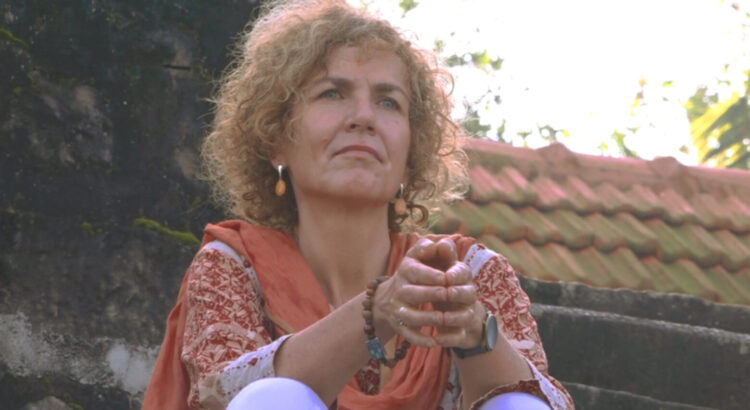
“Is it possible to live a more peaceful and creative life on our planet? At a time when the state of the planet poses important questions, what is life worth to us? And what do we still consider sacred?” asks Renata Keller, a filmmaker based in Germany and Switzerland.

These questions inspired the director to meet the Indian mystic, philosopher and grassroots activist Vimala Thakar (1921–2009). It was an encounter that deeply inspired and changed Renata’s life. Almost twenty years later, she revisited the profound work of this fascinating woman in the context of our time and translated her urgent call for holistic thinking and action into a cinematic work of art.

The film In the Fire of Dancing Stillness – Reflections with Vimala Thakar portrays the remarkable life of an independent Indian woman who sensed the new potential for human coexistence by turning inwards to explore inner life.

Through Renata’s film, we meet a female spiritual seeker who went against accepted norms in the middle of the 20th century. Thakar studied the Vedas and Upanishads and learned Sanskrit. She struggled passionately to find her own linguistic expression to convey and communicate her heart’s desire for inner and outer peace. The film director takes us on an exploratory journey, where we first meet Vimala Thakar as a young woman.

Unimpressed by several marriage proposals, she joined Vinoba Bhave’s peaceful land reform movement in India. Along with hundreds of fellow campaigners, she walked across India on foot, convincing wealthy landowners to give away a part of their land to poor farmers so they could build independent lives. The Vinoba movement was, and still is, one of the few non-violent revolutions worldwide in which people gave away land for purely humane and heartfelt reasons, without being forced to do so by a powerful authority (from Renata’s website).

Vimala Thakar had to end her commitment to the movement following a car accident. Her subsequent meeting with the philosopher and author Jiddu Krishnamurti changed her life radically. She finally realised what had become clear to her over the years: that only inner work and a transformation of one’s own consciousness could counteract the violence and aggression within oneself and in the world. She decided to dedicate her life to following the inner path and was soon invited to Europe, South America and India, where she began giving lectures and seminars on inner transformation.

Renata says the film illuminates Vimala’s collaborative and creative ways of working and responding, and a more female and intuitive way of leadership. For over 30 years, Vimala travelled throughout India and the world, met thousands of people, and led hundreds of social worker camps in India. During Vimala’s lifetime, 92 books about her work were published in English, 29 in Marathi, 123 in Gujarati and 47 in Hindi. Her work was also translated into other European languages. This illustrates the spread of her influence across Asia, Europe and America. Nevertheless, she was very shy and, as she did not like fame or media attention, remained relatively unknown despite the volume of her work and activities.

“As we are faced with the great challenges of the 21st century, Vimala asks us to make our lives the expression of a new dynamic of human relationships, a new culture based on inner stillness. In view of a growing sense of meaninglessness in the globalised and technologised world that we have created, she encourages us to find strength in silence and contemplation. And now that civilisation is facing serious challenges, we are called to create and shape new forms of coexistence between people and nature,” says Renata.

The film is an invitation to go deep within and take a fresh look at ourselves and the world around us, with a renewed curiosity about life. In this contemplative space, the dominant stance of knowledge and thinking is questioned, and a non-verbal exploration of existence comes to the fore.

In this interview with CSP, Renata talks about her film and how Ayurveda saved her from burnout.

Was your first trip to India during the shooting of the film on Vimala Thakar – The Fire of Dancing Stillness?

No, I have travelled to India since the early nineties. I have been on a spiritual search since I was a teenager, and that first led me to Buddhism during my travels in Thailand, and then to India. After my visit to Mount Abu and meeting Vimala Thakar in 2001, I did not travel to India again until 2013, when I went to the Ayurvedic Healing Centre, Vaidyagrama.

The film In the Fire of Dancing Stillness is my first professional exchange with India. Since my first visits, India has always been within me, wherever I go. I hope I can take up more projects there, and I would like to learn so much more about the ancient wisdom of India.

What inspired you to make The Fire of Dancing Stillness? It seems to be different in its conceptualisation from your other films.

I actually think there is a continuation through all my films, even though it may appear differently. I am interested in questions about how life works and how we can find solutions to difficult social, spiritual or ecological problems. I am also fascinated by heroic women who have paved important paths in life and society (like Gerda Lerner), and by how they have managed to find their way and develop their creative thinking within a predominantly (still) patriarchal society.

The film I made on the healing relationship between plants and human beings (www.echteheilung.ch) was driven by an urge to show the beauty of nature and its incredibly miraculous ways of interacting with us humans.

With Gerda Lerner, as with Vimala Thakar, it was a calling to make the film; it was not a decision. I had met Vimala Thakar for only three days in 2001, and that meeting had a profound impact on me. Her presence was so humble and yet so powerful at the same time. I always kept some of her books with me on my travels or next to my bedside table after that visit, and I was, and still am, inspired every time I open them. I was also deeply inspired by the way she lived, the profound integrity and dignity she embodied, and how she cared for humans, animals and nature as a whole.

In the beginning, when I started to feel the calling to make the film, it seemed like an impossible task, as I did not know anyone who had spent a longer time with her, nor did I have any material, such as photographs or video footage, about her. But people and things appeared along the way, as did confirmations that I should make this film. I wanted to present her in her authenticity and modesty, which is not very easy through the medium of film. But I tried to incorporate her deep love for silence and space in the film, as well as her Indian and Vedic roots. As a result, the film became more experimental than a classic documentary.

Vimala ji spoke about creativity and divinity. How do these concepts operate in your work?

Vimala Thakar’s views on life are very profound. Her foundational perspective on life is that everything is sacred, that every moment in our lives can be sacred and that, if we are truly in touch with that fact, we can also act from that deep source that allows us to act creatively and freely. For that, we also want to be in love with stillness and silence, because there, the original order of things comes close to us, and we can feel a profound unity with life.

I try to work on every project with that attitude, and I also need time to dive into this silence, to drink – so to speak – from the fountain of creativity, which is stillness. A sense of beauty and aesthetics is also an important factor. Beauty, especially beauty in nature, needs to be recognised in its sacredness, its wonder and its unknown source. We can be truly humbled when we look at a flower, a tree or a beautiful landscape because we come into contact with the hidden laws of the cosmos. And we simply do not know who is behind this beauty; it is beyond us. We are not the creators.

The sense of self-importance that we carry, quite unconsciously, as human beings vanishes in those moments, as we see that there is an implicit order to life that we are usually unaware of because we perceive life in such fragmentary ways. I try to deepen my understanding of all these insights day by day, moment by moment, and am always confronted with the grossness of being a human being. I guess this is why we have to evolve really fast, so that our actions come from a place of wholeness rather than fragmentation, and we find a way to live with all creation in collaborative rather than destructive ways.

How did you come to Ayurveda? Have you filmed anything at Vaidyagrama?

In 2013, I was very close to what we call in the West “burnout”. But I did not want to enter the Western medical system because I did not trust how they would respond to my exhaustion. I did not want to be psychologised. I knew I was physically and mentally exhausted because I had gone through a very intense period in my life, both in my work and in my relationships with friends, as well as through deep inner spiritual changes.

So I looked it up on the Internet, without knowing anything about Ayurveda. But it was actually a good friend who was travelling in India who recommended Vaidyagrama to me. It had been open for only about two years at that time. I was longing to be in a warm, loving environment, with a non-problem-oriented approach to healing. Although I had received acupuncture treatments in the past and have great respect for the Chinese healing system, I felt that this approach would be too sterile. I had heard that Ayurveda involved the application of warm oils during massages, and just the thought of it made me feel better.

So I was really innocent when I decided to go to Vaidyagrama, and I did not know what was going to happen once I entered the place. But I will never forget the friendly and warm welcome I received from everyone, especially the doctors and therapists, on my first day. I soon became good friends with Dr. Ramkumar, after having some important and profound conversations with him about the state of the world and the influence of Ayurvedic approaches in our times. I then invited him to come to Berlin the following year to present Ayurvedic thinking at one of my Salons.

I always have my little camera with me when I travel, and I took it with me to Vaidyagrama as well. So I always film things that happen in front of me…

Ayurveda and Yoga are very popular in Europe. How do you describe the difference between those offerings and Vaidyagrama?

I feel very lucky that I discovered Vaidyagrama (www.vaidyagrama.com; www.punarnava.org) before going to any other places. I truly like its serious approach to health and the way the doctors and therapists treat their patients, as well as the sense of community between patients and workers. I think it is unique. I also appreciated the morning and evening prayers, especially the fact that the doctors led the chants. It made me look at the art of healing in a profoundly different way.

This approach, in which the doctors REALLY care about your health and are so concerned about your healing, is radical. It is something that is totally absent from our materialistic and capitalist healthcare system in the West.

I cannot say much about European offerings of Ayurveda, as I have not experienced any of them, although I have great respect for people who want to bring Ayurvedic philosophies to the West. But I did not want to dilute my experience at Vaidyagrama with a more superficial approach.

Do you think that documenting Ayurveda through films can create awareness in the West?

Yes, I think so, for sure. There are some documentaries on Ayurveda. I have not yet found a film that presents the deep and ancient wisdom of Ayurveda in an authentic way and conveys its complex wisdom. Often, Ayurveda in the West is still seen as a kind of expensive wellness treatment.

How do you think strong women can change the course of history, as seen in the lives of the two women you have documented?

As women, we did not learn about our own history. We did not learn about our heroines of the past, as they did not even enter the history books. I don’t know how it is in India, but in the West, history classes are all about important wars, conquerors, colonial powers and powerful landlords, beginning with the Romans and Greeks and continuing right into present-day history and politics. There are rare historians who write about the history of human beings and, especially, the welfare of women. Where were the women when the men went to war? What did they do?

Women often made sure that society continued to function while men were prone to destruction and death in the name of saving their own country. We have to question, by the way, this crazy way of thinking and contemplate a future in which wars simply do not happen anymore, as we have seen their futility.

The field of women’s history, which Gerda Lerner pioneered, has changed thousands of women’s lives. Knowing that we have a history, that other strong women existed in the past and that they struggled with similar things to those we struggle with today, while independently innovating new ways of thinking in science, art and other fields of life, is inspiring. It gives us roots and a backbone, an inner support.

Both Vimala Thakar and Gerda Lerner were very independent thinkers who encouraged women to think for themselves and to free themselves from the patriarchal structures in which they were embedded. We need women like this to give us strength and faith so that we can find our own voices and change social structures that do not support human and natural life, creating more holistic lifestyles.

I know that my life has changed deeply after learning so much about these two women and many others who were influential. I also know of many women who made very different decisions in their lives after watching films about these women. We have to give each other courage and faith. When one woman does that, it is incredibly encouraging and can lead another woman to take new directions.

Have you found that there are many misconceptions about India outside its shores?

I think it is always easy to interpret another country based on what we read in the papers or hear through hearsay, and especially through the (superior) lens of our own culture. Also, if we do not understand another culture well in terms of its traditional and political structures, we misunderstand a lot of what is going on.

I have often met people who had strong views about India, believing that it is chaotic and poor and that women are treated very badly. All of this has a big grain of truth in it. But the criticism is often taken out of context or focused insistently on a particular point. The deeper currents that hold a society together are often dismissed. The social construct is SO different from that in the West.

In India, there is no official healthcare system, but people are ready to help each other and are very creative in finding solutions. As a foreigner, it is sometimes very hard to see how a society works in such different ways. The universal qualities of friendliness, care and social cohesion are still very profound in India, and I am again and again filled with admiration for how they work.

I also feel that, because India has had such a deep connection with the spiritual dimension of life for millennia, it has a responsibility to the world. It is the soul of our planet, and it needs to take its place in this regard.

To be so tempted by money, materialism and fame is going to be destructive for India. India also needs to enhance its rural areas again, support small farming systems and give the poor a chance to create small businesses. Otherwise, India will have megacities without rural support. I think there is great potential for India to flourish through a kind of traditional modesty and a very smart way of organising itself.

India has always been amazing at gathering the masses for important causes, as the Gandhi movement and the Vinoba movement showed, or as the recent mass tree-planting sessions in many places have demonstrated. Even now, during the Corona times, Indians are very inventive. There is a deep intelligence in the Indian soul, reflected in the Ayurvedic sciences and Vedic traditions, that needs to be believed in and taken up again, especially by young people.

How can you connect Vertical Impulse to your practice of Yoga and Ayurveda?

One of the first things I learnt through Ayurveda is that silence is the best healer for an exhausted body. Yoga teaches me to move in slow, precise movements, respecting the limitations of my body. Both are metaphors for life and work.

Vimala says, “Every act of living is an act of worship.” For me, when I founded Vertical Impulse, it was a moment when I knew I was no longer going to distinguish “work” from “life”, but that I was going to follow my longing for wholeness. So, 16 years later, I can say that I “live” as much as I can according to what I have learnt. Again, to quote Vimala, she says, “Life is a Teacher.” So every moment is a moment of discovery and a moment to act out of wholeness.

(After completing her master’s degree in Applied Imagination at the University of Arts in 2006, Renata Keller went on to study documentary filmmaking in London. Renata’s lifelong pursuit of philosophical and spiritual questions, along with her interest in women’s development, led her to Gerda Lerner’s work and inspired the creation of Why Women Need to Climb Mountains (2016). In the film True Healing Arises in Freedom (2019), she accompanies the biochemist Dr. Roger Kalbermatten in his research into the nature of healing plants and their relationship with humans. Her work can be viewed at www.verticalimpulse.com, www.inthefireofdancingstillness.com, and www.echteheilung.ch/en.)
Empathy And Transformation

Deepak Ramola brought together a group of artists to adopt the village of Saur in Tehri Garhwal, in his childhood home of Uttarakhand. With only 12 families left, as the rest of the village has abandoned it, the artists have tried to capture the stories and lives of the people still living there. His film the Wise Walls of Saur is based on his project of painting the walls of the abandoned houses with the stories of the residents both present and past.Deepak is a filmmaker, lyricist and poet, bringing to his subjects a deep sensitivity of the ways of the common man.

As the Director of the film he says, “As a child, I spent all my summer vacations at my maternal grandmother’s home in Rampur, a picturesque village in Uttarakhand, with clean air, brooks, and a lot of free time for conversation and stories. Over the years, I noticed the youth of the village increasingly migrating to the big cities in search of work, leaving behind age-old philosophies and value systems. The circumstances made me wonder what we could do to salvage the wisdom of rural life. The Wise Wall of Saur was born with the aim to document and celebrate the rural wisdom of a ghost village in Uttarakhand. The film is not only a narrative about a specific community addressing challenges but speaks of the universal sentiment of home, sense of displacement and desire to connect back to our roots. The film tells many stories of beliefs, creativity, community and the possibilities that bloom with collective action.”

Uttarakhand has such a beautiful natural landscape. How do you think we can stem people moving away from such beautiful villages?

People in the mountains have a strong and deep-rooted connection with nature. This sacred bond is embedded in local festivals, songs and cultural motifs. However, the allure of city life often pulls residents away in pursuit of better education and healthcare. To address this, we must improve local educational facilities and healthcare services, meeting the essential needs of the community. By nurturing sustainable livelihoods through eco-tourism, crafts, and agriculture, we can offer viable alternatives. Preserving our unique cultural heritage and involving the community in decision-making ensures a sense of belonging and pride.

You have childhood memories of this land, what motivated you to make this film?

Ever since I was 6 years old, I have had the good fortune of spending my summer vacations at my maternal grandmother’s home in a small village called ‘Rampur’. There was no dilemma when it came to choosing the destination. To spend holidays in the lap of nature, amid lush green mountains and a languid river versus going to a popular amusement park. I invariably chose the former. All of my best memories from childhood were shaped in the hills residing in a quaint setting. The conversations of people who live in the midst of nature are usually different from those that city people indulge in. They are widely personal, rooted in wisdom and strangely intimate. Merely kilometers away from the city limits, Rampur was an entirely different world.I thoroughly enjoyed and looked forward to vacations in the village and each trip brought forth a significant fact. I noticed that the smart, young brigade of the village was increasingly migrating to the big cities. Lack of opportunities was often cited as the primary reason. But I realized that there was a larger conflict at play, something I only grasped when I matured and pondered upon it.With my film, I aimed to capture these multilayered reasons, challenges, and dreams that unveil the complexities of migration. The painting is a small way to infuse hope and celebrate their unique stories.

Who organized the artists, whose idea it was to get the walls of abandoned houses painted? How did you interact with the artists?

When I first thought about capturing the profound wisdom of a village, I reached out to a close friend and one of India’s most talented muralists, Poornima Sukumar. Together, we envisioned how these stories could be visually translated, painted on the grand canvas of the village walls. We delved into discussions with the 12 families residing in the village, immersing ourselves in the essence of their tales, and delving into the roots of the Garhwal School of Painting.With the incredible collaboration of Poornima, my devoted team at Project FUEL, and a committed community of artists and volunteers, we went ahead on this journey, collectively breathing life into this ambitious project.

You have been involved in many projects where the wise words of communities are shared. What inspires you to go back in time culturally? How are these messages relevant even today?

In our extensive journey of documenting and sharing life lessons at Project FUEL, a striking pattern has emerged – many profound life lessons stem from tough experiences or adversities. As we assist individuals in opening up and reflecting on these crucial life moments, we’ve crafted an approach that fosters a sense of safety and empowerment, enabling people to address their vulnerabilities.This transformative journey emphasizes a universal truth: everyone seeks solutions, hope, or validation in an authentic, unbiased, and personal manner. Diverse perspectives broaden the spectrum of choices, resonating uniquely with each person.We draw from the wellspring of heritage, understanding that to honor its richness, we must share its brilliance with as many people as possible.These messages hold immense relevance today, guiding us to pay attention to our roots, the legacy we carry, and the stories that have molded us. Connecting with a broader community and historical fabric gives us the courage to confront the challenges that lie ahead.

How was the film received and what was its impact?

The film has been embraced with overwhelming love, evoking a profound sense of responsibility among its viewers. It vividly portrays the harsh realities that villages endure, where lives are shadowed by the constant threat of migration. Personally, the film’s impact has been most significant within the community of Saur itself. When we organized a screening exclusively for them, it was a poignant moment – many witnessed, perhaps for the first time, how incredible they are. It turned into a small but meaningful celebration of their tireless efforts to preserve their unique culture.My hope is that as the film travels more, it will continue to provoke a pause and reflection in people. I aspire for it to be a catalyst for action, inspiring individuals to stand up and make a difference for the villages they hail from. Each person has the power to contribute to the preservation and flourishing of these invaluable, cherished communities. As Lailah Gifty Akita puts it in Pearls of Wisdom: Great Mind, “There is a beautiful village in every country.”

Can you narrate some special moments interacting with the 12 remaining families of the village?

During the painting and filming journey, the 12 families were not just our subjects; they became our trusted guides. They actively engaged with us, providing invaluable suggestions on the artwork, picking up paint brushes to contribute to the murals, and generously nourishing us with their delicious meals every single day. Leaving the village, I don’t recall a single instance of going hungry.One of the highlights of each day was spending time with the children in the temple courtyard. We would gather for some delightful, simple folk games, irrespective of age, creating a space where everyone could shed their inhibitions, learn, and share their knowledge. Those hours of play allowed us to connect, be vulnerable, and experience the pure joy of being part of a community. It was in these cherished moments that the real essence of the village and its people shone through.

As a poet, how did this project find expression through words?

Honestly, I am still trying to articulate the emotions I felt during my time in Saur. Making the film was a more accessible medium to capture the reverence I felt for the community. However, weaving it into poems has been hard. I tear up every single time I pen down a piece about my time spent in the village.What I do carry with myself at all times is the nostalgia of goodness and simplicity I experienced. The village has become a metaphor of hope in my life, and this sentiment spills over into every story I try to tell.

What is the role of films, according to you, to highlight such social issues?

Films, to me, serve as society’s mirrors, reflecting the untold narratives and struggles often overlooked. They possess a unique power to evoke empathy, awakening the audience to social issues they might not otherwise encounter. How many people get to learn about the migration in Uttarakhand in prime-time news? A well-crafted film can ignite conversations, challenge biases, and spark collective action. It’s a tool to bridge gaps and inspire change. By showcasing the authentic lives of marginalized communities or shedding light on injustices, films compel us to reevaluate our perspectives and allow us to be aware. They are catalysts for empathy and agents of transformation.

Image Credit: Wise Wall Project by Project FUEL Photography by Vibhor Yadav


The Making Of A Train Romance

Abhishek Bhatnagar is known for Waster (2022), A Passenger in Love and Fat Boy (2018). In this interview, he speaks about the memories and romances that happen during travel.

Most Indians have fond memories of railway travel, both long-distance and local. What made you choose this setting?

I was brought up in Delhi-NCR, and we were lucky to get the metro train when I was a teenager. As a kid, I was always fascinated by the question of where all these trains finally go. Later, during my college days, I met my childhood love in the metro, which, in a way, gave me a second chance to restart and relive my incomplete first love story. I tried my hand at it, though I failed again.

I chose this setting because, as I grew up, I saw the metro network grow into a vast system covering five cities. It is like an entire civilisation to me, and so I thought of writing a film with niche details about how everyday passengers seek love during a simple, everyday metro journey.

How does Passenger in Love define your style of filmmaking – small casts, simple, endearing stories and settings with which many can identify?

I think it’s not my style; it’s just the mumblecore genre of filmmaking, which has been in practice for ages. You can take Dogma 95 or the French New Wave, or talk about Indian Parallel Cinema. In every generation, there are some filmmaking souls around the world who want to tell their stories without any pressure, and I think their passion helps them find a way. I am more of a storyteller, and I enjoy being naïve rather than being a real director with professional style and skills.

What was the biggest challenge for you while shooting this film?

I am a very quiet person, but for this film, I had to accommodate the whole crew from Mumbai in my house in Delhi because I couldn’t afford a hotel for them. Aah, I am kidding! That was the only fun part. I think money was the biggest challenge. We survived without money for a month while making the film. I made this film on the Red Bull budget of a low-budget Bollywood film, if you can imagine.

Are you a romantic at heart? Often, our creative work is a product of all that we value in life and what we cull from our personal reading, experiences, relationships and dreams. How much of this film is reflective of your own tastes?

Of course, I am! I am also planning to write two more parts of Passengers later, in my 40s and 50s, when I will have a bit more experience with romance than I do now. I will shoot those parts with the same cast. I have already signed the actors for them. It’s going to be like the Before Trilogy.

What do your other films have in common with Passenger in Love?

Air hostess.

One can study the setting, the dialogues and the costume, but how does one get educated in portraying human emotions?

I think that’s a gift a few of us have. I am lucky to have it, and that is why I feel it is my duty to make art.

How was it collaborating with your actors? What were the fun and enjoyable parts?

It was a beautiful experience collaborating with them. At first, I was not sure they would be able to learn all those lines by heart. I remember giving them the script and sharing their phone numbers. I strictly advised them to read the script only over audio calls and never, ever meet until we started the film. They were so sweet; they met directly on the set as strangers, and we shot the film.

Love In Trains And More By Abhishek Bhatnagar

Video Excerpt of the Interview

The India I love is Deeply Spiritual: German Ambassador Walter Lindner

Walter J Lindner has occupied the highest echelon of diplomatic service as Foreign Secretary of Germany by just being himself - a ponytail sporting musician with an uncommon view of the world. Having read Herman Hesse’s Siddhartha as a teenager, he became a seeker of the true meaning of life.

His fascination for India brought him here once as a backpacker in the 1970s and now as the Ambassador of Germany to India. He can be easily identified in the elite diplomatic streets of New Delhi riding around in his vehicle of choice - an Ambassador named Ambi Aunty.

Ambi Aunty got a new lease of life, when Walter arrived in India and found her in the garage. He got her painted red and presented his credentials to the President of India, with a flag fitted in front. “I have to be nice to her, otherwise she won’t take me places,” he says with a smile.

Born in Munich in 1956, Walter witnessed the coming down of the Berlin wall in 1989 in the very first year of his diplomatic career when he was Attaché in the Legal Directorate-General at the Federal Foreign Office, Bonn. The coming down of the Wall was an event that changed the modern world in a significant way. The music for that momentous occasion was Winds of Change by the iconic German rock band Scorpions, ushering a new world order - less hegemonic, more equal. The band played the same timeless song at a concert in Bangalore’s Palace Grounds in the 1990s, which this author attended as a die-hard Scorpions fan.

It is not surprising that Walter chose this song to commemorate 30 years of Indo-German relations this August, bringing together Indian musicians as he strummed his guitar. Says Walter, “Even today, this song is one of human hope. If you take it from the fall of the Berlin Wall and transfer it to today’s context, we thank God that this confrontation is gone. It is a relief that the Cold War is over. Today, as we battle Covid, every individual has their own worries and fears, and this song gives some hope - that if the Wall can come down, this situation too can get better.”

Walter is something of an anomaly in the diplomatic arena. He is a classically trained musician who picked up his grooves at Munich, Graz and Boston. He is also a lawyer by profession. Asked if it is his musical background which makes him sensitive to the other, he talks endearingly about the Indian ethos of ‘samskara’. “I think it is a part your DNA, when you're born. You know this better than we do in the West, but then it's also your upbringing. I grew up in modest surroundings and not in a protective environment.”

Walter worked first as a musician, but also as a taxi and truck driver and also at McDonalds to keep afloat, until he became a diplomat and had a chance to see how the other side of the world lived. “I traveled to so many countries on this planet and I saw how privileged we are in the West to live this life and we're still complaining about our situation.”

The attraction which began with the reading of Siddhartha was representative of the fascination that India’s deep philosophical approaches held to many of his generation. With his entry into the diplomatic service, “the interest in strategic partnership and economic and political ties with India followed. Yet, I think that a lot of Indo-German relations have to do with culture and it is also culture that comes to one’s mind when many Germans think of India.”

Walter’s first trip to India as a backpacker was in 1976 when he travelled over land taking six months coming through Turkey, Afghanistan, Pakistan  and down the Khyber Pass. A journey made by many a European curious about India.

Of his first impressions of India before coming here, Walter says they were a bit ‘naive’. “ I expected everyone to be sitting under a banyan tree, meditating. The bus I came in was very dusty and filled with people and the weather was hot, and I was used to driving in nice air conditioned cars. Then you have a situation where you stop on the road for four hours because there's a cow and nobody moves the cow. And you wait there, sweating…because this is India’s reality.”

The ‘simplistic’ image of India turned to a culture shock initially, and then to a new reality. “It's like a rose. You have all these spikes and thorns. You have to open up, and put away all the smells, the heat and the noise, and you find this beautiful rose inside. The beauty is always there but you have to first unravel all the layers. So it takes some time and some openness to  know India.”

Walter invested time and effort, travelling around India for four years, instead of the typical jet-setting one-week-exotic-holiday to India that some visitors prefer.

“To really really experience this country you will have to stay with people here month after month. It takes some time to adapt. I went through this cycle of observing the negative aspects of crowding, etc before getting to the India that I love so much, which is deeply spiritual. There is so much beauty in this country.”

As a diplomat, Walter has not spared any effort to know what makes India tick. He has met grassroots people, farmers, artists, away from the cocktail circuits that most diplomats inhabit. He even visited the RSS headquarters at Nagpur, to know the truth about an organisation that invites, in equal measure, both awe and flak. “Since humans are not perfect there's no paradise on this planet. For me the ideal India is that she is a country of variety, of tolerance, of coexistence, not minding what your neighbor believes in. You just exist together. It is the softness and non-violence incorporated by Mahatma Gandhi. But it has been a part of India all the time, and the fact is that Hinduism never induced anyone to occupy any other country,” says Walter with feeling.

There are negative aspects to every country, including India, but there also a lot of positive ones. “I guess the fair way of treating this is to not neglect this but to put it in context and try and see what's the real India, and that's one of my jobs as Ambassador. I try to be neutral and come with a positive attitude and even if there are things to be criticized, you do it in a way which is not condemning.”

India for Walter needs to be taken in slowly because “she is like right between the eyes. There’s no sugarcoating it. It’s totally intense. The beauty is intense, so also the tolerance. The beauty of the landscape, the openness of the people, the architectural beauties, the music… I discover everyday new things and you have to be here 50 years to really understand India, I guess, because it's a complex country.”

MUSIC

Not satisfied being uni-dimensional, Walter experimented with music as he did with everything else. After learning Western classical music, he tried to discover modern music to become a rock and jazz musician. He was open to other influences while in Latin America, Africa and Britain to finally come to Indian music.

“Music wise, India is pretty different from the rest of the world. Be it the instruments, the harmonies, the way you structure your pieces of music - the ragas, which is very different for a normal European musician. This is a challenge, so you have to be prepared to get into it. It’s not enough to say, ‘I now have the technical skills to play a sitar’. Its everything from the way you enter the stage, and kiss the ground, the way you talk to your fellow musicians, the way you dress, the way you sit, the way you tune your instrument… until you get into this mode. Now that is a lot of philosophical attachment.”

It’s not the same, he says, as jamming with a group of musicians in New York at the count of three. “ The way we start in India is different. For this you need patience, dedication and devotion. I'm very interested to work more closely with Indian classical musicians, because I want to discover more of their world.”

He is in talks with Hindustani musician Rakesh Chaurasia, who collaborates with musicians of the West. “Rakesh is crossing over to Western music but then always comes back to Mumbai and his family. It’s not like the Beatles coming to India or even Ravi Shankar who played the Sitar but in a way which was westernized. What we need right now is a combination which is tasteful and which has a lot of respect for the music of both sides.”

Winds of Change, desi style: https://t.co/x3u4GQW2nO?amp=1

So how does being an artist shape the way he looks at diplomacy. “If I was a dancer, or a painter or a poet, it would be the same. It gives you a different angle, a new perspective. One’s life is not limited to just earning money, which I do with diplomacy. As an individual, you wake up and have your thoughts and your spirit and your soul. So you need to take care of all of these aspects.”

Artistes have a way of communicating, of engaging audiences, which gives an edge in diplomacy. “It gives one a lot of self-assurance. I can  relate to people more. That's why I said in an interview the other day, that in 2020 we need a new kind of diplomacy. You have to relate to people, create sympathy. In this case, for Germany, I should make people think, Germans are pretty cool guys because they are listening and they are interesting.”

When Chancellor Angela Merkel visited India in 2019, Walter drove with her from the airport to his residence in New Delhi. It was a half an hours drive and her first question to him was ‘what did he like about India’. “If I was just a cocktail diplomat, I would only be able to tell her what my other colleagues say. But I want to talk about the fuller, richer India, about the nurse, the Bollywood actor, the farmer so that people get a more complete picture. If you are a one trick pony, it can be a bit limiting in whatever profession you may be.”

Indian influence in Germany

Germany is an attractive destination for companies, students and even immigrants. There are currently around 25,000 Indian students studying in Germany, which is the highest number of all European countries. It is even much more than in the UK, which most would assume is the preferred destination because of the language.

Walter says there are now many classes offered in Germany in English, besides fees being highly subsidised.

There are also the restaurants, the temples and yoga centers. “So, India has a very good connotation in peoples' minds in Germany. The landscape, the beauty, the profound philosophy combining body and soul - it's all there. People at large see a country with over 7,000 years of tradition, so this is quite a history of culture.”

India and Germany have a certain kind of closeness, says Walter, a closeness between two souls, beyond all the cultural and geographical distance. “We are both serious, no-nonsense, deep running thinkers. There's an understanding, which means maybe some of your brain cells work exactly like ours in the same cultural and spiritual ways.”

(Cover pic: Ambassador Walter J Lindner with Ambi  Aunty)

More friends xxx hd, Indian Desi Fuck, <a href="https://omarxnxx.com/category/xnxx-com/"xnxx.com, Camera Ascunsa Xxx, Kanye West & Lil Pump ft. Adele Givens - "I Love It"

Know Your Rhythm – Healing With the Yoga of Music and Sound

Arnab Bishnu Chowdhury is a composer, trainer, therapist and an explorer of Consciousness with Yoga of music - mantra, body, breath and sleep as mediums. The third generation of classical Indian musicians from the illustrious Maihar-Senia Gharana founded by Baba Allaudin Khan, his devotion to both Sri Aurobindo and the music lineage of Maihar is obvious.

Arnab is founder of Know Your Rhythm, a training program which create conditions for Aha! Moments to emerge. He offers Training, Therapy and Composition services and is based out of Sri Aurobindo Ashram, Pondicherry, India. (To listen, watch and know more, visit www.ninad.in)

In a vartalaap with CSP, Arnab talks about Music Therapy in the context of Yoga.

Where does Know Your Rhythm begin? What is its source or origin?

In our Indian spiritual tradition, the Yoga of Sound is supposed to be perennial as the universe itself – which we believe began with the cosmic vibration of AUM.

The Yoga of sound in the form of Mantra and Music is supposed to have originated in the Sama Veda. Like all streams which find confluence in the ocean, so do all streams of Yoga including Mantra, Music, Asanas, Pranayama, Mudras share a close relationship and interweave themselves as confluence reaching out to the Divine as ocean.

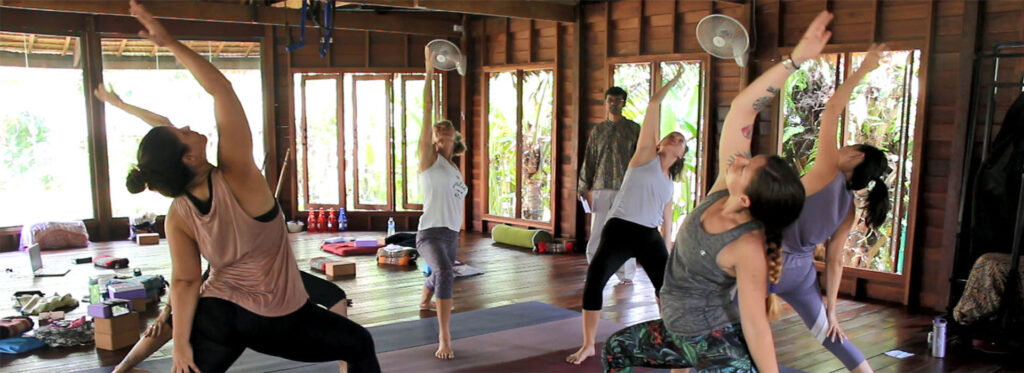
Know Your Rhythm’s unique perspective lies in exploring and offering insights and practices about the close partnership between the Yoga of Mantra and Music (Ragas, Talas) with the Yoga of postures (Asanas, Mudras), breath (Pranayama) and sleep (Nidra).

Know Your Rhythm’s vision lies in a supposition. Can we learn, explore and practice the Yogic practices mentioned in a blended way to arrive towards experiencing that cosmic AUM? Can we arrive at that dynamic silence where all the noise especially internal fades away, to a quantum change within?

Via Know Your Rhythm’s immersive exercises done in a therapeutic and yet playful atmosphere, we hope to create conditions for Aha! Moments to emerge.


And what do you mean by Aha! Moments? Can you share your experience as a teacher, therapist and composer?

Just say Aha! with me!  What does saying making you feel? A feeling of happiness and satisfaction? A feeling of discovering a paradigm not experienced before perhaps accompanied by a feeling of gratitude to the Divine? Where we rise to a new state of consciousness and perhaps don’t roll back to the earlier one?

As a rasika (lover of music and the arts), imagine you are at Thiruvaiyaru for the first time, sitting on the banks of river Cauvery, not far from the Samadhi of Saint Tyagaraja and you are swept in among the thousands of musicians and rasikas. You don’t simply hear or listen to Tyagaraja Aradhana in the early morning, you experience something. That something you experience are conditions for an Aha! moment to emerge. And these conditions include the fresh January breeze, the stunning silk saris and jewellery where every individual is dressed at their sacred best and not to forget the amazing fragrance of Kumbakonam coffee served in bright brass tumblers! You find yourself one among the collective singing sacred music, a feeling of oneness and somewhere along the way, your mind and heart leaps with Ananda. Do you see what I mean? In our Indian performing arts including music, poetry and dramatic arts all of which have a deep connection to a stream of Yoga, we have expressions such ‘Besh besh’ or ‘Kya baat hai’ to express that Aha! Moment. Perhaps the most significant Aha! Moment happens when we simply rise into Silence. We just know It with complete confirmation.

Of course, neuroscientists have been exploring this space for quite a while.

As teacher, I recall one instance quite clearly. While training special educators with their children with special needs, one of our Know Your Rhythm modules involves vocalising basics of rhythmic melody with phonemes. The phonemes in Indian classical music whether Carnatic and Hindusthani have not just spiritual significances but I find them therapeutic when applied in music and speech therapy. So during one such session, we called in the grandmothers of the children with special needs as I believe that grandmothers are carriers of great stories whether folk or mythological and the values in those stories often grow who we become as we grow up. Additionally grandmothers in our Indian family set up sometimes take care of their grandchildren so the intention is to train them with the very basics of Know Your Rhythm so that our therapeutic engagement does not stop with the special educators during the school hours but continues at home in a playful manner. During one such session, a special girl child after some encouragement with shakers had simply sung an improvised version of what had been taught. Her grandmother and the group of special educators were stunned and emotional. The grandmother told me that this is the first time ever she had expressed something proactively that too in the form of a melodic line. That was a collective Aha! Moment for all of us.

Here is one such session which takes off from the iconic ‘Ta Na Na’ song from the legendary television serial Malgudi Days composed by Shri L Vaidyanathan. Here as composer for therapy, I apply and play with the phonemes ‘Ta’ and ‘Na’ as a karaoke song with full body learning and invite others to come in with me and then we improvise. ‘Ta’ and ‘Na’ are musical phonemes found in Sanskrit, folk songs, Indian classical vocal percussion and Dhrupad.

https://youtu.be/W6AcWigd-dY

The short video was presented as participative therapy at the 4th International Conference of International Association for Music and Medicine (IAMM), Beijing, June 2016, as part of our paper presentation; based on a 2 year Know Your Rhythm training program with 10 special educators and their 60 students with special needs, Special School, CERTH-India Hospital, Pondicherry, India. This is part of our study in the form of video-evidence case studies called ‘Rhythm in Music Therapy – Composition and Composure’. You are welcome to join in this short karaoke session.

As composer, there have been numerous Aha! Moments. Most these extraordinary moments often come in as dreams during Nidra (sleep). In other words, to compose I need to compose myself. Similarly, to direct an improvisation session with other musicians especially to create music for therapy, we need to compose ourselves with specific intention so that our music gains the potential to heal our care receivers. To reach this state of consciousness, we apply various immersive exercises of Know Your Rhythm to ourselves starting with myself.

Here is a trailer from our therapeutic composition called ‘Atal – Unshakable’ which is applicable to the practice of Vinyasa Yoga where we are trying to match the rhythm of the music to that of the required rhythm of the breath so that when practiced, the Vinyasa flow happens seamlessly. Atal is based on Raga Bhimpalasi, equivalent to Abheri in Carnatic system.

https://www.youtube.com/watch?v=yzUh_F71F1o

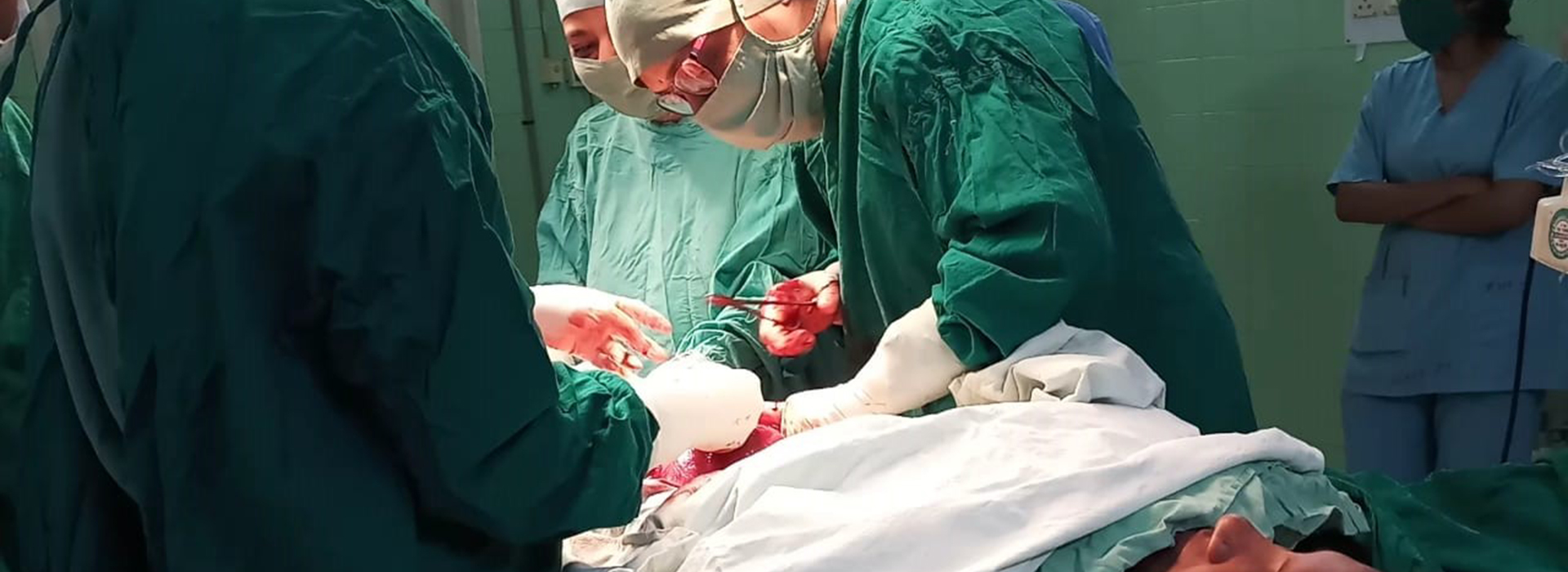
As therapist and composer for therapy, in recent years, Project Gratitude has touched my heart where we conducted a study to assess the psychological well-being in patients and their operating team in cases of caesarean section and hysterectomies, at Shree Krishna Hospital, Karamsad, Gujarat. In this successful research project, Know Your Rhythm methodology was applied to compose and engineer the therapeutic music compositions played during pre, post and during the operations.


Receptive Music Therapy at Shree Krishna Hospital, Karamsad, Gujarat, India

What is meant by Rhythm in Know Your Rhythm?

All beings are an orchestra that is playing 24 by 7. We have rhythms that seem to define us how we behave and interact with each other via rhythms – perhaps the most significant being the rhythm in our heartbeats. Even our heartbeats vary with rhythm of seasons as they tend to be faster in summer than in winter. The basal metabolic rate reflects thyroid activity. Our 24 hours orchestra of Circadian rhythms consist of waking/sleeping cycle, blood pressure rhythms, cardiac and renal functions, urinary excretions, changes in body temperatures and endocrine activities. An expecting mother with her unborn infant in her womb shares a special resonance as rhythm. We have Selenian rhythms named after Selena, the goddess of the full moon, which has a 28 day cycle reflected in the menstrual cycle.

Just like the music conductor of a symphony orchestra who is guided by the composer’s prescription of tempo expressed in beats per minute, our conversations have their own rhythms with pauses, inflexions, poise and the complex rhythmic gestures of body language including our posture and movement which communicate perhaps more than our verbalised language. Our macro world has their own rhythms as the sun, moon and the various seasons.

Brain scientists tell us about the brainwaves as alpha, beta, delta rhythms and they ‘reflect’ our state of consciousness. If we dive deeper into subtle body, discover energy points in the form of Chakras that vibrate and turn to channel energy into the body and meridians. Ancient Indian scriptures tell us about the intersection of 108 meridians forming a Chakra. The same special number 108 is reflected in Mantra Yoga where we chant 108 iterations of a specific form of Divine. Isn’t that rhythm too?

If vibration can be described as a rhythmic pulse, then we simply are a rhythmic system, truly complex one! Now what if we were to go out of rhythm?  Our cardiologist informs us about an ‘arrhythmic’ heart is a physical heart that needs treatment or surgery. Now what if were to consider an arrhythmic situation within us?  Is being ill or a dis-ease – an arrhythmic condition in our mind, heart and body?

Two examples come to my mind right now which I could share here from the 14th World Congress for Music Therapy, organised by IMC University for Applied Sciences, Krems and the University for Music & Performing Arts, Vienna, 2014.


Presenting live composition 'Spandan' as final artist of opening ceremony - 14th World Congress for Music Therapy, Vienna & Krems, Austria, 2014

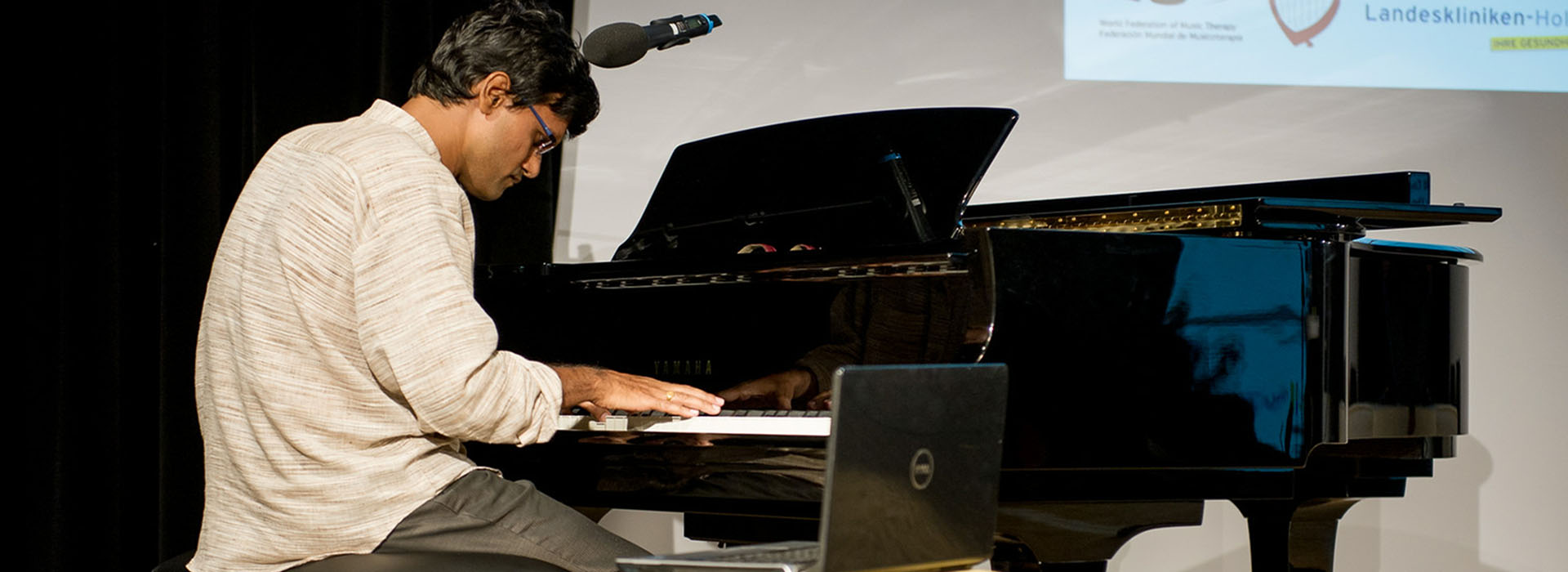
As the final artist-composer for the opening ceremony, I presented a 2 movement-based composition called ‘Spandan’, cosmic pulsation where I tried to communicate to our 1,500 member audience how the cosmic pulsation that flows in all of us, is also measurable as our heart beat. The composition has a solo Piano as movement 1 and Tabla with orchestral loop in movement 2, both with a recurring motif in Raga Kafi at between 60-70 beats per minute (BPM) as Laya or tempo expressing Empathy for a stable heart rate. Why Empathy you might ask? My attempt was to express Shringar Rasa via Raga Kafi and connecting Shringar Rasa to Empathy which is often perceived as a key condition for self-healing within the science of Therapy including Music Therapy.

Would you like to experience ‘Spandan’? https://www.youtube.com/watch?v=rQZM9kIbUjk

It was also an honour to present Know Your Rhythm as a Pre-Congress seminar workshop, selected among the eight training programmes, with CME (continuing medical education) accreditation from World Federation of Music Therapy (WFMT).

May I present a second example of the positive effects of rhythmic disruption leading to entrainment based on Indian classical vocal percussion? See if you can watch this flash mob without smiling which actually ‘disrupts’ the presentation of Dr. Gerhard Tucek, president of that particular World Congress: https://www.youtube.com/watch?v=xfAlhpY4HZc

What has been your personal journey leading to Know Your Rhythm? And where is Know Your Rhythm leading you?

There have two major inspiring movements which have been passed on to me as I grew up. For the past three generations, we have been based out of Sri Aurobindo Ashram and the other movement is being part of a family of Indian Classical musicians tracing our musical lineage from Maihar Gharana. My grand uncle and violin maestro Pandit Rabin Ghosh along with Pandit Ravi Shankar and Ustad Ali Akbhar Khan learned from Baba Allaudin Khan. I am particularly grateful to my father, teacher Hindustani vocalist Shri Arun Bishnu Chowdhury. As a debutant, accompanying him on Tabla at the age of 14 during the Madras Music Season in 1989 at Bharatiya Vidya Bhavan brings back an Aha! feeling to this day !

Growing up at Sri Aurobindo Ashram community while studying at Sri Aurobindo International Centre of Education was indeed a privilege. Studying aspects of Integral Yoga of Sri Aurobindo and The Mother (Mirra Alfassa) laid the foundation of Know Your Rhythm with the aim of spiritual Transformation being the goal of life and its activities in all its forms and manifestations. Integral Education which stems from Integral Yoga, is at the core of the pedagogy of Know Your Rhythm. I continue to serve Sri Aurobindo Ashram as a researcher, the more I teach the more I learn.

Every experience makes us grow like the notes in our Sargam.

Smt. Suzanne Sekhon, my teacher for Western Classical music at Sri Aurobindo International Centre of Education, discovered the composer in me at the age of 12 while I improvised while learning Bach’s 1st Prelude on the piano.

Professional experiences include exploring computer music, Artificial Intelligence with Indian Classical music paradigms with MIT Media Lab’s ‘Music, Mind and Machine Group’, teaching Know Your Rhythm to consciousness-seeking audiences at the universal township of Auroville, scoring music for children’s content including animation films, training Hatha Yoga teachers to learn to incorporate the Yoga of music and sound into their daily practices to collaborating with doctors to compose therapeutic music for specific conditions. At Sustainable Livelihood Institute, a collaboration between the government of Tamil Nadu and Auroville Foundation, I come in as senior faculty teaching Tamil Nadu government officers and community leaders from rural Tamil Nadu to become more holistic decision makers and proactive stakeholders with Know Your Rhythm. Earlier this year, Know Your Rhythm received certification from International Association for Yoga Therapist (IYAT).

The core remains founded in Yoga in whatever I aim to be, know, do and offer.

In the past decade, Know Your Rhythm has reached about 20,000 care givers across India and internationally via workshops, conferences, retreats. Care givers include not just medical and therapy professionals along with their patients. Care givers are those who ‘care’ for the society at large and want to raise the quality of life, so our target audience includes teachers, special educators, managers, government officials, and especially children and youth who will grow as global citizens of tomorrow! Papers, case studies, articles on Know Your Rhythm have been published in Springer Nature, International Journal of Pharma and Bio Sciences, Open Yoga Journal.

We have been blessed by the presence of the brilliant and eternal fountainhead called Yoga and its blended streams. During these challenging times with Covid and its repercussions, I sincere aspire and pray that we will be able to grow Know Your Rhythm as we evolve within. I invite all of you in this adventure.

Let us all invoke Peace with Shanti Mantra from the Brihadaaranyaka Upanishad https://youtu.be/xZqq9YpkmYA

AUM

Sarve Bhavantu Sukhinah -  May All be Happy,

Sarve Santu Niraamayaah - May All be Free from Illness.

Sarve Bhadraanni Pashyantu - May All See what is Auspicious,

Maa Kashcid Duhkha Bhaag Bhavet - May no one Suffer.

AUM Shaantih Shaantih Shaantih


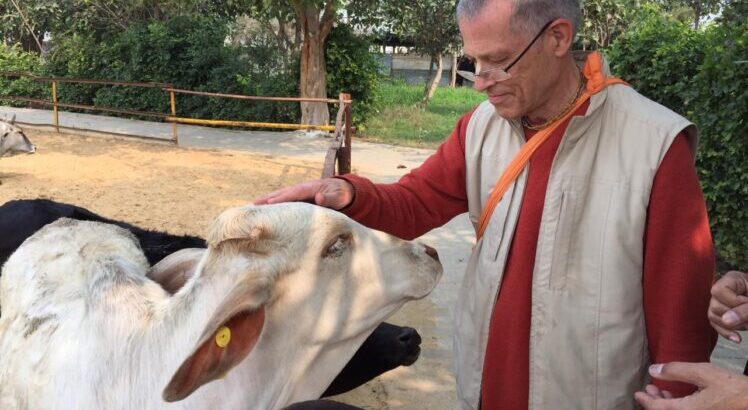
Cow Care in Hindu Animal Ethics – Interview with Kenneth Valpey

Kenneth R Valpey’s book Cow Care in Hindu Animal Ethics (Read it here: 2020_Book_CowCareInHinduAnimalEthics (1)) turns experience into literature, seamlessly bridging the old with the new. The experiences Kenneth went through as a ‘Hare Krishna’ monk in Bavaria in South-east Germany and then in his trips to India are interspersed in this book about Indian traditions - both imagined and lived.   

All of us in India live shoulder to shoulder with cows. But Kenneth has watched, interacted and bonded with them more than many of us. Kenneth constructs his book with stories which we are all familiar with but with added compassion imbibed from his guru. “I write from a position of liminality: Western in background and culture, as a young man adopting ways and ideas generally labeled “Hindu” and, more specifically, “Vaishnava,” later (re-)entering the academy to study my adopted tradition from scholarly perspectives.”

He grew up in suburban America, and his connection with cows, Kenneth says “was almost exclusively through drinking their milk—delivered to our door in glass bottles—and in eating their meat at supper.” It all changed when as a monk he began to have a “growing awareness of cows as beings with lives of their own. Those twenty-odd cows were to be cared for their entire natural lives—a practice introduced in a few nascent Western Krishna farm communities by their founder, my spiritual guide, A. C. Bhaktivedanta Swami Prabhupada. Cows became, therefore, part of our lives, an important reason why we lived as we did, pursuing an ideal of “plain living and high thinking.”

Kenneth’s book is part of the Palgrave Macmillan Animal Ethics book series and interprets “cow care” (the practice of keeping and caring for cows throughout their natural lives, translating the Sanskrit and Hindi term go-seva) “by observing cows (and occasionally brushing them or offering them snacks), observing and listening to those with experience caring for cows, conversing with cow care activists and colleagues, reading and thinking a lot - these have been my ways of learning about, being moved by, caring about, my subject.”

He provides direct accounts of four intentional communities inspired by A. C. Bhaktivedanta Swami Prabhupada dedicated to the well-being of the cow: Mayapur Chandrolaya Mandir in West Bengal, New Vraja Dhama in Hungary, Bhaktivedanta Manor in London, and Govardhan Eco Village in Maharashtra. 

Edwin Bryant, Professor of Hinduism, Rutgers University, USA writes about the book: A thoroughly researched and most timely book analyzing the placement of the cow throughout Hindu culture, and its potential role in human well-being more broadly. While the growing Western animal rights movement is primarily based in human-centric concerns, and the protection of animals objectified and valued in terms of benefits to human health, diet, ecology and environment, Valpey introduces us to the notion of the cow as subject and as citizen in its own right. Using traditional as well as modern theoretical frames of references, Valpey leads us to the inexorable conclusion that the welfare of human civilization and cow protection are inextricably linked.”  

CSP conducted an interview with Kenneth Valpey this week trying to understand his motivation for writing this which he worked hard to make available for free through Common Access. 

How did you come to this research? What was your first introduction to Indian culture?

I first met some Hare Krishna members in Berkeley, California in 1969. Eventually I interrupted my studies and became an active missionary with ISKCON. Nearly 23 years later, I went back to University and completed my studies in Oxford. I have been involved in the Oxford Center for Hindu Studies since 1999, when I started studying there.

About six or seven years ago, I was invited to give a talk at the Oxford Center for Animal Ethics and that is when my interest especially was awakened to the topic of Animal Ethics and Hinduism. The director of that center is Professor Andrew Linzey, a wonderful person and scholar. He invited me to contribute a monograph to the Animal Ethics series in 2017. Initially, I was not so keen as I had other ongoing projects. But, at his persistence, I had an idea to focus specifically on Cow Care and he was completely happy with that suggestion. 

My interest has also been philosophical because I have been exposed to the Bhagavad Gita since all those years and there is I would say a key statement in Chapter 5 of the Gita, a wise person, a pandit sees with equal vision “samadarsh” - all living beings. I have always been struck by that. [A learned brahmin, a cow, an elephant, a dog, or a ‘dog-eater’—a wise person sees [them all] with equal vision” (Gita 5.18)]. 

(In his book Kenneth writes:  “..arguably for most Hindus, consciousness indicates personhood as a fundamental category of reality; in contrast, designations such as “Hindu” and “cow” are of a secondary order, of identities that do not endure. Seeing equally means seeing all creatures as conscious beings who, depending on the particular bodies they occupy, exhibit varying degrees of the potential for full, enduring personhood. The implications of this worldview for animal ethics are considerable.”)

Your writing is very academic and scholarly. You left college in between and came back. What has influenced the writing - is it your life experience, or an academic journey into the subject, or is it your spiritual journey? 

(Smiles) I will take it as a compliment. I was concerned because I knew this is an academic publisher which means that everything you write (if it is going to be published) will be peer reviewed. So, I knew, I had to have proper standards in that regard. But, as I have said in the introduction,  I am also personally involved in the subject and I hope I brought some of that flavor into it.

How does your research address modern trends in cuisine and people's preferences towards one kind of food or the other. In India, decisions about eating or not eating meat are made not just for health reasons. It is also not about the inhuman treatment of animals. How will the West relate to respecting an animal for itself rather than for what it provides or work that it does?

Good question. I would say there is an increasing number of people awake to this dimension. Therefore this center for Animal ethics has a considerable presence. I am speaking in the Academic Universe.

The fact that such an institution exists in the West and incidentally, the director Andrew Linzey is himself completely sympathetic and very interested in Asian traditions. But, he himself is a Christian Minister. As a Christian priest he has been writing extensively several articles arguing that people are mis-understanding Christian theology with regard to diet. Such discourse means that this issue is opening up significantly. There is even a wider area called Animal Studies. Now there are departments and programmes in different universities on this topic.

Of course, in popular culture, there has been the impact of Vegetarianism which has mixed motivations no doubt, with a lot of it simply being about health. But  I think, there is an increasing number of people who are questioning the ethics of eating meat and so the Vegan movement in the West has become very vocal and surprisingly successful and this is to a large extent tied in with a concern about treatment of animals. 

I have met some people who are identified very much with the Vegan movement whose main concern is not just about eating animals but also about the use of animals for work. The more extreme Vegans say we should not be engaging bulls or horses in work as it is exploitative. So, there are these different extremes. 

I guess what I am trying to do in this book is that I am addressing the Vegans and saying that they have some very good points but there is no need to go to that extreme. It would be better If we understand relationships as we would say according to Dharma.

A common observation has been that in India, because it has been a pasteural and agricultural society, the cow especially was given a prefered status in society. Apart from the spiritual or the religious connotations it is also so in a very practical way because of the connection with the land. Does your research second this?

That is a common position that has been argued by some anthropologists especially, but it is also contested and debates kind of go back and forth. My own conclusion is you cannot separate life in terms of just economic arrangements for an agrarian society and what we now call ‘religious’ dimension. Of course, the term religion is an import from the west which makes everything complicated.

Why did you choose the Cow from a vast range of animals that are revered in India?

One reason was because as you probably know Dr Nanditha Krishna has written a wonderful book already on Sacred Animals of India and I thought there is no need to rewrite that book. I can say that I had a personal interest too. My own guru  was very concerned to establish farm communities which would include cows to be integral to farming and he wanted to do it  not just in India but also in the West. There have been attempts, some successful and some not. All relatively small scale. I wanted to follow this direction. What I felt was there was a need within our own society - ISKCON - to have a bigger intellectual foundation for developing what we are trying to do. I thought my book was one step in that process.

The more I did research, the more I knew how much I did not know. Especially on the practical and economic side - there are so many aspects to Cow Care. Getting back to why cows - as I mentioned in the book it is not just about the cows. The ethical foundation is the idea that all living beings, all life  is sacred. 

Why cows? I think this was nicely answered well by Mahatma Gandhi. I can’t give the exact quote. But essentially - Through care for cows, humans will realize the proper relationship with all the other creatures. 

(Kenneth adds in his book: The “less than ideal” reasons are nonetheless reasons for privileging cows: living cows do provide substances that humans benefit from, and this fact cannot and need not be ignored. One reason for singling out cows for special attention has little to do with Hinduism as such, and more to do with soil. Healthy, well-cared-for cows (and ruminants more generally) and healthy soil go together; the opposite is also true, and the misuse and abuse of cows have accelerated degradation of soil throughout our planet, leading to expanding—indeed runaway—desertification. Another important sacred text of Hindus, the Bhagavata Purana, seems to acknowledge this relationship when it identifies earth with cow and, in other texts, the dung of cows—which is extremely nourishing to soil—with Lakshmi, the goddess of fortune.

He adds: As a wide-ranging overview focused on cows, my aim is to make a case for cow care in particular and to set this case within a viable animal ethics discourse framework. I will be attentive to the practical challenges involved in cow care practice while questioning the current dominant instrumentalist and extractive economics of agribusiness that blinds us to the possibility of a different vision, a vision we may loosely call traditional. What I offer here are some rudiments of a vision of balance, as suggested by the Indic word dharma, and of interspecies care, as suggested by the Indic word bhakti.)

What I see is the close association of cows with  Bhumi devi and in that relationship in the sense it's through Gomatha that humans learn proper relationships with  Bhumi devi. 

The word Go also has a connotation with light.

Yes, It has a whole spectrum of meanings - light. I mentioned in the book (I referred to another scholar). In the Rig veda, cow is referred to indian 700 times mainly with the word “Go” and with others as well.

In Chapter 2, I offer a diachronic literary overview of relevant texts, beginning with the earliest known work, the collection of hymns known as Rigveda. Continuing with relevant references in later Vedic, post-Vedic, and classical Sanskrit works—the philosophically reflective Upanishads, the epic narrative Mahabharata, and the preeminent work of the Purana (ancient lore) genre, the Bhagavata Purana—we then touch on vernacular pre-modern and present-day literature. What emerges from this survey are two sorts of polarity—one of values, ranging between the Indic terms dharma and bhakti, and the second polarity one of meaning, ranging between literal and figurative understanding. These two polarities converge in the Sanskrit term artha, which indicates both value and meaning. Thus, cows as living beings and “cow” as a concept converge as a central locus of thought and action that strives for ethical integrity in all aspects of human life.

What are the implications of such research in modern times? Do you think we need to do more or  just take the texts for what they tell us?

I think any research is valuable. There has been quite a bit of research being done in India on products of the cow. Those who do the research need to learn what are the standards of rigorous and scientific research. It's not so easy. Double blind research and so on.  Just to set up a proper experiment can be very expensive. This also raises questions about the relationship between that form of knowledge and what is sometimes called ‘folk knowledge’ in a somewhat dismissive way. These are ongoing issues. 

Did you have any connections with Ayurveda which recommends using ghee and other cow products? 

Speaking of that, I was fortunate to spend a few days with one young man  who came from a family which goes back to five generations of Ayurvedic vaidyas. We visited one Go-Raksha project where they were producing Ayurvedic medicines and selling. As soon as we arrived there, he looked at the cows and said they were not being fed properly. The owners were saying they were making good medicines from Gomutra but were not taking care of the cows. He said if ‘you simply fertilize the earth with the products of the cow, and eat the products of the earth that has been grown in that soil then you will not need the medicines.’

You mention in your book four places where you studied Cow Care. Were those experiences very different?

They were very different in terms of scale especially. I mentioned Pathmeda which is one of the largest in India in South West Rajasthan and because of the scale. Each one had its own challenges. What I found in common I would say, perhaps I was fortunate or limited in this way,  in all the four places I went, the managers were extremely dedicated to their projects and had great faith in cows and they were there because they had a deep conviction that cows are very special. They would tell me, ‘Cows are not just animals. They are practically divinity’. That I found in common but the particular conditions that each of them were working with were all very different. 

Was this devotion only to the Desi variety of cows. Most of these Goshalas now have foreign breeds.

That was fairly true with most of those that I spoke to. They did have a very strong feeling that  Indian indegenous cows are the desirable breeds and so called “desi cows' '. It wasn't exclusively so. I met different extremes. Some were saying we only care about desi cows. One person I met in Gujarat was only breeding Gir cows. In Pathmeda, it is a rescue program which means taking cows of mixed breed. The good side is that the pure indegenous breeds are really wonderful- you just kind of fall in love with them as soon as you see them. The Tharparkar cows are so beautiful with their big horns and they each have their special characteristics and I think it's wonderful when those breeds are being preserved.

What were the outcomes that you expected from the book? Did you have an objective of a slight change of people's perception in terms of turning to vegetarianism or taking cognizance of this beautiful animal more or learning more about Indian traditions? Was there something at the back of your mind?

I am really not interested in any royalties for the book and so I managed to do crowd funding to manage the cost of open access and it is not cheap. But, I managed. According to the publishers’ website, it has been eleven months since the book came out; now  we have 35,000 downloads and I am happy that somebody is reading it. I am still waiting to get more reactions to the book. I am waiting for the critics - Who do you think you are? But, the hope is even as an academic book, it will have a trickle down effect and eventually more people will see that this is a serious thing. 

Ignorance of the traditions of India has to be changed, in the West. I am hoping this can be one brick in the structure to build this change in understanding. I know one book is not going to do a whole lot. But,  if it will inspire other scholars to then write and that can lead to others speaking about it and a person such as your good self to write, then it is a success.

Dravya is a Kosha in Digital Form, Modernizing Access to Ayurveda

There are millions of apps out there in the virtual world which help you with recipes, fitness, diets, even promise results for health issue, age related problems, dietary restrictions and food allergies. It has been pointed out, however, that most of them have been developed without a medical team.

Riafy helped develop Fitberry, one such app before it began its journey with Ayurveda. A chance introduction led to them partnering with Dr Nimin Sreedhar, an Ayurveda doctor and Managing Director of Elavaidya Knowledge Services Private Limited. John Mathew, Co-founder and CEO of Riafy says "Dravya is the most advanced technological work on Ayurveda in existence. Once completed, it’ll support 4.6 quattuorsexagintillion data extraction routes. P.S. there are 195 zeroes in a quattuorsexagintillion!"

Dravya is a huge collection of data on ingredients and products of Ayurveda. Dravya has amazing search capabilities and it is quite easy to use. Dravya is designed keeping the serious Ayurveda community in mind. It is optimized for quick and convenient use. Access tons of authentic and referenced information on herbs, animal products, metals, minerals, gemstones and formulations. Dravya can be used as a quick reference tool with detailed information on identification, properties and uses of ingredients and products. No more wasting precious study time or work hours collecting basic info for your learning, practice or research in Ayurveda. Dravya will be a trusted companion in your journey to become more efficient and effective with Ayurvedic medicine and Ayurvedic upchar.

It is humanly impossible to memorize and recollect thousands of ingredients and products mentioned in all of classical Ayurveda books. Keeping track of the products in the market is also a daunting task. Most of the current sources of this information are difficult to access, unreliable or confusing. This is where Dravya comes in handy. Dravya is like an ever-growing reference book focusing on dravyaguna, rasashastra and bhaishajya kalpana. Dravya bypasses all the hassles of having to carry bulky books or having to go through all the pages to find that tiny but important piece of data.

Dravya has listed ingredient names in more than 20 Indian and International languages. The content is presented in minimum words and in simple English with exact Sanskrit or technical terms given along with the translation. For Ayurvedic diet planners, Dravya has also included the nutritive values and food incompatibilities (viruddha).

Dravya has ‘multi-search’, a unique feature that enables you to type in multiple related keywords and get filtered results. For example, with multi-search, you can look up an herb belonging to daśamūla, with sweet taste, cooling potency and pitta reducing capacity which may be given for bladder pain and burning sensation. Or you can search for a proprietary product which is in powder form, used for diabetes, made by a specific manufacturer. Try typing in conditions like fever, cough, vomiting and you will get a list of only those ingredients and products that are indicated for all these conditions together.

In this interview with CSP, Dr Nimin Sreedhar talks about supercharging Ayurveda through Dravya. It can be downloaded at: https://play.google.com/store/apps/details?id=com.ayurveda.dravyaapp

How important is it to modernize Ayurveda's offerings in terms of access and information?

The requirement to modernize is relatively very new to Ayurveda. The literary sources of Ayurveda hint that until quite recently, perhaps till the 16th century, Ayurveda was not only contributing to global healthcare, but it was also imbibing information on ingredients and practices around the world. There were regular additions to the drug repositories and treatment methodologies for new diseases were postulated and documented as and when they were observed. During those times, Ayurveda remained modern. From what I understand, when modern medicine was mainstreamed in India, all the existing health systems including Ayurveda got compartmentalized. There rose an invisible barrier to assimilate new knowledge into Ayurveda. As our intellectual command of Ayurveda gradually declined, our diligence to contribute, update or even challenge the core literature of Ayurveda diminished. We would not dare tinkering with things we do not know much about, right? This, I feel, is the main reason why Ayurveda is presented as 'Ancient', even by professionals of this field. Therefore, the very acceptance of the fact that this timeless science has to be modernized itself is a step in the right direction.

Now, the answer to ‘how to modernize Ayurveda’ is in the second part of this question itself. By enhancing ‘Access’. Access is key. Knowing something as an individual serves that individual or their small circle of impact only. But for that knowledge to be truly benefiting humanity at large, it has to transcend the barriers of geography and culture. What better way of doing it other than using the internet and other modern day digital technologies?

Long story short, it is of utmost importance to modernize the access to Ayurveda information. The first measure that has to be taken on that line should be to create a standardized, validated, modular and scalable database platform for the entire existing information of Ayurveda so that we are confident to look at the humongous knowledge pool of Ayurveda without getting intimidated by it.

What inspired you to create Dravya? How much work did it involve in terms of years and manpower?

‘Dravya’ is the collective name for all the tools of a vaidya. It includes anything and everything that is made of the pañcabhūtās. Herbs, metals, minerals, animal products, gemstones and all the formulations made from these ingredients..they are all dravyas for a vaidya- as the Ayurveda Physician is called. The current curriculum of a standard course in India will surely make you a good Ayurveda doctor. But it would take eons further to become a vaidya, simply because there are hundreds and thousands of dravyas out there.

The ‘Dravya App’ is my humble effort to help a student or practitioner of Ayurveda to become a vaidya sooner. In a way this is a very personal pilgrimage as well. During my BAMS days, I was awe-struck in the beginning of the course but soon, I, like many others, got terrorized by the huge amount of data I had to cruch in such a short span of time. Eventually, a student doing this course will manage to graduate but they would only have a very limited number of info on herbs and formulations memorized or practically applied. A vast number of miraculous herbs would go unapplied. Many wonderful formulations would go unnoticed. All this is having a huge toll in the quality and efficacy of Ayurveda practice all together. For Ayurveda to revive its full potential, the vaidyas must have a commanding grasp of the tools they need to use.

Additionally, many vaidyas are interested in making some of their own medicines but procuring the most authentic ingredients is often a laborious task. A stark contrast to this scenario is small and medium cultivators across India who get interested in growing medicinal plants but fail to meet a sustainable market for their produce on time.

Summing all of the above thoughts up, I felt that a common platform that would give out reliable information as well as double up as a metamarket for ingredients and products of Ayurveda would be ideal. I did a thorough search but couldn’t find a platform good enough on this line. That is when this idea dawned upon me..”Hey! Why don’t I try and make one?!” Soon that thought grew within me and was moving enough that I quit my job and clinical practice to dedicate all of my time, effort and money into building the Dravya App.

Creating the Dravya App presented a lot more challenges than I anticipated. I had the core data that I was compiling since my second year of college but weeding it off the inaccuracies and standardizing it was the most tedious of tasks. I had to create a blueprint and algorithm for the search mechanism which is state-of-the-art for the Dravya App since there was simply no similar template that I could find. Adding it all up, the data compilation work is ongoing for around 14 years, the standardisation task required around 4 Ayurveda graduates and the software part is handled by a team of 6 developers. The first Dravya app prototype was launched in 2016 and the existing Android app was released 2 years back. Currently we have developed a powerful backend interface that would enable more experts to contribute to the core database without any risk of error or overlap. An iOS app is also in the assembly lane.

Video of Dravya: https://youtu.be/46Pt0x_qzqI

How many sources did you refer to?

I began with a popular malayalam compilation of formulation called Sahasrayogam. But soon I realized that the platform needed a stronger foundation of ingredient data. So I decided to go with the classics like Caraka Saṃhitā, Suśruta Saṃhitā and Aṣṭāṅgahṛdayaṃ. We are also compiling ingredient information from major Nighaṇṭus or Herb dictionaries of lore.

Who was your tech partner and how much information does the app hold?

Different modules of the Dravya app needed different kinds of skill set. So we ended up partnering with several developers ranging from freelance developers, to startups and established firms. We are in a process of amalgamating these scattered resources to a centralized technical provision which is easier to manage.

I have often encountered this question on who is your developer. From my experience, it is not about an individual developer or software company but how well you are able to convey what exactly you had envisioned and what amount of resources you can utilize to materialize this vision, that the output is dependent on. Also, it would be ideal to get somewhat literate on your exact technical requirements and be able to monitor if the implementations are also at par with your expectations.

For the second part of the question, we currently have around 3000 ingredients and products readied for the Dravya platform.

What inspires you to go beyond practicing Ayurveda to disseminating information?

Practicing Ayurveda is where my heart is. In a way, I am making this tool for myself so that I can try and bypass the decades my seniors and gurus had spent for basic data compilation. I believe that if we have powerful tools like Dravya, more skilled vaidyas can focus better on clinical practice and become stalwarts of Ayurveda.

I used to rummage through textbooks and ask all sorts of questions to my colleagues and teachers on ‘where is the reference of this formulation’, ‘what can we give for this condition’ or ‘what is the scientific name of this ingredient’...etc..spending hours or sometimes even days for an answer. Most often even if I get one, I am not satisfied. I knew that this was a widespread problem in Ayurveda practice. I realized that a database like Dravya would sometimes even save years in fetching data and it may turbocharge the pace at which Ayurveda is progressing now. This realization is my fuel.

What interest has the app inspired among non-Indians

We have not started active promotions of the app yet. However, currently we have over 26,500 users in India. Other countries showing good install rates are: Brazil, United States, UAE, Nepal, UK and France, in descending order.

The content of the app and its usability is designed in such a way that it can be used by those who are not adept in Ayurveda as well. People who are not experts in Sanskrit find the near-accurate translations of technical terms in the Dravya App very convenient. Moreover, the chances of losing out an info for the want of the exact keyword or spelling is minimal in the Dravya app. In a nutshell, not having to worry about what keyword to type is one of the USPs of the Dravya App which makes it a reliable app for non-Indians too.

As a faculty to various Ayurveda schools in the US, Europe, South America and Japan, I have seen many patrons and students use Dravya to know what a herb is called in their regional language. They would look up Ayurveda properties of items available in their place or check the ingredients of Ayurveda medicines they are taking. I get a lot of requests to incorporate a digital shop in the Dravya platform so that people around the globe can have secure access to Ayurveda products as well.

In your work with foreigners what approach do they follow in documentation and research of Ayurveda?

I have observed that most of the foreign students are very keen and methodical in their study of Ayurveda and the questions they raise often make me think deeper. They simply do not go easy on themselves or take Ayurveda for granted because they are very committed to the study. Admittedly, many foreign students would have used their life savings or quit their jobs or usual life to come to India and learn this great healing science that is Ayurveda. So they make sure that they are adequately documenting what they observe. The use of digital tools and apps for this purpose is much higher among foreign students.

The inquisitiveness of many foreign students towards research is also high. Many learning Ayurveda would already be accomplished research scholars who are here as part of their project. On the flipside, I am observing a growing international community who is considering Ayurveda beyond the existing modern research methodologies. Some of these international scholars have even teamed up with experts in India to try and establish a research philosophy native to Ayurveda.

What was your training in Ayurveda like? Does it need any tweaking to meet contemporary demands?

Coming from a family of allopaths and having been readying myself for MBBS, there was a lot of unlearning required to enter the world of Ayurveda. I wished I had gotten into learning Ayurveda earlier. I was extremely fortunate to have schooled under doyens like Prof. C.R. Agnives who has taught me the systematic approach to learn Ayurveda. Under Prof. Agnives, there was an excellent faculty at Nangelil Ayurveda Medical College, Kerala- my Alma Mater. Good teachers go a long way in kindling, sustaining and enriching a flame of acumen in Ayurveda within us. But there is only so much they can do. Learning is a journey you make alone.

It is not Ayurveda that needs tweaking to meet contemporary demands, it is the contemporary outlook that needs an overhaul. Rather than accidental choices, we need more people pursuing Ayurveda for the want of it. I feel that something like the Gurukula system of teaching Ayurveda implemented by the erstwhile AVP Ayurveda College- Coimbatore, under the patronage of Padmashri Krishnakumarji is the answer.

How could a combination of Ayurveda and Allopathy help to fight today's health crises.

Everyone deserves the best solution for their health. And, the best solution should take everything into account. It should be long standing, minimally invasive, without other complications, cost efficient, least damaging to our environment and so on. Most often, the best solution is even subjective. At times I feel that asking which health system is the best to manage a disease is like asking ‘when there is a fire, should I pour water from a cylindrical vessel or a cubical vessel’. The vessel is not the prime concern. No health system is perfect and complete. No system can replace another. In technology, competition is giving way to collaboration. This should happen in the healthcare sector too. As the ultimate goal of all healthcare systems are the same, I do not see why different systems cannot be combined and thereby iron out the wrinkles in each system.

I back the notion that the health of a person is the prime responsibility of that person. Ayurveda is an ideal system to empower individuals to manage personal health. Ayurveda can be the first line management option to metabolic diseases. It has always excelled in handling musculo-sceletal and neurological disorders. There are several areas in rehabilitation, palliative and geriatric care where Ayurveda and Allopathy can work hand-in-hand. Allopathy has a very strong forte in several areas too. I guess, there are no two opinions when emergency medicine and surgery are being considered. End of the day, we are not going to find a clear demarcation on which system should be put to use in which area. It all boils down to a council of open-minded and non-prejudiced experts monitoring each case individually. During my career in Kerala Ayurveda Limited, I had witnessed such a panel in action and have seen the ‘miracles’ when both streams work in tandem.

It will take a much bigger army of brave men from all systems of healthcare to execute this on a national level. Even more important is a visionary administration that has what it takes to orchestrate such a huge task. The right time for this combined effort is today, now and at this very moment.

Sanskrit is Best Placed to Enhance Brain Function and Cognitive Abilities: Dr Rishi Handa

Dr Rishi Handa, Head of Sanskrit and Religious Studies, St James’ Senior Boys’ School, London teaches Sanskrit during the week and plays music with his brother in their band Flute that Groove during weekends. Born and brought up in the UK, he is the first British born Indian to this post. In his interview with CSP, Dr Handa talks about Sanskrit's sophistication and appeal.

How has your interest in Sanskrit shaped your understanding and connect with India?

My interest in my Hindu culture was there prior to my learning Sanskrit and was actually the reason for my studying Sanskrit; significant to this was immovably reading Amar Chitra Katha comics when I was little. As I got older, I wanted to be able to access the ancient literature in the originals. But what Sanskrit has done for my understanding of ancient India is to appreciate, more than I could have ever imagined, the genius of our ancient rishis and panditas. Having studied jyotisha, Sanskrit and an introduction to the six darshanas, I'm in awe of the genius of their minds, the level of their intellect and the depths of their sadhana and tapasya to produce the content they have. It simply doesn't seem possible that the mind could even deliver this profundity of knowledge yet it has. And this is arguably unparalleled in the world. We have become paupers looking elsewhere for riches not realising that buried under where we stand is more treasure than we can even imagine exists. I feel very blessed to belong to a culture that has inherited this, and that I have been able to study it.

We did a recent webinar on Mantras and Neuroplasticity. Researchers say Sanskrit is unique in the connect between language and cognition. What are your thoughts on this?

I am aware that Dr James Hartzell did his doctoral research on Sanskrit mantras and neuroscience where he demonstrated that mantras have a positively profound effect on the brain. But to show that Sanskrit is uniquely placed to do this would require a study of how, if at all, the brain is affected by liturgy from other languages. Unless I'm behind on the research I don't believe this has yet been done, and is necessary to determine Sanskrit's position on the matter.

In terms of language and cognitive development, all languages contribute since they work on certain areas of the brain. However, classical languages are better placed to be able to do that as they require higher order processing and a real attention to detail. As a teacher of mathematics, I see myself using the same analytical skills in approaching maths problems as I do with deciphering the syntax and grammar of classical languages when translating.

To take things one step further though, given how sophisticated and rigorous Sanskrit is, I would claim that it is arguably best placed to enhance brain function and cognitive abilities. Last year I taught Ancient Greek which is more rigorous than Latin, and while I enjoyed it, Sanskrit clearly has greater finesse. I could be seen as biased but a former Head of Classics I worked under who had studied Latin, Greek and Sanskrit to A level, and who was Greek herself, admitted to me that Sanskrit was clearly the most sophisticated. Even those students of mine who study Greek and Latin alongside Sanskrit see its superlative nature.

As the first British-born-Indian to head the Sanskrit departmet at St James Senior Boys’ School, could you tell us about the previous academics and their contribution to creating an interest in the language 

Mr Warwick Jessup is Head of Sanskrit at the junior school and Senior Girls' school; he has held this position for many years now. He and his wife Elena Jessup who also teaches there are a phenomenal duo and are not only great teachers but have produced some of the best Sanskrit teaching books ever written. These books are so accessible for children and also for adults, taking students to IGCSE level. I've learned so much from those books myself. They were so well received that they're now published by Motilal Banarsidass publishers.

My predecessor as Head of Sanskrit at the boys' school was a dear colleague of mine by the name of Dr Antonia Ruppel who is extremely learned in Sanskrit, Greek and Latin; she's like a walking textbook of all three. She has written the brilliant Cambridge Introduction to Sanskrit and many are now learning Sanskrit from this accessible book. When I joined St James Senior Boys in 2013, I replaced Mrs Miriam Stollar who taught Sanskrit there for many years with her husband and Head of Sanskrit, Mr David Stollar. They both contributed so much to Sanskrit teaching at St James that it is their legacy that I am honoured to be continuing. Having moved on from St James, Mr Stollar and Dr Ruppel still continue to teach Sanskrit. Finally, I was very privileged to have worked in my first year with Reverend Dr Stephen Thompson. Dr Thomas is a walking encyclopedia of Sanskrit and although in his 70s, he has more enthusiasm for teaching Sanskrit than I have seen elsewhere. His first doctorate was on Patanjali's mahabhasya and his second one is now on the Mandukyopanishad. I've been very blessed to know and have worked with such amazing Sanskrit enthusiasts, and it's humbling to see non-Indians have this much sacrificial love for Sanskrit.

You mention that St James was started because of Sanskrit. How so?

St James was founded by the School of Economic Science (SES), an organisation originally established for the study of economics but later focusing on Advaitic philosophy and meditation. The organisation is also called the School of Philosophy and Economic Science. When the late Mr Leon MacLaren, founder of the SES, encountered pujya Shankaracharya Swami Shantananda Saraswati ji of Jyotirmatha, he was moved by Swami ji's wisdom on advaita, Sanskrit and how children should be taught. This resulted in Mr MacLaren's establishing St James School which would have the Advaitic wisdom of the unity of Being as its ethos. The study of language was to be based on Sanskrit because he believed it to be full of profound concepts, and hadn't changed over millenia.

Meditation is a part of the school making the school decades ahead of its time as schools have been talking about mindfulness meditation only now. All lessons, meetings and assemblies start and end with a brief period of individual stillness followed by a dedication to the Absolute with the words Om paramatmane namah. The canteen is also a vegetarian one.

To add, for many years, mathematics was taught through Vedic maths methods, spearheaded by Mr James Glover who is Chair for the Institute for the Advancement of Vedic Mathematics.

How frequent are Sanskrit classes at St James? Is it optional. 

At the junior school, all pupils study Sanskrit from the age of five. Lessons used to be every day but for logistical reasons, it is now slightly less frequent. They also have Sanskrit assemblies in the morning. The students at the senior girls' school continue twice a week for two more years and then it's optional as they select their GCSE options. At the boys school, my experience is that Sanskrit hasn't been easy for all young minds and so for practical reasons, it is offered to the most able boys. They study it for two years twice a week and then make their GCSE choices. It's unfortunate that more students want to choose it for GCSE than actually do it, simply because it clashes with other subjects that they also want to pick. But it's great to see that there is such enthusiasm for the subject. Many of the boys hold Sanskrit to be their favourite subject.

Yoga and Ayurveda and other Indian traditions stand on the foundation of Sanskrit.  Has learning the language led to an interest in these traditions or vice versa?

I think vice versa. There is nothing more of a priority than one's health - physical and now mental - which is why people in the West move towards Ayurveda and yoga. As they engage with these, they cannot avoid the philosophy that underpins them, and this is conveyed through technical terms in Sanskrit. It is from there that they come to appreciate that their engagement with those subjects would be so much more meaningful by knowing Sanskrit.

From TV ads to Psychology Books, Yoga Inspires America: Patrick Davis

Patrick M Davis represents a new generation of Americans who have embraced Hinduism. They have established a small temple in Austin, Texas where they celebrate Hindu holidays and do kirtan and puja regularly. 

A journalism student, Patrick is the leader of a Hindu-centered spiritual community, and kirtan musician in Austin, Texas. He says while his connection with Indian spirituality is only a few years old, his “longing to connect with the Divine is deeply rooted. As a child, I was more involved in church than the rest of my family. I loved hearing Bible stories. I was an overachiever and always knew the answers to the Sunday School teacher’s questions,” Patrick told CSP in an interview.

During his teenage years, his beliefs started to shift. “I questioned what I believed and why I believed it. Blind faith was no longer enough for me. I became immersed in counterculture (particularly heavy metal music), cannabis, and psychedelics. I saw this new identity as contradictory to church life and started labeling myself as agnostic. There is some irony here because I now see music and psychedelics as direct pathways to Divine connection.”

 A decade later, he found himself getting divorced and filing for bankruptcy. “During this time of profound change, I unknowingly set out on a quest for meaning. I looked for meaning at the bottom of many, many bottles of liquor and beer, but I didn’t find much there. Without knowing why, I picked up a copy of the Tao te Ching at a used bookstore. My search for meaning eventually led me to explore American folk music styles like bluegrass and old-time country. The simplicity and sorrow expressed in this music spoke to me deeply.”

Patrick is a self taught musician and would play the saxophone in school and later the bass guitar.  Today he plays the guitar along with chanting. “I was really burned out as a musician because I was playing in bands and trying to really promote myself. I was going out to bars and playing and trying to get people to come and was really trying to sell myself. When I started chanting, it wasn't about me. It wasn't about my identity as a musician and my ego, and this piece of music that I had created. It was more about the experience that you can have through the music. That just really touched me very deeply when I started experiencing that.”

 He moved to Austin, Tx in 2011 to pursue playing music more seriously. “I formed a band, recorded an album, and played countless live shows, but so much more has happened for me since moving here.”

Some of the Indian chants and music resonated with the music of the West. “It's partly like a lot of the older folk songs, and this might just be partially  because they're so old. There are some songs that no one knows who the author of the song is. There are different variants of the songs and they've just been passed down orally and never written down for years and years. Then in the early 1900s the songs started to be recorded and have a more concrete identity. The traditional American folk songs didn't have a writer attributed to them that just kind of grew out of culture. I think it's very similar to some of the traditional bhakti songs that are there  in India. We do ascribe authorship to some of them, but there's no real evidence, except by the style.”

Patrick got married, found a spiritual path, and decided to go back to school. “These three things are all tied together as my wife has been a huge supporter of my academic and spiritual pursuits.”

Around 2015, a friend started sharing American spiritual leader and philosopher Ram Dass’s lectures with him. “I wasn’t consciously looking for a spiritual path, but RD’s words resonated with me deeply. His talks made sense intellectually and also made my heart feel full. Not long after that, I learned about kirtan. Chanting mantras and the Hanuman Chalisa are the most heart-opening practices I have encountered,” says Patrick.

“Although I resisted at first, I now consider Neem Karoli Baba (Maharaj ji) to be my guru and Hanuman my Ishta Deva. They both grabbed a hold of me despite my reluctance. The practice and study of Bhakti Yoga have brought much peace and contentment to my life,” adds Patrick.

 Currently, he hosts monthly online chanting and once a month satsang for the Ram Dass Fellowship Austin. He is studying journalism at Austin Community College and intends to transfer to the University of Texas to continue studying journalism and also study religion.

The change came accidentally through a podcast by Ram Dass with Duncan Trussel around five years ago. Patrick was listening to it along with a colleague with whom he would drive to work with.  At that time “I didn't even know who Ram Dass was and we googled it up. The podcast was about his lectures from the 1960s to the present day. So my friend Matt and I, we would be at work and we'd be listening to the podcast, while we are working and then we would get in the car and drive home and just talk about it and have these great conversations and then everything unfolded from there.”

At that time, Patrick says everything was new to him. “I don't know if it was specifically one thing that he was talking about, but it was the way that he presented it and how modest he was and how he would talk about his own struggles and not trying to make himself seem very holy. He was very relatable and would explain things in an analytic way that made sense to my brain, but it was also like a heart connection going on at the same time.”

Initially, there was a need to have a guru. “I felt like I needed a physical guru on this plane but Ram Dass talks about that a lot too; that you don't need to meet the guru on the physical plane in this lifetime. I still haven't visited India and I would love to and I'm sure I will.”

Patrick describes an experience where Ram Dass’ guru Neem Karoli Baba reached out to him. “I felt like I was resisting him for a long time, but the more that I heard stories about him and read about him the more I felt connected.”

He says when he first started feeling the change, was the time when he and his wife started going to Church regularly. “She had started getting back into Christianity and I was putting all this pressure on myself that I have to pick one or pick the other, and no one was telling me to pick one. I was just making it up myself and I saw a post  from the ashram at Taos, New Mexico with Maharaj ji’s picture which said, “See all religions the same as they all lead to God. And I felt like a physical thing happened in my heart when I read those words. So from that point on, I said okay Maharaj Neem Karoli Baba  you are my guru and I'll stop trying to push you away anymore.”

Patrick says the people who have had those profound experiences have a different lens through which they see the world. “When those things started happening to me, I wanted everyone to have those experiences, but not everyone is is going to in this lifetime. So I think we need to just let people develop at their own rate and and have their own experience and not try to say you should experience the mystical.” 

Coming from Iowa, a smaller state in the Midwest, which is into farming and manufacturing, Patrick says he did not come across Yoga for the first 30 years of his life. “But when I moved into bigger cities, there definitely was more focus on yoga and more people practicing. It is more in the culture so much so that in the past two to three years there are TV commercials with Yoga in them.  “There's someone doing a downward facing dog, or someone is meditating and it could be for any product. One was for a cable provider and had to do with with doing a yoga video on your TV.”

In Austin, Texas, where Patrick lives now, there is a great awareness and presence of the physical aspect of yoga “because we are a very fit city. “We're very into fitness. So there's that aspect of it, but we also have a lot of hippie culture in Austin, too. The few yoga studios that I've been to in Austin don't play down the spiritual aspect of it. And a lot of them do have chanting at the end, or they'll have a separate event for chanting, or they'll have meditation classes. So I think people want the bigger picture.” 

Patrick has been chanting Hanuman Chalisa for the last three year and it has become a foundation for his spiritual practice. “What Hanuman Chalisa means to me? When I started learning it, It almost felt like I was remembering something that I already knew from maybe, I don't know, a past life or something like that. Parts of it would come into my head and I didn't even know that I knew it. It was just coming from all sides of me. It was inside of me and I was also learning it. It's just obviously  a way to connect with the divine energy and to practice devotion and it's also a way just to kind of separate myself from the stress of life with its meditative quality.

Patrick also does poojas in his shrine at home. “No one's ever taught me how to do a proper pooja so I basically just do my japa. I greet everyone on my altar and do my japa, my chanting, and that's pretty much it. I have been to a couple of temples, where I've taken part in puja, but my daily practice is pretty simple.”

 At the Neem Karoli Baba temple in Taos, New Mexico, the only one in the United States, there is a big congregation of American people who are connected to Ram Dass. Neem Karoli Baba’s influence, says Patrick, “is very pervasive, in ways that people may not understand fully. Maharaj ji's presence in America has been more subtle and through his devotees. Daniel Goleman wrote a very well known book called Emotional Intelligence which had a big impact on the psychology world and funnily when I first went back to school, I had two separate classes where the textbook mentioned him. It was cool for me to see someone who had been with Maharaj ji. It was very much like a reassurance that I was connected and was doing the right thing.”