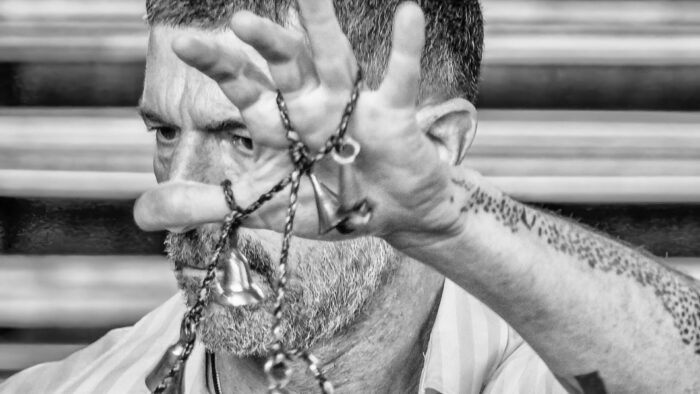
Sri Jaishankar Narayanan is a shishya of Pujya Swami Dayananda Saraswati. Following Swamiji’s guidance, he, along with his wife Smt. Srividya and fellow disciple Sri Kalyankumar, has established the Arsha Vidya Varshini Gurukulam at Dakshinamurthy Sarovar in Kallidaikurichi, Tirunelveli district, Tamil Nadu. At the Gurukulam, they not only teach Vedanta and traditional disciplines but also practice and promote an alternative lifestyle rooted in simplicity and closeness to nature.
In this interview, Sri Jaishankar Narayanan speaks about the role of music and local compositions in preserving culture, his research on Avudai Akkaal, and the continuing relevance of the Guru-shishya tradition in today’s world.
What is your message for youngsters today regarding following an Adyatmik path along with laukika jeevan, based on your experience?
The message for youngsters is to understand what their duties are and do them with an attitude of offering to Bhagavan. Freedom is not about doing whatever one likes but it is about doing what is to be done. Real freedom is when one is free enough to do the right thing in a given situation. Further if one is confused about what is right one should seek advise from one’s elders in the family and one’s Guru.
You have prepared a paper on Aavudai Akkaal. What inspired you to research her life and songs?
I was planning to conduct a Vedanta retreat in Tamil and looking for Vedanta texts in Tamil when I discovered Avudai Akkaal’s songs. I was really impressed by her story and the profound ideas expressed in her songs in a simple language. She was a child widow who went on to become a great saint and an author with the grace of her Guru. I conducted classes on one of her songs called ‘Pandithan Kavi’ which is an autobiographical account of her meeting with her Guru and the teaching imparted to her by her Guru.
Later I was invited to present a paper in a seminar organised by the Bharatiya Vidya Adhyayana Santhana on the topic ‘Medieval Bhakti Literature of Indian Languages’. I had already read about Avudai Akkaal and her songs and thought that it would be appropriate to present a paper on her life and works, which is not very well known in general.
What is the range of her songs in terms of Sahitya?
She has left behind for us a variegated body of work. Many of her songs can be set to a raga and a taḷa, but some can be rendered only as viruttam or vacanam. Amongst her songs which are on self-knowledge, 74 musical works are structured in pallavi, anupallavi and charaṇa format.Akkaal's Kanni, Kummi, Sindhu, and Pallu are very popular even today in the villages in Tirunelveli and Tenkasi Districts.Akkaal in her songs has used language and similes which are similar to those used by Shiva Vaakkiyaar, Pattinathaar, Paambaatti Siddhar and other saints before her. She has also been an inspiration to others who became familiar with her songs later. Her Songs have been an inspiration for Mahakavi Bharatiyar, particularly his Vedanta Songs.
Furthermore, her songs, including Advaita Meijnaana Aandi, Vedaanta Ammaanai, Vedaanta Aache Poche, Manam Buddhi Samvaadam - Anne Pinne, Soodaalai Kummi, Vedaanta kummi, Soodaalai Kathai, Kolaatta Paattu, Vedaanta Jnaana Rasa Kappal, Vedaanta Kappal, Kilik Kanni, Kuil Kanni, Paraaparak Kanni, Sri Dakshinaamurthy Patanam, Advaita Elelo, Vedaanta Pallu, Vedaanta Nondi Sindhu, Jnaana Kuravanji Naatakam, Vaalaambigai Pandu, Srividyai Sopaanam, Anubhoga Ratnamaalai, Vedaanta Vandu, Advaita Thaalaattu, Thottil Paattu, and Oonjal, took on many forms and stood out in many ways. Akkaal also composed the Bhagavad Gita Vachanam (also known Gita Saara-sangraham) and the Srimad Bhagavad Gita Saaram.
What would you say is her role in communicating the message of Advaita to the common man. How has her music been a vehicle for the message?
She composed her songs with profound wisdom in simple everyday language of the people around her, which are particularly popular among the women folk in Tenkasi and Tirunelveli districts. Akkaal has also authored many folk-styled compositions like ‘Vedaanta kummi’. Vedaanta kummi invites young girls for a dance called ‘kummi’. The song initiates the girls into ‘saadhana chatuṣhtaya’ which prepares them for receiving this knowledge of the Self and helps remove attachment to children and spouses. This is an extraordinary text which introduces the girls to various vedantic terminologies and concepts.
Even mundane rituals like extracting castor oil from castor seeds and the rules associated with menstruation were connected to Advaita by Akkaal through songs composed on them. Two long songs, Vedaanta ammaanai and Srividyaa śōbhanam, are sung, even today during menstruation in Sengottai.
Akkaal simplified the terse text for women by using domestic metaphors. She explains the rigour of Vedanta through the process of producing castor oil. Castor seeds are highly poisonous. To produce the oil, the seeds have to be treated, boiled and filtered again and again. Like castor seeds you process avidya by repeatedly reasoning and then recollecting. Then you can destroy the avidya (poison) and attain vidya (oil).
Akkaal's Kolaatta songs, which beautifully expresses Advaita, is still sung today. On the occasion of Deepaavali, women and children in Sengottai Agraharams make a cow and calf image, place it in the Sapparam (A vehicle to carry idols in procession) and celebrate. They dance Kolaattam in front of the Sapparam, sing Bhajans including Akkaal's songs, and go to the fields in the early hours of the morning to dissolve the mulaipaari and the cow-calf images. This festival is still being held today.
Have you been involved in researching other composers in the region?
Yes. Harikesanallur Muthiah Bhagavathar is a famous composer from my maternal Grandfather’s ancestral village Harikesanallur. Muthiah Bhagavathar has almost 400 musical compositions to his credit, the largest among the post-Trinity composers. Tana varnams, Pada varnams, Daru varnams, Raagamaalikas and Kritis that include 108 songs each in praise of Siva and Chamundeshwari apart from patriotic songs, Tillanas, and folk tunes.
Further the songs of Kulasekhara Alwar who attained mukti at Mannarkovil near Ambasamudram and songs of Mahakavi Bharatiyar are of interest to me.
As an IIT graduate and engineer what are thoughts on the the role of traditional Gurus in a changing world.
I studied Engineering and Technology at IIT BHU, Varanasi and worked in India and later the USA. What I learnt from my education and experience of living in India and abroad was that technology can give a comfortable life but cannot give happiness. With all the benefits of technology in developed nations people are still comfortably unhappy while the people in developing countries are uncomfortably unhappy. The pursuit of happiness is universal. If you conduct a survey with people on what they really want, you will find that everyone is searching for happiness which is not constrained by space and time i.e. they want to be happy everywhere and all the time.
Even though everyone wants unlimited happiness they are still seeking it through actions which are finite and limited. So, is there any way I can attain what I really seek? The answer to this question is the subject matter of Vedanta and it has to be learned from a Guru. That is why we have a teaching tradition which has a lineage directly traced to Bhagavan himself. To discover the happy and contented me, I have to lead a life of Dharma and prepare myself for the knowledge of the Self. The knowledge of Dharma and Atma - both require a Guru, as the subject matter is subtle and beyond the scope of means of knowledge like perception and inference.
Now a days we have Artificial Intelligence (AI) but even that cannot be a substitute for a living Guru. AI can be an aid in self-learning but not everything can be self-taught.
Could you tell us more about your work and research.
I am a shishya of Pujya Swami Dayananda Saraswati ji and studied Vedanta and Sanskrit as a residential student with Swamiji at Arsha Vidya Gurukulam at Anaikatti near Coimbatore. I am now involved along with my Gurubhai Kalyankumar in setting up a Gurukulam called Aarsha Vidya Varshini Gurukulam in Tirunelveli District to teach Vedanta, Sanskrit and other traditional knowledge disciplines in a residential setup. I am also teaching Vedanta online and that is my primary subject of interest.