I love the Story of Ganesh Who Writes, But Demands The Story Never Stop: Otis Haschemeyer

Andrew Otis Haschemeyer was a Stegner Fellow in Stanford University’s Creative Writing Program and currently teaches for Stanford’s 'Online Writer’s Studio.' His dad had received a gift, a wooden carved Ganesha from a friend. After his father’s death, Otis now has this Ganesha in his office.

Otis's father worked at Cornel Medical School in New York and his best friend was an Indian - Dr. Saresh, who lived several stories above him. Otis says this is how he "had some familiarity with India from a young age growing up in New York." He says he has always loved Indian food, and there were several places on 6th Street in the East Village he would go to eat.

Later,  working at Stanford Continuing Studies he says he was lucky to teach a student who then went on to found Indic Academy and invited him to teach some workshops. "I know I’ve learned more in those workshops than anyone learned from me," Otis says about the Indic Academy writing workshops.

In this interview Otis shares his thoughts on Indic writing and his own journey with it.

You mention a connection between Yoga, writing and music.  That is a beautiful connection. In all three there are points of tension and release. Can we say that yoga offers an understanding of life itself?

Yes, I think so. The thing I notice with yoga—maybe too much so—is just how physical it is. This is probably the base I feel with all these practices, yoga, writing, music, and so much more. It’s grounded in the physical. And the physical is grounded in oppositions. On the one had we could see that as “oppositional” but it is in the oppositional that we also find movement and ideally flow. We find that in the music, even in sound itself— as sound wave. We find that in writing, with the protagonist and the antagonist forces. And we find it—of course—in yoga, when, for example, I try to sustain a pose. I might appear still, but I’m engaged in dynamic opposition, which we might call life itself.

In your conversations you talk about Indian Hindu stories and non-Hindu stories. Is it only the characters and the context that defines this or is the structure also often distinct?

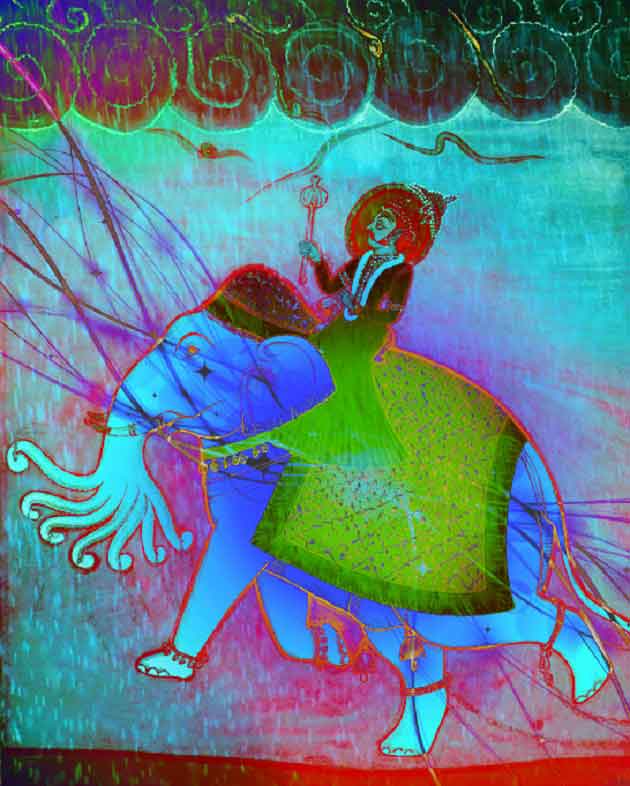
There are things that are universal in stories in all cultures. All stories sequence listening or reading events and create ways of understanding the world. The ancient stories both captured cultural history and conveyed knowledge and the ways of doing things, creating tradition. I notice and am struck in Hindu stories by the prevalence and centrality of the narrator, as a sort of originator of the story. I like that. And I love the story of Ganesh who writes, but demands that the story never stop. His pen failing, he breaks off his tusk to continue. That sounds like me. The writer doesn’t really invent—all we do is write it down. That’s what it is to be a writer.

You say you like the world these stories operate in? What is it that appeals to you _ Indian philosophy or the other cultural differences?

Coming from a tradition of monotheism, I really like this polytheistic world. I love the Gods and their personalities and the ways they can seem and feel to be part of everyday life. I like that more expansive collection of deities. It’s refreshing and entertaining and feels real and relevant. I also really admire the long history of India, going back so many centuries and the traditions in education and philosophy. It’s a profound context and one that can feel a little richer than the one I know of in the west. It’s also wonderfully new to me—I do like new.

Discipline is a word that is a recurring theme in writing and yoga. Is it a mental discipline or a physical discipline that is more difficult for you.

Ah, great question. I think the difficulty for me is in how I think of discipline. I can think of it as something negative—something that I have to do. But I think the real joy that can come from both writing and yoga comes from realizing that discipline does not describe something you have to do, but instead describes simply a discipline of showing up and not doing anything, just being there for life to happen.

A difficulty that lndians face is translating or representing words that have no equivalents in English.  What do you think is the best way to navigate this?

My advice about everything is to be honest. So, write the word and then try to describe it. Try to translate it—maybe not with a single word but with many. Words are just symbols of things that exist. If you have words and there is not one in English—that doesn’t mean the “thing” does not exist, it means we don’t have a word for it, and in a way we know it but are not conscious of it. What a great thing to bring to your English only speaking readers—an expanded consciousness of the known world.

What are the themes that you would like to read by Indian authors?

Wow, another great question. I read to go into another world (and escape my own!). Just let that happen. Invite the reader into your world and let them be there, completely—and by the world, I also mean the character, because the character is the sensory conduit for the world. I think the best stories capture both the uniquely particular and the universal struggle of human beings. I never tire of those stories. Stories like that help us carry on.

(Andrew Otis Haschemeyer was a Stegner Fellow in Stanford University’s Creative Writing Program and currently teaches for Stanford’s “Online Writer’s Studio.” He is the recipient of an Oregon Literary Arts Fellowship. He has won a Margolis Foundation Prize in non-fiction and the Jeffery E. Smith Editor’s Prize for fiction. His work has appeared in Best New American Voices 2003 & 2009, The Sun, The Alaska Quarterly Review, Iodine Poetry Journal, Barrow Street, Politically Inspired, and other journals and anthologies. His reviews appear in Broken Bridge Review and The American Alpine Journal. Cover pic is of Otis with his family: writer/activist Zondie Zinke, daughters Ozy and Zo and, as he says, lucky him).

Food & Faith: Shoba Narayan Walks Us Through the Spiritual Food of India

In her book Food & Faith: A pilgrim's journey through India Shoba Narayan combines her two loves cuisine and spirituality. A journalistic offering, she shares her experiences with sacred food in shrines across India _  Puri’s bhog, Amritsar’s langar, Palani’s panchamirtham, Mathura’s pedas, Ambalapuzha’s paal-payasam, Kashi’s sweets, Jaipur’s rabdi, Ajmer’s kesaria bhat, Madurai’s dosai, Jewish halva in Mumbai, and communal feasts in Udupi, Goa and the Kumbh Mela.

Shoba views cuisine as a vehicle for storytelling. She has been interested in it for the last 25 years as a food writer and began work on Food & Faith in 2015.

She moderated CSP’s session on jewellery at Namaste 2020. See here: Kavaca: Quintessence of Indian Jewellery - Center for Soft Power (softpowermag.com). In the interview below, we speak to her how India can showcase the rich complexity of her food to global acclaim.

Holy offerings in Jaipur (Pictures courtesy Shoba Narayan)

In the past food was intrinsically connected to worship. How prevalent is it now in urban metros?

As you know, there are many Indias. I feel that the connection between food and faith is still prevalent in India, both in rural and urban areas. It depends on the household and how devout the household is.

I have examined various factors such as economic strata, caste, age, class, education level, widely traveled or not, and family. It is difficult to come up with a correlation between each of these factors and whether the person is religious or not.

I have met wealthy people who are religious and wealthy people who disdain religion. I have met global citizens who are rooted in their faith, and immigrants who have given up on their faith. It would be easy to say that young people rebel against religion but if you visit our temples, churches, mosques and shrines, we see a large number of youth there. So it is not a simple thing to create a hypothesis based on faith.

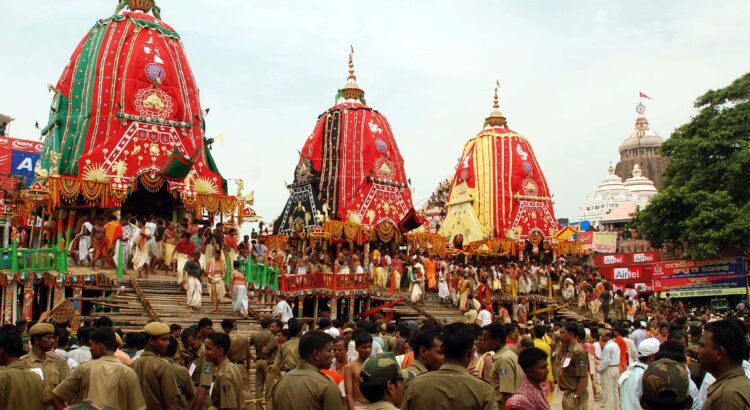
Jaganath Puri Temple, Odissa

What are the forces that have led to the preservation of this connect in India? Is it the same across communities?

India is one country where culture and society are intricately linked. In my research, I discovered that as countries got wealthier, they turned away from religion. Most modern societies have moved beyond myths into the worlds of science and rationality. Their creation myths, the way their ancestors made sense of the world, have been relegated to museums, theatre, storytelling and history textbooks. Today’s Rome with its Prada and Bottega Veneta stores is a far cry from the time when Roman gods walked the earth. The same goes for other ancient cultures such as Greece or Egypt. In Cairo today you don’t see Egyptian gods like Ra and Anubis on street corners in temples. But in India we do.

India's genius in comparison to much of the global world is that it preserves and values the ethos that comes from our myths and traditions.  It is as if we Indians are still acting in a sacred play that spans millennia. The Romanian religious historian Mircea Eliade called it sacred and profane. Myths, he says, are where the world of the gods breaks through the clouds and mixes with the world of humans. In Hinduism, we call these avatars, where the gods literally walk amongst us and teach us lessons, show us how to live. In India, we have preserved this mythical element.  It nourishes us.

Azhagar Kovil, Madurai

Your book is a combination of a travelogue and a cuisine book, two great sources of soft power.  How can we entice visitors to travel across India to sample this variety?

In order to do this, we have to figure out how to package the nuances and magnificent diversity of our traditions, rituals, stories, and symbols.

The Indian mind sees things in a non-linear fashion. This has been described by AK Ramanujan in his wonderful essay, "Is there an Indian way of thinking?" (ramanujan.pdf (profcohen.net)).The nested stories of the Kathasarithasagara are another example of this approach.

In terms of Indian aesthetics, India is a more-is-more culture rather than a less-is-more culture as described by the architect Mies van der Rohe. We are exuberant, colourful, and extravagant in terms of our stories, festivals, food and gatherings.

The problem is that it is difficult to package such an ethos into concise and specific products. In the modern world people want simple and minimal solutions. They favour an approach that is rooted in one or two ‘take aways’ rather than the layered approach of India.

Marketing mines have to apply themselves to figure out how to funnel the extravagance of India into deliverable cultural ‘products’ and experiences.

One country that has done this very well is Japan and we can learn a lot from it.

Could you describe how food is a carrier of culture for Hindus in temples. Do practices vary?

Food becomes sacred food after it is ritually offered to God. Neivedhyam becomes prasadam after it is blessed by god. The word prasadam literally means mercy or blessing. Azhagar temple prasadam was a variation because its main prasadam is a savoury dosai.  Other prasadams include piquant lemon rice, bright yellow in color and speckled with black mustard seeds; tangy tamarind rice; sweet pongal flavored with jaggery, cashew nuts, cardamom and tons of ghee. But the pride of place goes to the Azhagar Kovil dosai, famed in the area for its taste. The word “dosai” is the South Indian, and correct way to pronounce what North Indians crudely call the “dosa.”

The recipe is simple and boils down to one foolproof cooking technique: the dosai is deep-fried in ghee, giving it a richness and depth of flavor that no amount of healthy, low-cal cooking can replicate. Pounded white rice is ground with whole black urad dal along with curry leaves, asafoetida, black pepper, and salt. The resulting mixture is deep-fried in large containers.

As is common in temple cuisine, all the ingredients are native to India. Whole black urad dal—Vigna mungo-- is an ancient bean, highly prized in India and Pakistan for its bland, nutritive properties. The two most popular breakfast dishes in South India, the idli and dosa, a fermented combination of dehusked urad dal and rice. The dosa at the temple doesn't tamper with this black bean.

Amritsar

You cover a few religions in your book. Were there any surprises for you in any way?

Well, I really enjoyed the Jewish meal that I had.  For one thing, their halva is delicious!

My Israeli friend, Shai used to joke about the Jewish food philosophy.  “Every time someone tries to kill us, we eat,” he used to say.  “They tried to kill us; we won; now, let’s eat.”

During Rosh Hashanah, I dined with a Jewish family in Mumbai.  They are Bene Israeli.  Each dish has a meaning.  A bowl of ruby red pomegranate seeds signify bounty; apples dipped in honey for sweetness; dates which are food from the tree; leafy vegetables are called karsi in Hebrew, which sounds like the word, karet, which means cut off or destroyed. Similarly, the beets, which are served, are called silka in Hebrew, which sounds like siluk, meaning removal.

The festival is all about leadership, about winning, about being the head.  So Jews choose the head of the goat; the head of the fish and so on. Being vegetarian, I could not eat many of the dishes (smiles).

My favourite was the halva. Traditional Jewish halva is made with rice flour, all-purpose flour or maida, and sugar in the ratio 1:1:2.5. To this, add coconut milk and a pinch of salt. All the ingredients are mixed with a little water. The entire quantity is poured into a large pan and heated over a sigri or coal fire. After that, the art is in the stirring.  Most Bene Israeli families used to hire a man a few days before Rosh Hashanah just to sit and stir a cauldron full of halva for hours at a stretch. Once the halva reaches the consistency of, well, halva, or thick batter, it is poured into a large plate.  Dried fruits and nuts and sprinkled on top: skinned sliced almonds, skinned sliced pistachios, pine nuts, sliced hazelnuts, and others. The whole mixture is allowed to cool for twenty-four hours.

I have eaten many halvas in my life, but none as good as the one I ate for Rosh Hashanah at Ralphy and Yael Jhirad’s Mumbai home. The coconut milk gave it depth and density without increasing the sweetness.

Palani

Do you think regional cuisine should be showcased better? Do you have  any suggestions?

A good way to showcase regional cuisines is to somehow get tourists into Indian homes. The reason is that in most Indian restaurants, spices and gravies are laid on with a heavy hand. It is quite different when we eat at home. Our food is very light, subtle and satvic. In order to showcase this, we need to encourage and patronise restaurants that celebrate and showcase recipes from various regions. Karavali restaurant in Bangalore is one example but there are many others all over the world.

There are celebrity chefs like Gaggan Anand and Sriram Aylur in London who are rooted in regional Indian cuisine but have figured out ways to extract its essence for a global palate.  I am sure that they would have suggestions on how to propagate regional Indian cuisine and they need to be consulted.

The food served during different Indian ceremonies is very complex. Taste, diet and ritual come together very interestingly like in shraddham food. How does one showcase this complexity to the world?

I've visited Kyoto once as part of a journalistic assignment. There is a tourist organisation there that contracts with women who stay at home. For a good amount of money, tourists can visit Japanese homes, learn the chrysanthemum dance, experience the tea ceremony, learn how to tie the kimono and enjoy delicious home-cooked meals. You learn the stories, the culture, and the experience.

I can envision a similar thing happening in India where tourists are brought to regional Indian homes in order to learn how to tie the sari, draw the kolam or Rangoli, help with the preparation of a meal while learning all our stories.

There are songs where the menu at a marriage have been listed. Are there other ways we have preserved this cuisine?

Actually, our cuisine is quite well preserved. Partly because it is not marketed globally, it has preserved its essence. The thing with marketing and becoming globally famous as a cuisine is that global influences change the way the cuisine evolves.  In that sense, marketing our cuisine globally is a double edged sword.

Look at South American cuisines for example. Today some of the world's best restaurants are in Peru. Until now, Peruvian cuisine was untouched and unvarnished by global influences. Now that global chefs and foodies are congregating in Peru and Lima, you can see its cuisine changing and being ‘adulterated’ before our eyes.

Apart from the Jews have you looked at any other non-Indian communities. Has there been any exchange between people?

For my book, Food & Faith, I did not look at other non-Indian communities. Part of the pleasure of writing a book is to create boundaries within which the subject matter will fall. For this book I decided that it would be largely Hindu and definitely Indian.

(Shoba Narayan has written about food and faith for over two decades.  She was the Hinduism columnist for Beliefnet and won the James Beard MFK Fisher Award for distinguished food writing.  She has been a correspondent for Gourmet magazine and has written about culture, food and faith in her columns and essays for Hindustan Times and The National Abu Dhabi.  Food & Faith brings together two of Shoba’s passions: spirituality and food. Find her at her website: https://shobanarayan.com. )

Cover Picture: Making the famous paal-payasam of Ambalapuzha temple

The Gods Are Where We Are: Living Polytheism in the 21st Century

Ptahmassu K.M. Nofra-Uaa is an internationally noted iconographer whose celebrated work has been featured in publications including best-selling author Nicki Scully's book Sekhmet: Transformation in the Belly of the Goddess. He is the founder of Icons of Kemet, dedicated to the crafting of unique God-images for use in worship of the ancient Gods of Egypt. A spokesperson for devotional polytheism, his poetic hymns have been published by Neos Alexandria/Bibliotheca Alexandrina. He is a priest of the Temple of Isis California, a legally recognized sanctuary of the Goddess Isis in the United States, and a Priest-Hierophant in the international Fellowship of Isis, whose aims include the celebration of the Egyptian Goddess Isis and related Goddess traditions from around the world. (Official websitewww.iconsofkmt.com, Official store www.store.iconsofkmt.com)
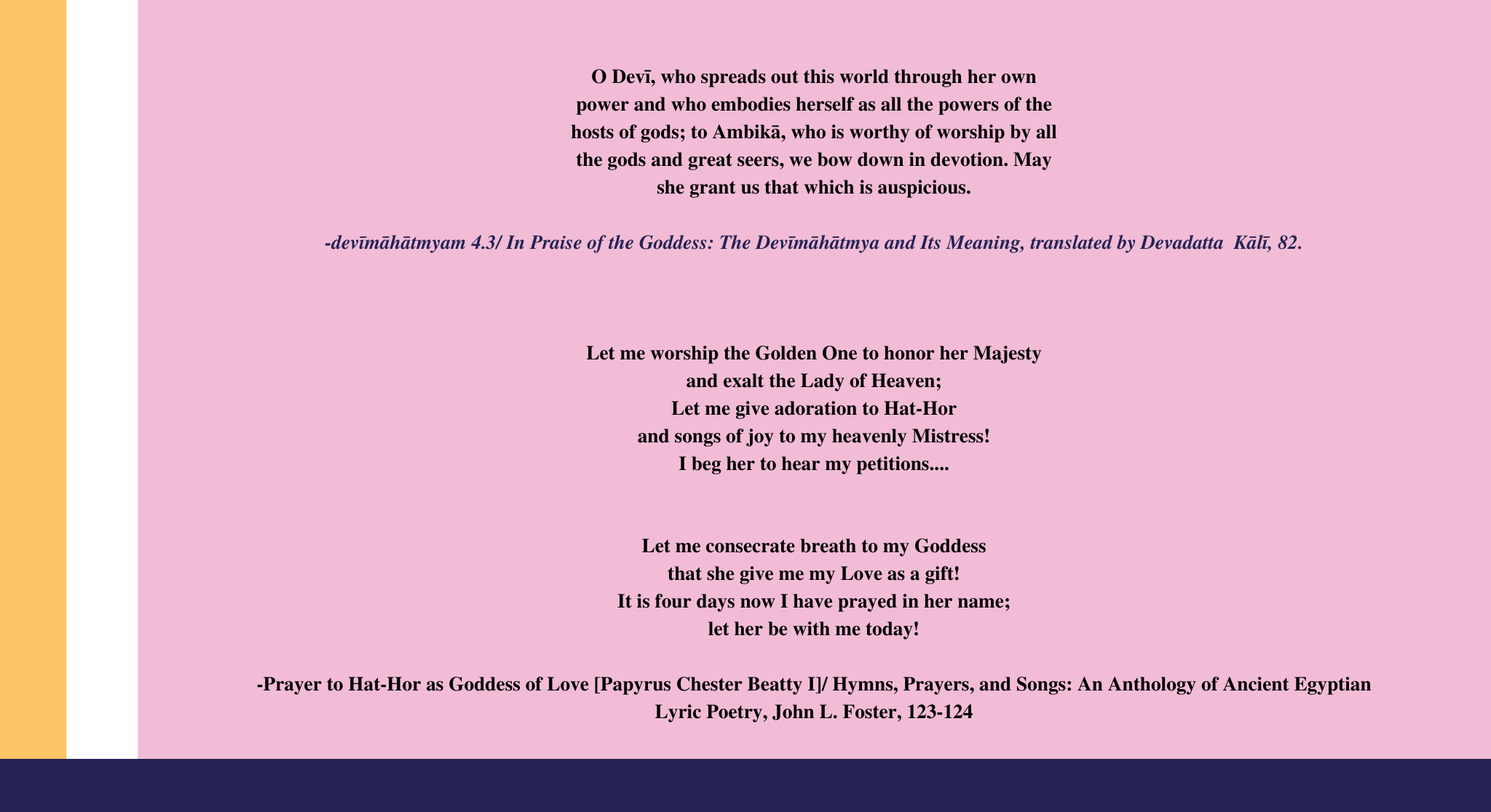
Center for Soft Power is privileged and grateful for this Interview with Master Iconographer Ptahmassu K.M. Nofra-Uaa

 You say you have experienced the power of Kali ma and that you had a book of Sri Ramakrishna Paramhansa which helped you in your life. How did they come into your life?

 Ptahmassu Nofra-Uaa: I first encountered the Goddess Kāli as a boy in a book on the religions of India given to me by one of my teachers, and I admit I was hooked. There is something captivating about Ma, and Hers is the power to split open the most resistant of hearts, to conquer the most adamant ego, to open up wide the most closed of spaces. She finds your sadness and walks with you through those terrible places which the human mind creates, the illusion of material life and suffering as permanent phenomena; and She tears down those illusions, revealing that it is the spiritual life, the non-physical state, that is the Ultimate Reality, the highest goal possible. It is through this realization that human beings can strive for union with the Divine, which can be achieved through bhakti yoga, the profession of one who thirsts for the Divine above all things.

As a young man I came into some misfortune and became homeless for a number of months. Sometimes I was offered a temporary place to stay by friends or friends of friends, and survived primarily on handouts from kind people who frequented the coffee shops I spent my daylight hours in. At this time I was very devoted to my meditations and spiritual studies exclusively, and my days were spent reading the cache of books I carried around in my backpack. I went into a used bookstore one afternoon and was perusing the religious philosophy section when I came across The Gospel of Sri Ramakrishna published by the Ramakrishna-Vivekananda Center. I sat down with it for over two hours, utterly captivated by the life of Sri Ramakrishna and His devotion to Ma Kāli, and finally decided to spend the last bit of money I had on the Gospel of Ramakrishna, instead of saving it for food.

Though I was at that time familiar enough with the philosophy of bhakti, something about the personality and message of Sri Ramakrishna touched me in a way no other guru or teaching had. I was in a certain amount of intense emotional pain at that time, a profound loneliness and depression, and also a fair amount of physical pain from an abscessed tooth, so I poured that pain and loneliness and depression into my relationship with Divine Mother, Whom The Gospel of Sri Ramakrishna inspired me to reconnect with. The Gospel of Sri Ramakrishna spoke to me of a human soul compelled by intense, painful longing for a true vision of Divine Mother, the Ultimate Reality of the Universe. It spoke to me of a soul attracted to the Source of its own beingness, the Goddess Who reveals Herself to the bhakta as Ma Kāli. When Ramakrishna describes His heart "...being squeezed like a wet towel" during His first vision of the Mother, I understood that this is what it means to love the Divine so completely, so authentically that one becomes immersed in the very object of one's devotion, until there is no division between subject and object. This was the love I found for Divine Mother at this time in my life when real love was a chimera to me. Love as lust, desire, and attachment was something I knew all too well, but what I really wanted was a love not rooted in the ephemeral, a love not attached to that which is destined to dissolve. This is the kind of love Divine Mother wakes us up to, and it is such a shocking phenomenon when it happens, it can only come from the being of a Goddess with a sword that cuts through all attachment woven through the ego.

One of the great gifts of Sanātana Dharma to the world is this path of bhakti, the principles of which can be found in and applied to other religious/ spiritual paths; that is, the path in which the devotee gives over their heart wholly to the Divine, and places the Divine at the center of all activities and goals. This is something I post about constantly on social media, because I think it exemplifies how we as devotees of our Gods can experience the presences of the Gods directly in all our life, not just in temple, shrine, or during special ritual times. I think it's easier to think about the Divine when one is in a sacred environment, surrounded by incense, flames, and in the presence of beautiful mūrtis or idols. But what about the rest of the time? What about our busy workaday lives that consume so much of our time and energy? How can we experience our Gods then?

The path of bhakti- and in particular bhakti yoga - bridges the gap between Sacred and profane, spiritual and material, in that the bhakta trains their mind to bring itself back to the Gods at the center no matter what the devotee is doing- household chores, stuck in traffic, taking care of the kids, running errands, grocery shopping in a crowded store, sitting in class during a lecture. When the Gods are recognized as being the Source of all activity, worldly or spiritual, and when the world is recognized as being composed of the spiritual, as a vehicle for it, in fact, then there is no separation between the human soul and the Divine. There is no differentiation between the Personality of the Divine and the human condition. We see that all our life is directly connected to our Gods, that the Divine is the root of all life and activity in the material world, that there is nothing that is not the Divine. This realization in us transforms our "mundane" experiences into opportunities for Divine engagement, whether or not we are in a sacred space such as a temple or stuck in traffic in the middle of a congested city center. If our mindfulness is present with the Divine, then our most mundane actions can be filled with the Sacred.
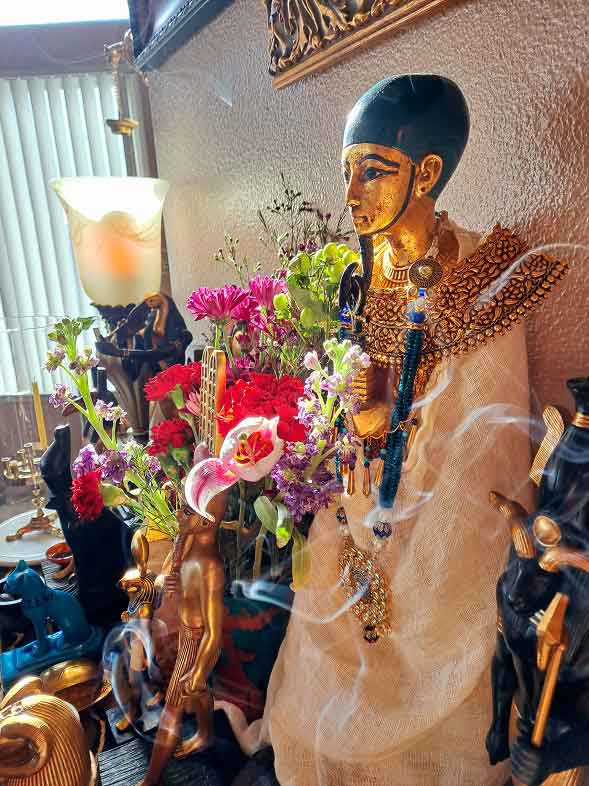
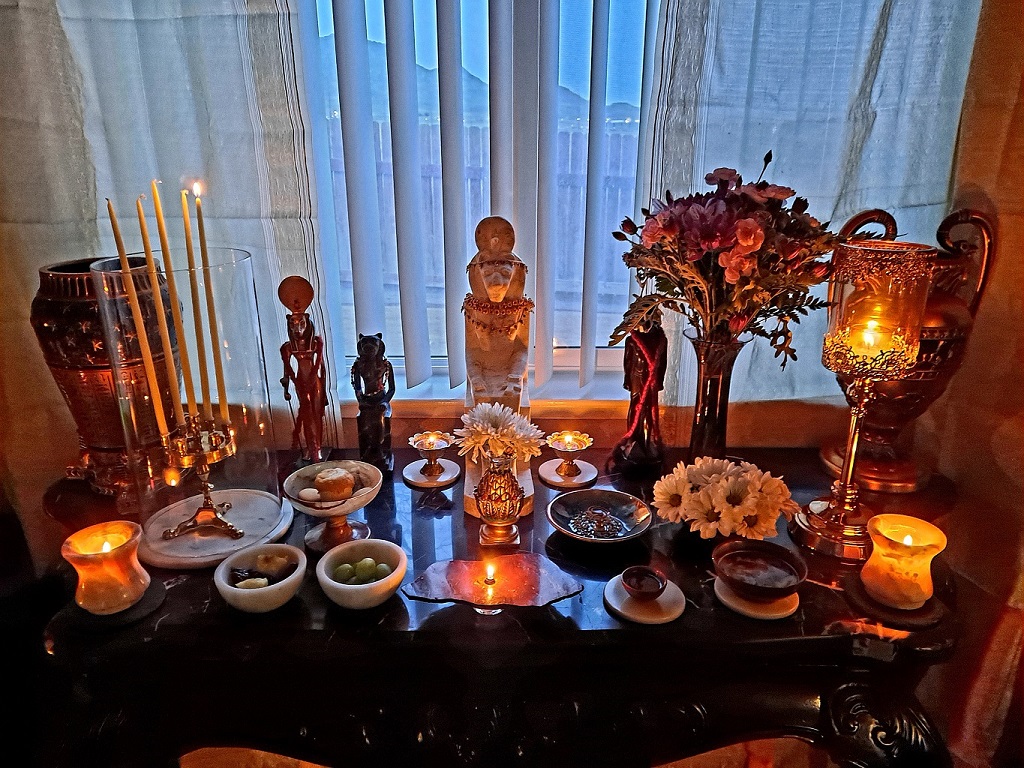
Top - The Shrine of the Household Gods in the iconographer's home, Below: The Shrine of the Household Gods in the iconographer's home

Indians pray to a pantheon of deities called devas. Are there similarities to Egyptian gods?

Ptahmassu Nofra-Uaa: There are definitely similarities between the devas of Sanātana Dharma and the goddesses and gods of Egypt. Firstly, one sees that iconographically the netjeru or Gods are visualized anthropomorphically, and that these forms remain consistent throughout Egyptian history. There are the cosmic Creators such as the God Ptah, Whose iconography in anthropomorphized form never changes over a period of four-thousand or more years. He is depicted with attributes that remain with Him- close-fitting skull cap, straight, squared beard, and hands protruding from form-fitting sheath carrying the ankh-djed-was (ankh=life+djed=stability+was=dominion) staff of creation. The God Ptah is always instantly recognizable because of His consistent iconography, which reminds one of Brahmā or Śiva, and in particular the triśūla-trident of Śiva representing His śakti-powers. The ankh-djed-was staff held by Ptah is a combination of three divine attributes associated almost exclusively with the God Ptah in His role of Creator of all life, material and spiritual. Likewise, the triśūla-trident of Śiva embodies His three powers of icçhā-will, kriyā-action, and jñāna-wisdom. Śiva's trident is so closely aligned with Him that the God's presence may be represented by the trident alone, just as the ankh-djed-was staff is recognizable as that instrument of Ptah's powers as Creator of the universe, Gods, and living creatures.

We find in taking a closer look at the forms of the devas that these correspond to the manner in which the Gods of Kemet- ancient Egypt- are depicted. Consider, for example, the bimorphic form assumed by Viṣṇu, Who transforms Himself into a boar in the Śiva Purāṇa, and of Gaṇeśa with His elephant head and plump, human child's body. Such combinations of human and animal are the well-known hallmark of the Egyptian netjeru, Who often appear in temple iconography as animal-headed and human-bodied. But we also have the strong presence of the vāhana-vehicle in the devas, which signify aspects of a deity's power, such as the lion of Durgā or bull of Śiva. The Kemetic- ancient Egyptian- netjeru have what are called uhemu, animal intermediaries like the Hap- or Apis- Bull of the God Ptah, and these animals are regarded as the living manifestations of a deity's sekhemu or powers. These animals or birds are believed to be the carriers of a deity's concentrated power, which becomes accessible to the material world through such a manifestation. Now, in the Kemetic tradition, the netjeru do not actually ride their uhemu as the devas ride Their vāhanas, but still, the Gods of Egypt are very closely tied to the manifold animal forms with which Their living powers are associated. In fact, the Kemetic Gods can also appear in completely zoomorphic guise, or be represented by the animal whose head They more often sport.

It is this reverence for the inherent sacredness - this inherent divinity- in the natural world that most closely ties the devas of Sanātana Dharma with the netjeru of Kemet. The Goddesses and Gods of Egypt demonstrate Their powers and qualities through the animal kingdom, and also in the plant kingdom, which exists prominently in the divine iconography of Sanātana Dharma. We also find the same type of iconographic determinations made in both cultures, such as the attitudes or postures/gestures of deities that act as identifying factors, specific regalia and weapons particular to both local and national deities that serves to embody how each deity's powers are demonstrated, and family units that form the core values presented in the sacred story cycles of each deity. In the Kemetic traditions, goddesses and gods are presented in tight-knit family groups often consisting of a male deity, his female consort, and a divine child or children, which become the specific focus of temple cultus. In Kemetic theology, for example, we have the divine family of the God Ausir (or Osiris), the Goddess Aset (or Isis), and Their son the God Heru (or Horus), Whose family tribulations and exploits became central to Egyptian religious thought and ritual. We might compare this with the family of Śiva  Pārvatī, and Gaṇeśa.
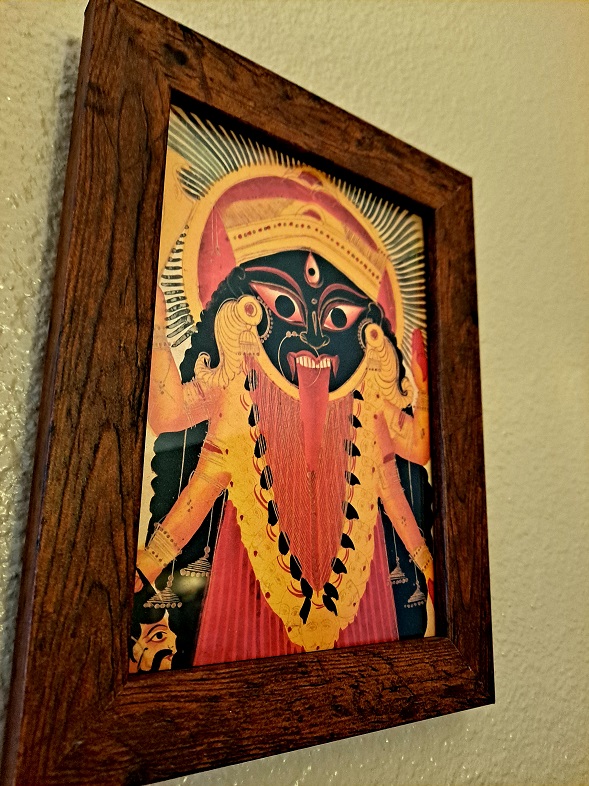
Goddess Kali watches over the iconographer in his studio
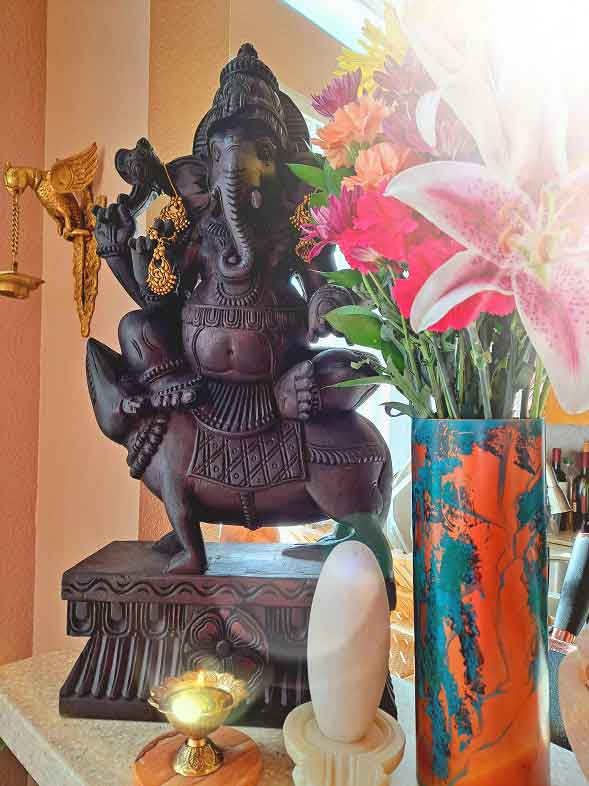
Lord Ganesha (middle) and Lord Indra (below)

You speak a lot about ancestral worship. Why do you think our ancient civilizations worshipped ancestors on par with the deities?

Ptahmassu Nofra-Uaa: Firstly, we recognize that our Ancestors have a vested interest in our success as human beings, that They want us to succeed in our endeavors, and that They understand what it means to live a human life fraught with all the difficulties and sufferings mortal life presents. Our immediate blood relations - those with whom we shared the closest familial ties while they were alive - are especially cognizant of the challenges we face on a day to day basis, and are more likely to lend us a compassionate ear once they have passed over into the spiritual world. Among these persons we might also choose to consider not only our blood relatives, but also very close friends who shared with us a deep spiritual connection. This would include peers in our religious communities, fellow devotees, teachers, gurus, satgurus, kulagurus, and āchāryas. We should understand that our karma has brought us into the presence of such persons, and that these ties will be passed down from lifetime to lifetime, meaning that they are also within our family of Ancestors and can be approached through prayer and devotion for the transmission of blessings.

In the Kemetic traditions we recognize the presences of the Akhu, "Shining Ones" or "Effective Spirits", Who embody all those Who have transmigrated the after death states and, because of Their virtuous deeds while alive, have received justification before the Gods and won a direct place in the domain of the Gods. While ones blood relations may be considered one's Akhu, it should be kept in mind that many Kemetics are non-Egyptians whose blood relations and family ancestors might be antagonistic to Kemetic beliefs, might be Christian, agnostic, atheist, or simply not on good terms with one, or for other reasons might not be responsive to the petitions of ancestor cultus. How does one maintain an ancestor practice under such conditions? Also, it is important to many Kemetics (practitioners of the ancient Egyptian religion) - who do not have blood ties to the native country of their faith - to establish spiritual ties with those who do, and the way in which this is achieved is through a sustained ancestor cultus to Egyptians who served the netjeru, that is, by petitioning those ancient Akhu or Blessed Dead with whom they feel a special connection. Kemetics who engage in this kind of Ancestor veneration often find themselves being "adopted" by ancient practitioners of their faith who are not related to them by blood, but become a source of spiritual strength and kinship nonetheless.

Why do our ancient traditions place such emphasis on Ancestor veneration? Because our Ancestors have already passed through the material world and entered the numinous spheres inhabited by the  Gods, and it is through Their experiences that we too might gain insight and blessings from the Gods we share with Them. Our thread of connection with our Ancestors - be They Ancestors by blood or spiritual ties - is intimate due to our common humanity, our common emotions, needs, desires, and suffering of mortality. These are experiences our Ancestors understand from direct experience, including the affliction of mortality itself, which the eternal Gods, the devas and netjeru, do not share with us because Their state is numinous and not constricted by physical dissolution.
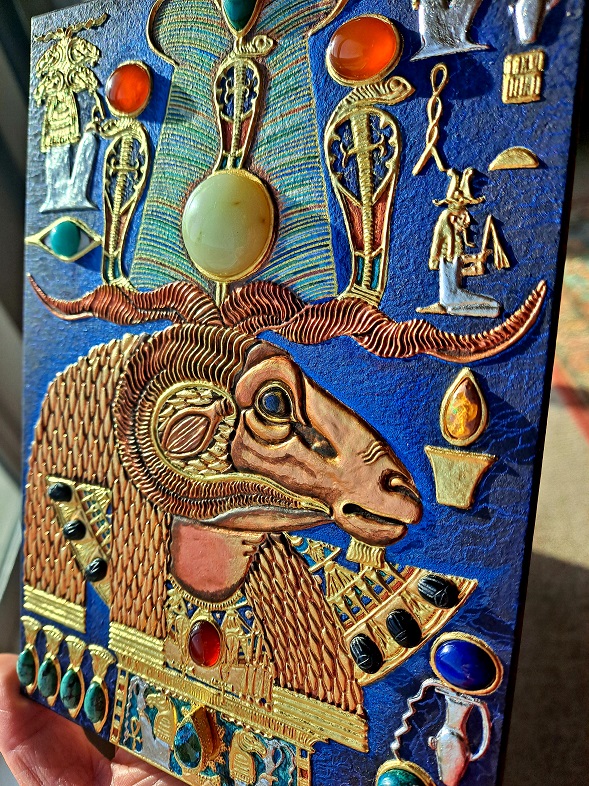
The Akem-Shield of Khnum-Ptah-Tatenen and the Egg of Creation

Have you been to India? Do you think our ways of worship are similar?

Ptahmassu Nofra-Uaa: I have never had the opportunity to make a pilgrimage to India, but this is something I yearn to do, for many reasons, the most important being that India is the oldest Dharmic civilization on our planet. She is the benchmark for how human beings can cultivate a direct relationship with the Divine and maintain that relationship without fail. The Sanātana Dharma of India  gives us a more than 6,000-year-old record of what happens when human beings respond to the innate calling of the Divine, and develop their culture as a dialogue between the Gods and the human conscience.

As a devotional polytheist, my strongest inclinations are towards the actions that bring us into direct contact with our Gods, the active engagement of the Gods through the activities of prayer, worship, ritual, pilgrimage, meditation, the maintenance of cult images or idols, and the maintenance of sacred spaces such as shrines and offering places. I also live a tradition that has not had the fortune of being handed down in an unbroken chain since ancient times, as is the case with the Sanātana Dharma. Kemetics today have a difficult time in responding to the call of our ancient gods because we are not raised with an awareness of the authentic prayers, ritual forms, and modes of service native to the worship of our netjeru. We do not have an instantly accessible lineage of clergy or living temples to help us in the cultivation of our faith. These are all things Kemetics must uncover and study on their own, which means we need examples of how ancient polytheisms can be lived in the contemporary  world.

 This brings me to the answer to your question. Sanātana Dharma is in a unique position amongst the world's living belief systems in that it recognizes many Gods, devas or Mahādevas, thus its practitioners are raised with a strong sense of plurality in approaches to the Divine and in lifestyle choices rooted in these different approaches.  It has maintained the same ritual forms for thousands of years, the same sacred architecture for temples, and the same sacred proportions and guidelines for mūrtis or Divine images. For devotional polytheists like me, striving to live a very ancient tradition rooted in the veneration of many gods, the milleniums-old practices of the Sanātana Dharma serve as living examples of how devotees today can engage the Gods through the maintenance of ancient ritual forms and modes of service. There are many layers of similarities one can detect between the sacred ideals and symbolism expressed in the worship of the devas of Sanātana Dharma and the netjeru of the Kemetic traditions.

One significant aspect that has thankfully remained from the ancient Egyptian religion is its temple record concerning the highly specialized ritual texts, offering procedures and types, ritual gestures, and iconography of different types of Divine images. These have all been preserved down to the intimate details, which give us a step-by-step record of how the netjeru are to be approached and venerated in Their Divine cultic temples. Something I should note is that while most Kemetics maintain some kind of shrine or sacred space for the veneration of Divine images and the presentation of offerings, the complex scale and sumptuousness of the ancient temples is a phenomenon relegated- for now- to the past. Kemetic priest/priestesshood does exist, and temple spaces are being established for the Kemetic Gods, but the scale of these spaces and the ritual observances taking place in them have been reduced considerably from those in existence in ancient times. However, there are still many simularities between modes of worship of the Sanātana Dharma and Kemetic traditions.

The mūrti is central to all places of worship in the Sanātana Dharma, whether in large temples or in private family shrines, and the procedures for maintaining and venerating mūrtis bears strong resemblance to the tradition of kau or sekhemu or cult images for the Egyptian Gods. In the Kemetic tradition, the cult statue, once enlivened through the correct ritual process, becomes the ka or visible aspect of the God, which is inhabited by the ba or spiritual essence of the God, making the image a tangible manifestation of the Deity's sekhem or power. For the Deity's essence and power to remain in the cult image, specific sacred acts and offerings must be presented to the sekhem perpetually (ideally every day), otherwise the Deity concerned will depart from the image and it will revert back to the status of inanimate object- meaning that the Deity's boons are no longer being transferred to the holy place or community via the tangible manifestation of the Deity's power on earth.

 The experience of darśana in Sanātana Dharma certainly has correlations with concepts present in the traditional worship of the Egyptian Gods, and so too with the main elements of pūjā and āratī. Receiving darśana or a direct vision/sight of the Deity in Their mūrti is one of the primary aims of worship in Sanātana Dharma, which has an inner and outer, physical and spiritual meaning. In the worship of the Kemetic netjeru, the Daily Ritual performed for the Goddess or God is called Wen her, "uncovering (or revealing) the face", that is, disclosing the countenance or likeness of the Deity, which is either veiled or housed in a shrine with closing doors. The highlight of the Wen her is called ma'a netjer, literally "seeing the God", the moment the officiant actually beholds the God. But this is a two-way seeing, for just prior to seeing the God, the officiant makes a preliminary offering of purifying incense to appease the Cobra Goddess dwelling on the Deity's forehead; this is understood as being the dynamic protective power of the Deity which prevents the impure from having access to the Deity's physical presence. So there is an understanding here that the Deity is seeing the officiant of the Daily Ritual as much as the officiant is seeing the God. This is the most awe-inspiring and solemn moment of the entire ritual, and the officiant throws their body upon the ground in prostration before the majesty of the Deity.

One of the initial acts of the Kemetic Daily Ritual is the iret teka or making the torch, the striking of the Divine fire embodying the revelation of light on the two horizons at dawn, corresponding to the moment of cosmic creation when light pierced the darkness of the void for the first time. The presentation of the torch to the Deity fills not only the sanctuary with light, but also the material world with the light of creation, dispelling chaos and making way for the light-body of the God. This aspect of the ritual would correspond to the āratī for the devas of Sanātana Dharma. An elaborate series of purifications is carried out with incense, water infused with sacred natron-salt, and scented oils that resonates with the abhishekam and vibhūti/ kuṅkuma application. Kemetic deity images also receive adornment with necklaces and regalia corresponding to the alaṅkāram, and a series of food/beverage/flower offerings corresponding to the naiveydyam and mangalākshatān of Sanātana Dharma. In both traditions we find the bathing, anointing, ornamentation, and feeding of the Gods Who are spiritually present in Their material images, and both traditions have a very long, rich history of how Divine images are crafted, enlivened, and maintained in their respectice temple homes.

 We cannot overlook the similarity in how the Gods of Kemet exit Their temples or shrines in processions, and how the devas in India are placed on Their vāhana mounts to emerge from Their temples during auspicious festival occassions. The traditional vehicles for transporting the Kemetic Deities on holy occassions are the wiau or boat-shrines, which were in ancient times elaborate replicas of divine boats made of wood and sheathed in gold and precious stones. The sekhem or cult image of the Deity was placed in a shrine in the center of the wia, which was then hoisted on the shoulders of priests who carried the boat in public processions. Though this sacred phenomenon is not being replicated in the present day exactly as it was, my own household maintains the tradition of taking the  divine images of the Gods out on pilgrimage during festival times or on holy days. This is something that would obviously strike a chord with practitioners of the Sanātana Dharma, who are used to taking part in ecstatic celebrations where the mūrtis of their devas are taken on pilgrimage by the community.

A final observation here would be the similarity between how devotees of the devas and devotees of the netjeru develop fiercly loyal, loving relationships with their Gods, which are expressed in daily life in some surprising ways. Something I've noticed in both traditions is how even pop music songs, secular films, and experiences in the secular world can be received by devotees as signs or blessings or messages from their Gods. All Kemetics I've met have these types of relationships with the netjeru, which are based on very deep engagement with the Gods as living beings Who utilize the material world in ways that devotees will understand and respond to.
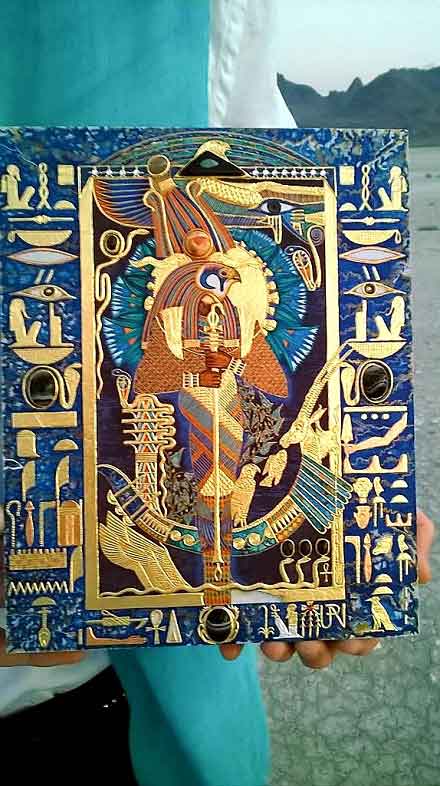
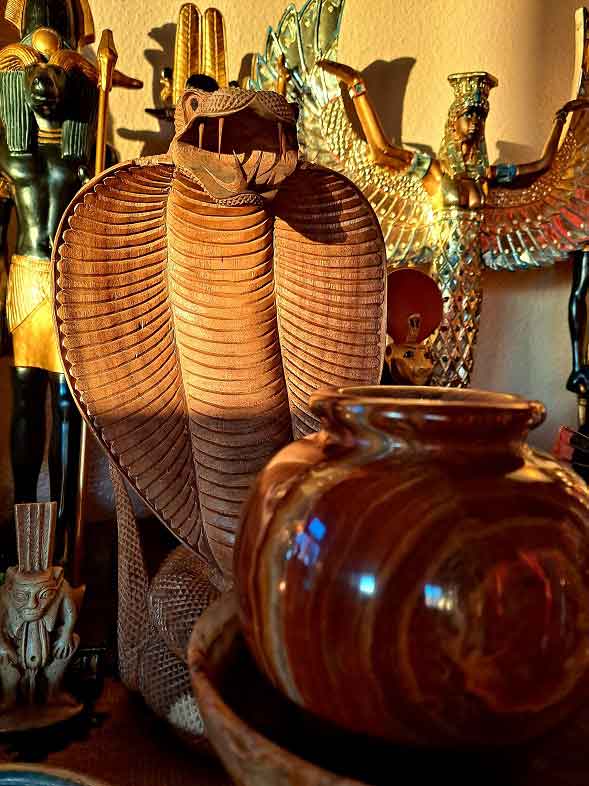
Top: Ptah-Sokar-Ausir Lord of the Secret Shrine, the Cobra-Goddess Wadjet on the Shrine of the Household Gods (below);

Why are westerners attracted to ancient Egyptian polytheism, and how can they approach its Gods in traditional ways? How is your work as an iconographer representative of that?

 Ptahmassu Nofra-Uaa: Speaking from my own experience and connections with other Kemetics, it is the netjeru, the Goddesses and Gods of Kemet, that spark a deep fascination and move people to investigate ancient Egyptian religion- called Kemeticism by many of its adherents. I think this comes from some primordial reaction to the iconographic forms Egyptian deities take in ancient images people are exposed to at a young age through the mediums of film and blockbuster exhibitions of Egyptian artifacts. The bimorphic- half-human, half-animal- representations of the netjeru provoke strong reactions that nonetheless attract as very natural ways these Gods communicate the scope of Their powers, and these are forms that touch upon people's attraction to the natural world, to its creatures and what these animals embody. One might think that the very alien appearance of ancient Egyptian deities would work against westerners being drawn to Them, seeing as how everything about the netjeru is so far removed from the mainstream Christianity prevelent in the west, but it is by virtue of Their unusual forms in iconography that people are intrigued on a very deep level, which makes them want to understand why that fascination is there in the first place.

As I said before, Kemetics tend to be fiercely attracted to their Gods, loyal to Them because there is a powerful sense that these Gods want to connect, want to be present in the lives of human beings, and intervene directly in the lives of Their devotees. I think many Kemetics felt those things quite lacking in their experience of monotheism growing up, and so many Kemetics I've talked to express this conviction that their Gods manifest tangible signs and messages through daily life experiences, and this is definitely nothing new in the history of humankind's interaction with these Gods. The historical record is full of monumental inscriptions, letters, stelae, and ex-votos describing encounters with the netjeru through life events or boons granted by the Gods as an answer to prayers. Something the netjeru are not is removed from Their creation, distant from humankind, or unconcerned with the maintenance of the material world.

My work as an iconographer has evolved from a number of factors present in my spiritual life. The first of these comes from the nature of my Patron deity and namesake Ptah, Creator of the material world, the Gods, and all living things, and patron of painters and craftspeople. Something that tends to happen in Kemeticism is that devotees are attracted to the deities that embody the prominent characteristics present in themselves, so my attraction to Neb (Lord) Ptah was most natural for me because of who He is, and how He manifests the excellence of divine craftsmanship in the arts. In what has been referred to as the Memphite Theology, recorded on the monument known as the Shabaka Stone, it is said that the Creator Ptah gave form to all things by speaking them into existence, and that He placed the Gods in Their bodies of wood, stone, and clay; so it was the God Ptah Who created the divine images of the Gods, Their cult statues or idols, and established the worship of the Gods as it should be conducted by human beings.

Fundamentally, one of the most traditional ways Kemetics can come to their Gods is through the veneration of the netjeru in Their traditional iconographic forms. These are forms that have a tremendous buildup of power in them due to their continuous use as cult images over a period of more than five-thousand years, and the same can be said for the ancient prayers, hymns, and ritual texts offered to the Gods in worship. These are tools for proper religious engagement that Kemetics use to maintain the sacred threads of connection established by the Gods Themselves at the very beginning of recorded history. But the iconography of the Gods is quite significant in our worship because these are the actual forms the Gods entered when They first entered material forms, and these are the forms They are attracted to. Since our religious life is grounded upon our connection with the Gods as living beings, it follows that maintaining the presences of the Gods in sacred spaces is to our benefit, and the way we accomplish this is through the maintenance of the sekhemu or power-images, the cult images or idols, our mūrtis.

One of the most important aspects of my work is the actual ritual process I have assembled from ancient sources as the cultic framework sustaining each part of a God-image's creation. These are the prayers, hymns, ritual utterances and gestures, offerings, and pilgrimages accomplished for every stage of the work, which is executed in a highly controlled ritual environment where standards of divine purity are maintained throughout. The work I do is not decorative art or art expressive of my personal ideas or experiences, but is rather a divine framework for receiving the actual spiritual essence and powers of the Gods, Who possess or inhabit sekhemu as the beneficiaries of the Divine cult. This concept of Divine images is instantly recognizable to practitioners of Sanātana Dharma, who would never refer to a mūrti as a mere work of art, but understand that idols are awake with an interior life provided by the presence of the deva inside it.
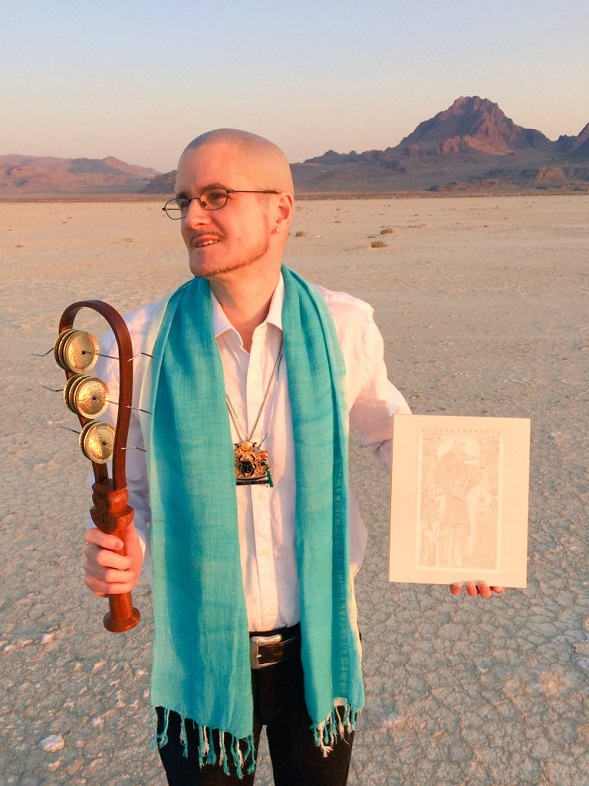
In the desert with the icon Anpu Lord of the Sacred Land in progress

What are the challenges to indigenous polytheism today? How can we preserve it?

 Ptahmassu Nofra-Uaa: The biggest threat I see to indigenous polytheism is the missionary work of evangelical Christianity, which is just another form of colonialism; Christian organizations spending large sums of money to sustain the work of missionaries abroad, whose sole aim is to convert a populace from its indigenous traditions to Christianity. This is insidious, pervasive, and the most effective way to eliminate indigenous polytheisms from the face of the earth. There are any number of approaches one could take to heal the effects of this epidemic, but I'm going to answer this question from my own personal experience, from the point of view I have as a devotional polytheist and iconographer.

The strength of Sanātana Dharma in India is rooted in its strong religious communities, and these communities are sustained by their gurus and āchāryas, priestly traditions and ritual specialists. At the heart of this community network are the temples, and at the heart of the temples are the devas in Their mūrtis. It is India's intimate relationship with Her Gods that has sustained the power of the Dharma as a way of life passed down from generation to generation; these are the Goddesses and Gods Who have protected and nourished India from the beginning of history, and generated a line of enlightened teachers stretching down to the present day. Without its Gods, without its temple institutions, without its priestly traditions and ritual specialists, without the mūrtis that give a tangible home to the devas at the heart of religious communities, there is no hope for indigenous polytheism to continue in India. Indigenous religious communities can only be strong if their sacred institutions are strong, and their values are being supported by qualified teachers and specialists who carry out the worship of the Gods correctly. Correct worship of the Gods means establishing right relationship with the Gods through the activities required by the Gods in order to maintain Their bonds with a specific community. The maintenance of right relationship with the devas is essential for the legitimate operation of any temple, and a fully functioning temple is a requirement for carrying out the work of the Gods correctly. All of these things go hand in hand, and if any link in the chain is weak or functioning improperly, or missing altogether, the system will collapse.

What needs to happen for indigenous polytheisms to survive is a complete resistence to the spread of Christian evangelism by strengthening temple institutions and the religious specialists tied to those institutions. In the case of the Sanātana Dharma, this means the preservation of the temples and the resuscitation of defunct temples as the centers of community life and propagation of the Dharma. I was recently told by an Indian woman living in a small town in India that the once-thriving guilds of sacred craftsmen responsible for creating mūrtis were becoming lax in their specialist knowledge and devotion, and were beginning to disband. This is certainly a concern, because the creation of divine images according to strict ritual procedures is the only way a temple community can ensure the establishment and maintenance of right relationship with its gods. Without right relationship with the Gods, there is no divine life in a temple and no outpouring of boons as a result of sacred activities; so the crux of the matter is the preservation of the traditions responsible for sustaining religious communities the right way. This has to take priority for indigenous polytheism to survive.

Something I would like to see happen is the creation of some kind of support network- both online and offline- for sacred artisans, iconographers, and religious specialists of various polytheist traditions to share with one another, encourage one another's activities, and compile precious data concerning the materials, methods, and philosophies vital to the maintenence of right relationship with the Gods. Who is going to carry on these traditions in the next generation if this knowledge isn't preserved or prioritized for transmission? This means a willingness to cooperate and see traditions not as a luxury or cultural curiosity, but as a vital aspect of humankind's sacred development and relationship with its gods. Once this information is lost, it might be gone forever, and I know this only too well in the case of my own tradition because I am attempting to put back together the pieces of a very fragmentary puzzle in order to serve my Gods authentically and correctly. My work as an iconographer is grounded wholly in the purpose of establishing ties between the Gods and humankind, and to strengthen those ties through the correct ritual procedures and images. If our sacred relationships have any value, we must struggle to offer our best in each moment, and sustain our efforts not only for ourselves, but for those who come after us.
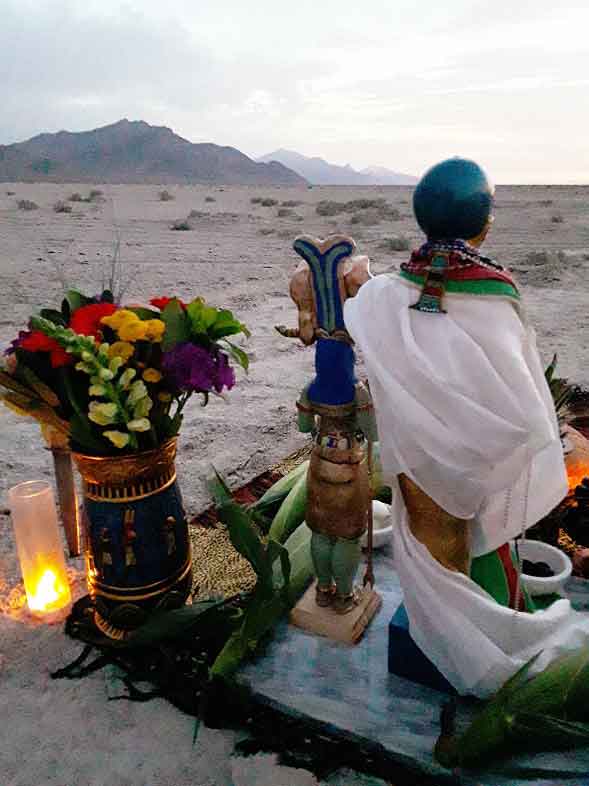
Idols representing forms of the God Ptah greet the sunrise in the Northwestern Utah desert, US
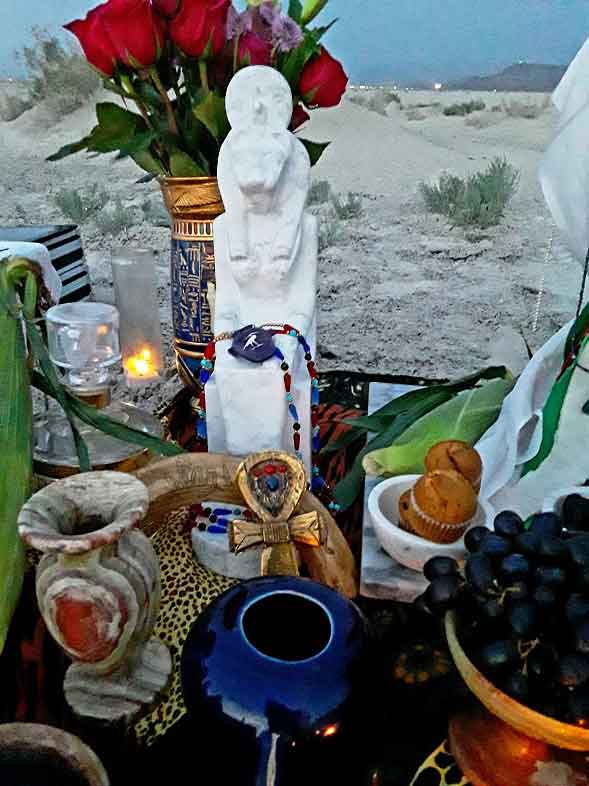
 How does nature worship continue in these traditions? Is it among a minority?

 Ptahmassu Nofra-Uaa: It is evident to me that India possesses a reverence for the Divine as expressed through the natural world that is virtually absent in the west. India has a very rich history of recognizing the powers of the devas in specific rivers, mountains, caves, and natural sites, and the experience of these is very much a part of the history of Sanātana Dharma as I have studied it. This kind of history exists in a similar way in Egypt in regards to the Nile River, the cataracts in the south, specific mountain peaks, and species of trees that were venerated by the ancient Egyptians as places where the Gods dwelt or places where the Gods were apt to demonstrate Their powers. One can see in the iconography of Egypt the predominant features of the natural world- plants and animals- utilized as embodiments of the Sacred, as manifestations of how the Gods transfer Their boons to the material world. These same features are very prominent in the Sanātana Dharma of India, which are also expressed in terms of pilgrimage to natural holy sites, such as the Gaṅgā Herself, Whose waters are venerated as being the divine source of purification from sin.

 The majority of Kemetics today are practicing their faith outside a Nilotic context, which means that our sense of how the netjeru use the natural world to communicate Their presences to Their adorers has changed; because we are no longer in the physical environment native to our faith and its unique iconography. But something I've noticed in some Kemetics is the transference of the mindframe of sacred geography from a Nilotic to non-Nilotic context, as in seeing whatever natural environment they happen to live in as having qualities connected to specific gods- in a manner similar to how the ancient Egyptians viewed their landscape as sacred. This kind of transference of mindframe (which I call thinking Kemetically) is something I rely on heavily in my own spiritual practices and work as an iconographer. Since I live in the middle of the desert, in natural surroundings not unlike Egypt's Western Desert, it is easy for me to view the natural world around me through the ancient Egyptian lens that sees the mountains, sand, caves, and lonely stretches of barren land as imbued with the dynamic powers of the living Gods.

Through my work as a Kemetic priest, I have been able to recognize the patronage of specific deities resident in our landscape as local deities, and establish sites for pilgrimages and rituals where these deities may be venerated through Their traditional Kemetic rites. These are also places where the God-images I craft may be brought on pilgrimage to receive Divine empowerment, and absorb the sacred powers inherent to this holy landscape. Within this system I have developed over a period of many years, the veneration of nature is part and parcel of establishing right relationship with the Gods, Who move through nature without being subject to it or contained within it. The netjeru have always chosen specific plants, animals, and features of the natural world to demonstrate Their powers, and this includes rain, wind, storms, and changing weather patterns. These things show the human condition that the Gods are where we are, that They are living Powers that touch us directly and engage physically through the world we recognize as our own.

 I would like to think that nature worship- veneration of the Sacred that transmits its boons through our natural landscapes- is not destined to be a passing footnote in the history of religion, especially when we consider how many of our natural resources we have destroyed because of our greed and shortsightedness. We have anihilated entire species, and laid waste to portions of our planet, which might in some cases be irreversible. There are some who feel, perhaps, that nature worship is part of superstitious practices that belong in the past, but something I recognize as the invaluable lesson of nature worship is the recognition of value beyond the human condition, that our earth and its species are our mother and father, the true custodians of our species, and the only chance we have for a future. What happens when we've decimated our planet and the delicate ecosystems that belong to it? Then we have murdered our own future. Sanātana Dharma has always championed the rights of the natural world by asserting the sacredness of all living things, not only human lives, but all life, all aspects of creation. From the smallest insects to the largest mountains, from massive river systems to seemingly insignificant streams, the Dharmic view is that these are sacred presences which require respect and preservation. Human beings are not the only precious lives.

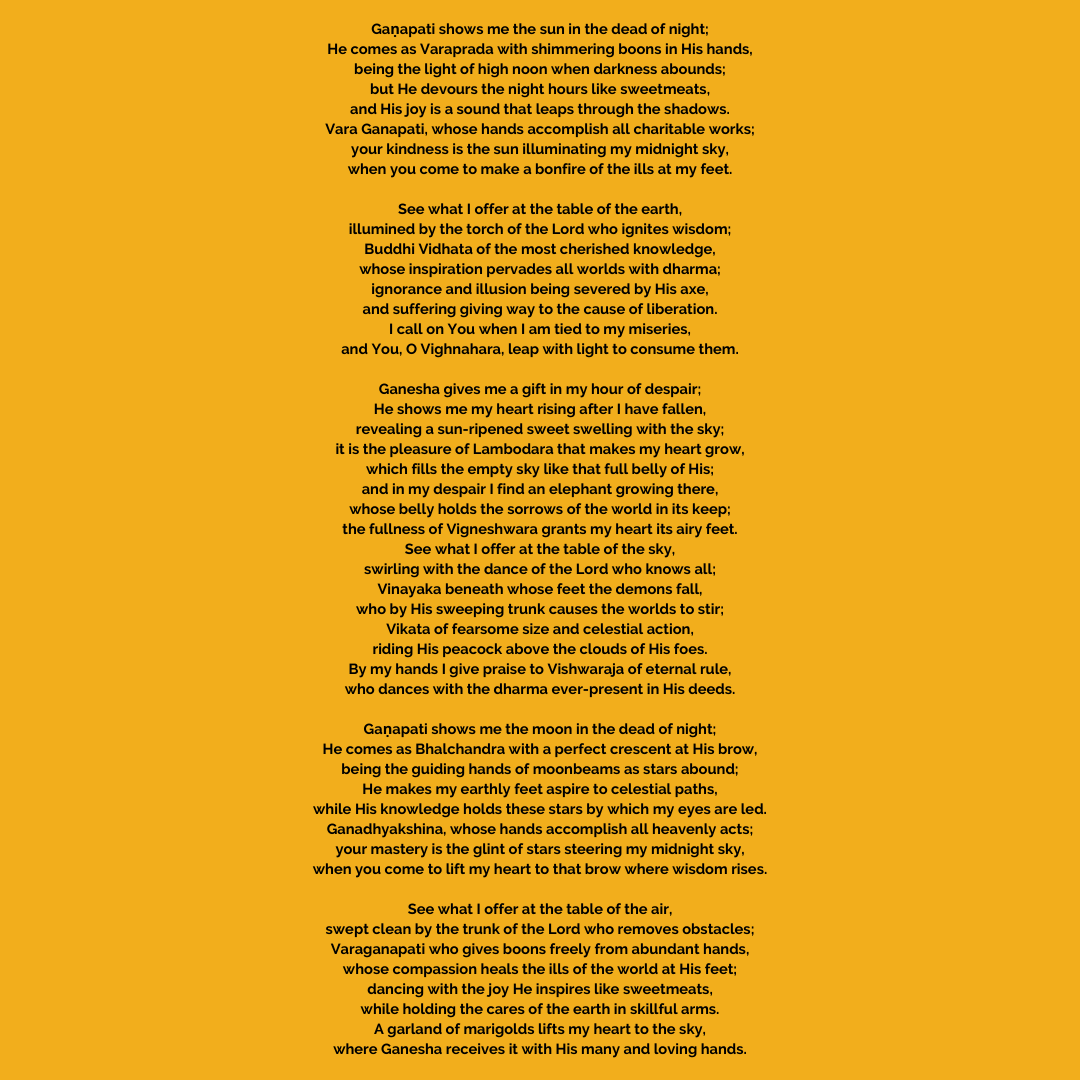
Marigolds For Ganesha / I Offer At the Table of the Air by Ptahmassu K.M. Nofra-Uaa
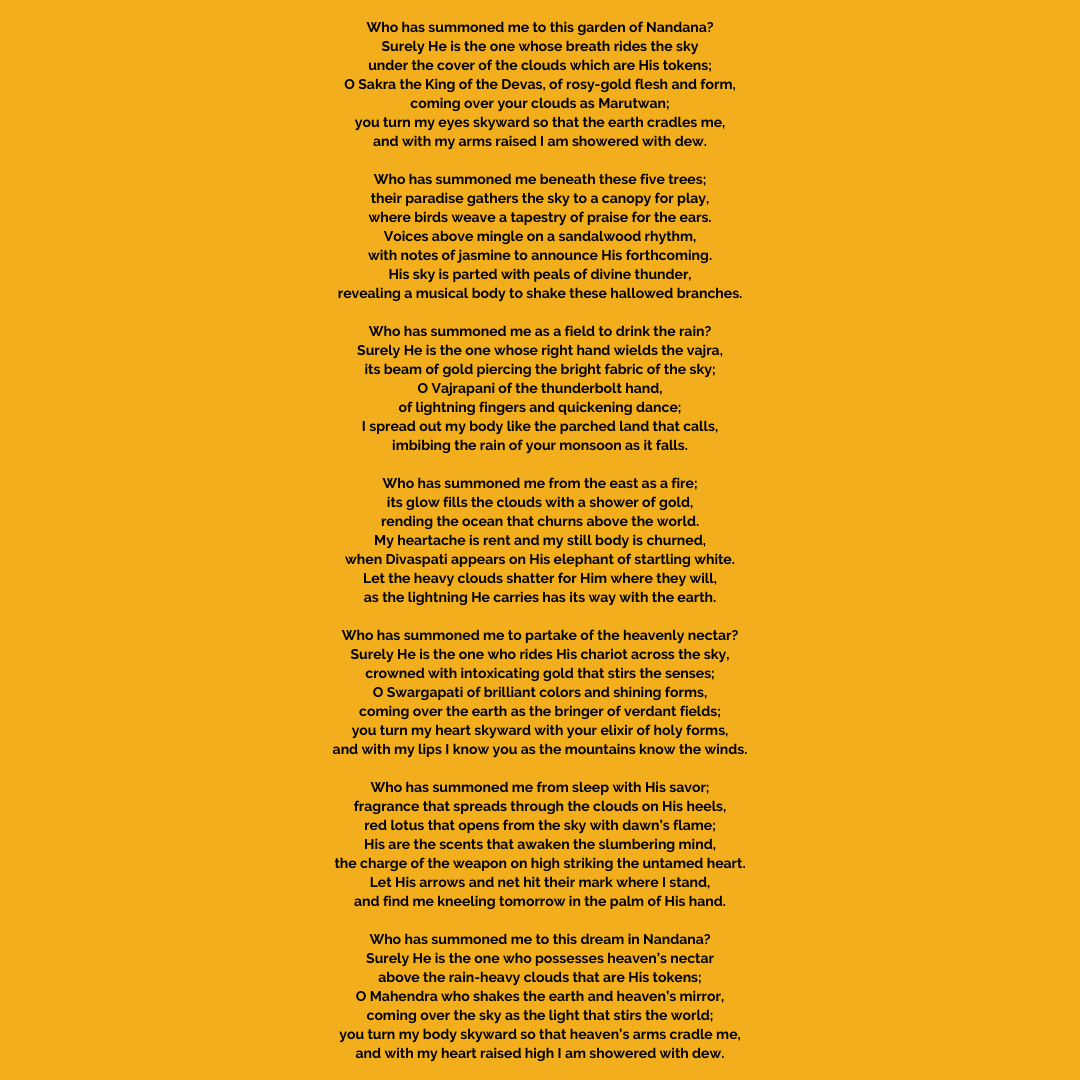
Who Has Summoned Me / Surely it is Mahendra By Ptahmassu K.M. Nofra-Uaa
430 Years of Hyderabad: Living Innovation

The Year 2021 is special for  Hyderabad and Secunderabad as the twin cities complete 430 and 215 years, says Dr Andrew Fleming, British Deputy High Commissioner to Andhra Pradesh and Telangana. Based in Hyderabad, he speaks about the soft power potential of the Telugu speaking region in Education, Tourism, and Tech and Life Science. He compares Hyderabad to London, saying both cities are a melting pot of cultures and have an eternal sense of mystery.

Dr Fleming, you have spoken about your fascination for maps in your childhood. Does this continue today?

Maps were my escape as a child. I had, like many children a strong imagination and I pictured myself in so many far off places with the bazars of India being one distinct memory going back to my primary school days. So with that experience, maps remain important to me – there are three hanging in my home, one from the 1700s; and many books on maps to be found on my rather haphazardly arranged book shelf. In recent times, I have even learnt to use Google maps properly but if truth be told, I am a bit of a luddite and I like my maps in print!

What according to you is the best launch vehicle for diplomats in making a contribution to international relations? How would you grade the College of Life and Travel versus elite Universities and government training programs?

My journey was far from conventional and so I cannot make the comparison you ask. I did not attend any university and my Honorary Doctorate was a very recent thing that made my father so proud. In my acceptance speech, I spoke about my route to Diplomacy and told that I was a graduate of the University of Life. In the UK, this is still possible – you can enter the Civil Service at the lowest grade and rise to far higher levels than I have. There are a few examples of more senior colleagues than I who did this now heading Sovereign Posts and I make no secret of my ambition to follow in their footsteps if possible. However, the vast majority of our top diplomats are the products of some of our nation’s best universities, our new High Commissioner to India for example, Alex Ellis, was at Cambridge.

Going to University does not preclude travel – we both happen to have spent times in our teens traveling (and indeed in Alex’s case working as a teacher) in India. Because of being at work from 17 I was able to travel once or twice a year but for relatively short times – many university students have the chance of longer overseas experiences but by 30 I had been to over 60 counties learning and taking something from each (now the running total is 115). I think whatever the background people have, a good diplomat will be someone with a genuine interest and curiosity in the world. I had a wonderful job once where I was given license to wander around West and Central Africa building contacts and relationships on a specific theme. I think I was well suited to that because of my experiences and interests and it reflected in what I achieved – it was front line old school ‘expeditionary diplomacy’ which these days, in the same region, would probably not be possible in the same way.

And by working at every level of my service (I did not start in the Diplomatic service) I think I have an empathy with junior colleagues that can be very hard for those who have entered at a management level to entirely replicate. This has served me well in all my jobs. But I equally see the benefits that a far higher level of formal education have given some of my peers and seniors. The bottom line is my organisation - Foreign, Commonwealth & Development Office (FCDO) embraces diversity and makes it possible for people to progress based on their skills and talents – I am very lucky to be part of that.

And here in India of course, a nation has produced excellent diplomats like recently retired Syed Akbaruddin the pathway is different for aspiring diplomats but clearly, from all I have interacted with, it works very well too.

Were you given a choice of posting? Could you share your first thoughts about Hyderabad.

Hyderabad, as a place I wanted to visit, first came on my radar in the 80s when I saw an image of the Charminar and was so intrigued I started reading about it. However, I will confess I did not know there was a British Deputy High Commission here until I read the job advert. Within a day I had spoken to the then post holder and decided I wanted this position. I applied, was successful, and first visited Hyderabad in 2016 having secured the role. It was a bit of a blur, but I went to see the Charminar – then still circumvented by traffic.

When I returned in July 2017 to take up my post I felt welcome and at home from the moment I set foot in the city. I had done as much homework as possible and it really paid off. There are - in my mind - two types of cities – the one that has the listed sights you can marvel at and then say you have ‘done’ and the type full of hidden secrets waiting to  be discovered, a place where the more you see and know the more you realise you don’t know much at all. Hyderabad I realised immediately was like that and from my arrival until now the discovery continues.

Having travelled around the world, which cities would you compare Hyderabad with? 

I always compare Hyderabad to London because, both cities are what I have described in my last answer. Also they are both incredibly cohesive – a melting pot of diverse cultures and faiths. London has a resident of almost every nation on earth, Hyderabad did not compete in that way but, as one of the world’s fastest growing cities, it has residents from every state in India and people representatives of the many faiths of this great nation. And what both cities have in common is that when they celebrate a festival- be it Hindu, Muslim, Christian, Sikh or otherwise, people of every other faith are (outside of pandemic times) likely to come out and join in. I just love this fact!

What are the areas of partnership between UK and India which have been a focus for you?

Before the UK had a Deputy High Commission serving erstwhile Andhra Pradesh we had a Trade Office here in Hyderabad, established around 2005. And our relationship on Trade and Investment between this region of India and UK remains an important priority. The Tech and Life Science sectors provide a platform for many collaborations between our my nation and the Telugu speaking region, be it between top end companies, obviously including in the response to COVID-19, or providing soft landings for Start-Ups. We continuously and proactively work on all of this. One of the latest outcomes was an MoU signed between that wonderful incubator, WE Hub (which by the way affords the best view of the new city) and Bolton University which was witnessed by both my Foreign, Commonwealth and Development Office Minister, Lord Ahmad and Honourable K.T. Rama Rao garu, is one of the latest milestones. There is a lot more work in the pipeline so follow our UK in Hyderabad Twitter handle to keep in touch.

I want us to make more progress in other sectors like Aerospace and Defence, as well as the Creative Sector and AgriTech sectors. On the latter, we are also looking to deepen our collaboration with ICRISAT, a UN institution that leads the scientific vertical of food security in the semi-arid tropics and is a top class centre for research in this area.

On top of this there is Education, the primary remit of British Council, and Climate Change which is a top priority for my government which will host COP26 at the end of 2021.

Were you able to discuss any new cultural initiatives with the new High Commissioner of the UK to India during his recent visit?

Most of our cultural activities here in India are primarily led by the British Council. The current pandemic makes physical cultural activities difficult to plan at the current time. Yet, it is hugely gratifying how people remember what we have done. The last major cultural initiative saw Anoushka Shankar accompany the film Shiraz: A Romance of India on her sitar. It was a magical evening, it was also the first charged event we ever did in the city. 2000 tickets went in hours and the organisers said they could have sold 10 fold. It shows the appetite that Hyderabadi’s have for culture and I hope we will bring more once global circumstances permit.

Even a decade ago the digital divide between India and the West was very huge. Would you say that since then India has made huge strides in digital access and empowerment?

Yes, undoubtedly this has been transformational and there are greater experts than I who can set out the detail.  However, as a force for good it has helped many people improve their business and their status.

One thing I do notice here is how women and girls tend to be disadvantaged in accessing and harnessing the new opportunities the digital age offers. This is especially evident when I work with partners like ‘Voice 4 Girls’ who do such amazing work with poorer communities.

Also, the digital age opens up new threats of Cyber Crime (a topic the Lord Mayor of London raised when he visited in 2019) as well as the risk (again more impacting women and girls) of cyber based bullying and harassment on which I am in touch with the leader of Women’s Safety, Swati Lakra and another NGO active in this area, Tharuni.

Suffice to say this is another area we are always open to collaboration and potential partnerships as an office.

How would you rate Hyderabad in terms of entrepreneurial opportunities for start-ups and foreign investment as well as for ease of business?

The start-up eco-system and levels of State Government support for it are phenomenal. I recently heard that the city has no less than 76 incubators, accelerators and other verticals designed to aid and support start-ups. I doubt another city, even Bengaluru which claims the most actual start-ups, have more. Innovation which Hyderabad lives and breathes is picked up upon and embraced by all my visitors and the community has weathered the pandemic quite well – indeed many have made new global connections due to the different ways they have been forced to work. It all makes for an exciting future.

On Ease of Doing Business, Telangana has been a consistent top end performer ranking first or second among states across India throughout my time here. I try to ensure that those serious about doing business in this state hear the state’s own narrative first hand from IT & Industries Principal Secretary or a colleague and I believe, without exception, they have been impressed by the offer. I can point to many who have gone forward with their plans on that basis and been equally satisfied with the reality. I would add that my office have been working with the state on Ease of Doing Business for some time now and I hope this will continue.

The UK has consistently ranked high in Soft Power rankings. What are the areas in which you think India's Soft Power mechanism can learn from the UK's strategy?

The UK draws some its greatest soft power strengths from education where we have one of the best offers in the world and culture including our film and artistic industries and sport. I think UK’s success is about recognising and focusing on what it is good at.

For India, culture is also a stand out pillar and let us not ignore that India’s increased support for climate change evolved far more through a cultural based persuasion than a scientific one. Are there countries to which this narrative is now exportable, I think there are. I think India is good on digital too, another measure in the ranking system. It can focus on improving, there is always scope to do better.

Longer term, India does not do as well on attracting foreign students to study here and whilst I am very up front about the UK offer, I do personally feel that it is when in University that young people have perhaps the best opportunity to experience another country. Over the years I have seen the number of young people from the UK opt to study in China, be it for a semester or an entire course. A lot less come to India, I think there is a need to look at this, understand why, and try to address them. India is on an upward trajectory and the global value of people who understand India and how it works is on the rise. There is huge potential here as it is also in India’s interests too, to have a greater international community who understand and identify with India, and that is only possible to be spending at least some time living here. I think it was China’s strategic approach to attract global students that has previously improved their ranking but with the synergies and connections between UK and Indian institutions there is scope to learn from out education sector in taking such a strategy forward.

What according to you are Hyderabad 's strongest soft power attractions. Do you think it's being harnessed effectively?

I have mentioned culture and digital and these are the two stand out areas for Hyderabad. The cultural one is not yet projected as effectively as it can be; I have talked already about the uniqueness of this city and what it has to offer. It has a unique history and identity that it could be a lot more forthcoming in amplifying. 2021 is actually a special year because the twin cities of Hyderabad and Secunderabad are 430 and 215 years old respectively. The opportunity to capitalise on this has perhaps never been so great from a soft power perspective and although the pandemic is a significant reason, I would love to see those in charge of the State Tourism Ministry give some creative thinking to what might be possible to attract more international interest from mainstream and religious tourists.

Hyderabad’s digital credentials are definitely strong and are much of the reason why Telangana has such consistently high ease of doing business rankings (I acknowledge Andhra Pradesh is another star performer). And tech innovations continuously improve quality of life and the presence of the world’s largest tech companies with their largest international offices in this city are bringing billions of dollars’ worth of investment into the city.

Erstwhile combined Andhra Pradesh was among the top states sending students to the UK to study. Do you think the recent Oxford University incident will be on student's minds when they look at the UK as an education destination?  

It is not for me to comment on the details of individual incidents about which much has been written but I do not know the details. But in answer to the question of impact, Indian students going from the UK to India  has increased dramatically since my arrival in 2017. In the calendar year of 2020 almost 53,000 Indian students received visas to study in UK, a 43% increase on the previous year.  With the commencement of our post study graduate immigration route in July 2021 I am confident that this upward trajectory will only continue, direct enquiries from my contacts with a desire to send their children to the UK has increased exponentially since my arrival and the many who have returned in this time have been delighted with their experience.

What are your fondest memories so far of Hyderabad? How is the city to be experienced?

In every country I have lived, people have been my fondest memory and so is the case here. I love many other things about the city but if you analyse what make a place, it is for me, always the people that bring it to life and make it special. In Hyderabad the warmth and hospitality, the genuine interest in my country and my family, the desire to show and share with me every facet of this incredible region and so much more that stand out.

The city is to be experienced (like London) in small parts and with the company of knowledgeable locals who can introduce you to so much more than the eyes first see.

How friendly and comfortable is South India for non-Indians.  What are the things your family likes doing here together?

I think Hyderabad and the wider Telugu speaking states are incredibly friendly. I love going out and exploring the countryside and I walk most Sundays somewhere outside the city. Often the family join me in part or in full. And of course we have enjoyed some trips, one of our favourite being to Hampi which must be one of the most underrated tourism experiences in the world.

Devaratham – A Ride Down the Road of Indian Bhakti

On the auspicious day of Paguni Uttiram in the last week of March, the Lord of the worlds is taken out in a procession with his consort across temples in South India. The purappadu for the divine couple by the devotees goes on for hours, sometimes the whole night. Across India from Thiruvarur to Tirupati to Puri, this magnificent display of bhakti as people shoulder the Lord has been captured in a new book.

In his book Devaratham, a Study of the Temple Cars of India (published by IGNCA), Dr Susil Pani has put together his labour of love on the chariots of India. It is said that these chariots were made in Dwapara Yuga for the first time and the ratha uthsava observed. “In the period before that the uthsava murtis were seated directly on their vahanas and carried by men. With passage of time the rathams came into the forefront for major uthsavas like Brahma Utsava when the uthsava murthi was placed on the ratham with elaborate decorations and pulled along across the village and the temple,” writes Stapati Sri K Rajamani in the book.

India has the largest and oldest temple chariot (Devaratham) processions in the world. Dr Pani quotes the introductory verse of the description of the devaratham in the Vishnutatva Samhita:

Ratham devamayam virpa sarvademayamm thatha

Sarvayajnamayam…

(The ratham is the embodiment of the god, an embodiment of all gods,

An embodiment of all sacrifices)

Rathas are mentioned in the Vedas, our Rishis considered themselves to be chariots and their verses their chariots.  In an interview with CSP, he says rathas were important during this period. “A great detail description is there in the Vedas, particularly in the  Rigveda  describing the parts of the ratham. Ratham and vahana are used sometimes interchangeably. The deities identity is established by its vahana (ratham) used. Example is the bull or Nandi is for Shiva. But remember that the vahana had no identity of its own, but was a portion of the deity, in other words it drew its powers from the deity, hence Nandi is also known as Nandikeswara, the one who draws his powers from Eswara or Shiva. The symbolism of the ratham is aptly described in the Kathaupnishad comparing the human life on earth. The body is the physical ratham, the mind is the chariots sarathi, the soul is the rider or deity seated at the center, the whip the vital being and the final destination is the union with the  Divine. Rishis did extreme tapasya to acquire rathams from the deities  whom they worshiped or the powers associated with the deity, hence they could carry themselves to different worlds.”

Dr Sachchidanand Joshi, IGNCA, writes in the preface of the book that the Rig Veda uses the term ratham more than a thousand times, “along with a complete description of the components of the ratham like rathamokha (face of the ratham), charam (wheels), etc. The Sulabha sutras describe the methods and measurements in the art of making the devaratham. In the Puranas we have detailed descriptions of the rites and rituals for the consecration of the ratham known as Ratha prathistha vidhi. The epics Ramayana and Mahabharata have descriptions of the rathas.  The most popular being Sri Krishna giving the knowledge of the Gita or Gitaaupadesa to his Sakha Arjuna.”

There are terracotta seals found in the Indus Valley depicting carts and almost every temple of antiquity today has rathams. The Konark temple is a giant chariot to the mighty Surya. The Vithala temple in Hampi is testament to the generosity of Krishna Devaraya towards temple activity. The largest and most spectacular cart festival today of Lord Jagannath of Puri, Orissa.

Dr Pani writes that the devarathams were replicas of the Devalaya or the temple and so there is a striking resemblance between them. “The height of the temple is in a fixed multiple of the height of the Moolavar or main deity. The same principle is used for the ratham; the height of the ratham is in a fixed multiple of the height of the uthsava murti. The height of the uthsava murti is also in a fixed ratio or proportion of that of the main deity. Similar to the temple, the ratham has an Upapitha, Adhisthana, Pada, Vimana, Sikhara and the stupa.”

Dr Pani points to the amazing scientific perceptiveness of our forefathers. He says the stability of the ratham (which weighs tons) is to be “attributed to the principle of unity, balance, distribution of weight, and proportional system as described in the scriptures. It provides both static and dynamic stability. All the elements of the ratham are interlinked to hold in position the ratham while stationary or while moving during the rathayatra and ratha uthsava. In addition to rings and nails, square shaped iron rods are placed strategically passing through from the platform to the base of the ratham to prevent the components of the ratham from disengaging during movement. The panels have holes or slots cut into each section which fits into the next section. There is just enough space between the panels and other parts to allow minimum movement and expansion due to exposure to moisture and sunlight.”

(Pic by Dr Susil Pani)

Wood was the preferred material by the sthapati to make the vahanas. “Due to the high cost of teak wood, other woods were used ike Mavilingam, Karrungal, Red Sandal, Nuna maram, Pala maram, Asthi maram, Manjanathai maram and Ellupimaram.” Dr Pani adds that a few temples have chariots made of gold and silver, including the Manakula Vinayaga temple in Puducherry. The Vitthala temple has a stone immovable ratham.

The author provides great detail on the movement of the rathams when it is taken out it procession. The teirtheru or car-street is usually as square around the temple, so that a complet parikrama is made of the temple. The four streets symbolise the four Vedas. “The devaratham is usually place opposite the east gate or gopuram facing south and the place is called as “Theiradi”.

Travelling from Madurai to Puducherry on work (he is an ophthalmologist), Dr Pani would see the ratham at Villianur in the outskirts of Puducherry. In 1996 he began taking pictures and documented all the three rathams of the temple in detail.

He researched the shastras to find out the minutest of details. “There is a separate manuscript for the ratham called as Viswakarmiya Ratha Laxanam, originally to have been written by Vishwakarma, the original is available in the Saraswati Mahal library in Tanjore,  which deals exclusively on the ratham.  Ofcourse the panels in the rathams depict the deities, epics etc in the temple and have to follow the norms set in the Shilpashastra.”

Kandarpa Ratham: Sri Krishna and Sri Radha in divine love at the center and the whole universe in the form of a ratham formed by the devoted gopis playing musical instruments and forming the parts of the divine ratham. Patta chitra painting from Odisha (Pic by Dr Susil Pani)

The ratha is often described as a devalaya and the deity is believed to be absent from the main shrine when the Utsavar is out. Dr Pani says, “The actual deity is absent from the  main shrine truly only in one place, the Jagannath temple. Hence, only in Puri no puja is conducted inside when the Lord is taken out. (Symbolically) In all other places, a replica called utsava murti made from bronze is taken out in procession.  In South India, only in Chidambaran Nataraja temple, the main deity is a bronze murthi which comes out for the rathyatra, another speciality is that Nataraja comes out twice a year.”

The introduction of the book traces the origins of the temples cars referring to a variety of rathas including devarathas, sangramik ratha, karni ratha etc. Information found in the agamas and shastras have been compiled and presented. The book also looks at the relationship between the temple and the ratha. The measurements, rituals and other details point to the brilliance of ancient Indian sculptors and architects.

Celebrating the New Year with Conscious Indian Food and Cooking

Indians celebrate their New Year very differently from the rest of the world. For one, the festivities begin very early in the morning, with prayers to Ganesha. Lakshmi Priya, who comes from a lineage of restaurateurs is all set to celebrate Tamil New Year next week at her farm - Alankar Organic Farm - in Pollachi in Coimbatore.

Lakshmi’s restaurant Sree Vidya meals in Ramnagar in Coimbatore, which serves authentic Kongu Nadu vegetarian lunch meals only, is temporarily closed due to the pandemic. She will however be cooking and serving a traditional meal on that day as she believes the Tamil New Year’s day is an auspicious day to start a new journey.

Using  cold pressed oils and only seasonal fruits vegetables and millets and rice grown in their farm and locally sourced has been their mantra. Her menu for this occasions eliminates all processed food - so no white sugar - and includes the organic produce from her farm.  It also combines all the five tastes with a twist - pineapple  (pulippu), palm sugar (enippu), neem flowers (kasappu), salt (uvarppu), chilli (karam) and tamarind (thuvarppu).

Lakshmi says conscious cooking for her is a “wonderful experience which brings together all the senses in harmony with the cells in our body - where we see, smell, taste, feel and hear!” the sounds of cooking. Above all  “cooking with a positive and a  happy mind is the essence of conscious cooking.”

She lives life in the peaceful lane with green fields and a one acre pond dedicated to rain water harvesting and her papaya trees to the Great Indian Hornbills who come to pick the fruit.

Lakshmi Priya at her organic farm

It is indeed a blessing, she says, to get up early in the morning, and work in the kitchen “with a calm mind with the joyful intention visualizing a rainbow in your kitchen. Knowing you are blessed with this unique talent of preparing a simple, nourishing and a soulful meal. It is a new journey every single day which not nourishes not only your body and soul but  also that of the people you serve heartfully.”

Lakshmi cooks for a varied group of people starting from farmers, to the farm labourers, to the people who work with the utensils and knives and and also to those who bring in even a single ingredient we use in our cooking.”  I am consciously grateful as i cook to the varied people starting from the farmers ,to the farm labourers, to the people who make the utensils knives  and to many more who bring in a single ingredient which we cook with .

Lakshmi’s inheritance includes the time spent with grandmothers who have passed many precious ancestral recipes as well as the know how of cooking which have been  part of their daily life.  “All the women  cooked with ingredients sourced locally and most importantly seasonally.

They did not have a dilemma about the menu or confusion about what was to be done and their simplicity was the foundation of that wisdom.”

Peanut podi urundai to be mixed with hot rice and cold pressed ellu ennai (sesame oil)

Cooking was an everyday ritual for these women and “they could easily rustle up a meal for any occasion or festival. Even the simple morning sukku kaapi to the nightly turmeric milk with crushed pepper before bed, cooking was an enjoyable every day ritual,” says Lakshmi.

Lakshmi’s grandmother Rajalakshmi aatha (term for paternal grand mother) was a staunch vegetarian while her other grand mother Alamelu ammayi (term for maternal grandmother) taught her to cook meat based dishes. She says both were unique in their own way. For several years, Lakshmi provided consultancy for family run non-vegetarian restaurants in Chennai, until she turned to vegetarianism for health reasons.

Hibiscus tea

Her father was diagnosed with an auto immune condition causing rheumatoid arthritis for which allopathy doctors said he had to take steroids for life. “Only when your cells cannot fight an infection does it become a chronic illness. I realised that food is the only medicine fr the body.”

Lakshmi started her research into auto immune causing foods and foods which cause inflammation in the body. The worst offender was meat. When another family member was diagonsed with another painful auto immune condition, they almost reversed the condition with only a plant based diet. That was when she turned to vegetarian and vegan cooking.

She prepares “nutrition dense cooking. Any thing interfering with nature is destructive including cooking. Keeping most of our food raw is an amazing practice, but Indian vegetarian cooking is a wonder,” that combines eating the food raw and also cooked, she adds.

For more than three decades, Lakshmi has had only seasonal fruits for breakfast and aligns her routines to the circadian rhythm as most small town folks do. Living in a gramam (small town) makes one appreciate the finer tastes too. “Everything tastes better because every thing is mostly grown locally. Also cooking with fire wood, using stone mortar for grinding..added to the “unexplainable feeling of contentment when one grows ones own food.”

Organic mango ice-cream

Among her favourite gojjus and chutneys include those cooked with edible flowers which bloom seasonally “Neem flowers, drumstick flowers, tamarind flowers, agathi flowers. I enjoy making curries with tender coconut, chutneys with raw grated coconut adding spices like coriander seeds, jeera, garlic and raw seasonable vegetables like red pumpkin, radish, gourd varieties.’

Lakshmi’s menu is as varied as it is colouful and nutritious. She serves  millet or hand pound rice based idlis, dosai, appam or paniyaram with raw chutneys. Curd is set in mud pots and churned into buttermilk and served with herbs like coriander, curry leaves and ginger.

Palm fruit (nongu) mixed with tender coconut, cardamom and palm sugar and a mango and chilled coconut mixed smoothie are ever day summer drinks.

Lakshmi cooks with iron kadais and iron dosa tava and uses mud pots and stainless steel because she has been “blindly following my grandmothers path and of course it does not have any artificial synthetic coating.”

Lakshmi wishes to impart the knowledge she has learnt and hopes to start a practical international culinary school in her farm in Pollachi to promote the Indian culinary art of well-being and health.

Portrait of Baul: A Son’s Love Letter to His Mother via the Music of Bengal

I think it is amazing that these people (Bauls) have managed to find a safe space where they can interact and exchange ideas and have shared experiences. It has been going on for hundreds and hundreds of years, and the fact that this landscape is in clear danger of being destroyed is upsetting. My aim is to see how we can protect that landscape, where people from different cultures, with different visions or different voices, can have safe conversation without hitting each other over the head with a stick. The differences that separate us are what makes us interesting. I believe in that freedom, and I feel that freedom has been in danger for a long time - London based Bangladeshi Enamul Hoque

“What is it of the Baul tradition that may lead us towards study? Why should the world take notice of a cult activity almost exclusive to Bengal, practiced by only a minute fraction of a population?” Enamul Hoque asks in his digitised work - Portrait of Baul.

Enamul has played a leading role in ensuring that the traditions and philosophies of Baul, so eloquently expressed in their music, do not fade away. He has spent over two decades exploring and archiving Baul songs and performances in a collection of audio, video and photographic recordings. To date he has collected over 350 songs performed by Bauls. See video: Portrait of Baul by Enamul Hoque on Vimeo

London-based Bangladeshi artist Enamul avers he is not an expert on Baul music. To him, it is ‘a personal story. "It is really a love letter to my family and my mother. Collecting the songs was a tool to talk to my mother. This was a tradition that belonged to her childhood."

It is March 2021 and into the second year of Covid; many of us are far from our loved ones, unable to make trips back home. Meanwhile, India and Bangladesh are mending political fences in a realm far removed from the Baul music that Enamul loves.


A world-renowned photographer, he has been travelling to Bangladesh every year since he was 10 years old. He says he’s a bit distant from his own Bangla community as he came to the UK when he was very young, the first of his family to have an upbringing in the West. “There grew a distance between me and how I communicated with my family. We went through a period where I couldn't explain myself in a manner that they understood.”

When he first started the Baul project, Enamul felt it was something that would help him deal with some of his own inner issues. “It was helping me as an artist and as a creative in the UK, because I’ve never done a project based around my own Bangla identity. When I was going to school in the ’80s there was a lot of racism. We weren't exactly made to feel welcome. So you have this little seed inside your head that yes, you're British but you're not British or you're British but you're not English. Ultimately, if you don't belong you have lots of issues. You feel like your voice is not being heard.”

It was the sound - of the drums specifically - which initially appealed to him more than the lyrics, which he studied later. “In my way of processing information, whether it's creating music, books, films, I'm stuck in between two separate cultures - one being an Englishman, another being a Bengali. The funny thing is I don't feel I belong in either of them. I experience the best of everything, but at the end of the day I don't really feel like I belong anywhere. I feel like a tourist within the Bangla community. When I go home they treat me like an Englishman and when I'm here, they treat me like a Bengali.” he muses ruefully.

Enamul brought his work as a commercial photographer (he has been taking pictures  from the age of 10)  to the Baul project - the same high standards and professional specifications used in his work with popular household brands in the UK such as Nike and British Airways. The aesthetic he learned in the West rather than south Asia, but this helped in projecting this ancient music on to screens larger than life.

Recordings were done in the natural landscape of the Bauls, but Enamul says he’s a fussy professional and often asked for retakes. “I sometimes got them to do two or three takes before the sound was perfect in a particular song, and the Bauls kept asking me why, why?”

The Call of Baul

Fakir Lalon Shah, was a Bengali Baul saint, mystic, songwriter, social reformer and thinker (1772 – 1890). When Enamul came across a Lalon song by accident, he felt “it expressed what I was feeling. It took me on a journey that continues today.” For him the Baul project was a personal enquiry. The focus was on Fakir Lalon Shah, though the tradition goes back farther.

The Baul 'wandering-minstrel' tradition is truly ancient, over 1000 years old, and predates Mughal rule in India by several centuries. In his Portrait of Baul, Enamul describes the Baul as a “spiritual sect of travelling minstrels who wander through Bengal from village to village, performing songs in exchange for hospitality or small rewards.”

When he first heard these songs, Enamul didn’t quite understand what they meant, but they resonated within him as the sound of home. “Despite the transient nature of Baul performances, the extraordinary qualities of their music and Lalon’s lyrics leave lasting memories with those who hear them – so much so that people of Bengali origins now living far away find them strongly evocative of ‘home’ where once they were inextricably part of the fabric of life,” he writes.

Enamul is not an academic, he’s a fan. “I don't consider myself a Lalon or a Baul  expert. I think I'm a Lalon fan. I feel what he has to say is fundamentally important for all humanity.”

In a song sung by Baul Pagla Babla, recorded by Enamul, the words translated go -

Rich in rhythms and sweetness and spice,

I’m blown way out of my mind -- oh wow!

What magic is there in these songs of Bengal...

Oh wow! Oh my!


The joys of prem juri, the ektara’s pulse,

The vigours of Baul in songs and dance,

The lilting pulse of udara mudara tara,

And all in a single tune sometime!

Oh wow! Oh my!

Portrait of Baul


Most nations boast a bardic tradition, where the song writers pour forth songs of nature, philosophy, devotion and detachment and, in modern times, songs of social change to the accompaniment of native instruments. In Bangla, the sounds of the ektara or dotara are haunting, and the lines that accompany them invoke great emotion.

The Bauls embrace many backgrounds - Hinduism, Buddhism and Sufism. There are images and pictures of them, says Enamul. dating to several centuries back.

“Fakir Lalon Shah was around during the times of the British, and I understand he was a bit problematic; the British probably didn’t know how to manage or control him. They probably just saw him as a fakir in a village. He was there around 140 to 150 years ago, so not as old as the Indian Baul heritage. I became greatly interested in his work.”

The Bauls were truly minimalistic, much before it became a fad, never seeking more than the next meal. Their search was for the “Unknown Bird’ – the ‘Man of the Heart’ who resides within each one of us, much like Advaitan philosophy, and clearly related the Buddhist concept of the deeper self within every individual. It is on offer for anyone who can walk the difficult path to comprehend it. The word 'baul' in ancient Sanskrit means 'madness', and their way of contemplative life  is a kind of crazy, obsessive desire to find inner meaning.

Says Enamul, “It's the madness of letting go of everything that you're connected to. Letting go of your material needs, letting go of your greed. It's dancing within a tune or a song; when you close your eyes you can still see the pictures of the song. Most people are  not capable of letting go because there's always something that's holding them back - whether it is attachment to family or to property or to money. We're always attached to something, so the madness of letting go is difficult to do. Only a few people can do it in their lifetime - if they're lucky! This project allowed me to let go from time to time, when I am with the Bauls three to four weeks a year over a period of two decades.” Enamul finds that Baul singers today have “a hard time surviving because they haven't kept up with modernity or technology.” See Video: PORTRAIT OF BAUL - Enamul Hoque on Vimeo


It takes six to seven years to become a proper Baul musician. “Most people who go into the Baul tradition probably don't have that many choices or opportunities. Within the Bauls there's a hierarchy - who's seen as a guru, who's seen as a sanyasi, who’s seen as a student. It's a huge commitment.  I've spoken to people who come to listen to these songs and I usually find that something has happened to them in their own personal lives for which they need comfort. So the Baul perform a service to the villagers or whoever listens to them, but I don't think they are appreciated or understood in that manner.”

The songs of Fakir Lalon Shah deal with soft subjects in a very simple manner. “He tells us how to treat our mothers, how to treat oneself, how to be kind.  At times, I saw the world becoming a little bit mean with capitalism and materialism  changing humans.  Don't get me wrong - I'm a materialist myself and I like to have nice cars, expensive cameras, expensive computers and fine clothes. What a lot of people haven’t understood is that we've been conditioned into becoming good capitalists. We've been conditioned, ever since we were born, into being good taxpayers, but we haven't been trained to really look after our souls, or our minds. This is where Lalon trains us.”

Enamul’s research started around two decades ago when he would spend a month at a  time traveling across all of India, Bangladesh and Pakistan. He says the research was more in Bangladesh as his mother lives there.  He has covered all the districts in Bangladesh, but not so much in India. Mostly the Bauls from India came via invitations from other Bauls in Bangladesh.

“The Bauls obviously go back and forth across the border. So they would have other Bauls who they would recommend to me from time to time. I would ask them to invite those from India to come to my home in Bangladesh. They would come and stay with me for five days or a week .”

Has the music changed across our borders? Enamul says that there is a slight difference. He hesitates, not wishing to bring religion into the conversation. “While most of the Bauls from the India side are probably more Hindu-leaning, in Bangladesh they are probably Muslim- or Sufi-leaning. I think it is amazing that these people have managed to find a safe space where they can interact and exchange ideas and have shared experiences. It has been going on for hundreds and hundreds of years, and the fact that this landscape is in clear danger of being destroyed is upsetting. My aim is to see how we can protect that landscape, where people from different cultures, with different visions or different voices, can have safe conversation without hitting each other over the head with a stick. The differences that separate us are what makes us interesting. I believe in that freedom, and I feel that freedom has been in danger for a long time.”

The songs are odes to oneness, but initially difficult to comprehend. “You have to listen to them over and over again, understand the Bangla first and then translate into English, finding the right form of the narrative. Sometimes even the people who are singing the songs, can’t fully explain or describe what they are telling us about.”

He would go back to the singers every year and it took a long time to develop their trust and friendship, “but now they see me as part of themselves.” At first, he found himself stumbling around trying to find out how to interact with them, how to talk to them, wondering how they could talk to him in ways other than the music.

Enamul says it took a while to speak the same language. “Big institutions have tried to do projects of this nature, but they have failed because they became like a dinosaur. When they dealt with these people, the relationship was never equal. While my relationship with them is not one of equals, I have tried to come down to their space, rather than having them look up to me. It took me a couple years to understand that. All of a sudden, I have become a caretaker for a great number of people, which can prove quite difficult at times.”

Not all Baul singers are the same. For some it has become a trade, to make money performing on stage and TV; those who are really concerned about Baul philosophy are few and far between, says Enamul.

It is the message in the songs, the simplicity of their lives which holds enduring appeal. “Even  practicing Bauls can't understand the whole of the philosophy or live that philosophy. In some respects, I'm trying to be a modern-day Baul,  almost a digital Baul, wandering from place to place, taking a few pictures and videos, expressing myself through visual imagery. Sometimes doing things even if  people don't pay me.”

Enamul talks about the voice inside our heads talking to us all the time.  “Experiencing Baul and Lalon has given me tools to make friends with the voice inside my head. This whole project has cost me - and others - quite a lot of money and it's taken a lot of time from me, but what it's given me in return is immeasurable.”

While the notion of the wandering mistral is romantic, it is a hard life in modern times. Enamul says that he has met many bourgeois Bangla families, both in India and Bangladesh, who feel the Bauls are amazing, “but whenever they enter their house they're always very careful about where they can go and what they can do.”

Having seen them close up, Enamul knows “these Bauls lead a very difficult life. I think if we want to have them around then we should think about building infrastructure for them to exist. Most Bauls don't have health care. They live on a day-to-day basis by begging. If we want them to exist in the manner that they do, we have to help them survive.”

It is important to build infrastructure both in India and Bangladesh, says Enamul, for them to exist either in an arts or a cultural sphere. “Sometimes they are not safe in the gatherings they have in villages. They are at the mercy of the local zamindars or local politicians, and often are not free to say what they want to say. We need people in powerful organizations to develop that safe space for them to have those conversations, because, through their songs and through their lifestyle, they raise very big questions that we need to consider - and answer.”

The project has been better accepted by Westerners than by his Bangla friends - much the same way that a lot of south Asian culture is consumed and owned. “We have to remember that a lot of non-Indians are looking at it in a somewhat academic way. If a British person came across this project, he or she would do a little bit of research on their own - about who was Fakir Lalon Shah, what is the 'caged bird'. They will do some academic research to get to the bottom of  the subject so that they can fully grasp it.”

The Bengali people themselves are experiencing the music, and not engaging in intellectual research exploration, says Enamul. “For them it is a very raw emotion and because it’s Bengali, they feel it's their own. For me I had the best of  both worlds. The first time I heard a Lalon song, I didn’t understand it, but I burst into tears. I didn't know why I was crying. I didn't know why it had that impact on me.”

“The only reason that I’m still around is because I went to their land so it wasn't that they came to me. I went there, I went to see where they lived. I went to stay in their shacks or their tents. I shared their spaces to sleep, I ate with them and I joked with them. If the world was perfect I would want this project to grow so that I can take them around the world. UNICEF gave these people recognition as a 'Masterpiece of Intangible Oral Heritage of Humanity' in 2005, but I think UNICEF as an organization has had a difficulty in connecting with them because the Bauls have so very different a way of being and working. They need a crazy person like me,” he says, “who's an independent creative to support them.”

CREDITS

Portrait of Baul is a project, conceived and created by Enamul Hoque, produced by Abbas Nokhasteh, and funded by OpenVizor with additional support from the British Library. Design direction has been given by Matt Moate, Technology Support by Event Projection and texts have been assembled by John Baker with invaluable help from many colleagues and friends.

Pictures courtesy Enamul Hoque