Ragamala: Where Raga Meets Image, Poetry, Living Tradition

In this interview Dr. Rita Sodha, Asst. Professor, Department of Art History and Aesthetics, Faculty of Fine Arts, The Maharaja Sayajirao University of Baroda, Vadodara speaks about the intersection of music and paintings. In an event conducted by the Heritage Trust with INDICA, she spoke about the musical elements of miniature paintings.

From the time of Bharata’s Nāṭyaśāstra, rāgas have been intrinsic to performance. Music was always present in nature—it existed as nāda, or sound—but over time it was shaped into melody, and then systematically codified. This led to the creation of texts that functioned almost like textbooks, guiding singers in practice and performance.

But how does one remember a raga - something so abstract and fluid? What is the Dhyāna Formula in Imagining the Rāga as a Person

Early musicologists developed a unique method: the dhyāna śloka—a poetic verse that captures the essence of a rāga by imagining it as a person. This “person” could be powerful or feeble, fair or dusky, heroic (vīrahīṇī) or longing. Sometimes, rāga and raginī (male and female aspects) were envisioned together, with detailed attributes: temperament, appearance, color, even their emotional tone.

This was not just poetry for poetry's sake. The singer, before beginning a composition, would internalize the dhyāna śloka - and in doing so, he would bring the soul of the rāga into the space. It allowed both the artist and the audience to enter the emotional world of the rāga. This made the abstract more tangible, more felt.

From Dhyāna to Painting: The Visual Language of Rāga

Artists, inspired by the vivid descriptions in the dhyāna verses, began to create miniature paintings—visual equivalents of the poetic and musical imagination. These were not spontaneous artworks; they were deeply rooted in court culture. Just as kings commissioned illustrated manuscripts of the Bhagavad Gītā, Rāmāyaṇa, Gīta Govinda, Rasakapriya, or Rasamañjarī, they also supported Rāgamālā texts—both in poetic and pictorial form.

These paintings flourished across Indian courts—whether in the Deccan, the Pahadi regions, Madhya Pradesh, or Kutch. Just as a trained ear could recognize Bhairav or Gaud Malhar in music, a trained eye could identify Kakubha Rāginī or Gaurī in paintings—even if the names weren’t inscribed.

Just as singers use phrases (āvaroha, avaroha, vṛtti) to explore the rāga, painters too evolved a visual vocabulary, based on the dhyāna verses. Thus, thousands of Rāgamālā paintings emerged across India, each reflecting the synesthetic blend of melody, mood, form, and feeling.

Meshakarna and the Rāgamālā Systems

One of the earliest musicologists to formalize such a system was Kshemakarna, who lived in the 16th century. He documented an elaborate family of 84 rāgas, rāginīs, and rāgaputras—a full lineage of musical beings. His system, known as the Meshakarna Rāgamālā, became especially popular in the Pahadi school of painting.

Interestingly, these 84 rāgas are rarely found in Rajasthan, where a different, more localized painterly tradition developed. In Rajasthan, there is no surviving theoretical text or musicologist's name attached to the Rāgamālā system—it is simply known as the Painter’s System. Other known schools include the Hanuman system, all of which evolved their own methods of visualizing rāgas after the dhyāna formula.

Music and Painting: Parallel but Not Intersecting Practices? A question arises—did musicians ever see these paintings?

While the paintings are historically situated in courts where music was performed, and while some studies have identified actual singers portrayed in these artworks, there is little evidence to suggest that the paintings influenced musical practice directly. Musicians likely did not use them for reference. But what connected both was rasa—emotion.

For instance, Todi always evokes yearning, a sense of waiting for the beloved. Megh Malhar captures the urgency and pace of rainfall. These core emotions remained constant across both painter and musician. That shared emotional universe was the bridge.

Rāgamālā: A Living Record of India's Sonic Aesthetic

Ultimately, Rāgamālā paintings sit at the beautiful intersection of music, poetry, painting, and living culture. They are not just artistic expressions but historical evidence—of a particular rāga, a particular performer, a particular court. They preserve not only the emotion of music but also the nuances of musical vocabulary, courtly patronage, visual technology, and the evolution of Indian aesthetics. They embody a time when art was not fragmented but holistic—when a rāga could be sung, painted, described, and felt all at once.

These vivid descriptions inspired miniature paintings, turning abstract music into visual form. Court artists illustrated these verses, creating Rāgamālā paintings that paralleled the musical mood. Each rāga—like Bhairavi or Todi—has emotional depth, and both painter and musician captured this essence in their own language.

One major tradition, the Meshakarna system (16th century), described 84 rāgas, rāginīs, and rāgaputras, and was widely followed in the Pahadi school. Rajasthan, however, followed a different Painter’s System with no known textual source. While it's unclear if musicians directly engaged with these paintings, they shared a common emotional world. The art and the music both expressed longing, joy, devotion—rasa that transcended medium.

In essence, Rāgamālā is a rich cultural intersection of music, poetry, painting, and emotion - offering not just aesthetic beauty but a historical glimpse into the living world of Indian classical art.

How A Gamaka Notation System Will Transform Music Learning

The Gamaka Box Notation System (GBNS), invented by Ramesh Vinayakam, is a pioneering visual framework that brings precision to the curved, expressive world of Indian classical music. While rooted in the timeless Guru-Shishya Parampara, GBNS makes gamakas visible, learnable, and teachable—without losing their soul. Incubated at IIT Madras PRAVARTAK, this patented system bridges tradition and technology, enabling deeper learning, global access, and lasting preservation.

Could you please share your personal journey which led to the Gamaka Box Notation System

My journey into music began as a young boy, deeply immersed in the beauty and mystery of Indian classical music. Like many others, I was shaped by the guru-shishya parampara—a tradition rich in emotion, intuition, and sacred transmission, yet often lacking in documentation and reproducibility. As I grew into a composer, orchestrator, and performer, a question began to arise - how does one capture the very soul of Indian music, the gamaka, with precision and repeatability?

The Turning Point

The need for answers became urgent during my work on film scores and cross-cultural collaborations. I found that Western musicians, despite their extraordinary skill and discipline, struggled to reproduce Indian melodies—not due to any musical shortcoming, but because they couldn’t see what they needed to perform. Our notations were flat. But Indian music is curved. It is alive. It breathes, glides, oscillates.

And that’s when a seed was planted in me.

I began asking myself:
What if we could see the gamaka?
What if we could make the invisible visible?

From Intuition to Innovation

The idea of what would eventually become the Gamaka Box started taking shape gradually—through years of experimentation, sleepless nights, failed sketches, and deep introspection. I began visualizing melodies as shapes on a canvas. I no longer thought of a note as a dot on a line—it became a journey, a contour, a landscape.

I started mapping this vision on a grid, where time flowed horizontally, pitch rose and fell vertically, and gamakas traced graceful arcs across this space.

In that moment, the intuitive began transforming into the structural. I realized this was more than a personal tool—it had the potential to become a revolutionary bridge between oral tradition and visual learning.

Technological and Emotional Development

It took years of iteration and collaboration to refine this idea into a scientific, repeatable, and eventually patented system. I worked with vocalists across traditions, educators from different lineages, technologists, and musicologists to rigorously test and validate it.

We animated the curves. We built alignment with digital tools and learning management systems. We challenged the system across genres, schools, and compositions.

The result was the Gamaka Box Notation System (GBNS)—a method that finally does justice to the fluid, expressive core of Indian classical music, while also making it accessible to global learners, diverse abilities, and evolving pedagogies.

For me, GBNS is not just an invention. It is a service to the artform.  It is my way of ensuring that Indian music can be taught with clarity, preserved with precision and shared with the world - without losing its essence. 

And perhaps most importantly, it is my offering to future learners—so that every student, no matter their background, language, or ability, can see, learn, and love the gamaka—the living, breathing soul of Indian melody.

What was the role of IIT Madras PRAVARTAK in incubating the Gamaka Box Notation System (GBNS)

IITM PRAVARTAK: A Crucible for the Gamaka Box Notation System

The Indian Institute of Technology Madras PRAVARTAK (IIT-M PRAVARTAK) played a foundational role in the early journey of the Gamaka Box Notation System (GBNS), offering not just institutional backing, but a fertile ecosystem where tradition, technology, and pedagogy could intersect meaningfully. What began as a deeply personal quest to visualize the soul of Indian music—the gamaka—found its first home and nurturing ground within the walls of IIT-M PRAVARTAK.

We are forever grateful to Dr.Kamakoti and Dr.M.J.Shankar Raman for their great support and being a pillar in our journey.

The turning point came when GBNS was selected for incubation at the Rural Technology and Business Incubator (RTBI), one of IIT-M PRAVARTAK’s flagship platforms for socially impactful, innovation-driven startups. This incubation offered far more than infrastructure; it provided strategic mentorship, interdisciplinary dialogue, and crucial validation at the conceptual stage. Here, the initial sketches and intuitive frameworks for GBNS were put through the rigors of prototype development, academic review, and real-world application.

What made the support unique was its ability to blend technical guidance with artistic sensibility. Experts from departments such as signal processing, music cognition, and education lent their insights into some of the most complex challenges of the project—tracking pitch, mapping temporal movement, and designing an intuitive human-computer interface for musical learning. These collaborations ensured that GBNS was not just innovative in form but scientifically robust and pedagogically relevant.

Equally important was the institute’s vision to bridge STEM and the arts. At a time when music technology in India was still nascent, IIT-M PRAVARTAK embraced GBNS as a pioneering example of interdisciplinary thinking. It became a testing ground where students, educators, and technologists could experience and contribute to the system in its formative stage. IIT-M recognized that GBNS wasn’t just about notating music—it was about transforming how Indian music could be taught, preserved, and globalized.

The institution also played a crucial role in helping GBNS achieve intellectual property protection, guiding it through the patenting process. This milestone marked GBNS as the world’s first patented system to visually notate gamakas, a remarkable feat that owes much to IIT-M’s ecosystem of innovation, legal counsel, and visibility among educators, policymakers, and potential investors.

In summary, IIT Madras PRAVARTAK  was not merely a supporter but a true enabler of the Gamaka Box vision. Through incubation, technical mentoring, and a commitment to cultural innovation, it helped transform a personal insight into a globally scalable educational technology. It laid the groundwork for GBNS to emerge as a tool that brings scientific precision to one of India’s most expressive and intangible art forms—empowering learners worldwide to see, hear, and feel the living flow of Indian melody.

Music Meets Technology: How does GBNS enhance, not replace the Guru-Shishya Parampara

The Core Belief: Parampara is Irreplaceable

Indian classical music is not merely learned—it is imbibed. It seeps into the being of the student through lived experience, subtle observation, and immersive surrender. At the heart of this journey is the Guru-Shishya Parampara—a lineage that is emotional, spiritual, and deeply artistic. It transmits not just musical knowledge, but rasa (emotion), bhava (expression), sanskriti (cultural context), and an unspoken bond between the guru and the shishya that often lasts a lifetime.

This sacred tradition of human, intuitive transmission is irreplaceable. And it should never be replaced.

But the world has changed. Today’s learners are scattered across geographies. Time is fragmented. Attention spans are challenged. And the oral nature of traditional teaching, while profoundly rich, is often difficult to scale or sustain in modern settings. The absence of visual tools can make complex musical ideas elusive—especially for students without a strong cultural or linguistic foundation.

Indian classical music has now found a place in schools, universities, and online platforms—expanding beyond the gurukuls and traditional kutis where it once lived. How, then, do we retain the spirit of parampara, while adapting to the needs of today?

GBNS is not here to override tradition. It is here to support it, to amplify it, and to democratize access to it. It is a companion to the guru—not a replacement.

Visual Reinforcement of Aural Wisdom

When a guru sings a gamaka, the student listens. But when that same gamaka is also seen—traced as a flowing curve across a visual grid—the understanding becomes sharper. GBNS brings a multi-sensory experience to learning, helping students grasp intricate phrases, meends, brigas, kampitas, and transitions with precision. It doesn’t reduce the art—it reveals its contours.

A Living Notebook for Practice and Reflection

GBNS functions like a musical diary, notating not just the swaras, but their movement—the soul of the raga. Shishyas can revisit their lessons through animated notations, reinforcing memory and enabling focused practice. It’s the digital version of sitting with the guru and absorbing a phrase again and again—only this time, the phrase is archived and repeatable.

Extending Parampara to a Global Generation

For diaspora students or non-Indian learners who may not have physical access to a guru, GBNS provides an authentic and guided entry point. It allows teachers to extend their reach across continents, while still retaining the integrity of their tradition. In this way, GBNS becomes a bridge—not just between guru and student, but between tradition and time.

Empowering the Guru, Preserving the Bani

Teachers can use GBNS to codify their bani (style), organize their lessons, and build pedagogical archives. This ensures that their unique interpretations, rare compositions, and improvisational styles are preserved—not just for their current students, but for generations to come. GBNS helps a guru’s voice echo beyond the boundaries of time.

Continuity Beyond the Lifetime of the Guru

Oral traditions are inherently fragile. When a master leaves the world, entire repertoires can vanish with them. GBNS offers a way to preserve the unpreservable—to record and transmit the nuances of Indian music with fidelity, even long after the guru is gone.

Bridging Tradition and Academia

For Indian classical music to thrive in the modern world, it must be able to coexist in both spiritual and scholarly domains. GBNS allows for seamless integration into school syllabi, online learning platforms, and music research. It helps traditional knowledge meet contemporary educational structures—without losing its essence.

“The guru shows the path, GBNS lights it.”

GBNS is not a substitute for feel, touch, intuition, or inspiration. It will never replace the warmth of a guru’s voice, or the grace of their glance during a lesson. But it can accelerate understanding, deepen retention, and enhance clarity—so that the learner can spend more time absorbing rasa, and less time struggling with recall.

Could you briefly describe the thought process behind its development: the technological explanation 

Gamaka Box Notation System (GBNS): Thought Process and Technological Development

The Gamaka Box Notation System was born from a deep need to bridge the gap between the rich expressive tradition of Indian classical music and the limitations of existing notational systems. 

While Western staff notation and Indian scripts like Sargam offer a linear representation of pitch and rhythm, they fall short in capturing gamakas - the essential melodic ornamentations that give Indian music its soul.

Thought Process Behind the Invention

The core idea emerged from a guiding vision: "If we can see the gamaka, we can learn it."

I realized that while Indian classical music is taught orally, it lacked a precise, visual and repeatable method to record and teach gamakas. Inspired by the need to democratize this musical knowledge and make it accessible beyond oral traditions, I set out to visualize gamakas with scientific clarity, much like how waveforms show sound visually.

Technological Explanation and Development

The GBNS uses a grid-based visual system where Time (horizontal axis) and Pitch (vertical axis) create a canvas.

Gamaka curves are drawn as flowing lines or shapes across the grid, representing pitch movement over time.

Each swara (note) is no longer static, but dynamic - showing how the note evolves, oscillates, or transitions, thus capturing the nuances of gamakas.

It is compatible with software tools and can be digitally authored, animated, and even integrated into LMS platforms like GuruSish for education.

What is the scope of the Gamaka Box Notation System (GBNS) in Music Education

This system was developed through years of experimentation, cross-verification with expert vocalists, and iterations with musicians from both Carnatic and Hindustani traditions. It is now patented, making it the world’s first scientific visual gamaka notation system, and a pioneering tool for music education, preservation, and innovation.

  • The Gamaka Box Notation System (GBNS) represents a groundbreaking advancement in music education, with the potential to reshape the way Indian classical music is taught, learned, and preserved. At its core, GBNS offers a visual and scientific representation of gamakas—the microtonal ornamentations that are central to Indian melody but notoriously difficult to notate. By standardizing these fluid movements into teachable, replicable visual forms, GBNS brings structure to a deeply oral tradition. This paves the way for its seamless integration into curricula at various levels, from school boards like CBSE and ICSE to university music departments. For students, this means a strong foundation in both classical rigor and contemporary musical understanding.
  • One of the most exciting aspects of GBNS is its alignment with digital learning ecosystems. Designed to integrate with platforms such as GuruSish LMS, it supports animated playback, teacher-guided modules, and self-paced learning. This makes it an ideal tool for remote learners and hybrid classroom environments, especially as the global education landscape increasingly embraces technology. By digitizing and visually representing gamakas, GBNS removes linguistic and cultural barriers, making Indian classical music accessible to learners across the globe. It also enables Indian music to sit alongside Western staff notation, offering a bridge between pedagogical systems and encouraging intercultural collaboration.
  • In terms of inclusivity, GBNS is uniquely positioned to serve students with diverse learning needs. For blind students, the system can be adapted into sonified pitch flows and braille-compatible formats, enriching their aural learning experience. For deaf or non-verbal learners, the visual aspects of GBNS can be paired with vibrational or light-based feedback to convey musical ideas. Autistic and ADHD learners benefit from the structured, predictable grid layout, which supports sensory regulation, focus, and sequencing. In these ways, GBNS goes beyond being a tool for education—it becomes a vehicle for emotional development, self-expression, and holistic learning for all students, regardless of ability.
  • Furthermore, GBNS holds immense value in preserving India’s rich musical heritage. Indian classical music has traditionally been passed down orally, which makes it vulnerable to loss and distortion. GBNS allows for the precise visual documentation of gamakas, compositions, improvisational styles, and regional variations. It can capture the nuanced interpretations of individual gurus, the stylistic signatures of different gharanas, and rare or endangered musical forms, providing a reliable archive for future generations. It turns Indian music pedagogy into a living, growing body of documented knowledge—one that respects the past while preparing for the future.
  • The cognitive benefits of using GBNS are equally significant. Its multi-sensory format enhances musical perception, pattern recognition, memory, and emotional intelligence. By engaging students visually, aurally, and kinesthetically, the system supports learning styles promoted by experiential education models like Montessori and Waldorf. It encourages improvisation, musical thinking, and creativity across disciplines, helping students not just replicate music but understand and internalize it. In doing so, GBNS fosters a deep, lifelong connection to music that transcends rote learning and encourages personal expression.
  • In summary, the Gamaka Box Notation System is not just a notation tool—it is an educational revolution. It makes Indian classical music more accessible, teachable, and global. It provides a scientific and inclusive framework for learners of all kinds. It supports teachers, empowers institutions, and bridges traditions with technology. Most importantly, it safeguards the living legacy of Indian music while amplifying its reach in the modern world. GBNS is the embodiment of “Music for All”—where melody becomes a language that everyone can see, feel, and understand.

Where are you launching it?

As of now, the Gamaka Box Notation System (GBNS) is being launched and implemented in collaboration with educational institutions and government school systems to make structured Indian music education more accessible. One of the flagship launches is:

Launch in Assam: “Assam’s Musical Revolution”

We are initiating a large-scale pilot implementation of GBNS-powered music education through the GuruSish LMS in collaboration with the Adarsh Vidyalaya Sangathan.

56 government model schools across Assam are adopting this system. The launch is titled “Assam’s Musical Revolution”, celebrating the fusion of scientific music pedagogy and regional musical heritage. This marks the first-ever state-wide rollout of a patented Indian music notation system in a public school ecosystem.

Private School Launches

We are also rolling out GBNS through the GuruSish LMS in select private institutions like:

Ramana Vidyalaya, Chennai – a progressive school that has adopted GBNS as part of its structured Indian music curriculum.

Teacher Training & Content Development

In parallel, teacher training programs and content digitization are underway to equip schools, educators, and institutions with GBNS lesson templates, Visual gamaka libraries, LMS-ready syllabi, Pedagogical guides

 We are actively working on expanding to other Indian states, collaborating with central and state education boards and partnering with universities and international music institutions to globalize Indian classical music education using GBNS

How can GBNS help Non-Indians learn Indian Classical music

The Gamaka Box Notation System (GBNS) serves as a vital bridge for non-Indian learners seeking to understand and engage with Indian classical music—a tradition rich in nuance, subtlety, and deeply rooted oral transmission. One of the most formidable challenges in learning Indian music lies in grasping gamakas, the intricate melodic inflections that define the identity of a raga. These subtle pitch modulations are not easily conveyed through words or conventional notation systems. GBNS transforms this invisible musical essence into visible, flowing pitch curves, allowing learners to literally see what they are meant to hear. This visual approach is akin to showing a dance choreography instead of just describing the movements—an intuitive method that transcends cultural and linguistic unfamiliarity.

A significant barrier for non-Indian learners has always been the language dependence of traditional music education, which often assumes proficiency in regional tongues such as Sanskrit, Tamil, Telugu, or Hindi. GBNS eliminates this obstacle by using a universal, visual language. Learners from any background can access the structure and soul of Indian music without needing to decode verbal instructions. In doing so, GBNS does for Indian music what Western staff notation once did for European traditions—it makes the music globally teachable and learnable.

Another hurdle for international students is the inconsistency in teaching styles across different gurus and institutions. What one teacher may emphasize, another may omit or present differently. GBNS addresses this by offering a standardized, scientific notation system that maintains uniformity regardless of the teacher’s style or school. This standardization ensures that non-Indian learners can follow a clear, reliable path of progression, much like the graded systems they may be familiar with in Western music education, such as those offered by Trinity College or ABRSM.

Moreover, GBNS fits naturally into curriculum-based learning systems. It provides structured levels, a vocabulary of gamakas, visualizations of raga frameworks, and even improvisation guides. This makes Indian classical music compatible with global educational formats, enabling its inclusion in music conservatories, world music programs, and formal pedagogy abroad. For composers and arrangers working in cross-cultural genres, GBNS offers a visual handle on Indian melodic behavior, making collaboration and fusion projects more accurate and respectful.

In the context of online learning—a mode widely adopted by international students—GBNS shines as a digital-native tool. When integrated with learning platforms like GuruSish, it offers features such as animated gamaka playback, audio alignment, and feedback tools, creating an immersive, self-paced environment that does not require physical presence or constant supervision. This empowers students across continents to learn at their own pace with both rigor and flexibility.

Importantly, GBNS also ensures that Indian classical music can be archived, preserved, and propagated globally. Its capacity to capture and record compositions, improvisations, and styles with fidelity makes it invaluable to institutions and libraries outside India that wish to preserve this heritage. For learners, it offers not just access, but an opportunity for deep cultural appreciation. By learning through GBNS, they aren’t just imitating Indian music—they are understanding its grammar, internalizing its logic, and respectfully engaging with its living tradition.

In summary, GBNS fills a longstanding gap in Indian classical music education by making the art form accessible, scientific, and inclusive. It removes barriers of language, geography, and oral instruction, creating a global gateway for accurate learning, teaching, and artistic collaboration. For non-Indians, it opens the doors not just to playing Indian music, but to truly feeling and contributing to its rich and evolving journey.

Bhakti Holds Our Arts Together; Without It They Are Lifeless: Veejay Sai

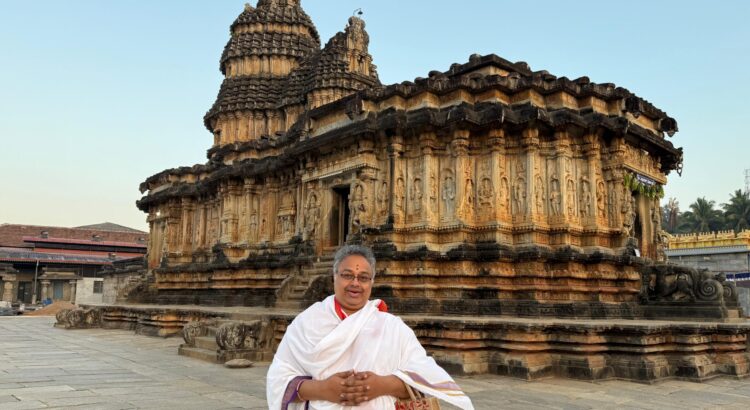
Veejay Sai is an award-winning writer, editor, columnist and culture critic. He has written and published extensively on Indian classical performing arts, cultural history and heritage, and Sanskrit. He is the author of 'Drama Queens: Women Who Created History On Stage' (Roli Books-2017) and ‘The Many Lives of Mangalampalli Balamuralikrishna' (Penguin Random House -2022). He lives in New Delhi.

Sai attended INDICA’s Meta-retreat on the Cultural Appropriation of Carnatic Music held at Tiruvannamalai recently. In this interview, he speaks about his journey as a writer and the current stage of writing on art and culture today.

What are your thoughts on the Cultural Appropriation of Carnatic Music?

There are many today who say, “Carnatic music is just an art form.” But this is a shallow and incomplete understanding. Carnatic music doesn’t exist in a vacuum. It is not “just music.” It comes from a specific context - a sacred, devotional, culturally rooted context. And when you remove it from that foundation, you are not simply adapting it - you are appropriating it.

Carnatic music is born from bhakti. Its foundation is built on devotion - to Rama, Krishna, Shiva, Devi. The kritis of Thyagaraja, Muthuswami Dikshitar, and Shyama Shastri are not mere compositions—they are acts of surrender, of spiritual yearning, of intense emotional communion with the divine.

You can take the rāga Todi or Varali or Kalyani and sing, “My phone is black in colour,” and yes, technically it might be in tune. But it will have zero rasa, zero impact. The rāga is not just a melodic structure. It is a spiritual vehicle. When you sing of Ramanāma, of Krishna, of Premālila, the effect is transformative. The bhāva is embedded in the very DNA of our music.

This is not a limitation—it is the strength of the tradition.

But today, we are witnessing appropriation at multiple levels—through institutions, through individuals, through seemingly well-meaning experiments that slowly chip away at the cultural core of the art form. There's a growing discomfort, even shame, in acknowledging the devotional roots of Carnatic music. Performers are praised for "decontextualizing" it, for making it “secular,” for using it in abstract or activist frameworks without a trace of its original meaning. This is cultural dilution, not evolution.

We are not against experimentation. But it must come from within the tradition, with deep knowledge and reverence. You cannot distort the foundation and claim innovation. You cannot ignore the sampradaya and call it progress.

There is also a parallel movement happening—of artists, rasikas, and scholars who are fighting to bring the music back to its roots. Who understand that true respect for the art comes from respecting its context. We are not gatekeepers. We are caretakers. What we seek is integrity.

Carnatic music is not just to be performed. It is to be lived. And for that, we must protect its soul. Because without bhakti, without dharma, without its spiritual center—Carnatic music ceases to be what it is. It becomes sound without soul. And that is the greatest loss of all.

With Bharatanatyam legends Shanta and VP Dhananjayan outside Padmanabhaswamy temple 

Can studying art with a scholar’s eye also lead to deep, personal insights, where art feels like a turning point or inner journey, not just something to analyse?

Over time, I’ve come to realize that engaging with art goes far beyond academic study or critique—it demands personal involvement. Whether it is music, dance, or visual arts, true understanding only comes when you immerse yourself in the form, when you live it.

Take music, for example. You cannot fully grasp it unless you learn it - unless you understand what a rāga is, what tālam is. The art becomes a part of you through your own indulgence, discipline, and surrender. It’s not just about appreciation from the outside; it's about being moved from within.

For years, I’ve felt a calling to write about art not just as an observer, but as a seeker -wanting to preserve the stories, the journeys, the spirit of art as service. Meeting great artists, learning from their life experiences, you begin to see how art shapes them - and, in turn, shapes you. Art begins to lead you. It takes you along on its own path.

I remember something the legendary Kelucharan Mohapatra ji once said to me. He said, "It is very good karma to be born an artist. One must have done many noble deeds in past lives to be born with the ability to create or even appreciate art." I believe this to be deeply true.

Just look at the world—of the billions of people, how many are truly able to experience the aesthetic joy, the rasa that art offers? It is rare. And when you begin to feel that joy, when you experience rasa svādhana (tasting the essence) or witness rasa siddhi (the perfection of that expression) in a great artist, you recognize it as a turning point. Art begins to touch something deep within you. It awakens you, uplifts you, moves you - especially in life’s most unpredictable moments.

And this is where art goes beyond scholarship, beyond theory. When you begin to walk toward understanding it sincerely, art meets you there. It reveals itself—not just to your intellect, but to your spirit.

With the great Mandolin U Shrinivas and Rajesh 

How did the trainee reporter of Mumbai become the wise art celebrity writer of today? How has your journey been?

Bombay at that time was a different place—calmer, more intimate. The Internet hadn’t arrived yet. Communication was personal: landline phones, handwritten letters, and face-to-face meetings. Mobile phones had just started to make an appearance around 1995–2000. The city was vibrant, but without the rush and detachment we now associate with it.

Back then, artists were far more accessible. There was no air of ego, no “I am so-and-so and you are not.” Yes, there were boundaries, but they were soft, almost invisible. I had the good fortune of meeting and interacting with some of the greatest stalwarts of Indian classical music and dance.

In music, there was Pandit Bhimsen Joshi ji, Pandit Jasraj ji, Pandit Ravi Shankar ji, Kishori Amonkar ji, and her mother, Mogubai Kurdikar ji. Titans of Hindustani music. I’d meet dancers at the NCPA, at the Worli Centre—Pandit Birju Maharaj ji, Kalyanasundaram Pillai sir, Kadri Velu master. These were masters with profound dedication to their art. And yet, they were so welcoming. At that time, I was just a junior journalist working for a local afternoon paper, trying to carve a space for arts writing. I had to approach them, explain what I wanted to do—and they always received me with warmth and generosity.

I had also written about cinema and had the privilege of meeting legendary film music directors like O.P. Nayyar, Naushad, Anil Biswas, and singers like Lata ji, Asha ji, Shamshad Begum. These were icons, yet they spoke freely. It all came down to the rapport you built. There were no fixed rules. You had to know instinctively when to approach an artist and when to simply observe, listen, and learn.

Even among actors, I developed close friendships—Dev Anand saab, for instance. I wasn’t star-struck; my respect came from a different place. Painters at the Jehangir Art Gallery, theatre personalities like Pearl Padamsee, the vibrant scene at Prithvi Theatre—it was all part of a living, breathing arts ecosystem. I was also deeply involved in theatre myself at the time, though I wasn’t yet fully aware of the politics behind the scenes. I was simply taking in the performances.

Many from the older generation of artists were incredibly open—Ustad Allah Rakha, Girija Devi ji, and so many others. Even the smaller sabhas and lesser-known festivals had a kind of purity. I used to travel to Pune often—especially to Bhimsen ji’s home. Musicians would share rare recordings, offer insights, sometimes give me a cassette and ask for my thoughts. They’d sit with me for hours, explaining the intricacies of taal, the subtle nuances of their craft. These experiences are etched in memory.

One project I hold close to my heart is Utsav: A Celebration of Indian Music, produced by Star TV and anchored by Zakir bhai (Ustad Zakir Hussain). I did the research and scriptwriting for it, and we had a wonderful time filming on sets in Gurgaon.

That Bombay no longer exists. The city, true to its nature, has moved ahead—as it always does. But those years were special. They were personal. They were full of learning, warmth, and discovery. I carry them with me always.

You have stopped writing for some mainstream publications because of their public bashing of our value systems. Are there other spaces and forums for Dharmic writers today?

To start with, there are very few genuine spaces left today to write about the arts. That in itself is a sad commentary on where we stand. Most of the remaining platforms are either owned or completely taken over by what I would broadly call the left-liberal ecosystem.

For many years, I wrote for The Hindu. I contributed to websites like Scroll, even though their ideological bent is, frankly, rabidly left. But when a window opened for writing on art and culture, I never let it go—regardless of the tilt. We simply couldn’t afford to turn down the opportunity.

Today, such spaces are becoming rarer by the day. And I find it surprising—deeply disappointing, even—that in this day and age, no one has thought to start a serious magazine dedicated solely to art and culture. Where are the investors? Where is the vision? What are we doing with our cultural capital?

For several years, I also wrote for Narthaki, an important online platform for dance, founded by Anita Ratnam. Her leanings are known—left liberal—but again, where else does one go? The more frustrating question, to me, is: why hasn’t anyone from the so-called right-of-center or culturally conservative space created an alternative? Why hasn’t that ecosystem stepped up?

We have Swarajya, yes—but how much can one magazine cover? Politics consumes everything, and art and culture get pushed to the margins. There’s a vacuum waiting to be filled, and yet no one seems to be stepping in.

The other side of the problem is even more worrying: where are the writers? There are so few of them today. It takes time, patience, and discipline to become an arts writer. You have to watch the same performance for the 500th time, listen to the same krithi, the same rāga, over and over. You must develop a critical eye, and that doesn’t happen overnight. If you don’t cultivate that patience early, it’s not going to appear magically one day.

I had the good fortune of being mentored by editors who understood this. People like Behram “Busybee” Contractor, who told me early on: “Stick to art and culture. That’s your forte. It will pay off one day. Don’t give up.”

And he was right. Today, after more than two decades of writing—20, maybe 22 years—I can say that every bit of exposure, every review, every conversation with an artist has added to the texture and depth of my writing. But it’s been a slow, unglamorous journey.

That’s the irony of the moment: we live in a world that is expanding faster than ever—digitally, globally, politically—and yet the spaces for serious, sustained writing on art and culture are shrinking. And that should worry us all.

What is the philosophy of Bharateeya art? Is it to be discovered anew or just be understood better? How are artists navigating this today?

In my understanding today, Bharateeya art is not merely art for art’s sake - it is art in the service of dharma. Without bhakti, it may be skillful, it may be refined, but it remains hollow at its core. This realization didn’t come to me overnight. Like many others, I too came from what you might call a woke-secular ecosystem, where art was viewed “objectively” -detached from the spiritual or cultural foundations that actually gave it meaning.

But over time, I began to see the limitations of that approach. You can watch a performance and walk away, treating it like just another show. Or you can choose to open yourself to it - allow the art to move you, to change you, to speak to something deep within. That is where the transformation lies.

In the Indian tradition, rasa is not just a response - it is a revelation. And there are artists, even among the younger generation in Carnatic and Hindustani music, who are steeped in this spirit. They have tasted that rasa and are generous enough to share it with those willing to receive.

At this stage in my journey, I find myself drawn more and more toward these artists. I no longer seek out quantity, or novelty for its own sake. Now, it is about quality—of intent, of depth, of resonance. And I’ve come to believe that, in Indian art, quantity is not the enemy of quality; rather, it is through repeated immersion, over time, that quality reveals itself. That is the journey within Bharateeya art - a journey not just of technique, but of the self.

Why did you explore the performing arts? What draws you to them? In your earliest interactions with stalwarts what were the core values they espoused that shaped you?

One of the most striking things you realize when interacting with the stalwarts of Indian classical art is that many of them share certain unmistakable traits. Simplicity is one. Humility is another. Despite their towering stature in the world of music or dance, they live life casually—day by day—with art always occupying a sacred, central place.

In my conversations and interactions with legends like Pandit Bhimsen Joshi, Ustad Bismillah Khan, Dr. Balamuralikrishna, Lalgudi Jayaraman sir, and others, I began to understand just how rare and valuable these qualities are. It’s easy to be pompous, to put on airs, to project brilliance. But to be truly simple—that takes effort, depth, and character. Art teaches you that. Art chooses you when you are humble.

All of them had that touch of grace. On stage, they could create magic—music that brought audiences to tears or transported them beyond the mundane. And off stage? They’d be sitting around, sharing chai, cracking jokes, completely grounded in everyday reality. Their greatness wasn’t something they wore—it was something they were, almost unaware of it.

I remember Pandit Ravi Shankar once saying, “You are only as good as your last performance.” That kind of humility isn’t performative—it’s a way of life. Before going on stage, you pray. You hope. You surrender. And you say, “May this also go well.”

These are not just artistic lessons—they’re life lessons. And as a writer documenting the arts, you try to absorb and reflect that spirit in your work. My editors often reminded me: “You’ll be dead and gone someday, but your line—your sentence—will remain. It will either carry your voice with integrity or shame you long after you’re gone.”

That’s the discipline. Use simple language. Don’t try to impress. Don’t show off. Through your writing, a reader should be able to experience an art form they may never have seen or heard.

You try to write with the clarity of Bhimsen ji’s voice, the sharp, discerning eye of Kishori Amonkar tai, the playful innovation of Balamuralikrishna sir, the spiritual reverence of Lalgudi sir. These masters teach you - not just how to listen to music, but how to live with art. Day in, day out.

And when you listen, really listen - you begin to carry a small part of their rasa into your own life and work.

Who are the artist of today for whom you would travel far to listen. Why are they special?

At the very top of my list is Abhishek Raghuram. His music is an acquired taste—uncompromising, deeply introspective, and intellectually layered. What makes him extraordinary is not just the virtuosity, but the distillation of musical thought. Listening to him is like entering a conversation—between Abhishek and Thyagaraja, or between Abhishek and Muthuswami Dikshitar—and you, the listener, are allowed in. He is, in my view, the finest living Carnatic vocalist today.

Another voice that captivates me is Trichy Pradeep Kumar. While he has gained wide recognition through his work in cinema, his Carnatic grounding is profound. There’s a certain mesmerism in his voice, a texture that lingers. When he sings classical, it’s nothing short of transportive.

Among flautists, Shruti Sagar brings a remarkable clarity and emotional intelligence to his playing. On the Veena Ramana Balachandran is a revelation. His music is not just mature beyond his years—it is meditative, precise, and deeply moving. He's a fantastic vainika whose performances offer a rare stillness and beauty.

On the violin, Ganesh and Kumaresh continue to innovate within tradition, and Mysore Nagaraj and Manjunath offer brilliance that borders on the telepathic. Jayanti Kumaresh akka on the veena is both graceful and commanding—her music is grounded in sampradaya, yet fresh with each recital.

Giridhar Udupa on the ghatam is another name that instantly comes to mind—an artist who knows how to listen as much as he plays. His presence elevates every ensemble.

Bombay Jayashri remains one of the most dignified and soulful voices of our time. And Vishaka Hari is extraordinary—not in the traditional Harikatha format, which has its own conventions—but as a performer of Sangeetha Upanyasam, where she blends music and storytelling with unmatched elegance and precision.

Dushyant Sridhar, while not a musician in the strictest sense, brings profound clarity and conviction to his pravachanams. He is a scholar-performer whose command of text and context makes every discourse a deeply enriching experience.

Among younger Hindustani musicians, Amaan Ali and Ayaan Ali continue the majestic sarod legacy of their father Amjad Ali Khan. Their concerts carry both reverence and boldness, a beautiful balance that defines great lineage.

These are not just performers. They are seekers. Their art pushes boundaries but remains rooted in tradition. They are the kind of artists who make you stop, listen, reflect. The kind of artists I would cross cities for, without a second thought.

With Bharatanatyam dancer and guru Dr Vyjayanthimala Bali 

In debates about rare or popular krithis, kutcheri formats, part time or full time artistes, what is it that we must not lose sight of?

I’ve never quite understood this obsession with “rare” kṛtis. Just because you haven’t sung it—or just because someone in the audience hasn’t heard it—doesn’t suddenly make it rare. If you’ve been in the field long enough, very few compositions are truly rare. They’ve all been sung at some point, by someone, somewhere.

And in today’s world, where we’re swimming in technology, resources, books, and recordings, there’s really no excuse. Almost everything is accessible—if not immediately, then with a little effort. So let’s be honest: there are no “rare” songs, only singers who choose to present certain works well or poorly.

Labeling something as “rare” has become a clever marketing trick. You hear it everywhere—“a rare padam,” “a rare jāvali.” Many of these compositions have been around for 200, 300, even 400 years. There’s nothing rare about them. What is rare, however, is sincerity. What is rare is depth. What is rare is honesty in presentation.

The real question we must ask is: Is the artist conveying what the composer intended? Is the emotional truth of the piece intact, or is it being distorted in the name of novelty? I don’t have a problem with traditional kutcheri formats, nor with experimentation—as long as the music stands strong. If the music is fine, everything is fine.

We are here for the music. Not for labels. Not for gimmicks.

The ultimate artist, in my view, is one who disappears into the art. Their ego steps back, and the music takes the front seat. They do not demand attention—they become the medium. And yes, such artists are few. On the other hand, there are performers who believe they are singing, they are the center. But art is always bigger than the artist. Those with big egos vanish quickly. Art, like dharma, endures.

And that is the heart of the matter: Art is not separate from dharma. In Bharateeya parampara, art is a form of service. It is an offering, not a product. As long as dharma survives, art will survive. They are inseparable.