
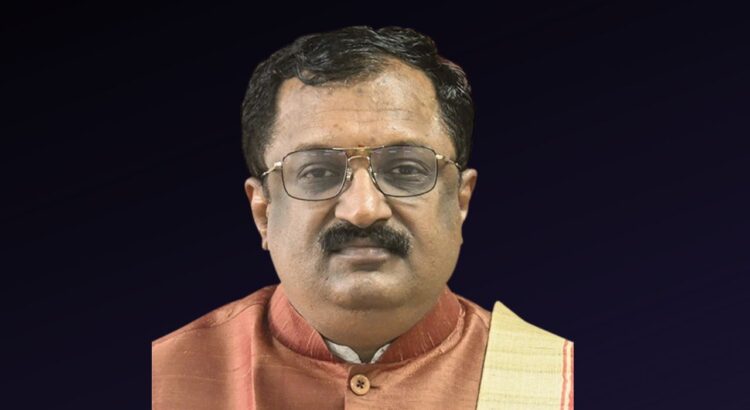
Prof Varakhedi On Reimagining Sanskrit

Prof. Shrinivasa Varakhedi , a distinguished scholar and academic leader, currently serves as the Vice Chancellor of Central Sanskrit University. A passionate advocate for the revival and modernization of Sanskrit education, he has played a pivotal role in shaping national policies and institutional strategies for Sanskrit development. In this conversation, he outlines the key reforms, challenges, and opportunities for integrating Sanskrit meaningfully into India's contemporary education landscape.

What key policy changes are required to strengthen Sanskrit education in India today?

There are several strategic steps that need to be taken. First, Sanskrit should be made available as an optional language from the primary to higher secondary level across all school boards, in alignment with the NEP 2020 and NCF’s R3 framework. Second, Sanskrit learning centers must be established in all premier institutions such as IITs, NITs, IIITs, IIMs, and national institutes, alongside departments in mainstream universities.

We also need to modernize the curriculum while preserving its traditional strengths—this includes integrating modern pedagogical tools and enforcing Simple Standard Sanskrit (SSS) as the medium of instruction. Additionally, Sanskrit must be included as a subject in national-level competitive exams like the UPSC and UGC-NET, with an updated, relevant syllabus. Importantly, students from Gurukulas, Pathashalas, and Veda Sanskrit Vidyalayas must receive equal opportunities for higher education. The growing interest in Indian Knowledge Systems (IKS) further strengthens the ecosystem for Sanskrit education.

How can Sanskrit be integrated more effectively into the National Education Policy (NEP) 2020?

The NEP’s emphasis on multilingualism offers a natural space for Sanskrit to flourish. It can be offered as an optional language across all school levels under the three-language formula. Sanskrit universities should evolve into hubs for interdisciplinary education by incorporating subjects like AI, philosophy, linguistics, and environmental studies.

We also need to ensure academic mobility through the Academic Bank of Credits (ABC), allowing students to seamlessly transfer credits between Sanskrit and non-Sanskrit institutions. Teacher training must be prioritized, and Sanskrit institutions should begin offering modern and vocational subjects to meet evolving educational and career needs. Additionally, developing a common vocabulary across Indian languages with Sanskrit as the interlingua would greatly aid linguistic integration.

Efforts to make Sanskrit more playful and engaging at the kindergarten level, and large-scale translation of key textbooks into Sanskrit under the Bharatiya Bhasha Pustak Yojana, are steps that can further mainstream the language.

As someone involved in shaping the Vision & Roadmap for Sanskrit development, what were the most critical reforms recommended?

One of the cornerstone ideas was the use of Simple Standard Sanskrit across all levels of education, under the mission "Sanskrit Through Sanskrit". We also proposed a digital Sanskrit knowledge repository to store texts, commentaries, tools, and resources for wider access.

Another key recommendation was to integrate Sanskrit into vocational education—linking it with Ayurveda, Yoga, Vastu, art forms, and other skill areas. Promoting a multidisciplinary approach in Sanskrit universities and colleges, alongside strong institutional capacity-building through faculty upskilling, digital infrastructure, and increased research funding, were also highlighted as essential reforms.

How can Sanskrit universities collaborate with mainstream institutions for a more holistic education system?

Collaboration is key. We can promote joint or dual degree programs such as Sanskrit with AI, philosophy, law, or psychology. Cross-institutional research on Indian Knowledge Systems can bring valuable insights, and student exchange programs or open elective courses can bridge disciplines and interests.

There’s also great potential in sharing faculty for short-term teaching across institutions. Additionally, mechanisms like Recognition of Prior Learning (RPL) can help integrate students from Gurukulas and homeschooling environments into the mainstream academic system.

What steps can be taken to make Sanskrit education financially sustainable and more attractive to students?

First, we need robust scholarship and fellowship schemes tailored for students pursuing Sanskrit studies. Second, we must open pathways to entrepreneurship in Sanskrit-based domains such as e-learning, content creation, heritage tourism, and translation services.

Forming institutional linkages with industries like Ayurveda, publishing, yoga, and digital heritage can also create viable career tracks. Highlighting success stories through media campaigns and ensuring seamless entry of Sanskrit students into top institutions like IITs and NITs through dedicated programs will make the field more aspirational.

How can regional language policies be aligned to support and promote Sanskrit learning?

Regional languages and Sanskrit have a symbiotic relationship. Sanskrit should be taught alongside regional languages in schools, which will enrich both. We can create regional language–Sanskrit dictionaries and comparative grammar tools to facilitate deeper understanding.

Encouraging regional universities to offer localized Sanskrit learning materials, organizing state-level cultural and language festivals, and conducting IKS activities in regional languages are all practical ways to integrate Sanskrit meaningfully into the regional education framework.
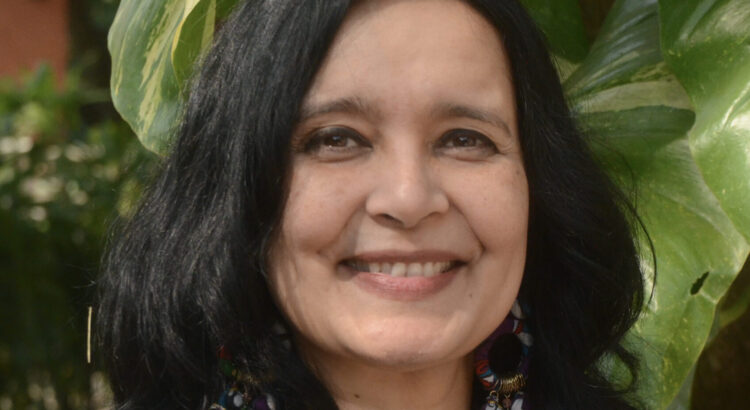
Wisdom Once Lost, Now Rising: Smita Barooah

In this interview, mental health therapist, author, writer, blogger Smt Smita Barooah speaks to us about how do we navigate colonial discourses, how they continue to negatively shape our identities and how we can bring about a shift by reshaping the Asian template in general and Indian narrative in general.

What was your experience at the Indica Meta Retreat on Colonial discourse? We're there some key take aways for you. 

The India Meta Retreat was a wonderful experience. Meeting like-minded people in a safe, tranquil setting, with few distractions, allowed for in depth discussions and brainstorming.

The key takeaways were that firstly we need to stop labelling ourselves as the Right Wing. It’s a label that’s been thrust upon us and we have unquestioningly embraced it. That label immediately lumps us together with the Western Right, which in many ways is the antithesis of our inclusive and open worldview. The more appropriate term is Non-Left.

Secondly, it is important to meet in person, to dispel misconceptions and clear doubts about civilisational and political issues.

The impact of Western culture and habits is so ubiquitous that many of us have ceased to even be aware of it. In careers such as yours as an addiction counsellor, are there times when Indic solutions can be applied to therapy and healing?

This question is pertinent because my training was Western but I worked in an Asian (Singaporean) setting. Thus I experienced the drawbacks of trying to rigidly implement Western solutions when dealing with Asian families & individuals. For instance, the Western concept of personal boundaries are not always compatible with the Asian way of living. The concept of “my life, my rules”, is not the standard Asian template.

This problem was even more pronounced when I started working in India. Here, solutions for the individual issues cannot be found in isolation. They need to include the family and social realities. They say it takes a village to raise a child. I’d add that it takes a community to heal a person.

In this context I’d like to share that one of the people who nudged me to start off on my own , is a senior psychiatrist ,who is also an Art of Living teacher. When I asked her how she managed to synthesise two polar opposite ways of thinking, she explained that her Art of Living journey started when she realised that science could only take one so far.

If you think about it, that is the quintessential Indian way. We seamlessly marry seemingly contradictory things all the time- we can be traditional in the temple and completely modern at a party. We can be a high flying scientist and yet pray before each rocket launch. This integration requires two key characteristics: Openness and flexibility , which are key strengths in navigating many life’s challenges.

What is the role of women according to you in policy making and narrative shaping in India today? Could you share your experiences at the intersection of policy, society and family?

Traditional India has always given the woman an elevated position because she is the upholder of tradition in a home. Sanskaar is usually passed on by her. Families are the building blocks that make up society, which in turn makes up a nation. If you get the family structure wrong, the entire edifice is shaky.

Therefore policy makers have to empower the woman through education and employment opportunities. The education has to include knowledge of history ,culture and civics, which she can pass down to her children. To be fair, today’s policy makers are aware of this and are working on it. This is why we see so many schemes exclusively for women.

Your family has played an important role in shaping the Indian view of history and culture in different ways. What have been the major influences in your lives?

My husband (Shri Sanjeev Sanyal) comes from a family of revolutionary freedom fighters and their legacy has inspired my husband & sons. In addition to writing about ancient Indian history, my husband has taken it upon himself to write out the history of the revolutionary movement, as a shraddhanjali to his ancestors. My sons train in martial arts. In fact, my older son is a Mixed Martial Arts fighter and represents India. This passion is directly derived from the family tradition of being fighters.

My own moorings come from my mother’s grandmother (badi-nani) and my grandmother (dadi). Both these women were very wise & they passed on the stories of the Ramayana,  Mahabharta along with intergenerational values. These need to be seeded from a young age.

When we talk about identity, nationhood and even diplomacy, what role do the values of Sanatana Dharma play in our interactions with international communities?

I believe the values of Sanatan are embedded, in some way or another, in each one of us. So when we interact with the international communities , we need to unapologetically be ourselves & push back against light weight preaching. Just our standing up and being authentic is enough because we live what the West preaches.  For instance, inclusivity, which is such a buzz words today, is a core values of Sanatan philosophy.

Similarly, the West goes on & on about the environmental. We are a people that worship Bhoomi ma, Vayu, Agni, Varuna. We have our Vana Devis, Devatas & sacred groves. The list goes on. The point is that what they speak about is the lived reality of so many of our people.

How do you think the Indic ecosystem can use social media effectively to project its views?

 Social media is a very powerful tool if used correctly. It helps connect people, share ideas, dispel falsehoods and  disseminate information. There have been too many misconceptions about India & Sanatan that need to be systematically countered , and it is being done slowly.

However, quick access has drawbacks , which includes getting addicted to the dopamine from clicks. That can be a slippery slope as the ego can take over & override reason & research.

When we engage online, we have to also be careful to not become dogmatic & judgemental of people who don’t practise Santantan as we do. Our Dharma is like the ocean and many streams feed into it. We need to be always mindful & respectful of that. Black and white thinking is the Abrahamic way. It is not our way.

In your career as a counsellor,  what are the main issues that you see affecting people today that is leading to addiction. Could you tell us a bit about what you have learnt over the years in terms of role of family,  society and the cultural settings that can support individuals going through a crisis?

Addiction is not the problem per se. It is always a symptom of an underlying problem. There are many issues that contribute and they include heartbreak, depression, anxiety, inability to fit in to the “norm”, peer pressure, lack of purpose, isolation,  spiritual vacuum & so on.

Since it is a bio-psycho-social issue, the interventions require medical, psychological & family support. One of the indicators of healing is the ability to reengage with other people in a meaningful way.  So families play a big role here, and therapy often involves engaging with and eliciting support of family members.

Various studies have also shown that healing is better when people have a spiritual anchor. Many people in recovery will tell you that they got better when they surrendered to a force bigger than themselves.

Finally, healing the mind also requires healing the body, because both are interlinked. That’s the foundational belief of yoga. The West is talking about the mind-body-spirit connect only now. We’ve known that for millennia . The problem is that we got lost in the middle and forgot some of ancient wisdom. Thankfully we are rediscovering them again slowly…