Dharmic Principles In Organisations Can Create Conscious Decision Making

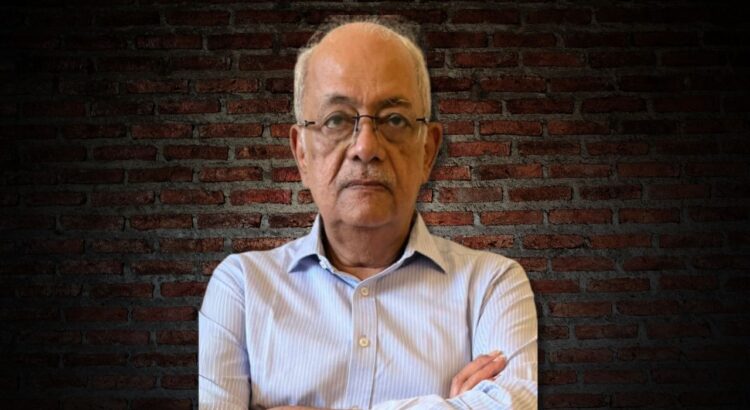
Professor G Ramesh retired from the Center for Public Policy of Indian Institute of Management Bangalore after serving for about two decades and has been the Chairperson of the Center for Public Policy of IIM Bangalore. He is a Fellow of the Indian Institute of Management, Ahmedabad (1990) and was Member of the Indian Economic Service (1980 batch) for a brief period.  

Presently, his interests lie in IKS and its interface with Public Policy and Management and focused on promoting research on Dharmic style of public policy and management. He has undertaken studies in the areas of temple economics and management, and management of mega events like Kumbh. He runs a Think Tank on Public Policy in Bangalore. It functions as a think tank and research center in public policy and public administration. In this interview he speaks about Dharmic influences on management and corporate decision making.

How do the principles of Dharma influence ethical decision-making?

The best definition of dharma is: Dharaya iti dharma: that which upholds, sustains, and uplifts. It also means that which unites.

Dharma is holding fast to principles which have to be sustained and uplifting. It should hold forth strong principles, but should contain principles which help sustain quality, nature and culture of the organization which binds everyone together. The contrast in what organizational academicians call as satisficing outcomes or solutions or exploiting opportunistic behavior.

Dharma should also be a factor which binds organizations. It should be a shared value system which holds employees together like a glue.  Organizations are not held together by just systems, control and outputs. These are held together at subtle level by norms, customs, stories, and culture.

All organizations lay for themself certain principles to be followed, just like what the Courts specified as basic structure of the Constitution. These principles are not necessarily laid down through written rules, and these include unwritten rules as well.  These specify what are non-negotiable areas of discretions. These are no-go areas of decision making and operations. Dharma is holding to one’s principles even under adversarial conditions.  Which means any violation of these not only can jeopardize business interest but can also attract severe penalties.

Organizations are heavily concerned with risk management. Laying down principles also helps derisking large organizations engaging a diverse range ofemployees from a diverse range of backgrounds.

Organizations may have different threshold levels of dharma or ethical standards. Defining and enculturing the overall organizational ethical ambience and standards is the role of the Board and top management. This is an important aspect of corporate governance.

These are certain ethical standards specified for organizations as aspects of corporate governance by the Ministry of Corporate Affairs, SEBI, etc. These are mandated norms of compliances.  Dharmic principles are more than this and refer to intrinsic value system which are self-prescribed and self-regulated. These are far superior, enduring and overarching than mandated regulations.

In corporate reporting, there is an attempt to report triple bottom line with reference to sustainability. In dharmic management, this is far from being prescribed. But we can recommend one thing.  Dharmic principles should enter the economic calculus of decision making.  Where a firm has to choose an option which is ethical but comes at cost the trade off due to dharmic principle has to be specified enabling the decision maker to make a conscious choice.

What can be plausible areas of conflicts in choices that can happen with ethical bearing. It can be with reference to employee consideration, client consideration, stakeholder interests and not just investors and promoters, sustainability, long term considerations, etc. These can be cases of outcomes which have external diseconomies.  Some of these pertain to the interests which are external to the organizations but involving costs to the stakeholders.

We said dharma is holding on to principles even under adversarial positions. This was amply demonstrated during Covid when several corporates and firms refrained from retrenching their employees even when there were drastic cuts in orders and under severe cost pressure. Similarly, corporates like Tatas practise strict principles with reference to integrity and commitment to promises. Similarly, it has been observed that lakhs of small borrowers from banks are quite conscious of the commitments and try to avoid being NPA at any cost.

There is now a push back on adharmic decision making. The reporting standards make mandatory for firms to report on decisions having negative environmental impact, transparency, unhealthy practices in product or promotion, etc. It is important these are inherent and intrinsic to the organization rather than externally driven.

Can personal and organizational dharmic principles determine ethical decision making.

Ethical policy framework and action agenda are the overall ambience that envelop the decision-making framework of an organization.  It is the Board and the top management which sets the ethical culture of the organization. The Board has to be self-governed by Dharmic principles to enable overall dharmic standards by which the organizational decision making and outcomes will be evaluated. It is the Board and Top Management that align the strategic direction and control of the organization with the ethical policies. Often organizations make laudable statements about dharma but implement incentives that run counter to the stated principles.

Ethical Decision Paradigm can be seen under the Principal - Agency framework which is about the alignment of the goal of the agent with that of the principal, and the evaluation and incentive system that reinforce this alignment. For the Principal Agency system to operate in dharmic way, Governance system addresses the question ‘who guards the guardians’. If there is mis alignment because of the divergent personal goal of the individual or counterproductive incentive system, then there is possibility misalignment between the individual and organizational goals which could undermine the ethical health of the organization.

At a personal level too, individuals carry their own threshold levels of dharmic principles and ethical standards. It puts individuals in dilemma when organizational ethical standards are in conflict with his standards. In extreme cases either he becomes a whistle blower or exists the organization. It is a challenge. There is also self-selection which happens.  Professionally run firms try to recruit individuals who are in alignment with their standards and also attracts ethically strong professionals. It is important for the organization to establish and articulate the dharmic principles in clear term.

Many organizations follow what I call as compliance culture. These fir ms look at prescriptions as compliances that are mandated and try to meet it. Mandated prescription often set the floor and are expected to be met at the minimum. But firms take these as goal, like in the case of CSR which they look at it as compliances. I call this as tick box approach. These try to observe compliance culture than a culture of fulfilment. If the management does not believe in what it says it always runs the risk of mis-adventure or disaster at some point.

This makes the job of Board even more important. There is huge literature on CEO selection. The board has to appoint a CEO who can lead the organization ethically and can set the ethical standard of the firm. This in turn determines how ethically the firm would be run. The dharmic CEOs have to look for themselves and  self-realization in fulfilling organizational goals, than in maximizing his returns.

These days it is not unusual for CEOs to look for Gurus who can mentor; it is obvious they are looking for guidance outside the management and domain.

In what ways can Dharma be considered both personal and universal in its application.

It works at individual levels, firm level and industry ecology level.

In economic perspective we look at it from micro and macroeconomics. The principles that govern at work at individual level work at macro as well, for example demand and supply. Macro can be considered as aggregate of micro units.

In organizational perspective, locus of organizational study is classified micro (intra organizational) and macro-organizational level (organization wide and interorganizational). There are certain principles that govern individual level and some which are organizational level.

Building dharmic perspective at organizational level has to be seen as Institution Building exercise. Left to itself organizations follow market-based principles of profit seeking, compensation, rewards and punishments. Ushering in dharmic principles takes strong institution building interventions to ensure alignment across the organization. Firms struggle to find alignment between dharmic principles and profit seeking behaviour as there could be tradeoffs between these.  Left to itself organizations will slide into market behaviour which is a self-regulatory system indeed but can go awry sometimes in the absence of dharmic governing principles.

The dharmic principles between organization and its individual employees have to be aligned. If it is misaligned it can cause high risk to the organization. The alignment is represented below.

Dharmic Organization
Individual High Low
High Aligned, Vibrant) Mis aligned. High organizational risk
Low Mis aligned. Organization prevails. High Business and Reputation Risk from Individual High (Aligned, high entropy)


This stresses dharmic qualities have to be hallmark of both the organization and individuals. If one of them is aligned it can cause business and reputation risk to both the individuals and organizations.

We have seen it during the period of meltdown and recent bursts of unicorns of how valuation driven business model bereft of dharmic principles ran into trouble and posed serious challenge to the investor ecosystem itself.  Greenspan, the Chairman of Federal Bank mentioned in the Congressional hearing that he had underestimated the ‘greed’ of the bankers in risk taking abilities. He said he thought CEOs would be governed by their sense of risk management, and market corrections would happen automatically which did not happen. All these boil down to lack of dharmic considerations in assessing business practices and financial health.

While organization dharmic principles we may say are institutional, individual principles are highly idiosyncratic, contextual, intrinsic, and intangible. It is here that organizations face challenge of selecting people with appropriate value systems and enculturing them. Organizations need people who raise common concerns as organizational conscious keepers.

What are some examples of Indian management practices rooted in the principles of Dharma?

Indian Style of management was much talked about subject in 80s but lost traction. One concept which used to be mentioned is Paternalistic style of management. Indian Style of Leadership, for example, is supposed to be Trust Based, Ethical, Charismatic etc.  In India, employees expect a familial and supporting ambience than competitive pressure.  Increasingly even management experts have come to the view that team performance and supportive environment is more conducive than competitive environment internally.

Our management practices were more accommodative of stakeholder considerations. Old industrial houses like Tata, Birla, Kirloskar were always mindful of their social obligations and these did not require mandated CSR laws. These were also employee friendly. These took care of the neighbourhood with schools and hospitals, and the society at large. These even contributed to independence struggle and for them industrialization was nation building. We have also developed community-based organisations like cooperatives like NDDB. Mandis are operated on mutual basis and long-term relationship basis.

There is a branch of study propounded by Neil Fligstein who stresses kinship in market relationship. This has been broadly the governing factor in our market regulation.  Our markets have been self-regulated through communities and kinship than state regulation.  So much so that the market players step in to help any player who find it difficult to meet the obligation. They ensure the market as a whole thrives in all weather.

Community and stakeholder management is also way of manging risk.  Community steps in to save firm in distress and similarly stakeholders are accommodative when the firm is facing crisis. Firms are generally considerate towards employees and count loyalty a lot. They don’t strictly treat it as contractual obligations, firms go beyond that.

In organizational control literature, control is discussed in terms of market, hierarchy and clannish mode of controls. By default organizations are market based (incentive driven) or hierarchy driven. It is difficult to attain clannish mode of control, for example of an employee says he is an IITian, IIMite, etc.  This clannish system is difficult to ensure in organizations and requires intensive enculturation and support. We call establishing a Dharmic culture as ushering a clannish system.

Our management style stresses trust-based relationships than contract based. Under the branch of Institutional Economics, contract theory discusses relationship between principal and vendor and the principles that govern it. It is based on economic principles, and it is about designing contracts to minimize moral hazard problems and minimize information asymmetry. Later theory stresses the overall regulatory environment that determines the effectiveness of the contract theory. Corporates increasingly adopted vendor management systems, pre qualifications and ratings to communicate trust and quality. In Indian contractual systems, we primarily rely on vendors promises and track record and comfort level.  It is trust based system of contracting. The world also realizes that the reputation of the vendor is more important than all the specifications and pre qualifications that one can set in the tender.

I was writing a case on a leading poultry grower, and I asked him about his philosophy towards charity and CSR. He said since he is fair to his stakeholders and supports thousands of growers and lakhs of traders, he did not feel the necessity for CSR. This has been our philosophy. Charity and fair business practices are basic to our business than mandated contributions through CSR. Fair business is intrinsic to our thinking than external and mandated.

In Indian conditions we refrain from exploiting advantageous position. Our position during Covid was ilustrative of this and we were aiding other countries even when we faced pressure of vaccines. Similarly, our mandis operate such that even smallest trader can survive.

How does the concept of karma yoga align with modern productivity and performance management?

This can be viewed under various frameworks.

The most spoken about theory of motivation is Maslovs hierarchy of needs or motivation which starts with Hygiene factor with the highest factor being Self Realization. Later he in fact extended it to Transcendence. Our philosophy has always spoken about higher goals.

Another approach is, we discuss under the framework of do end justify means or means justifies ends. We believe if means are proper, end will be appropriate. Other view is that only success counts. Increasingly experts qualify this saying only sustainable success matters. The principal agent framework as mentioned before expects the Principal – Agent will act in his self-interest and the organization's challenge is to design a system which will be minimize the mis alignment between the principal and agent.  The agent is supposed to pursue opportunistic goals with guile.  The organization is expected to minimize the information asymmetry, moral hazard, and hidden agenda. In our culture these are taken care through dharmic behavior from both the principal and agent and these are unwritten and unspoken. These come through enculturation and organizational culture.  For a long time, the management literature used to speak about enabling Japanese work culture.

What are the key differences between Western management theories and Indian management philosophies based on Dharma?

These differences we have to infer. These require in depth research.

  • Western management principles stress Individual utility maximization, organizations for maximizing, maximization whether is profit or resource utilization, short termism, incentive driven, distribution efficiency through market and control over resources, innovations and IP for individual benefit, growth, contracts, etc.
  • Dharmic management principles stress individual utility but at the cost of society, organizations for stakeholders, more equitable distribution, institutional mechanisms to ensure welfare and distribution like temples, sustainable long term goals, incentives as well as intangible goals, IP for common good, common property, trust, etc.

These are concepts worth exploring and researching.

How can leaders balance personal ambition with adherence to Dharma in a corporate setting?

Once the Chairman of Infosys said the corporates have to temper the expectations of investors rather than fuelling these. This is rue of compensation of employees also. Today it is a rat race. Leaders should set right goals, expectations, and fulfilment. These should not fall to the Greed. Greenspan post meltdown in the Congressional hearings he said,  he thought market would correct itself, but the leaders were overtaken by greed.

Dharmic system requires self-regulation than some authority to command and comply. Dharmic leaders set the right governance culture of the organization. Dharmic leaders cannot be rewarding themselves when the firm is underperforming. Studies have shown thst CEOs have rewarded themselves in US even on the face of declining performance. In modern day parlance, I would say being professional is being dharmic.

How can the Indian concept of satyam (truth) be applied to maintain transparency and integrity in business practices?

In a management way, Satyam is viewed as eradicating Info Asymmetry, disclosure, standards, ratings, etc. These methods have been devised to control Asymmetry and communicate credibility and quality. In dharmic culture these are assumed and it goes by reputation. In deep cultural society, if one doubts quality they take it as personal affront, just as some Doctors or Lawyers would take it. The dharmic practices reduced the risk of trading and business. It is this that enabled global trading in the absence of shipping documents and bank guarantees.

In what ways can understanding the idea of detachment from outcomes improve leadership qualities?

A leader lives in a VUCA world. He is alone and he is swayed by uncertainty, shocks, complexity, etc. He needs strength of personality, detachment, and stability, Increasingly CEOs seek Mentors, Coaches, Gurus to handle stress and the competitive world. This comes lack of self-searching, reflection, and strength of character. Even Arjuna had self-doubts at the battlefield, which provided us with the invaluable Gita.

What challenges might arise when applying Indian management principles in a global, multicultural work environment?

Global market is highly competitive, and dog eat dog markets. There are severe cost pressures, profit pressures, and pressure to cut corners. Also, we live in a globalized world. Our corporates operate in multiple markets and multiple culture. These need to adopt and compete.

One positive factor, globally there is now pressure to comply to transparency, open border, quality, and multi culturalism. There is growing manifestation of India’s soft power. We are also appreciated for our work culture, skills, and loyalty to organization. Our philosophy of Vasudeva Kudumbakam fits very well globalization and multiculturalism. We need to deepen this awareness.

What role do festivals like Mahakumbh play in connecting us to our past, our spiritual core?

Festivals like Mahakumbh are about connecting with our past, renewing ourselves and also about charity or service to community. These are not just about taking a dip in sacred river.

The purpose of maha kumbh is for people to purify themselves internally through yoga, meditation, vrats, and giving. In fact rich people gifts resources liberally in these melas. These are for self reflection and self realization. It helps to reawaken our spiritual core and connect with ourselves. In fact, these are also occasions when pilgrims give away their desires and take resolutions.

Kalpavas is one such practice. Through long vrats and meditation kalpavasis rejuvenate oneself. It's very historicity, adds mysticism and aura to it. It is an immersion programme. It also signifies to us the importance of rivers and environment.
Highlighting Bharat’s Intellectual Heritage

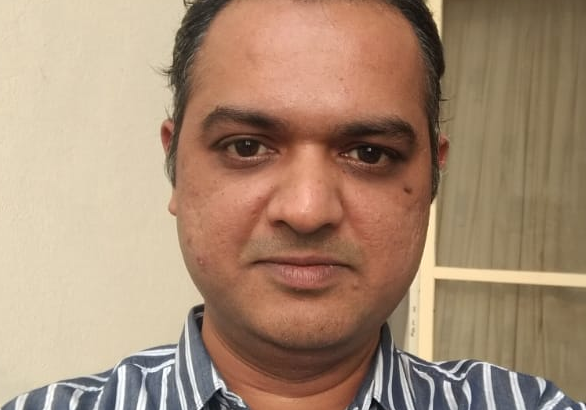
Prakash Chitre. An independent researcher and author. He is an independent researcher and author.

All his working life he was a marketing professional till he took complete retirement almost a decade back.  Almost since then, he has been focused on researching the subject of the ancient Indian Knowledge Systems and the verifiable and valid evidence for the same, a subject very close to his heart.

The said research resulted in his book, “Our Intellectual Heritage: There exists a large body of evidence for the width, depth and accuracy of the ancient Indian knowledge”. It was published by Motilal Banarsidass Publishing House  in March 2024.

What inspired you to take on such voluminous research on IKS?

Right since my childhood I had been aware, conscious in fact, to some extent, that our ancients had deep knowledge. But I did not know any specifics, regarding the subjects etc and as to how old was such knowledge. Even less did I know that there is plenty of evidence for the same.


Towards the end of 2019 or the early 2020, I came across information about the archaeological findings at Bhirhana and Rakhigarhi (both in Haryana) and that the old parts had been carbon dated by ASI (Archaeological Survey of India) to 9,500 and 8,500 BP, respectively. That clicked. I then started looking at other such sites in the Saraswati Sindhu Civilisation (earlier known as Indus Valey Civilisation or Harappan Civilisation, which as it turned out later, were inadequate names). This civilisation showed an incredible knowledge of Metrology, Civil Engineering, Water Management, Sanitation, Town Planning etc.


It made me aware that our ancients had deep knowledge of a large number of subjects besides Wisdom, Spirituality etc. This naturally led to research on wider scale.


This eventually resulted in my book, “Our Intellectual Heritage”, which was published by Motilal Banarsidass Publishing House in March 2024. The objective of my book is not only to share awareness of the extremely wide range of subjects in which our distant ancestors had deep and accurate knowledge, but also that, and this is very important, there exists a large body of evidence of their knowledge.


Of the many topics your book covers, which are the areas where we really need to work hard to make sure people are aware of India's work.


Simply put, to begin with, the following two points need to be conveyed as widely and convincingly as is possible:


a)    Our distant ancestors, several millennia ago, had deep and accurate knowledge of a very large number of subjects such as astronomy, many branches of mathematics, the sciences including medicine and the veterinary science, metallurgy, philosophy, architecture, sculpture, painting etc.

b)    There indeed exists a very large body of evidence for the width, depth and accuracy of the ancient Indian Knowledge.  


In India we saw knowledge as one whole unit, interconnected and influencing one another.  Should we actually accept Western categorization of knowledge into science, non science, spirituality etc?


Yes. These were interconnected in the ancient Indian Mind. However, that is not the case with the modern Indian Mind. We have been strongly influenced, and I do not exclude myself, by the Western way of thinking and assessing. If we want our fellow Indians, on a wide scale, to not only know about the knowledge of the distant ancestors of all of us, but also  to accept and internalise it, and consequently develop a fact based collective pride in our past, as opposed to wishful thinking, it will involve demolishing several preconceived beliefs, skilfully inculcated in us by our erstwhile rulers and others. That is a humongous exercise and an arduous task. In my humble opinion, it will make our task a little less difficult if we go along with the categorisation or presentation of science and non-science. However, I am conscious of it that I am only a researcher and author and not an educationist or psychologist and thus I may well be wrong.      

What were your primary sources while researching the book?

Firstly, I must make it clear that my research is of the secondary kind ie I have researched the primary research done by eminent scholars, which I have duly acknowledged all over my book, plus of course my own commentary, inferences etc. I have drawn from the works of 220+ scholars, representing 45 different fields of scholarship. While most of them are Indians or the Indian diaspora, a very large number of them are from 14 countries to our East and West.


I researched sources such as their research papers published in professional journals, their articles, books, lectures etc.  I have also quoted from the websites of various prestigious institutions such as the IITs, Universities in India and abroad and have provided the link in each and every case.


With the help of these quotes, I have tried to build and tell my story, the story of the multifaceted intellectual past of India and the abundant evidence for the same.


Which were the facts that surprised you about India's contributions?


Actually, everything I found in my research surprised me immensely and in an equally pleasant way.  Ergo, it will be difficult, perhaps even wrong on my part, to single out anything specifically. But perhaps the following struck me the most.


a)    As many as 6000+ years ago our ancestors showed knowledge of subjects such as metrology, as reflected in the dimensional ratios of the bricks they made for their structures, as also in the integral ratios of the dimensions of town boundary walls, various structures in the towns and the network of roads etc. These ratios were common and standard all over the vast Saraswati Sindhu Civilisation region.


b)    More than 7,500 years ago some Indian scholars were knowledgeable enough in the subject of astronomy and mathematics to work out the Solar longitudes as can be found in one of the updates of Surya Siddhant.

c)    Our ancestors made several important mathematical as well as metallurgical inventions.  


It is commonly known that the Zero was invented by India, but what is not commonly known is that the number system, the place value system and the method of mathematical operations, which are commonly used all over the world today,  were all invented by India. This may well have been forgotten now but centuries ago, the European, Arab and Persian scholars knew it and also acknowledged it in their writings.


India made metallurgical inventions such as the Ukku or Wootz steel, a micro alloy which had the unique property of being extremely hard as well as ductile at the same time. It also invented the extraction of Zinc, on an industrial scale, from its ore. Both were exported on a very large scale. It also invented the Corrosion Resistance technology which is seen in the iron pillars, found in various parts of India as also in the massive iron beams of the surviving Konark temple and its fellow temple which collapsed some 500 to 600 years ago.     


Do you see any patterns in how this knowledge evolved over time?


Not exactly a pattern of development but I did notice a very special period in our past. It is well known that the period from the 4th or 5th to the 16th century CE is known as the Classic Period of Indian Mathematics etc. However, while India’s intellectual history is several millennia old, and not just one or two, I noticed it that if one looks at any one specific millennium, the 1st millennium BCE was a Golden period of Indian Intellect. A lot happened during this period which reflected Indian genius in a wide range of subjects.


In the chapter “Brilliant Minds of Ancient India and their Works” I have written about only 72 or so of these brilliant minds. Of these 72+ there were as many as 20+ who lived in this millennium. They were mathematicians, philosophers, thinkers, grammarians, an etymologist and linguistic scholar, a scholar of prosody, physicists, meta physicists, civil engineers etc.


The six Vedic Philosophies and four non-Vedic philosophies developed during this millennium; two of the latter went on to become religions. At least three of the six Vedang were composed during this period. Many of the beautiful Buddhist paintings of Ellora and several exquisite cave monuments were made then.


The Takshashila University was founded during this millennium and went on to flourish for over 1100 years. The various Centres of Education, such as those at Kashi, Magadh, Kusumpura, Mysuru, Ujjain etc gained greater prominence during this period than earlier.


It was indeed a golden millennium when the Indian genius flourished. It does not mean that it did not happen before or after, because it did, as you will read in my book. But if you look at any one millennium, either BCE or CE, this was the millennium which was very special. 

What are your thoughts on the Indian mind based on your research. 

I came to know that the ancient Indian mind was always extremely hungry for knowledge. One simple fact is enough to illustrate it. The Takshashila (6th or 8th century BCE to 5th century CE) and Nalanda (5th Century to 12th century CE), both had around 10,000 students and around 2,000 teachers each. The population was so high in spite of the fact that admission was strictly on merit and only 1 out of 3 applicants was accepted.


It follows that those aspiring student who set out to these universities knew well that chances were that they may perhaps have to return the same way without being accepted. Yet they all undertook long, arduous and extremely dangerous journeys to seek admissions in these highly prestigious universities. This remained the case for centuries of existence of these universities. This could have happened, on such a large scale and for such a long time, if and only if they were extremely keen on acquiring higher education.  The thirst for knowledge drove them to take such immense risks. 


The subtitle of your book says that “There exists a large body of evidence for the width, depth and accuracy of the ancient Indian Knowledge. Could you elaborate please?  


I found that the large body of evidence can be broadly categorised in the following groups:


The Evidence of:


01) The ancient Archaeological findings.

02) The ancient temples and cave monuments.

03) Those of our ancient treatises which have survived as copies of the originals.

04) Hundreds of correct Astronomical Observations in ancient Indian Texts.

05) India’s Mathematical Inventions and Discoveries.

06) India’s Metallurgical Inventions and Exports.

07) Ancient Indian Philosophical Thought.

08) Ancient Indian knowledge of Medicine, Surgery and Veterinary Science.

09) Ancient Indian Knowledge of Linguistics, Etymology and Grammar of Sanskrit.

10) The thousands of manuscripts of ancient Indian texts found outside India.

11) The centuries old writings of non-Indian scholars about Indian knowledge.

12) The ancient Indian Universities discovered so far and the Centres of Education.


I have discussed all these in my book.


How would you like to sum up the ancient Indian knowledge?


As you will see in this book, the ancient knowledge of India was not confined to any point of time, subject or geography. It was very widespread.


Subject Spread


The ancient Indian knowledge was spread over a very large number of subjects such

as acoustics, architecture, astronomy, civil engineering, economics and political science, etymology, grammar, mathematics, medicine and surgery, metrology, metallurgy, physics, philosophy, sanitation, veterinary medicine and surgery, water management etc etc.


It is significant that the universities at Takshashila, Kanthalloor and Nalanda taught 60+ subjects.


Spread of Brilliant Minds


I have written of about only 70+ of them in my chapter “Brilliant Minds of Ancient India and their Works”. I am certain that I must have missed out many whose names and works are known.


Besides them there were also those scholars who wrote treatises which are well known but their own names are not known. Surya Siddhant for example. There were several updates to this ancient treatise on Indian Astronomy, stretching over several thousand years Before Common Era (BCE). But the names of those who made those updates, especially the older ones, are not known.


There were unknown brilliant scholars whose knowledge of Metrology, Town Planning, Civil Engineering, 6000+ years old, can be seen in many of the Saraswati Sindhu Civilisation sites.


The same is true of the RgVed. It consists of ten Mandals, all written at different points in the ancient times, stretching over many thousand years BCE. But little is known about their authors.  There are several other treatises, containing knowledge in different subjects, written by ancient scholars whose names we do not know with certainty.


Time Spread


It was spread over a very large time period, several millennia. To mention only two subjects, astronomy was as old as 7,500 years or more (ref. the Surya Siddhant and innumerable subsequent treatises), civil engineering and ship building (port of Poompuhar) as old as 9,000 to 13,000 years, etc. and continued to be there in all time slots since then.


Geographic Spread


It was not confined to any one or two parts of India but was spread all over the nation, be it North, East, South or West.


That such Indian knowledge was deep as well as accurate, can be seen in various parts of my book. I am not very familiar with the ancient intellectual history of the World but shall not be surprised if this aspect, as discussed above, happens to be quite unique to India.

Computer Science, Logic And Navya-Nyaya

Nikhilesh Ghushe is involved in research, which is focused on inventing new abstractions and formalisms, to be used in computer science, inspired from the understanding of human comprehension of natural languages, as described in Navya-Nyaya and Vyaakaran.

How has family’s interest and erudition in Sanskrit sparked your interest in the language. 

I come from a family of Sanskrit scholars. My father was a Vaiyyakarana (वैय्याकरण) who studied in Kashi in the Guru-Shishya tradition. He was taught Vyaakaran (व्याकरण) and Navya-Nyaya (नव्यन्याय) from a very early age, as was the norm in those days for anyone starting to learn Shastras (शास्त्र). He was also exposed to related Shastras such as Mimansa (मीमांसा) and Vedanta (वेदांत), especially Shabdadvaita (शब्दाद्वैत).

He never went to a modern school, and because of that remained uncorrupted by the modern world-view, which implicitly infects the minds of most of us who studied in the current education system. For my father, even basic concepts like the concept of a number, a place, a thing, or time, came from the tradition, not from the modern scientific world-view. This led me to see most things from two different perspectives. One that the school taught me, and the other the way my father saw. I developed an early sense that the school is not giving me the full picture, and there are other ways of looking at things.

Another important factor was that my father, and his friends from Kashi, exposed me to Hindi poetry at an early age. I loved Hindi poets like Jaishankar Prasad, Mahadevi, Nirala, Maithilisharan, Hariaudha, Pant, Dinkar etc who wrote in Sanskritized Khadi Boli. I learnt a lot of Sanskrit vocabulary, almost like a leisure fun activity, with no stress.

You mention a deep interest in Shaiva Darshan, and specifically the Pashupat and Pratyabhigya tradition. Bhartrhari makes a connect saying language is the sheath that covers metaphysics. What are your thoughts on this?

I am extremely pleased to get this question. 🙂 My father was fascinated with Bhartrihari’s Vaakyapadiyam (वाक्यपदीयम्). He has given lectures during his tenure as a professor, suggesting that Bhartrihari’s Shabdadvaita (शब्दाद्वैत) can be considered a Nirishwarawadi (निरीश्वरवादी) expression of Kashmira Shaiva Darshan (काश्मीर शैव दर्शन). And hence, they should be treated like the pairs of Mimansa-Vedanta (मीमांसा-वेदांत), Saankhya-Yoga (सांख्य-योग), and Vaisheshika-Nyaya (वैशेषिक-न्याय). Though I have not fully studied Vaakyapadiyam, I have read its Brahmakanda (ब्रह्मकाण्ड), and have skimmed through the other two Kandas. Also, my personal spiritual interest led me to the Shiva Sutras (शिवसूत्र)of Vasugupta. And to both my joy and surprise, the first three Karikas of Vaakyapaidyam, have a correspondence with the first three Shiva Sutras. I think the best way to answer this question would be to write my interpretative translations of the six of them, followed by a note to bring it together.

First three Shiva Sutras

चैतन्यमात्मा ॥१॥

Awareness (that which knows) is the self.

ज्ञानं बन्धः ॥२॥

Knowledge (that which is being known) enslaves.

योनिवर्गः कलाशरीरम् ॥३॥

Category of the birth-womb, and tendencies, is the body.

First three Karikas of Vaakyapadiyam

अनादिनिधनं ब्रह्म शब्दतत्त्वं यदक्षरम्। विवर्ततेऽर्थभावेन प्रक्रिया जगतो यतः॥१॥

The imperishable essence of the beginning and end-less Brahma is Shabda (The Word), and it manifests as the process of the world, through the arising of meaning.

एकमेव यदाम्नातं भिन्नं शक्तिव्यपाश्रयात्। अपृथक्त्वेपि शक्तिभ्यः पृथक्त्वेनेव वर्तते॥२॥

That (Shabda) which the Vedas describe as one, becomes manifold by Shakti (the meaning-arising power) residing in it, and thus, even though being undifferentiated, because of Shakti, becomes differentiated.

अध्याहितकलां यस्य कालशक्तिमुपाश्रिताः। जन्मादयो विकाराः षड् भावभेदस्य योनयः॥३॥

The power of time, which is an inherent tendency of Shabda, sustains within it the six types of actions (meanings of verbs) - beginning, being, changing, growing, decaying, and ending - which, in turn, are the wombs of the manifold objects (meanings of nouns).

Semblance between Kashmir Shaiva Darshan and Shabdadvaita

So for the Shabdabrahmavadis (शब्दब्रह्मवादी) like Bhartrihari, awareness or Atma (आत्मा) is shaba-tatva. In other words, substratum of our awareness is Shabda. Shabda means both sound and word, but not in the sense of merely the physical vibrations of air, but the essence of that vibration. Let’s say we hear the sound “Ram” at two different occasions. Once from someone talking to us, and second time as a part of a song we hear on our mobile. We identify the two sounds as the same, even if they might have different loudness, or they may be coming through different mediums, and are created by different sources. Why? because by sound, we don’t mean a particular physical occurrence of vibration, but its essence which we identify as the common across its multiple physical occurrences.

This “essential” Shabda carries the power to evoke a meaning. This is analogous to how awareness (or Aatma) has the capacity to arise knowledge within it. If we perceive intensely, we can see that there is always an underlying presence of sound in our awareness. For instance, there is always a background noise going on, that we don’t necessarily notice. There might be a song playing somewhere far away, a buzz of a machine, or traffic noise. Even in our dreams and in our sleep, there is an unnoticed background noise. This is a single continuous presence. Only when we hear a meaning-carrying sound, let’s a say a sentence uttered by someone in front of us, then we divide that single continuous presence into chunks of sounds, based on what meaning those chunks evoke. We call these chunks individual words.

This is exactly analogous to the continuum of reality that is one single whole, which we divide in to individual phenomena by giving it names. Where does a tree start and where does the soil end? Where does the ocean end, and the air above it begin? It depends on how have we named the phenomena. If we are using the word forest, both the tree and the soil are included in it. Only when we bring our attention to specific words - “tree” or “soil”, then our mind divides the continuous reality, abstracting out chunks meant by those words. Observing how a child learns words, can be very instructive in this regard. This is analogous to one single awareness, appearing as many, based on the different things it knows. One Jeevatma is separate from the other, only because they know different things. And thus the knowledge-arising power of Aatma, is analogous to meaning-evoking power of the Shabda, and both result in dividing of a single continuum.

In addition to this ability to evoke meaning, the Shabda also has the power to give order (क्रम) to the divided chunks. This is the power of time. Because of this power of time, we are able to abstract out the phenomena we call “actions”, from the single continuum of reality. Actions are meanings of verbs. These actions further give rise to the naming of distinct objects, as different from one another. The object of eating is food, the object of going is place, so on and so forth. Objects are meanings of nouns. Thus, according to Bhartrihari, the continuum of reality is first divided into meanings of verbs, and these verbs, then give rise to the perceptions of meanings of nouns. That is why most nouns have their etymology in verbal-roots. This is analogous to Jeevatmas differentiated from a single awareness based on knowledge, further acquiring a body, based on it’s tendencies (which are actions and hence meanings of verbs). The physical bodies, which are objects and hence meanings of nouns, are a result of the tendencies of the Jeevatma.

Thus, Shabda-Artha and Shiva-Shakti are just different ways of looking at the same underlying reality.

You are the Co-founder of AcquiredLang (https://www.acquiredlang.com), a stealth mode research startup working on the overlap between Artificial Intelligence, Nyaya Darashan, and Sanskrit Vyakaran. Do you think bringing IKS to AI will help make AI more representative and ‘ethical’. What role does epistemology in Nyaya Darashan play in developing AI systems capable of better decision-making and knowledge representation?

Our research so far, has been more on the side of inventing new abstractions and formalisms, to be used in computer science, inspired from the understanding of human comprehension of natural languages, as described in Navya-Nyaya and Vyaakaran. Our focus has been on bringing theoretical clarity, consistency, and exhaustiveness to the understanding of human comprehension of natural languages, so that it becomes accessible to the computer scientists. The following are a few representative concepts from which we have taken inspiration for this purpose:

  • Navya-Nyaya-Paribhasha (नव्यन्यायपरिभाषा) - a canonical subset of the Sanskrit language, used for unambiguously describing all types of human cognition, including comprehension.
  • Shabdabodh (शाब्दबोध) - method of describing comprehension of Sanskrit utterances, using the Navya-Nyaya-Paribhasha.
  • Prakaar-Sansarga-Visheshya (प्रकार-संसर्ग-विशेष्य) - a fundamental unit of Navya-Nyaya-Paribhasha, and hence by extension a unit of knowledge representation.
  • Karya-Kaarana-Bhaava (कार्य-कारण-भाव) and Kaarana-Mimansa (कारणमीमांसा) in Nyaya - the Theory of Causation in Navya-Nyaya, developed from the much older Vaisheshika tradition.

Based on the work so far, we are confident that thorough research in IKS, we can bring far greater expressivity to knowledge representation, and explainability to AI decision-making. However, it is hard to say whether it will make AI more ethical.

How can principles of Nyaya Darashan be used to enhance the logical reasoning capabilities of AI systems?  In what ways can combining the logical structure of Nyaya and the linguistic rules of Sanskrit Vyakaran lead to advancements in AI-driven language models? What are the benefits of using ancient Indian logic (Nyaya) compared to Western logic systems in AI frameworks?

I am combining the above three questions and answering them together in one long answer.

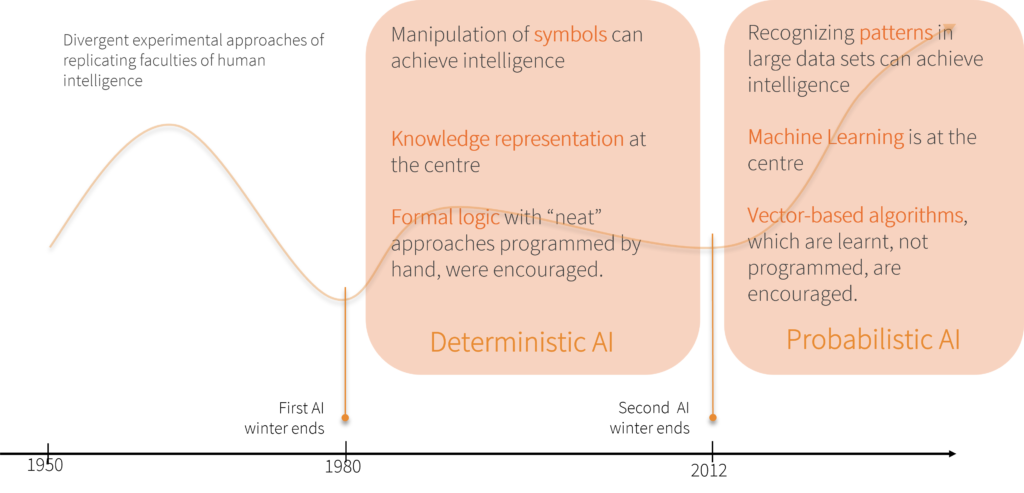
If we have a historical look at development of AI since the 1950s, we can roughly divide it in three phases (shown in the image above):

  • From the 50s to the late 70s - when a diverse set of approaches were tried, with success primarily thwarted by non-availability of good-enough hardware.
  • From early 80s to 2012 - when Deterministic AI was in focus, with the following salient points:
    • A fundamental belief that “manipulation of symbols can achieve intelligence”.
    • Knowledge Representation was at the centre.
    • Algorithms based on formal logic, programmed by hand, were encouraged.
  • From 2012 till present - when Probabilistic AI is in focus, with the following salient points:
    • A belief that “recognising patterns in large data sets can achieve intelligence”.
    • Machine Learning is at the centre.
    • Vector-based algorithms, which are learnt, not programmed, are encouraged.

The deterministic approach did not prove to be successful in representing and fruitfully analysing complex human experiences. Looking back, it seems that the available forms of formal logic were not a natural fit for representing the entire gamut of human experiences. I will come back to it later below.

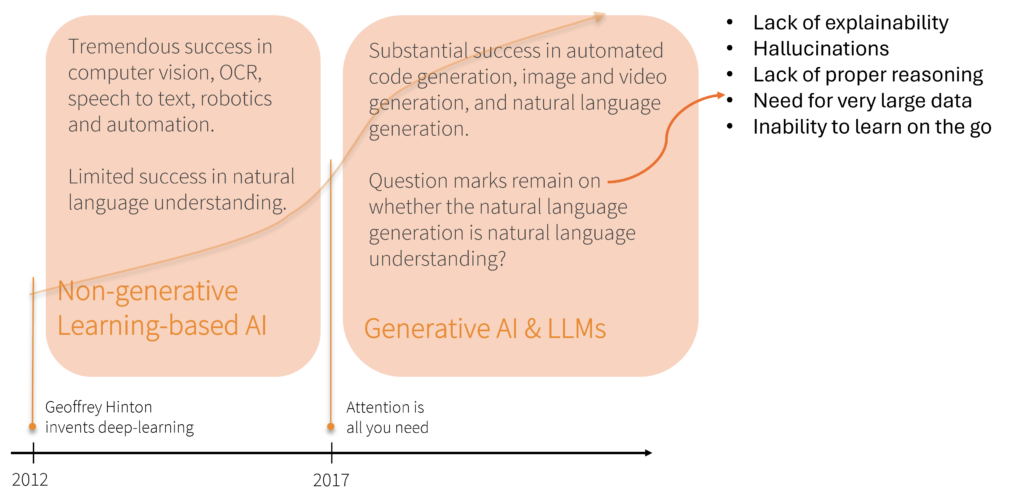
The age of Probabilistic AI was started with Prof. Geoffrey Hinton’s seminal work that invented deep-learning. This phase can be further divided into two sub-phases:


  • From 2012-2017: Deep-learning based algorithms achieved tremendous success in computer vision, OCR, speech-to-text, robotics and automation, but had limited success in natural language understanding. Vector-based probabilistic systems deal with many aspects of reality far better than symbolic logic. Probably because vector algebra developed as means of describing the physical properties of the real-world, and hence were effective in dealing with colours and sounds, but less so with words and meanings.
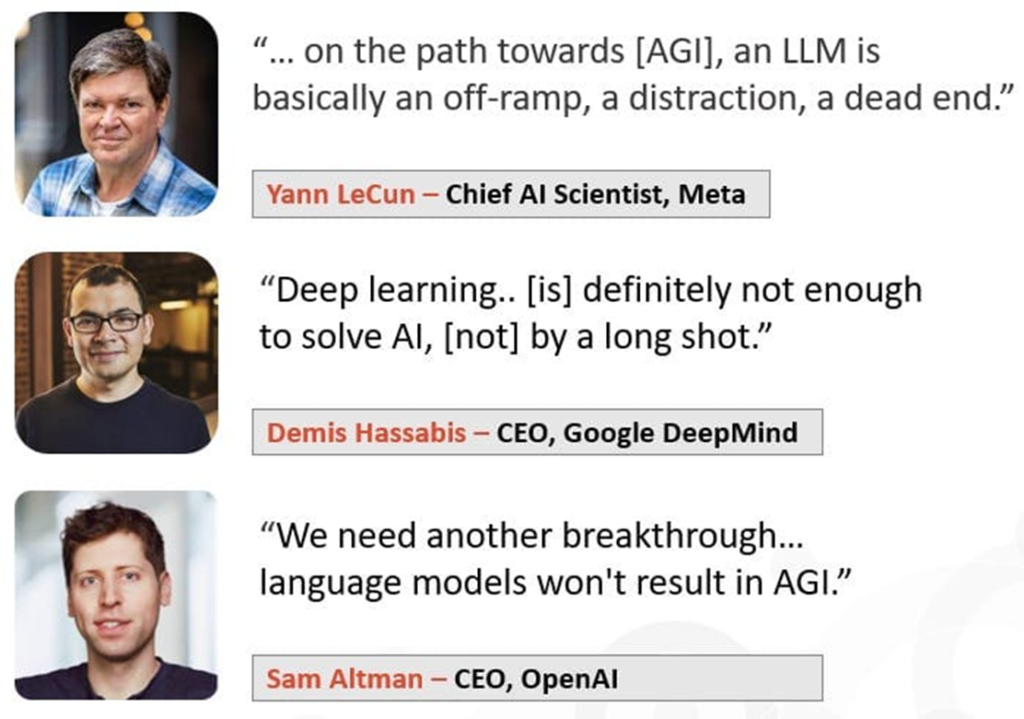
  • From 2017 onwards: Starts with the seminal work on Attention-based techniques which led to creation of LLMs, which achieved substantial success in automated code-generation, image/video generation, and natural language generation. The LLMs are great retrieval machines, and when fed with a very large amount of information, they can pick an appropriate response from this already vectorized and digested information. But they are not very great at combining information to retrieve new results, because of they need millions of instances of something to learn a generalized pattern, which a small child can grasp with 3-4 examples. And therefore, question marks remain on whether natural language generation is natural language understanding? Inability to explain its outcomes, hallucinations, lack of proper reasoning, need for very large data, and inability to learn on the go are some of its principal drawbacks. We can see leading people in AI saying this already:

In my opinion, most of these drawbacks actually stem from a single issue, that there is no symbolic semantic model backing these Probabilistic AI systems. By symbolic semantic model, I mean a well-defined set of symbols and rules shared between both humans and machines. In the absence of such a symbolic model, humans will never feel fully confident, that the machine understands them. So this brings us back to the question - why did the symbolic systems, from the Deterministic era did not achieve much success dealing with the diverse set of human experiences. My conjecture is, because the systems of logic used for them were inadequate.

Currently, what we call symbolic logic in computer science (also called formal logic), is based on fundamental works by stalwarts such as George Boole, Gottlob Frege, Kurt Gödel, and John von Neumann. These systems of symbolic logic deal with idealized mathematical objects, such as “propositions” and “predicates”. A proposition is supposed to be a unit of knowledge, to which a truth value can be assigned. A predicate is suppose to be a template of knowledge, with unfilled variables. When we substitute variables with values in a predicate, we get a proposition - a statement which can be ascertained to be true or false. But it does not serve well as a template of a generic natural language sentence, because it falls short of accommodating the full complexity and content of what a human can understand from a sentence. What we humans call context is not formalized in these predicate based systems of logic. More complex systems, such as Modal and Temporal logics, attempted to accommodate some of these ideas, but they all either fall short, or end up being too complex and inelegant for humans.

This is not to take away from the great achievements of symbolic logic, which has resulted in the development of the field of computer science, and served as the basis of so many software infrastructures such as many programming languages, and databases. This is just to convey that, for meeting the current expectation of AI, we need to look for new kinds of symbolic logic which are not restricted to dealing with idealised mathematical objects.

Another aspect of this “idealisation” is that the logic itself only deals with the “form” of logical discourse, not the content of it. In words of Bimal Krishna Matilal:

Thus, the basic features of Western logic are: It deals with a study of ‘propositions’, specially their ‘logical form’ as abstracted from their ‘content’ or ‘matter’. It deals with ‘general conditions of valid inference’, wherein the truth or otherwise of the premises have no bearing on the ‘logical soundness or validity’ of an inference. It achieves this by taking recourse to a symbolic language that has little to do with natural languages.

The main concern of Western logic, in its entire course of development, has been one of systematizing patterns of mathematical reasoning, with the mathematical objects being thought of as existing either in an independent ideal world or in a formal domain.

Indian logic, however, does not deal with ideal entities, such as propositions, logical truth as distinguished from material truth, or with purely symbolic languages that apparently have nothing to do with natural languages. The central concern of Indian logic as founded in nyāya-darśana is epistemology, or the theory of knowledge. Thus Indian logic is not concerned merely with making arguments in formal mathematics rigorous and precise, but attends to the much larger issue of providing rigor to the arguments encountered in natural sciences (including mathematics, which in Indian tradition has the attributes of a natural science and not that of a collection of context-free formal statements), and in philosophical discourse.

In this context, Navya-Nyaya can be of great value. Navya-Nyaya serves that place in Indian knowledge tradition, which is played in the West by Epistemology, Ontology, Cognitive Science, and Logic. Indian tradition does not treat these areas in silos, but brings all of them in a single coherent whole, largely thanks to the work of Gangeshopadhyaya (गङ्गेशोपाध्याय) of Mithila. Gangeshopadhyaya combined the earlier Sutra-based tradition of Nyaya with the tradition of Vaisheshika (वैशेषिक), and wrote the Magnum Opus Tattvachintamani (तत्वचिन्तामणि). Tattvachintamani is a single coherent exposition of how humans acquire knowledge, which includes: how we perceive through our senses, how we apply logic on the perceived knowledge to infer new knowledge, what is the form of the knowledge acquired through these different means, and what is the ontology covering all possible objects that make up this knowledge.

Navya-Nyaya has two unique advantages to serve as the basis of symbolic systems of logic underlying AI systems:

  1. It does not separate the “form” from the “content” of logical discourse. It does so by having both ontology and logic in a single semantic whole, with Sapta-padaartha (सप्तपदार्थ) providing the ontology, and Anuman-Praman (अनुमानप्रमाण) providing the inferential logic. Sapta-padaarthas are the top-level categories of meanings of words. In Nyaya, they are treated as the ontological primitives that span everything that a human mind can conceptualise. Anuman-Praman is a sub-field of Nyaya that deals with inference. It includes a formalism called Panchaavayava Vaakya (पंचावयव वाक्य), or five-part statement, which gives a method of applying the rules of inference. This formalism of inference, is defined in terms of the ontological primitives, not in terms of a context-free idealized objects like predicates.
  2. It has a formalized meta-language that deals with the non-idealized ontological primitives, called the Navya-Nyaya-Paribhasha. It is a refined subset of Sanskrit language, designed to write canonical representations of human cognition. Gangeshopadhyay invented this refined subset of Sanskrit language called Paribhasha, which simply means Parishkrit Bhasha (परिष्कृत भाषा) - refined language. Unlike the language of mathematics, which works on idealized mathematical objects, the Navya-Nyaya-Paribhasha allows any Sanskrit word to be used in it. However, it forces one to explicitly spell out cognitive relations between the meanings of these words.

In addition to the above two, there is another sub-discipline that Navya-Nyaya shares with Vyakaran (and to some degree with Mimansa), called Shabdabodha. It is a theory of comprehension. Navya-Nyaya deals generally with knowledge acquired from any means - through sense organs, through inference, through analogy, and through verbal testimony. Shabdabodha is that sub-field, which delves deeply into verbal testimony. It answers fundamental questions of how the grammatical structure of Sanskrit language, is linked with ontological primitives and rules of logic of Nyaya. Over two and half millennia of history, Shabdbodha has matured to such as level that an exhaustive theory has emerged, containing a huge repository of methods, capable of elucidating meaning of any Sanskrit sentence as a ambiguity-free, context-aware formal representation in Navya-Nyaya-Paribhasha. Gadadhara Bhattacharya’s seminal work Vyutpattivaad (व्युत्पत्तिवाद), is the book that brings all of these methods together in one coherent whole.

There have been attempts at representing natural language using formal logic in the Deterministic era of AI. John F Sowa’s work on Conceptual Graphs is one such work of great prominence. In my opinion, the reason for their limited success, was that they all started with some form of formal logic, and tried to counterfit how can natural language statements be expressed in it. Shabdabodha, on the other hands, starts with a natural language, and asks what formalisms are needed to unambiguously represent the full gamut of knowledge a human can grasp from a natural language sentence. And thus there is true possibility of finding new formalisms and abstractions inspired from Shabdabodha that can serve as the basis of symbolic semantic systems, which are far more sophisticated compared to the ones from the Deterministic era, and can complement very well the flexibility offered by systems of Probabilistic era.

What specific techniques from Panini’s Sanskrit grammar can be applied to improve Natural Language Processing (NLP) in AI?

Our research does not directly deal with NLP. We are creating a new software infrastructure based on principles inspired from Nyaya and Vyakaran. But still let me attempt an answer, though with a caveat that much of it is conjecture.

It would be safe to say that Sanskrit is probably the most feature-rich natural language. In the sense that the number of syntactic tools, and their corresponding semantic operations, available in the Sanskrit language are far too many. I am going to give three examples here:

  • Sanskrit language has a large number and well-defined types of suffixes or Pratyaya (प्रत्यय), such as: sup (सुप्), tin (तिङ्), krit (कृत्), taddhit (तद्धित्), sanadi (सनादि). The corresponding semantic transforms they perform on the meanings of the Prakriti (प्रकृति), or the root words they attach to, is well-defined. Such exhaustiveness and detailing are not seen in other languages.
  • Same can be said about the number of pronouns or Sarvanaam (सर्वनाम). Let’s look at a list: अयम्, इयम्, इदम्, सः, सा, ते, एषः, एता, एतत्, कः, का, के, यः, या, ये, अहम्, त्वम्, इदानीम्, तदानीम्, अत्र, तत्र. For comparison, in English language, there is only one word “he” for all the three - अयम्, सः, and एषः. The Sanskrit pronouns अयम्, सः, and एषः specify the different notions of orientation (near-ness/far-ness) while pointing at the referent using a pronoun, which are left unspecified by “he” in the English language.
  • Similarly, the exhaustive listing of types of compounds or Samaas (समास): तत्पुरुष, कर्मधारय, अव्ययीभाव, द्वंद्व, बहुव्रीहि, समाहार etc, and how they affect meanings of the resulting compound word, the samamstapada (समस्तपद), is not as clearly found in other languages.

This is the closest a single natural language can get to the superset of features of all languages. Secondly, Paninian tradition organizes these features as part of a unified system of both syntax and semantics. This allows us to see which of these features are mutually exclusive, and which depend on one another. The knowledge of these (and numerous other) features of Sanskrit, can be used to come up with new formalisms (and data structures and algorithms implementing them) to build an abstract and generic model of natural languages. Because of the huge number and overarching nature of features of Sanskrit, such a model may represent semantics of any natural language, rather than a particular one.

One of the challenges of machine learning based NLP approaches has been their inability to explain the results in symbolic terms. In areas of AI, other than NLP, there have been attempts to build memory-backed neural nets, such as the Differentiable Neural Computer by Alex Graves’ team, which have a better shot at explainability. But they have not found much application in NLP yet. Probably because, there are no good symbolic models of human semantics as expressed in natural languages, that can serve as the basis of building such a memory. A generic abstract model of natural language, based on formalisms borrowed from Sanskrit, can be the basis of designing such systems.

How does the rule-based nature of Sanskrit Vyakaran compare to modern programming languages used in AI development?

This is not an appropriate comparison. Modern languages used in AI development such as Python or Rust, are programming languages. They primarily deal with vectors and matrices as primitives, and incrementally build higher-level structures using these primitives. Various architectures such Transformers, or Mamba, or RNNs, or Differential Neural Networks etc provide the basis for building these higher-level structures. Each of these architectures has certain assumptions about intelligence and the real world. If we must make a comparison, we should do so between the underlying assumptions of these architectures and the principles of Sanskrit Vyaakaran. The programming languages used in development of AI are not very relevant.

What challenges might arise when incorporating the complex grammar rules of Sanskrit into AI algorithms for language processing?

When we first thought of using Sankrit knowledge for AI, the primary challenge was to resist the urge to apply the rules of Sanskrit grammar directly to computer systems. The modern computer systems stand on a large and brilliant body of theoretical computer science work done since the 50s. The language and methodology of this body of work has a sort of “impedance mismatch” with the language of Sanskrit Vyakaran and other shastras like Navya-Nyaya. We had to dispassionately study both the streams of knowledge, grasp the concepts from the Shastra, understand the context and purpose in which they were developed, and see what are the gaps in modern computer science, that we can be filled by taking inspiration from the shastra, and then develop our own theories and systems in the language of computer science. This was a tough challenge.

The unique challenge of Sanskrit is that it has hundreds of technical terms which have a different meaning than ordinary usage and this includes scientific, artistic, philosophical, cultural, and biological terms. This ancient language was the vehicle of expression of the minds of ancient Indians, which predates the English language by millenia. Do you think it is possible to use machine translation for Sanskrit given its complex nature?

My work is more focused on using Sanskrit for computer science and AI. This is a question about using computers science and AI for Sanskrit. So again, I am going to attempt an answer with the caveat of some of it being conjecture.

In languages such as English, the position of a given word in a sentence, relative to other words, is extremely consequential to the meaning of the whole sentence. This was a grave challenge because of which NLP achieved limited success till 2017. One of the critical reasons why LLMs succeeded, was a feature of their underlying architecture, called positional encoding (which works in conjunction with another feature called self-attention). These features were able to successfully address the challenge of using the positions of words in a sentence. But this success, is precisely a drawback for interpreting Sanskrit, in which the position of words play almost no role in interpreting the meaning of a sentence. Samaas, Sandhi, and the fact that a large number of texts are in verses, pose further challenges of automated translations.

However, mathematical principles learnt in attention-oriented research behind LLMs, and also more recent attempts like Mamba, are useful. And ground-up efforts to build fresh architectures applying those mathematical principles, and understanding of Sanskrit languages, can definitely lead to success in machine translation, and other useful NLP applications around Sanskrit.

How do you think IKS can broaden the scope of AI by incorporating the First Principles approach of Indian systems. 

I’ll try to answer this questions in terms of examples of first principles thinking inherent in IKS. For instance, whenever we think of numbers 1, 2, 3 - we implicitly imagine them to be on a number line, or an element in a set of Natural numbers. But to someone like my father, who never went to a modern school, numbers were Sankhya (संख्या) one of the 24 Guna (गुण) of Navya-Nyaya. Gunas are properties residing in some substance, or Dravya (द्रव्य), in the real world, not some Platonic idealized abstraction like that of a Natural Number. Sankhyas are canonically expressed in the Navya-Nyaya-Paribhasha as oneness, twoness, threeness (एकत्व, द्वित्व, त्रित्व), which are understood to follow rules such as “oneness pervades twoness” (द्वित्वम् एकत्वेन व्याप्तम्), “twoness pervades threeness” (त्रित्वम् द्वित्वेन व्याप्तम्), and so on. Because, wherever there are two fruits, we can infer that there is one fruit. This is a formalization of common-sense. Navya-Nyaya provides similar formalization of common-sense notions such as colors, smells, touch, measurements, distinctions, connection, disjoning, etc. All of them seem to be useful as first principles for giving common sense to machines.

Another example could be Navya-Nyaya’s concept of Jeevatma can help AI systems understand how humans operate and this can help in disciplines related to management and governance. Unlike in Vedanta or Sankhya, Jeevatma is considered a substance, or Dravya, in Nyaya. And each body of a living being has an associated Jeevatma. This substance (Dravya) is considered to be capable of having 9 properties (Gunas), namely: 

  1. Gyaan (ज्ञान) - cognition,
  2. Sukha (सुख) - happiness,
  3. Dukha (दुख) - sadness,
  4. Ichha (इच्छा) - intention/liking,
  5. Dvesha (द्वेष) - avoidance/disliking,
  6. Prayatna (प्रयत्न) - effort,
  7. Sanskaar (संस्कार) - memory,
  8. Dharma (धर्म) - all remaining tendencies of Jeevaatma that lead to happiness, and
  9. Adharma (अधर्म) - all remaining tendencies of Jeevaatma that lead to sadness.

There is further discussion on how these properties of Jeevaatma arise and affect each other. Repeated Sukha leads to Iccha, repeated Dukha leads to Dvesha, Ichha and Dvesha leads to Prayatna. Prayatna is that property of the Jeevatma that can make the body, associated with the Jeevatma, move and impact the outside physical world. Dharma and Adharma are those tendencies which causes Sukha and Dukha respectively. Gyaan is cognition, which leads to Sanskaar which is memory. The ideal way to live life according to Nyaya, is to minimize arising of Prayatna due to Iccha and Dvesha, and let Gyaan lead to Prayatna.

Such a model, can help AI systems model the behaviour of conscious beings. They can also be used as formalism in developing management theories of HR and Marketing. Udayanacharya’s Atma-Tatva-Viveka is a brilliant exposition of Nyaya’s view of Atma.

There are other areas of IKS where we can find substantial inspiration to broaden the scope of AI. I am putting here two more examples coming to mind: - Mimansa and Dharmashastra has a treasure trove of ideas relevant to what is currently being dealt by AI Ethics - The notions of Vibaava (विभाव), Anubhaava (अनुभाव), and Sanchaaribhaava (संचारीभाव) from the Rasa-Shastra, can be used to model the whole range of emotions that arise in a human being.

How can our understanding of aesthetics be incorporated into technology where it is both a form as well as a function of the Indian principle that that which is good is aesthetic.

The short answer is - by considering technology as a Devi. I am taking aesthetic liberty in answering this question, so please don’t hold me to Shastra Pramaan. Abhinavagupta seem to see beauty in every aspect of life. For him, rasotpatti (रसोत्पत्ति) is the means to ultimate divinity. Bhartrihari says “साहित्यसङ्गीतकलाविहीनः साक्षात्पशुः पुच्छविषाणहीनः।” - “Those devoid of literature, music, and arts are verily animals without horns and tail.”. Contemporary stalwarts like Ravindra Sharma of Adilabad, describe civilization as a Saundarya Drishti (सौंदर्य दृष्टि) - an Aesthetic Vision.

The only true way of bringing aesthetics to technology, is to produce technologists who have that Saundarya Dristhi, who are poets and artists at heart. And the heart can only be moulded with devotion. We, the technologists, need an Ishta (इष्ट) to fall in love with. An Ishta whose Purana (पुराण) would teach us to look at technology with a Saundarya Drishti. Who makes us see technology not just as means to material convenience, but as a process of beautiful abstractions appearing in our minds and manifesting themselves in the physical world. Someone amongst us technologists, has to the see the process of creation of technology, as a microcosmic reflection of the creation of the world. As Abhinavagupta sees the process of poetry descending in to vaikhari (वैखरी) through the heart of a poet, as a microcosmic reflection of the Parashiva descending in to the manifest world. Someone amongst us needs to write a Purana of the Devi of technology - and preferably in Sanskrit - giving new meanings to ancient words - and discovering appropriate Prakritis and Pratyayas to describe technological concepts. I possibly lack the Pratibha (प्रतिभा) to do so, but I end this by praying to Maa Shakti to produce capable sons who could sing praises to her, in her new forms.

A Vibrant Ecosystem Needed To Build Joyful Startups

Young entrepreneur Dhrupad Vipat is a founder member of Stealth Startup. Speaking about entrepreneurship in the Dharmic space he says, "During an entrepreneurial journey one of the key aspects responsible for conviction behind an idea is validation through data and market feedback. Building conviction in the Dharmic space based on data and market feedback is challenging due to the scarcity of authentic data and reliable market sources. This lack of validation not only fuels doubt but also increases the likelihood of frequent pivots, hindering long-term focus and commitment." Read more about his journey.

What were the influences in your childhood which inspired you to connect IKS and technology?

I am born and raised in a Maharashtrian Brahmin family settled in Madhya Pradesh, where we have devotedly practiced our kulacharas (family traditions) for generations. Being a third generation Sangh swayamsevak, the values of service towards nation and Dharma were instilled from the shakha. My maternal grandfather’s narration of those stories about Chhatrapati Shivaji Maharaj made me imagine the forts and wars though I had never visited them in person during childhood. This unique combination of experiences at an individual, family and social level instilled strong sanskars in me, but there was often a conflict with the other world whether during school, college, or the early years of my career. At home, traditions were unquestioned, while the external world encouraged questioning everything.

This dichotomy led me to asking "why" about our practices, seeking answers that would bridge these two worlds. Those answers helped me gain a deeper understanding of both worlds. This began shaping my understanding of work and its nature. I realized the importance of aligning my work with my inner values to optimize for joy and fulfillment.

While this was happening, many unique opportunities started coming my way, opportunities that connected Dharma and technology. I felt a deep resonance with this space, as it was aligned with my sanskars and allowed me to pursue my work without inner conflict.

Could you describe the startup ecosystem in the dharmic space based on your experience with a video platform?

Conventionally, the term Dharmic startup ecosystem is interpreted to mean companies who are restricted to developing products and services related to Hinduism (or other Dharmic religions) such as online pooja, meditation, yoga, astrology and physical products useful in rituals and festivals related to these traditions.

This ecosystem is undergoing significant growth, with the number of startups in this domain increasing 4-5 times over the past three years, with the number exceeding 20-25 startups. I was part of a team that built Vayam, a live events hosting platform for social and religious communities in India during COVID, addressing the need for virtual interaction amidst restrictions. Other startups are addressing diverse gaps in the digital space, offering services such as online pooja, astrology, and well-being-focused content tailored to modern lifestyles. Additionally, the ecosystem is aligning with global trends, such as AI, where entrepreneurs are exploring generative AI tools for Indian Knowledge Systems (IKS) research and scriptwriting.

A critical challenge for most of the startups in the whole ecosystem lies in achieving sustainability. The approach to problem-solving often lacks a holistic perspective, with problems being tackled in silos. This results in partial solutions that fail to address interconnected problems, thereby limiting scalability and financial viability.

On a broader and deeper level, the articulation of _Dharma_ (as one of Dharma, Artha, Kama and Moksha - the four Purusharthas )—as a guiding principle for entrepreneurship and business—is missing from the discourse. Our shastric tradition offers deeply holistic and human-centric frameworks for designing solutions and building sustainable enterprises. However, these frameworks have yet to be effectively articulated or adapted for the needs of contemporary startups in all areas going beyond the restrictions above. Bridging this gap and taking the Dharmic approach presents a profound opportunity to create a meaningful and sustainable impact on the whole startup ecosystem.

How did you get interested in starting a platform for dharmic enterprises?

 Entrepreneurship is becoming an aspirational career choice today in India. But there are a few challenges with the current startup ecosystem. The definition of a successful business today has been reduced to raising funds and chasing high valuation numbers. Many of these so-called “successful” businesses simply replicate western solutions, which may not align with the unique context of Bharat’s users and markets. This narrative of success becomes aspirational for the rest of society, setting a narrow template for aspiring entrepreneurs. As a result, entrepreneurs often fail to explore and understand their own unique capacities and capabilities. In this chase, entrepreneurs rarely evaluate the broader impact of their actions and business on society and the environment. Alarmingly, many internet-based businesses overlook the harmful effects of their offerings on their own users. A worrying trend is the recent surge in corporate governance issues, particularly in startups.

The lack of clarity and well-thought-out motivation behind choosing entrepreneurship as a career path has led to a journey filled with contradictions, such as struggles with work-life balance, rather than being joyful and fulfilling. On a macro level, the current startup ecosystem falls short of posing the right questions for entrepreneurs and guiding them to find answers. Due to this many entrepreneurs are unable to navigate their journey in a balanced and sustainable way. While reflecting on these problems, we realized that Indian entrepreneurs could feel significantly empowered by gaining a deeper understanding of Dharma. We concluded that there is a need for a platform for connecting like minded dharmic individuals to facilitate exchange of ideas between them, giving mentorship and investing capital.

What is the main challenge when it comes to sustaining businesses in this space?

During an entrepreneurial journey one of the key aspects responsible for conviction behind an idea is validation through data and market feedback. Building conviction in the Dharmic space based on data and market feedback is challenging due to the scarcity of authentic data and reliable market sources. This lack of validation not only fuels doubt but also increases the likelihood of frequent pivots, hindering long-term focus and commitment.

It becomes essential to draw conviction from Dharma itself, as a deeper understanding of Dharma leads to unwavering conviction and clarity in one's actions. Another significant challenge lies in finding mentors and investors who share the same depth of conviction in Dharma, making it harder to align on vision, values, and long-term goals. For businesses to grow sustainably, it is crucial to cultivate an ecosystem of interconnected individuals (entrepreneurs, mentors, and investors) who share a deep understanding and commitment towards Dharma.

What are the areas that young entrepreneurs can hope to successfully start new businesses?

Even before thinking which areas to work, a more fundamental question is how to think about entrepreneurship. The availability of private capital has increased significantly in the past few years, and entrepreneurial tendencies have found expression among the younger generation in our society. A young entrepreneur's motivation today is usually to work in an area which  is attracting capital, which is either a new trend or a replica of successful ideas from the west.

This limits the entrepreneur's ability to not only identify real, deep problems that need attention but also to fully understand the impact they can create. The lack of deeper self-awareness  and understanding of one's conditioning often results in a loss of purpose, while the relentless hustle culture leads to burnout. When an entrepreneur with a deeper self-awareness looks at the startup as their life's work they pick their area of work in alignment with their conditioning which makes the journey joyful and fulfilling.

What support do you offer and who are your resource people?

The initiative is still in an early stage. It is called Dharmic Network, a network of four stakeholders Entrepreneurs, Investors, Dharmic Coaches and Service Providers (CAs, Legal services, etc). The context of Dharma here is a conduct which ensures wellbeing for all business stakeholders including society and ecology at large. The core idea of Dharmic Network is to bring these four types of stakeholders together to help an entrepreneur practice business in a Dharmic manner.

There are three core offerings: a regular Offline Immersion Retreat, an online network product and a knowledge base. The journey for an entrepreneur begins with the offline immersion retreat where they get a chance to reflect upon their journey, understand their conditioning and think about their work in the larger context of their life. After this they will be able to access the Online Network Product, where they can raise capital from Investors, seek mentorship from Dharmic Coaches and get services from the Service Providers. Then comes the Knowledge Base, which offers Dharmic wisdom based practices, frameworks and content for entrepreneurs to conduct business in a Dharmic manner.

Our resource persons are the Dharmic coaches who recognize the importance and nuances of conducting business in a Dharmic manner. We have established connections with a few Dharmic coaches and are actively seeking to connect with more. We are working to connect with individuals from traditional Indian business families who have built or scaled businesses. Additionally, we are seeking those in senior leadership positions who have overseen strategy, development, and execution within organizations.