

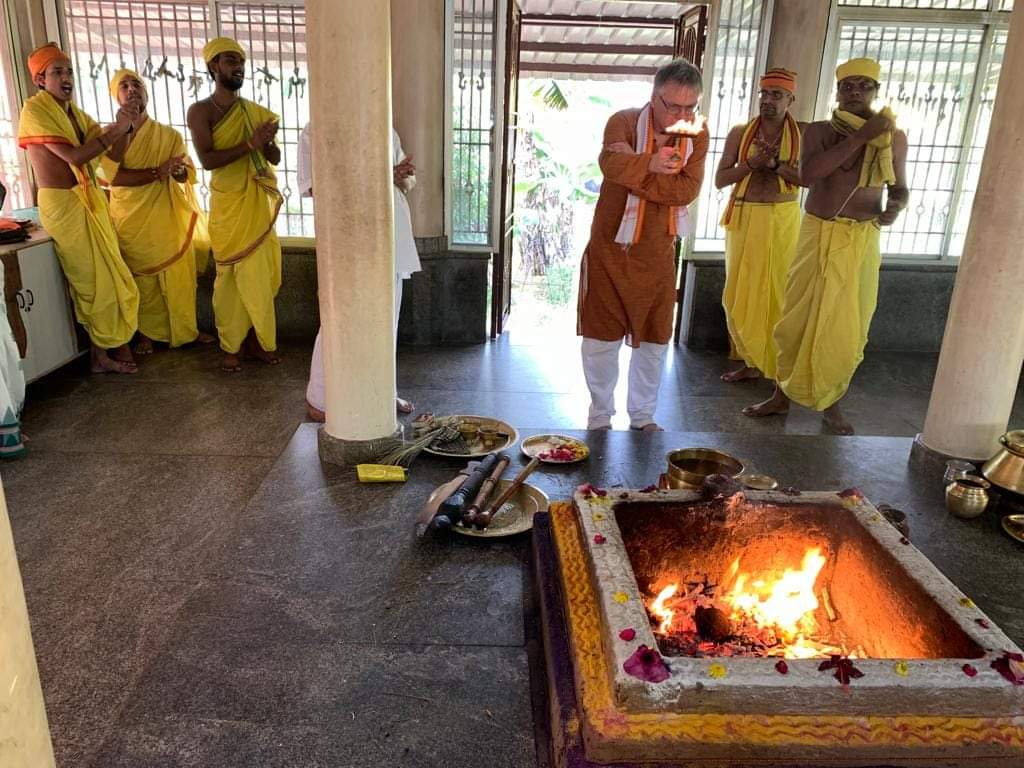
Dirk Gysels has travelled from Tervuren in Belgium to Thiruvannamalai to enjoy the many spiritual activities that occur in this beautiful season in the land of Sri Ramana Maharishi.
He marked Gita Jayanti with a powerful fire ritual. He writes in his social media post: For every verse of the Gita, including the Gita Dhyanam and Gita Mahatmyam, an oblation was offered in the fire. Six hours of continuous sitting and reciting.
Of the Ramana Ashram itself, he says: With the synergy of the Mountain, the living Presence of the Maharishi, the continuous Veda recitations and not in the least, the collective field generated by tens of thousands of hours of Self-Enquiry and Meditation over almost a century, it remains an ocean of sacredness and stillness.
Of touching the real India, and in his words, not the crazy life that goes on on its surface, he says on December 12 he had his third Brahma yajna, the last of the three one can have in one’s lifetime. For him and the other participants, it was one of the strongest fire rituals they had participated in.
Dirk is a retired teacher and HR consultant for the Belgian Government and says he is now in the grihasta stage of life.
At the end of this enlightening interview, he adds, “One last word, yogically speaking it not advisable to speak about subjective experiences unless it serves the purpose of inspiring people to walk the path. It is in this spirit that I gave these answers. Hari Om Tat Sat.”
How did your interest in India and Sanatana Dharma begin?
I was a teenager in the seventies. At that time Indian spirituality became enormously popular in the West. Among young people it became almost mainstream. This was fuelled by the missionary efforts of charismatic gurus like Maharishi Mahesh Yogi, Srila Prabhupad, Bhagwan Shree Rajneesh, Swami Rama and others.
Like so many others I started with transcendental meditation, dabbled with Bhagwan (Osho), Sai Baba and Hare Krishna.
However there were some unexpected other experiences. One evening sitting on my bed, after I had been reading the life of Sri Ramakrishna, suddenly I felt and saw an enormously hot, brilliant light shooting up my spine and exploding in my head. Within this light, there was the transfigured and very lively face of Sri Ramakrishna.
In that period, along my spiritual interests, I was very much into extreme left politics. Then I went with my class of 17 year old boys to a Catholic monastery for a retreat. The nuns warned us that a mad recluse was living in a hut on the domain. But he was just crazy, not dangerous.
And indeed on my first walk I crossed a shabbily dressed skinny old man. Suddenly he turned and said to me: ‘Stop dividing the world into bad fascists and good communists.’ I was shocked and wanted to know more about him. So I went to his hut. The recluse, brother John, started to apologize. ‘I said this so that you would come to me. The nuns may think I am mad but I lived for 20 years in a cave high up in the Himalayas. Then I came back to Europe. You have the etheric vibrations of a yogi. I want to teach you certain things.’
He gave me his writings which unfortunately got lost. I visited him again but never really followed him. It was all very ascetic with brahmacharya and all those rules and I was not willing to live like that.
But those two experiences really put me on the path.
Does academic study prepare one for the actual experience when one visits India?
It can be because it gives some broad information and it sharpens the mind and the reasoning faculty. But these things belong to the manas. What one needs is a training of the buddhi, the cultivation of willpower or sankalpa shakti and a purification of the heart. Academic studies won’t do that.
Moreover academic studies may strengthen our doubting nature and undermine shraddha. According the Bhagavad Gita, doubt is a serious enemy. At a certain moment, one has to trust and jump into the river.
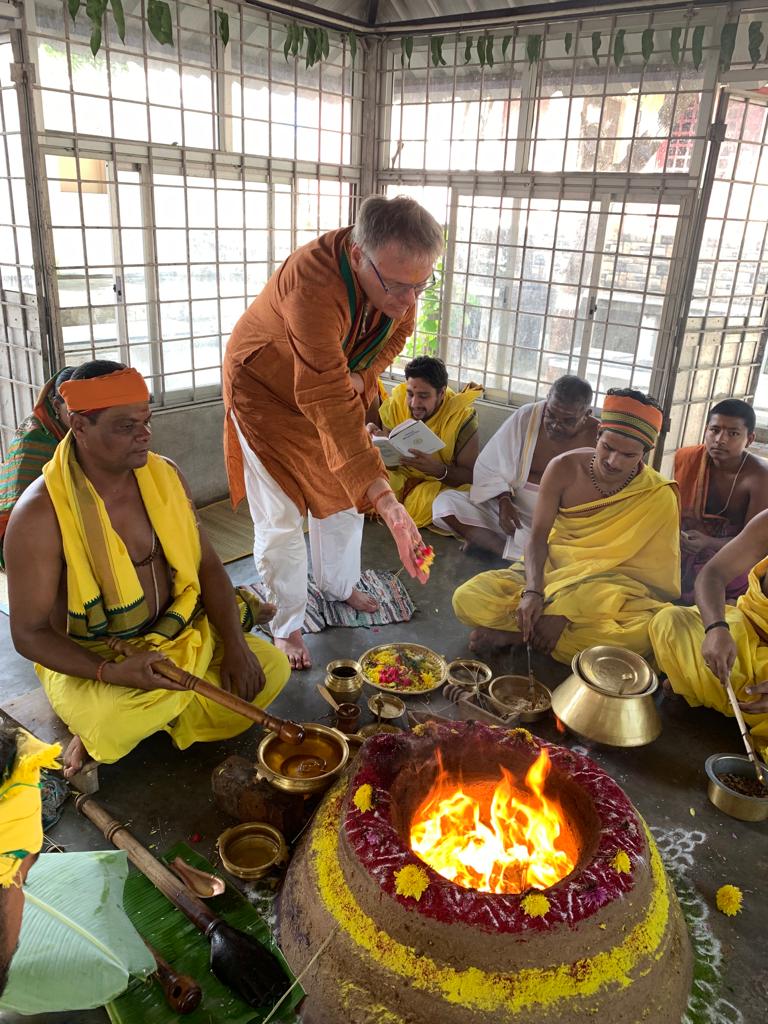
You have done Yagnas, 3 Brahma Yagnas to be precise. While there are phalas associated with doing them? What is your immediate take away?
In 2022, Swami Atmananda invited me to come for a longer period to his ashram for learning a not well-known set of prana techniques to open up the 14 main nadis. He taught these in person and was continuously monitoring my body-mind system.
As part of the training I had to sit as often as possible in Yagna kunds to make my pranas go upwards. This was a very powerful thing. Regardless of the phalas, I feel the psychic energy field changing and a continuous vibration of uprising energies. So an accurately done yagna has that effect. This makes yagna a part of yogic processes.
Do you think mainstream India has lost touch with its core? How do you access it?
Some years ago I was sitting with an aged yogini in her Ashram at Sapta Ganga in Haridwar. She said: In India nothing becomes really lost. It only goes undercover.’ So yes, mainstream modernized Hindus have to a great extent lost touch with the spiritual vibrancy of their heritage. This is a danger because there are two very aggressive religions working brutally and skilfully to destroy the dharma. But I see a turn happening towards a reappraisal of the ancient dharmas. But a lot has to happen. Temples should be free and not under governmental control. Priests should be properly trained and rewarded. And the kshetrams should be cleaned up. I would also have a ban on all new commercial and housing projects in these places. I see this happening in Tiruvannamalai and my heart is weeping.
And of course accessing mainly happens after a proper training in an ashram under a qualified guru. Sadhana is the main key.
What in your opinion is the role of our great gurus in showing the path even years after they are gone?
There are two answers to this. Very likely their writings, pictures, maybe some video recordings are available and can serve as an ongoing inspiration. These gurus were great so their lives can serve as benchmarks for present day teachers.
And the Shakti of the Master may still flow through their disciples and grand disciples. That is the meaning of Parampara. But there is not higher grace than to be physically present in the psychic field of a living yogi. At worst, they generate a very high level of sattva. At best, they may abide in the gunatita state. If one is open to this through sadhana, this would be a tremendous blessing. Properly maintained samadhis will to some extent fulfil the same function.
What aspects of Indian culture appeal to you and how do you do your Sadhana?
All that still echoes to Sathyam, Shivam, Sundaram.
I do my sadhana continuously, with faith and reverence over a long period of time as Patanjali tells yogic aspirants in the first pada of his sutras.
My basic sadhana is meditation and kriya. I was initiated by Swami Veda Bharati in meditation, by Sri M in kriya and by Sri Atmananda in Gita chanting, study and the 14 nadi kriyas. I also practise some japa’s and yoga asanas. So I know what to do and more importantly I enjoy it tremendously.
What does Yoga mean to you. How does it connect to the mantras, rituals, the sthalas, kshetras, the annam you eat, the temples you visit?
Yoga is getting the mind calm, transparent, silent so that the pure Self is able to shine through. My yoga guru Swami Veda always repeated from Vyasa’s commentary on the first yoga sutra: ‘Yoga is samadhi’. And so I aspire for samadhi.
I appreciate rituals but they are not that important to me. I practise the yogic food rules of being vegetarian but I am not a puritan.
Instead of going through the other aspects of this question, allow me to tell an experience. In about 2010 Swami Veda planned to inaugurate and practise the prana pratishtam of white Tara, Saumya Tara as Mother of Compassion in his ashram in Rishikesh. We arrived the day before the ceremony. The murti of Tara was stalled in the adjacent Shiva temple and blindfolded. The moment I came into Her presence something happened. As a very lively and calm presence of Consciousness, She entered through my sahasrara. This actually brought my sadhana to a higher level. So kshetrams and murtis are for real. They are part of the game and this makes India unique. I also like very much Sadhguru’s Linga Bhairava temple and his Dhyana lingam. Both are magnificent generators of Grace.
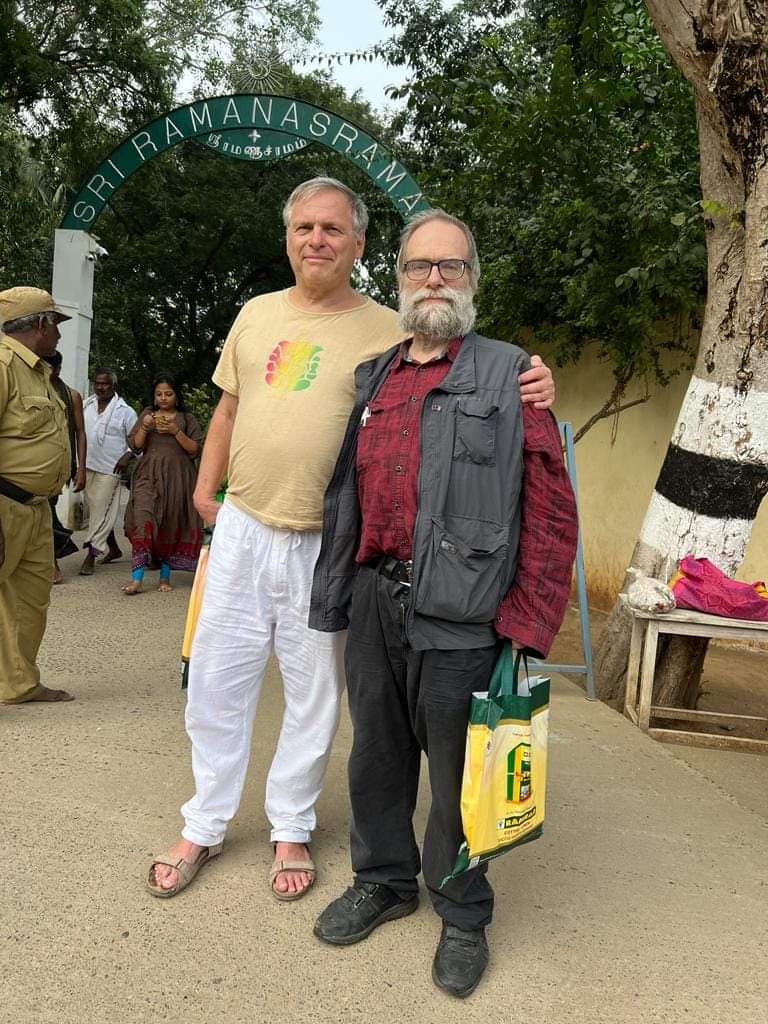 Dirk Gysels With Koenraad Elst At The Gates Of The Sri Ramana Ashram
Are there Indologists who inspire and guide you?
One of my best friends is a famous Belgian Indologist. It is always great talking to him. But frankly, many Indologists have done great harm to Indian culture. Here and there they have offered some valuable insights and made some necessary corrections in the understanding of the dharma, but realize that they earn their bread by tearing down sacred traditions. They are mostly agnostic or atheist and have little feeling for the soul of Hinduism. But luckily there are exceptions.
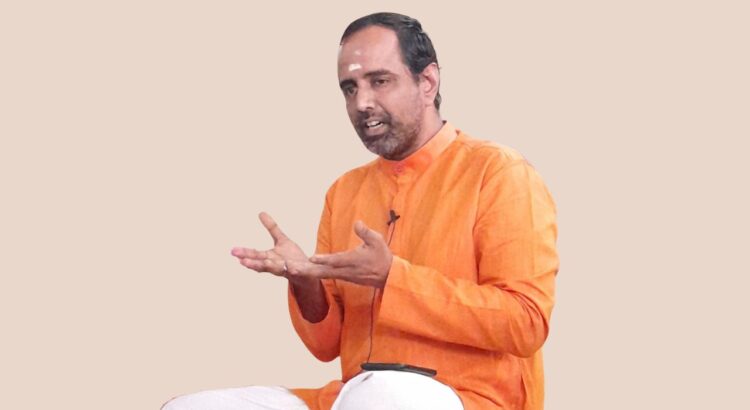
 Prof Jayaraman being felicitated for his contributions to Tamil language by Governor of Tamil Nadu
 Hatayoga Pradeepika translation into Tamil, published by INDICA