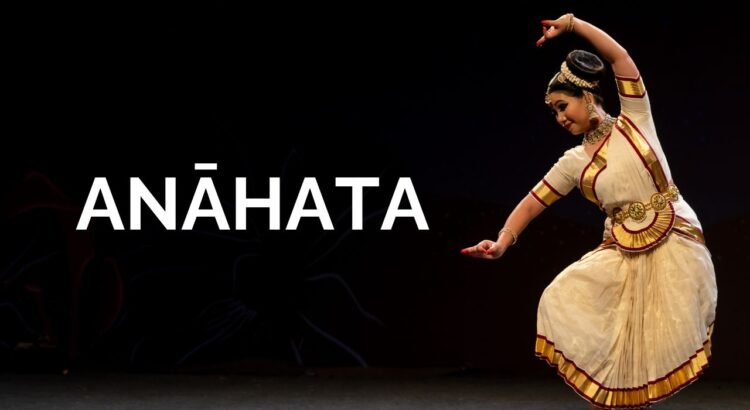
Bhakti Poetry Experienced Through Mohiniyattam

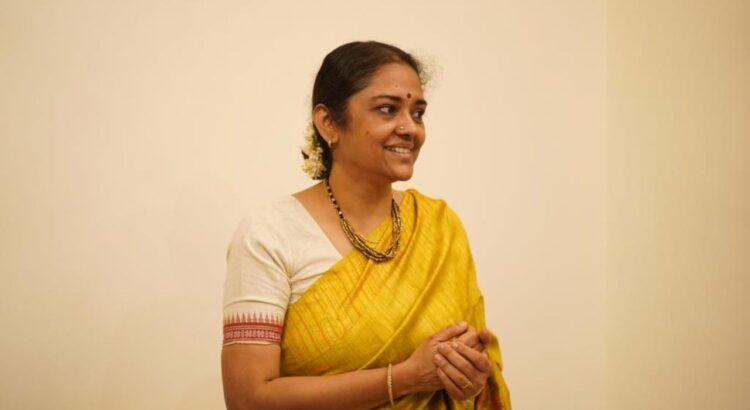
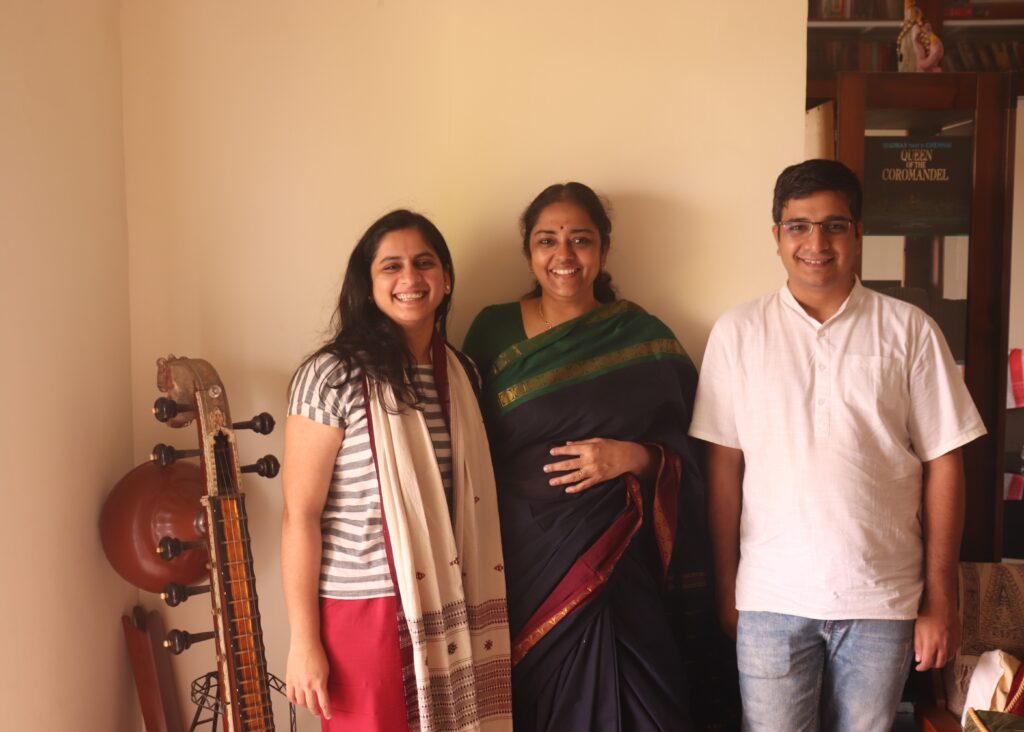
Malavika Menon a Mohiniyattam dancer talks of Anāhata as a state of being, a place of silence and liberation. Her project Anāhata – Seeking the Inner chord of Music delves into the different shades of bhakti. Drawing from compositions of some of the great bhakti saints, she will explore their expression through Mohiniyattam, bringing together different threads of bhakti from across India.

She says the project takes inspiration from the comment of poet and translator, A.K. Ramanujan - “A bhakta is not content to worship a God in word and ritual, nor is he content to grasp him in a theology; he needs to possess him and be possessed by him. He also needs to sing, to dance, to make poetry, painting, shrines, sculpture; to embody him in every possible way.”  Says Malavika, “The bhakti saints had the most unconventional relationships of utmost intimacy, where every tone of rebuke, rage, humor, love, desperation was permissible. God was sacred, divine and beautiful, but he was also family!”

The poets whose work will be featured are Annamacharya, Akka Mahadevi, Nammalvar, Kabir, Marathi saint poets, Sree Narayana Guru, Lal Ded and Jayadeva.

Malavika is a Mohiniyattam dancer, choreographer and teacher, who has been learning and practicing the artform for over 18 years. She is a senior disciple of Guru Vinitha Nedungadi, who is one of the foremost practitioners of Mohiniyattam, from Palakkad, Kerala.

Malavika has been an active solo performer in this dance form and has performed at several notable art festivals in the country. She is also known for her work - Lāsya Mukharika, which was an endeavor to document the history, growth and development of Mohiniyattam through a series of interviews with more than twenty senior practitioners of the artform as well as some senior dance critics who have witnessed the evolution of Mohiniyattam from its early stages. This was an attempt to develop and archive informative material for the usage of dance students, researchers and art enthusiasts.
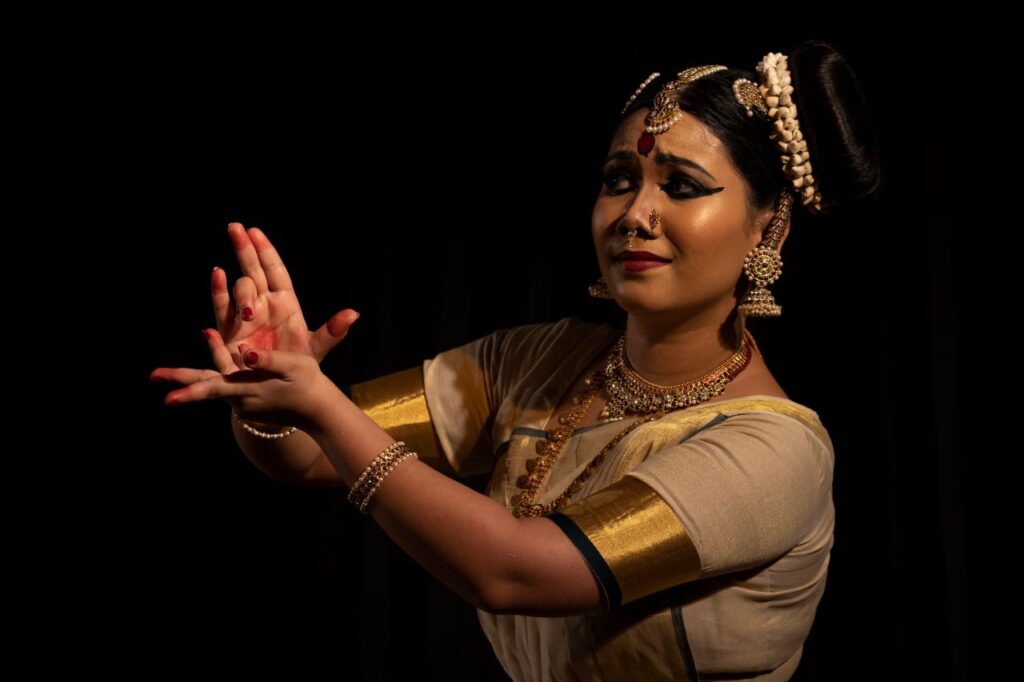
Do you find that Mohiniyattam has inherent qualities that make it suitable to show the ecstasy of bhakti? How is the expression different from say other Indian dances?

All Indian classical dances are stylised forms of art that have a nature of its own. Mohiniyattam’s inherent quality is the unhurried nature and slow paced movements that are filled with lāsya, or graceful lyrical movements. Bhakti comes in different forms, but the underlying emotion is the same across all regions of the world, irrespective of any language, region etc. Bhakti being a universal emotion definitely finds an important space in any classical artform. Dance is an offering in itself to a divine energy, and the aspect of bhakti is deeply rooted in all Indian classical artforms.

What drew you to Mohiniyattam once you had entered the world of dance? Were there other dance forms you practised before?

I began learning dance with Bharatanatyam at the age four and continued learning the art form for more than 12 years. I stepped into the world of Mohiniyattam at 6 years of age, after completing a few years of practicing and learning Bharatanatyam.

As much as I liked and enjoyed performing both dance forms, at some point in my dance journey I decided to focus on one artform and go ahead to involve myself more deeply in its practice, performance and research. It was at the age of 16 that I decided to focus completely on Mohiniyattam. It would have been the richness of the form in both abhinaya and nritta, combined with a strong movement vocabulary that I received training in that got me closer to this artform. My body started responding to the music and essence of this form very organically, and naturally the transition into Mohiniyattam happened. My Guru in dance also happens to be a Mohiniyattam dancer, which also resulted in me being inspired to take up learning and practicing this artform further.

In your series Lāsya Mukharika, you documented the evolution of Mohiniyattam through interviews. Do you feel that Mohiniyattam is underrepresented in the world of classical and semiclassical dance? What are some misconceptions about this dance form that you wish to remove?

Yes, at some point Mohiniyattam was underrepresented or did not come to the forefront as much as other forms like Bharatanatyam, Odissi or Kathak. Probably because it did not have enough practitioners and performers until the late 1990s and early 2000s. The concentration of good performers of Mohiniyattam was in Kerala and the artform did not have much representation outside of Kerala.

Some of the misconceptions about Mohiniyattam for a long period of time used to be that it is performed only by women, it is slow and boring, and involves mostly the rasas of sringara and bhakti only.  But these misconceptions have been wiped out with the efforts of serious practitioners of Mohiniyattam who contributed greatly to widen the scope of performance in Mohiniyattam. It was a combined effort by two to three generations of dancers to introduce new themes, ideas, movement systems to this artform. Lāsya Mukharika was an attempt to document and archive this evolution of the artform by interviewing some of the most important Mohiniyattam artistes in the history of this artform and understanding their journeys with dance.

What gave you the idea to unite several cultures from different parts of India into this project? Do you feel the multilingual nature of the compositions will be better to show the true spirit of the bhakta?

I have been interested in reading bhakti poetry for a couple of years now. It was a sudden idea to incorporate a melange of bhakti poetry in a Mohiniyattam production. The concept arose from the thought of showcasing bhakti with not just a spiritual approach to the divine, but also by portraying the intimate and close relationships many bhaktas had with God. God became family, and was humanized by the poetry of many bhakti saints. I was interested to bring this aspect to light through this dance production. To convey this I wanted to pick and choose compositions of different bhakti saints coming from completely different backgrounds of region, language, class and caste, but their journey was very similar in many ways. The spirit of bhakti overflows in every composition, and the fact that it is multilingual only adds on to the idea that bhakti remains a constant in every life as is universal.

How do you intend to represent the universality of Bhakti while retaining each unique flavour of the regional poems, and Mohiniyattam itself?

The poems will be musically composed in a style that suits Mohiniyattam. However the language it will be sung in will be from the original text it was composed in. The language used will not change, the musicality and cadence of the lyrics will be understood so as to retain its regional flavour while composing the music.

These poets come from different parts of India and wrote in their regional languages, thus making this work multilingual. All the poetry will be visualized in the movement language of Mohiniyattam, which in itself is lyrical and has a special importance for poetry in its repertoire. Being the classical dance form of Kerala, the traditional compositions in Mohiniyattam are mostly in Malayalam and Sanskrit. However, poetry and other music compositions in Tamil, Telugu and Hindi have been adapted to Mohiniyattam previously as well.

This project has been envisioned as a solo production of Mohiniyattam, which would be 60 - 90 minutes in duration. The music will be specially composed for this work, and the studio recording of the same will be done so as to create an opportunity for repeated presentations. The work will be premiered as part of the Soorya Festival in Trivandrum, Kerala.

Would this also in some ways expand the Mohiniyattam repertoire from only Jayadeva's compositions to other compositions.

The concept of bringing together the works of multiple bhakti poets in one presentation would be a novel one as far as the Mohiniyattam repertoire is concerned. Traditionally, Jayadeva’s Ashtapadis are widely performed in Mohiniyattam, but the works of the other poets are not much tapped into, hence making this an interesting as well as an important production to work on. The unhurried and lyrical nature along with the importance of taking the essence in a poem and visualizing it in its movement language with the help of stylised abhinaya and nritta is at the core of this dance form’s vocabulary. The challenge lies in bringing together the different languages and tonality in each of the selected poems to give it an appropriate musical composition that will not take away from its regional flavour but at the same time suit the spirit of Mohiniyattam.

The poems of Lal Ded, Andal, Mirabai, Namdev, Akka Mahadevi are all rarely or almost never been adapted into the style of Mohiniyattam. While some other Indian classical forms have adapted this poetry, it would be a new attempt as far as Mohiniyattam is concerned.

How do you think we can achieve a state of Anahata through our dance forms. You quote AK Ramanujan in saying we need to possess our deity. Are the two linked?

Anāhata in this context refers to the state of mind that has found an inner peace and silence. The point of finding one’s inner music where all other noise is silenced. The true spirit of all classical dance forms is also to find this inner peace or vishrānthi where all other externalities become blurred and only the dance exists. In a way, a bhakta also seeks such a silence, where he/ she can become one with the paramātma. Where one’s body, mind and soul is tuned to attain mukti or sayoojya.  The process or experience may be different, but dance is also a prayer that is done with one’s body, mind and soul to attain that oneness.

As AK Ramanujan refers to the bhakta’s state of possession, a dancer’s state of being completely immersed in the dance is also definitely similar in philosophy. Only with complete immersion, the true spirit and power of our classical dance forms can be experienced.

What new insights will music lovers get who have heard these timeless songs scores of times when they see your performance? How will the music be transformed?

The music for this production is being planned and composed in such a manner that it suits the rhythm of Mohiniyattam as a dance form. Having said that, it is also important to keep the spirit of these songs and the cadence and rhythm of the poetry intact. Some of the music compositions are timeless pieces that are very widely heard, but the newness will be the form in which it is danced to. A Marathi abhang is not something one gets to see in the Mohiniyattam dance style. So the challenge is to create choreography that merges with the music and will be a different and fresh visual treat for the audience.

Some verses such as poetry from a famous work of Sree Narayana Guru will be rendered in a  Carnatic raga and given a new voice when added with a traditional pure dance piece such as the Cholkettu in Mohiniyattam. Some of the poetry that we may have heard as a bhajan or kirtan, when taken for dance will have its own flavour and form. This would certainly be a fresh experience for viewers.
A Book That Helps Indian American Kids Explore Their Identity

Dr Bijoy Misra serves as the President of India Discovery Center, USA and leads the efforts of content creation and organizing the IDC activities. A physicist by profession, he has turned his attention to promoting authentic information about Indian history and culture. He helps run the South Asia Poets of New England group. A Sanskrit scholar, he is currently an Honorary Research Associate in the Department of South Asian Studies at Harvard University.

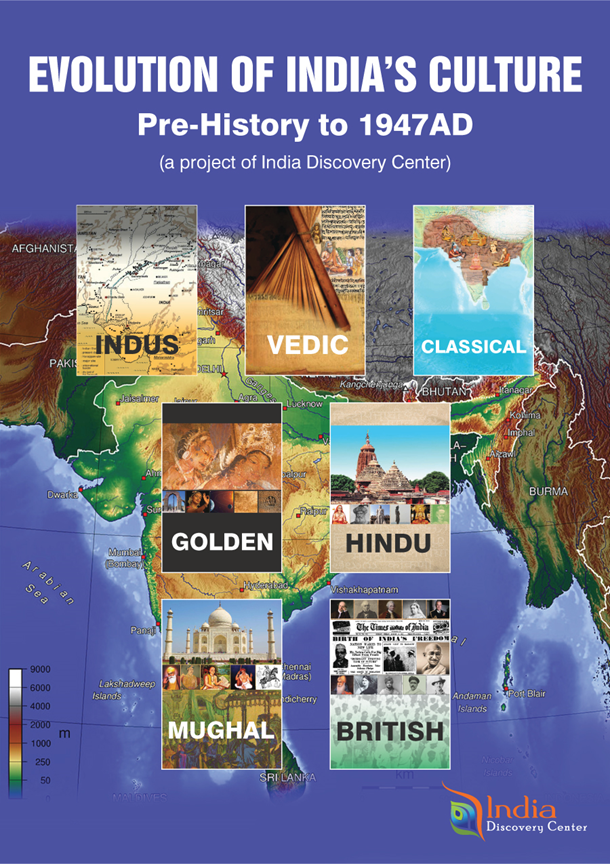
In this interview, Dr Misra talks about the new book published by IDC – Evolution of India’s Culture – Pre-History to 1947 AD. Below is a short excerpt from the Art and Culture Chapter:

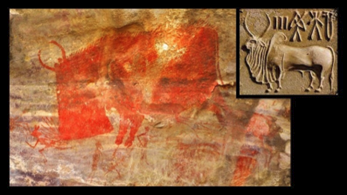
The earliest ‘culturally conscious’ Indians belonged to the H. erectus communities of the Middle Paleolithic period, who created the ‘Nevasan’ (and Soan) cultures 500,000 years ago. Sites for this culture are spread all over India and yield siliceous ‘flake stones’ and ‘axe-cleavers’, with rituals guiding life and death. Around 130,000 years ago, these axe wielding hunter-gatherer hominids began occupying the ‘Bhimbetka’ caves of central India (approx. 750 rock shelters over 10 km) which became one of the few continuously maintained ‘cultural’ landmarks well into recorded history. (Figure 2.1.1)

Figure 2.1.1: Depiction of the Indian bison on walls of Bhimbetka vs usage the bull insignia in Indus seals

PDF copy of the book can be downloaded free at https://www.indiadiscovery.org

What inspired you to write this new Indian history textbook, and what unique perspective or approach does it offer compared to existing textbooks?

My mother always advised me that our children should know about India and her story.  I participated in an Indian cultural school that ran on Sundays in the US.  Through my interaction with the students there I realized how little I knew about my origins.  I took interest in Sanskrit and that opened me a whole new India that I had not seen before.  I realized that Indian history has only been written by visitors through anecdotes or journalism. I thought we had a unique opportunity of observing India from a distant land with eyes of Indian descent.  I helped create tracks and teams to research the tracks to help create a story for our children.  Indian American children are a new entity in the modern world, and we thought we should help them explore their identity.  So, the book.

Film makers today are revisiting India’s recent past, post 1947, looking at history from an Indian point of view. Is this something that is important to you?

It is important, but not relevant.  Blaming the past or observing differently will not help clean the stains.  The British did try to derail India to digress from her fundamentals.  It would appear that they succeeded.  The new India has become a political entity than a cultural entity.  India needs massive man-power deployment and exponential production.  The new films look like marketing videos, which would not help children.  India has to help create a student body deeply entrenched in the wholesomeness of life that India discovered.  The education system needs major metamorphosis towards the fundamentals.

Can you provide an overview of the book's structure and organization, including the key time periods and themes covered? Art and Culture has been given a special place, which is not usually done in other history books. How important is it to give this perspective of India where art is an integral part of our daily lives.

The tracks were determined through an initial key word indexing.  I had designed courses and taught Digital Libraries at Harvard before.  The indexing organization came from this course.  You can call it meta-word statistics through matrix analysis.  Twelve people participated to make an objective scheme.  The time periods were driven by the available literature. We broke it into segments such that we could be focused in our statements.  Very early we realized that India is a nation of Art.  Some of the local dancers and musicians were attracted to research and they put their signature to the story.  Some of the early sciences in India are artfully expressed in beautifully crafted sentences.   Nature provides art to India that translates into people’s lives.  I must say that it is eroding, the erosion must be halted.

Given the vastness of Indian history, how do you strike a balance between depth and breadth in your textbook?

We cover what is available in literature.  We distribute ourselves in the country and among people to ascertain our viewpoint.  We give ourselves time and we discuss in weekly meetings.  People of different backgrounds, different ages, different professions and genders join in the discussion.  We develop an immigrant’s view which has no region or religion in it.  The track leader presents the view through a set of two dozen slides in a public seminar attended by about a hundred people.  People join as an open-door policy.  The seminars, one per period, were held every six months.  The seminar presentations are given as references in the book.  We plan to assemble all contributors in a meeting next year when we map to create the second part of the book (From 1947 AD to the current time.)

How do you incorporate primary sources, visuals, and multimedia elements to make the learning experience engaging for students?

In the book, we only give 2 D pictures.  We do give references to websites where further exploration is doable.  Our goal in the book is to breeze through the massive history to show that India is a living culture.   A good man can be vandalized if he/she is not careful.  We hope such message might come through, which could be a good learning experience for the world children.  We are developing a multimedia project called Virtual India, which would be in the mode of self-learning and research.  There we hope to analyze the fundamentals of mathematics, astronomy, language, grammar, art, music, sculpting, metallurgy, building, food, medicine and yoga.  This may take another three to five years to be coded and developed as a product.

The authors of the essays are senior experts in diverse fields. How does their contribution encourage critical thinking and discussions among students about the complexities of India's history and culture?

I don’t think we would call ourselves as “senior experts”.  Our only definition is that we entered the project without any bias.  We have to see India as a child may see.  We have to explain the scene to the child.  Our own children grew up before we could create a dialog, we thought to empower the future parents.  What I personally discovered that India as a culture refined itself by heavy experimentation.  Certain fundamental ideas of these experiments are built into respecting the people and respecting the tradition.  Amidst this lie the utter respect to truth and acceptance of events.    Truth will shine and the oppression will cease, we only have to work with diligence and utter sincerity.  Noble leaders will come from our children, so is our hope.

Economic history has been integrated into every narrative of India's past. India’s economic attractiveness and uniqueness in the Indian Ocean region was of much interest to the world. How is this brought out in the book?

We do show maritime trade with the Arabs during the Indus Period.  Maritime trade had exponential growth a Mauryan times with boats plying up to China.  India was a big exporter of grains and raw material in those early centuries.  We ascribe India’s opulence in the Golden period to the maritime trade.  All exchanges were in gold and silver.  We show sea routes and do narrate some of the expeditions.  Far east was colonized and Indian culture did spread to educate and to spread the faith system.  We show how the sea routes eventually became the pathways for the western ships to come and camp in India.  We develop a thesis that the occupation of India was because of the regional autonomy in trade leading to local negotiations and tricks.  This is our viewpoint.

India is a country with significant regional diversity. How does your textbook address regional variations and their impact on the nation's history and culture?

We address it, we don’t consider it a handicap.  It makes the culture rich.  In our Language and Literature track, we show the massive display of talents all around the country.  Harmony and coexistence lead to stability and creativity.  Spectacular temples of different styles have come up in different parts each respecting the other.  Divisiveness was caused by controlling the food distribution by instituting some federal rule.  Many of the British rules need complete revisions in modern India.  Whether a good government would come with a bright leader is a good question.  It can be a function of time when ownership is created.  I would think it may take fifty to a hundred years.  Our book may help.

How have recent developments or research findings influenced the content and approach of your textbook?

We are so designed that we can revise the book as new discoveries are made.   Fundamental questions like how Sanskrit developed as a language or who the Vedic composers were need serious multi-disciplinary research.  We note in various places in the book where new research is needed.  Our hope is that some in the new generation will take up India as a challenge to explore the fundamental ideas of the culture.  We have to find the veracity in the statement of Charaka that the faulty mind causes disease. Is it a statement or a discovery?  Man is not born to die, but dies out of own misconduct.  Charaka’s book needs huge knowledge analysis to establish an eastern view of life than that of conflict, struggle and decay as developed in the west.  It is one of many examples. Some of us are engaging to find the neurological implications of human speech following the Vedas.

Professor Subhash Kak in his recent book The Idea of Bharat states that whatever the origin of the use of the name, Bharata (meaning absorbed in light or wisdom), is the right fit of “how Indian has been seen by natives and outsiders, as a storehouse of spiritual and scientific knowledge.” Your book reflects this truth. What are your thoughts on this, in the light of the country now readapting this name.

I have not seen the book yet.  Prof Kak just mentioned to me about the book.  I don’t think a name change is important or necessary. India as a name is celebrated and respected in the world.  Meaning of any word is arbitrary, India as a word also provides deep philosophical and intellectual messages world over.  This must not be lost.  Panini called the names as samjnA संज्ञा, how people would know.  We should keep operating on conventional लौकिक names not to create confusion at the present time.  We have other pressing issues.  Living abroad I see the depth of the word India.  It has a charm and a glory that must not be subdued.  भारतवर्ष may have the right diction, but that is a different discussion.

Indian Philosophy has largely been dialogic and not prescriptive, says Pavan K Varma in his book The Great Indian Civilisation. While our greatest texts are seen as Shruti or revealed texts, there has always been space for debate and evolution. How does your book deal with this tradition? How does your book explore the role of religion in shaping India's history and culture?

Again, I have not read the book.  We also made a point not to read any interpretation books but to stick only onto the sourcebooks.  On philosophy we found the discovery of personal freedom through Sankhya सांख्य as the most dominant thesis.  Individual freedom helps foster creativity and that has helped the culture to evolve, thus is our view. श्रुति created a paradigm of conformity, to respect what was observed in the past.  The parts of observations are analytic, the speculative portions are debated.   Modern religions are local cults to create belief systems.  They are not analytic.  Rituals are done since they did yield results.  It needs huge discipline and a lot of blessings for the success of a ritual.  Through Islam and the British, India had to abandon the long processes of ritualistic discipline in favor of quick worship and dependence on luck.  Some people still live on truth and they win the life’s struggles.

As the publisher, what do you hope students and readers will take away from your textbook in terms of a deeper understanding of India's history and culture?

We did host a local teachers’ workshop two weeks back on Sept 30.  Three Middle school teachers and one High School teacher participated.  I did say in my introduction that we hope that the teachers may find a different message for children in the book.  The western system of education and classroom processes are designed to foster individualism than social acceptance and community development.  What India discovered is that each person is good in his/her own way and the education is a tool to tap that innate potential.  So, education is cooperative and a method of helping to develop respect for each other.  Everybody does not have to score a goal, but some can cook good food for the team.  All can be respected.  No life is less than the other. Teachers were very intent in listening to me.  But to create a modern classroom based educational activity would be a challenge.  I realize that the western method of competition for individual security is spreading fast. With the current opulence in the US, nobody would be left behind if we create a society with respect for all.  Respecting the individual in his/her own being is what India taught to the world in history.  Hopefully it will shine back again, our book may help.   India herself has to be the leader in this transformation.

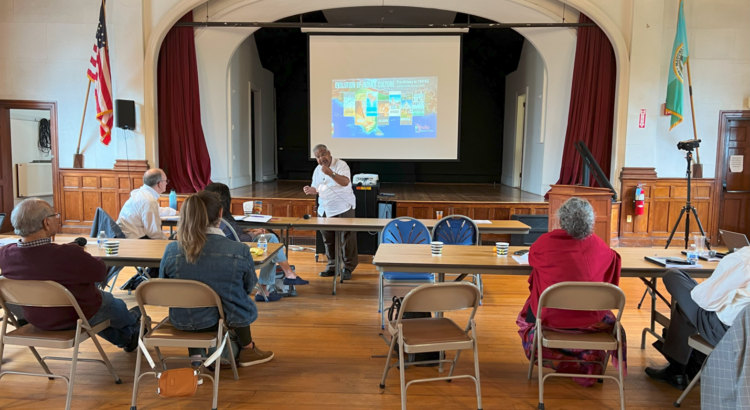
Feature Image: Dr Misra introducing the book to the local teachers, Sept 30. Workshop at Bemis Hall.

My Heart Belongs To India Says Spanish Teacher

Sonia Ortiz hails from a fishing town in northern Spain near Bilbao. "I found the way to spice up life through teaching when I discovered international life, as it combines my two passions: teaching and travelling. My first position in an International School was in Colorado Springs. After that I returned to my home country for good, but it ended up being a good two years instead, until I landed in Colombo. After my last attempt to live back in my hometown, I understood my wings couldn’t be folded."

Therefore, she embarked on a life changing experience to Yokohama, Japan. And then to a new adventure in HCMC, Vietnam, where "my driving force was born: my beautiful, heartwarming son. And then fate brought me to India, to Bangalore, where I have been living for over a year now."

She first travelled to India in 2015, to Chennai plus the cultural triangle of Delhi, Agra and Jaipur, where she encountered colours, sounds, flavours, smells that "I had only dreamt about before. My second trip was to Mumbai, Goa, and I actually came to Bangalore and Mysore. I found our city an oasis, so comfortable for an expat, diverse and welcoming. And in my third trip, India stopped being a tourist destination to become home, a home with a throbbing heart where I feel so valued, appreciated and loved."

Sonia moved to India from Vietnam at a time when she felt it was time to move on in her career as a international educator. “I had done my first interview and already, even though I had other options in other countries that were interested in me, I fell in love with the idea of moving to India and being able to experience Indian culture first-hand and to live in such a fascinating country.”

She says it is ‘fate’ that brought her here. “I really think it was fate because I really feel that I have found my place here. My heart belongs to India. It's everything from my school which I go to work happily every day, to my students and my colleagues whom I love. I love my apartment, the city. I really feel that I have found a place that I appreciate and it appreciates me and the combination makes me a full person.”

Asked about her first impression on landing in India, Sonia says when she landed in Bangalore airport, she was struck by how modern the facilities were and how everything was “was so clean and well-lit, even though it was about 2 am in the morning.  And I remember coming out of the arrivals gate and seeing all the cafes and restaurants. Of course, everything was closed, but I just thought, my goodness, what an exciting place to be in.”

Of Bangalore, Sonia says that one has to make the effort to know it and it is not like “many other cities around the world, things are not obvious. They are somehow hidden, but it has so much to offer, so when you make the effort it's a real pleasure and you discover many interesting things. My favourite thing to engage in is to discover little by little the things that Bangalore has to offer mostly with my Indian friends.”

Sonia says she is lucky to have some close Indian friends with whom she loves spending time with. “I love hanging out with them and going to different restaurants and cafes trying out new foods, and of course going shopping for example to Commercial Street and seeing different fabrics, stores, the prices and the styles. I love going to the different landmarks of the city, both by myself and also in particular with Indian friends.  For example when I went to Cubbon Park, I got a picture of how it used to be versus how it is now and a more personal point of view like different corners where people used to do things that now are forbidden in the parks such as picnicking or the little toy train or the different statues and the meaning they have. I'm very proud of my Indian friends and I hope I would be able to make more and to keep seeing the city through their eyes.

Speaking about the rally she participated this month with Heritage Parampara Trust, she says there is no one thing she can speak about as everything about the rally was unforgettable.

“Everything was such an incredible experience from the beginning to the end. I started the rally crying. I freaked out because it was my first rally ever and a couple of hours before starting, we were told that we wouldn't be in the amateur category but in the professional category. However, my partner, the navigator, was very supportive. The rest of the participants that I talked to were so nice and they tried to calm me down and said very nice things to me. The marshals were very supportive too. The racing parts were so filled with adrenaline rush.”

The rally for Sonia meant heightened emotions and feelings. An avid photographer she took numerous pictures of the temples and all the sites they traversed. “I took so many pictures there because I was not only feeling my eyes but my soul as well.”

The route included Kote Varadaraja temple in Sathyagala, Himavad Goplaswamy Betta, Chamundi Betta in Mysuru, Saptamatrika Chowdeswari, Karighatta Srinivasa Temple, Vaidyanatheshwara Temple, Hole Anjaneya, Ugra Narasimha and Varadaraja Swamy in Mallur. The thrill of the rally accompanied by the scenic sights of nature intrigued Sonia. “Being able to absorb the sights and the sounds and the colours of the Indian countryside was really soothing. So everything was fantastic and I would like to include the food, the hotel, the people from the company that came to see us off on Sunday, with all those little kids around. The gifts that we received, everything.”

Coming from Spain, the scenes and sights of the Indian landscape are vastly different from what Sonia is used to. “But I've been living in Asia for many years now. I started in Sri Lanka where I lived for one year, six years in Japan and nine years in Vietnam. And still I can proudly say that India is unique. Indian landscapes wouldn't be the same without all those colourful village houses which you see when you are driving by,”

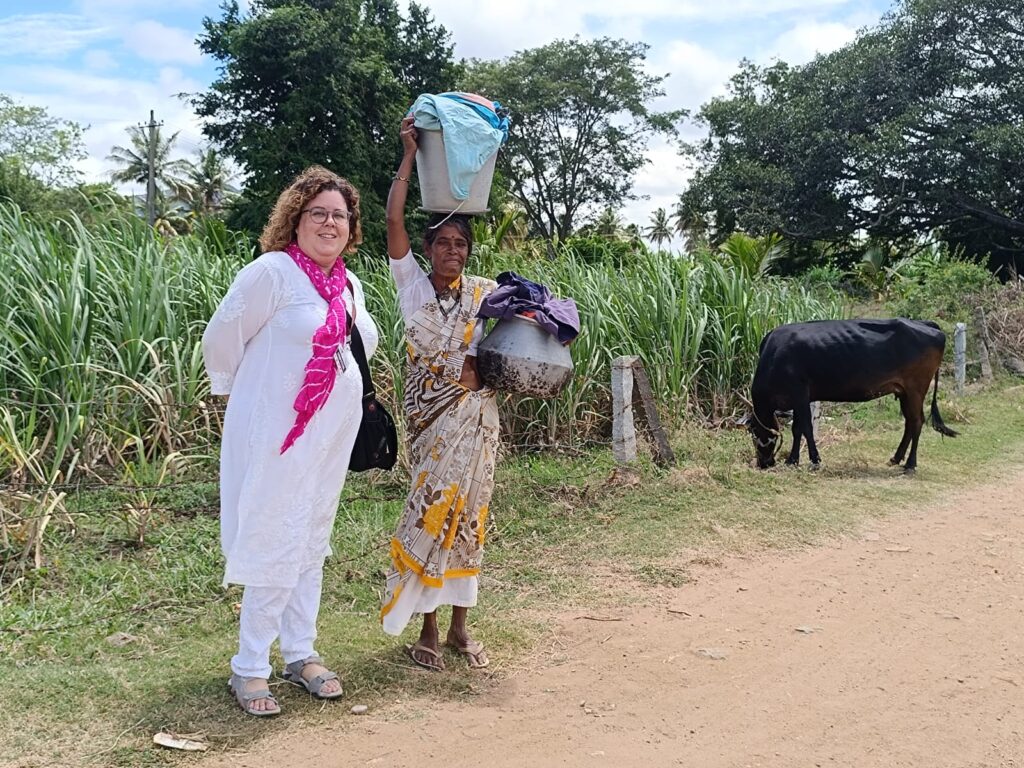
“I have taken so many pictures of these houses. It is usually not the house itself that attracts my attention. It's about what people make of their lives both inside and outside of those houses. So the architecture is basically an extension of their lifestyle. They sometimes wash their clothes there, they chop the vegetables outside, they just chill and hang out and talk. There are people of different generations, which is something I find very, very warm. In the landscapes, of Karnataka, you have a mixture of forest and rice fields, mountains, some drier areas with palm trees. Driving around Karnataka is a way to experience a lot of different sites that you could never find in a travel book or even by recommendation.”

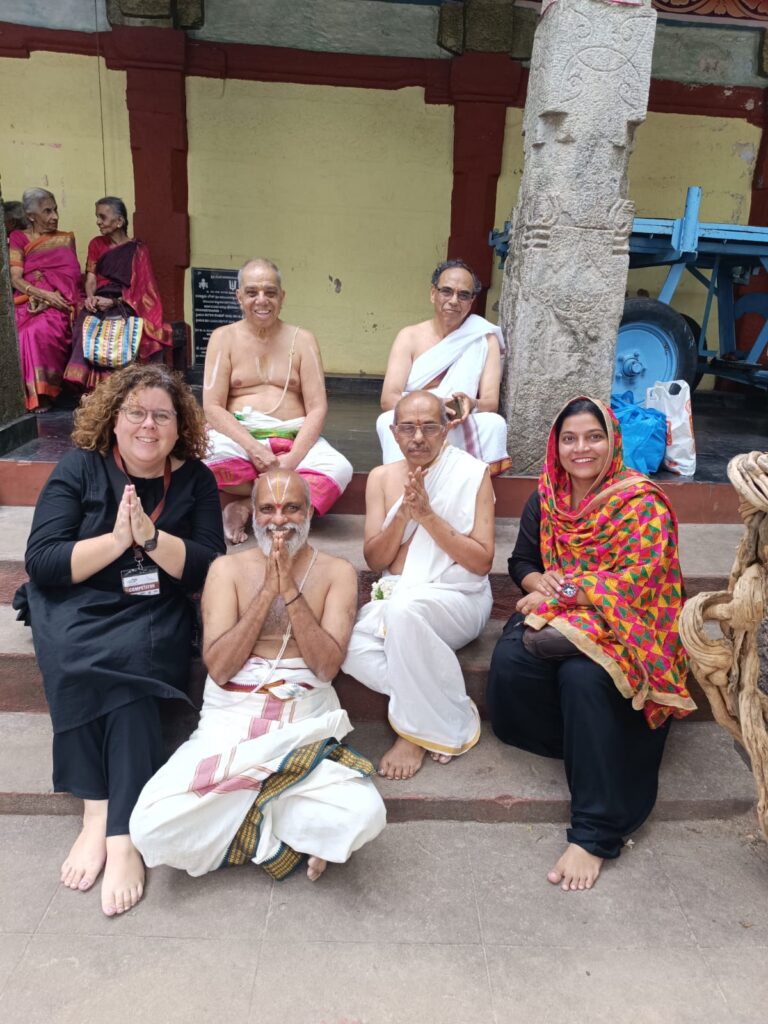
As for the temples she saw on the way, Sonia says they were all very different from each other – “really interesting and full of culture and history”. They are alive. They are not only historical relics or heritage sites, they are places where the community gathers and not only prays, but they eat and socialize and make a life there.”

This was something that touched a chord for her, because when she visited Central Spain this summer and went to a lot of villages, she found that several of the churches were closed most of the day because there weren’t enough priests to keep them open and a lot of the villages to her seemed to be dying. By contrast, “India is everywhere, so full of life and it has such a strong feeling of community and community life.:

Sonia hasn’t had an opportunity to listen to too many Indian languages. Her work environment in school, she says, is 100% in English, and as a foreign language teacher the common language of communication is English.

“So at work, I don't hear any Indian languages other than in the background sometimes. Anywhere I go, obviously as, I'm a foreigner, and I kind of stand out with my hair and my eyes people immediately switch to English, so I don't even have the chance to listen to the language (Kannada) much.”

Sonia is hoping that once she settles down and has a little more free time, she can learn the local language. “And in that time, I would like to go to the movies more often and watch more Indian movies and get my ears full of the sounds of Indian languages.”

Colour, music and dance are a big part of both our cultures. Sonia couldn’t agree more. “It's so funny that you include colour in the question, that's so important for me. And actually, I tend to identify each country that I've lived in with a colour. For India, it would be orange, and orange is actually my favourite colour. As for music and dance, I try to join every single time that I have an opportunity to join. Whether that is different dances that we do in school to be performed in front of other teachers and students, or in my community where I live, that they sometimes organize different festivals.”

For Navaratri, Sonia says it’s going to be the Dandiya Festival. Her neighbourhood is organising some workshops and “I'm very excited to go and join the dances and learn the different sounds and different tunes of the music. As for art, I've attended many different art exhibitions by different artists. I'm so proud, for example, to say that the last art exhibition I attended was actually by two artists that are my colleagues and my friends.”

Sonia Ortiz is full of life, fun and has a deep curiosity about everything she encounters in the city and country where she has made her home. Wishing her many more years of fun in India.

Talking With Tradition, Connecting Shastra To Samaj

Dr Sushruti Santhanam combines her musical talent with an intellectual rigour on researching Indian art forms. Based in Pune, she founded the Centre for Arts, Society and Policy (CASP) www.casp.org.in which is a practitioner-initiated space looking at how art emerges in the interaction between aesthetic need and social life. She has worked for decades with artists from all over India.

This year, Dr Sushruti has initiated district level surveys of traditional performing artists (music, dance, storytelling and ritual arts) sponsored and promoted by patron and people’s group in each district. The pilot of this project Abhilekh has been launched in Solapur district of Maharashtra.

The second project she says is “creating a consultation with artists on ideas of ownership, stakeholdership and innovation, designed as a response from traditional artists to legal frameworks of IPR and copyright.” CASP will be organising a symposium in October as part of its annual series Talking with Tradition. This year’s theme is –Traditional Knowledge and Ownership. She spoke to INDICA about her music inherited from her illustrious mother, Sangita Kalanidhi R Vedavalli and her interest in research on the Indian arts.

What are the roots of your interest in the arts that led to the setting up of CASP

I have had the opportunity of being born in a family where everything revolved around music. In later years I had the absolute privilege of working closely with traditional artists and some artisans across three states. I also found some very unique and extraordinary teachers particularly Guruji Ravindra Sharma of Adilabad and scholar of handloom and craft knowledge, Dr. Annapurna Mamidipudi who helped shape my perspective on craft and art dimensions of Indian society. I became fascinated by how knowledge moved, how it worked in producing art forms that are at once old and new, at once intimate complex thought processes and a socially evocative phenomena and how artists both conserve their aesthetics while simultaneously responding to changing contexts.

Combined with my knowledge of Carnatic music and a ring side view of the professional life of Carnatic musicians, my attention was forced onto the relationship between art and society, art as a way of knowing techniques and as a way of knowing the samaj.

I studied the works of Ananda Coomaraswamy and it helped me understand arts practice as the basis of collective identity, a collective space of catharsis, a structured space of training the mind, a deep state of spiritual evocation and a resilient and long-lived profession.

It made me ask grainier questions about traditional knowledge, about its mechanics, about how it helped art shape social cognition. I studied tradition more as paddhati (modality) not just parampara (genealogy), as the workshop that forced artists to connect shastra and samaj.

I wanted to create a space where this conversation could be captured through research and work with artist communities, where practitioners, scholars and others who are invested in Indian performing arts, could share their insights and concerns.

What is the vision and mandate of your organization? Who are the stakeholders and how do you hope to create impact?

The challenge in theorising on Indian art is to bridge the gap between scholarly work and the language of its experience in society. The other big assumption that we need to fix, is the idea that the ‘performance’ in performing arts refers only to stage performances (to the extent that all forms of singing, dancing and story telling are today being brought on to the ubiquitous urban stage).

The primary provocative statement I made before setting up CASP is “Traditional art is not entertainment”. I hoped that this would make people ask, what else is it then. I looked for people who worked in the domain of performing arts who would resonate with this idea. And that is how I met Baithak Foundation’s Mandar Karanjkar and Dakshayani Athalye.

I had been working through my Dakshina Dvaraka Foundation (DDF) on public curation of the philosophical perspective of Ananda Coomaraswamy. He draws a very insightful picture about how Indian society nurtured arts practice as a knowledge system and theorized its processes while allowing for it to be expressed playfully and evocatively in the public sphere. DDF did a series of curated performances over a period of 5 years before covid lock down combining art and craft, history and design, to illustrate the unity of Indian aesthetic thought.

Baithak Foundation was deeply concerned about the loss of experience of traditional art forms in common spaces, especially focussing on the loss of access among children of underprivileged, migrant and rural communities. They run an arts appreciation program which they now manage in over 40 municipal and rural schools in Maharashtra.

We combined the two streams of work in art research and intervention and asked the questions about common social patronage for traditional arts practice in Indian society.  CASP was then conceptualised as a kind of an R&D space for organisations that are seriously interested in making effective interventions in the field of Indian arts, going beyond archiving disappearing art forms or organising events.

We want to re-tell the story of Indian Arts traditions as being central to the social cognition of society, as a way of knowing the world. In our idealistic moments we would also dream of seeing local markets for art forms flourish so that Indian artists don’t become a charity case for government schemes and NGOs. We want to work with artists, traditional communities that patronise and use these art forms (across economic and social classes), urban organisations, support groups and policy makers.

Photo Credit By Sri. S.Harpal Singh, Adilabad

As the daughter of an illustrious Carnatic musician, do you think that such a traditional art form can adapt to changes without impacting its core values? What according to you are the essential values which should be preserved.

There are two things about tradition. How we have come to perceive it and how it actually works. These two often do not coincide, especially in today’s public imagination of what tradition is. Tradition is somehow seen as unchanging and gets defined more through texts than through practice. Anything that is transmitted through aurality changes and the Guru Sishya parampara is more than just an aural mode. As a student of music, I was told to stick to the Guru’s way in more than just musical behaviour. But as a student of History, what I have learnt from watching my mother, her peers and her talented and committed students, is that traditional artists take on a mandate of keeping their art form relevant to contemporaneous contexts.

They have to secure the ground beneath their feet before they speak of values. This ofcourse each artist will do with varying degrees of understanding and conviction to the lineages they represent.  The great traditionalists speak of dealing with change not rejecting the idea, slowing it down so that it may be moderated. Two dimensions of music help them, in the case of Raga Sangita, following the oral lineages and the ascriptions to shastra; the other, is social memory of the elements of the form. Both these anchors are referred to by the term ‘tradition’.

In both streams, adapting to change is mostly a technical process. I have watched my mother and several respected elders of Carnatic music speak of the tradition, dilution and realignment with the audience. They were technical discussions. The grammar and syntax of music anchored practice and the social compulsions and tastes pushed ahead the transgressions. This negotiation keeps the art form alive.

That action of negotiation is the core value of tradition.

These negotiations sometimes take place in relationship with an audience community, sometimes in the musicological space and sometimes through technology mediations. As long as there is negotiation there is engagement with the form of the art, from antiquity to now.

In carnatic music for instance, one of the core values is the form and recognition of a raga and this process is, today, vested in the repertoire of the vaggeyakara, their predecessors and their sishya parampara  (and those that followed that parampara impressionistically as well). The vaggeyakara compositions are like the early laboratories that combined the best of theoretical frameworks of ancient musical forms, with experiments in compositional form of kriti, that was later adapted to the ubiquitous kutcheri.

Questions of ownership with regards to the arts has so far been addressed along community and caste lines rather than in terms of individual ownership.  Is this a shift brought about the economics of performance?

Ownership as authorship, yielding recognition and validation is an old debate. The more recent positions taken by historians and anthropologists largely highlighting inter caste dynamics as being at the core of an idea of ‘appropriation’ of knowledge and the gradual exclusion of some communities that were holders of art knowledge in the previous century from modern performance spaces, address very limited historical questions. I think many historians also are looking beyond these binaries to look at issues of technology mediations, sovereignty of economic practices etc. There certainly is an important conversation there, which society needs to have and resolve, regarding exclusion and appropriation of knowledge.

Appropriation is one way of looking at transgression of a knowledge genealogy. When we ask how musical knowledge passed through the 20th century, much as we may ask how did the knowledge of stock trading pass, we will encounter instances of linear progressions but also transgressions and complete discontinuities of practice. Knowledge will pass on between spaces and communities, as its systems transform. It is not the job of the Historian to judge these processes, merely describe them to the best of their methodological capacity.

Every era of History writing has some predominant social concerns which gain centrality for the Historian. In the past 2- 3 decades or so the foremost concerns of historians and sociologists of Indian society have been related to caste, religion and politics. It is not a surprise hence that these concerns reflect in writings on traditions of art practice.

Mandar Karanjkar, Dakshayani Athalye and Sushruti Santhanam (centre)

Sociological tools to study society are often inadequate in the arts. What new ways can we study Indian art performance and its changing nature today?

The answer to this continues from the previous one. Historians must also address the gaps and inadequacies in the basic theoretical framework within which academic writing happens, whether in history, anthropology or ethnomusicology. For instance, traditional arts practice in India challenges very basic working definitions and binaries like theory and practice, tradition and innovation which are commonly seen used in academic writing. In some sense this confusion has even entered institutionalised music instruction, where curricula are divided into theory papers and practical exams.

New tools and perspectives to study Indian art traditions are going to have to come from studying their techniques, not just those that are contained in texts, but those that are embodied as creative techniques and listening practices, as techniques that translate sound and vision into a collective of cognition of raga and hasta mudra. We have to also look at how these processes are entrenched in the vocabularies of communities that use and patronise art forms.

Indian art forms are very unique not just in content but also in their transmission.  They can add value to largely Western models of AI and IPs. Should we evolve new laws which are more relevant to the Indian context?

The reason why I began looking at Intellectual Property Rights, copyrights, patents and GI, that are now being discussed in relation to the practice of traditional arts, relates precisely to your question. For centuries knowledge in the arts has been transmitted through processes of imitation, interpretation and experimentation. Should we not first understand how this was done before we claim to secure it through laws that were created elsewhere to suit the requirements of an entirely different social value system.

Consider this, applying copyright laws to music is a transference of laws from publishing to performing, which are two different modes of knowledge production. Even if we are to consider the music industry and reproduction of music as being aligned to publishing, there are vast differences in how we view authorship when it comes to traditional music/arts. Its modes of ascription, stakeholding, contributions, validations are very different and perhaps have been seminal in shaping the art forms as we see them today. Should we not ask what would happen to the art form if we change the modes of ownership without consultations and deliberations? That is the theme of this year’s edition of Talking with Tradition, our yearly conference.

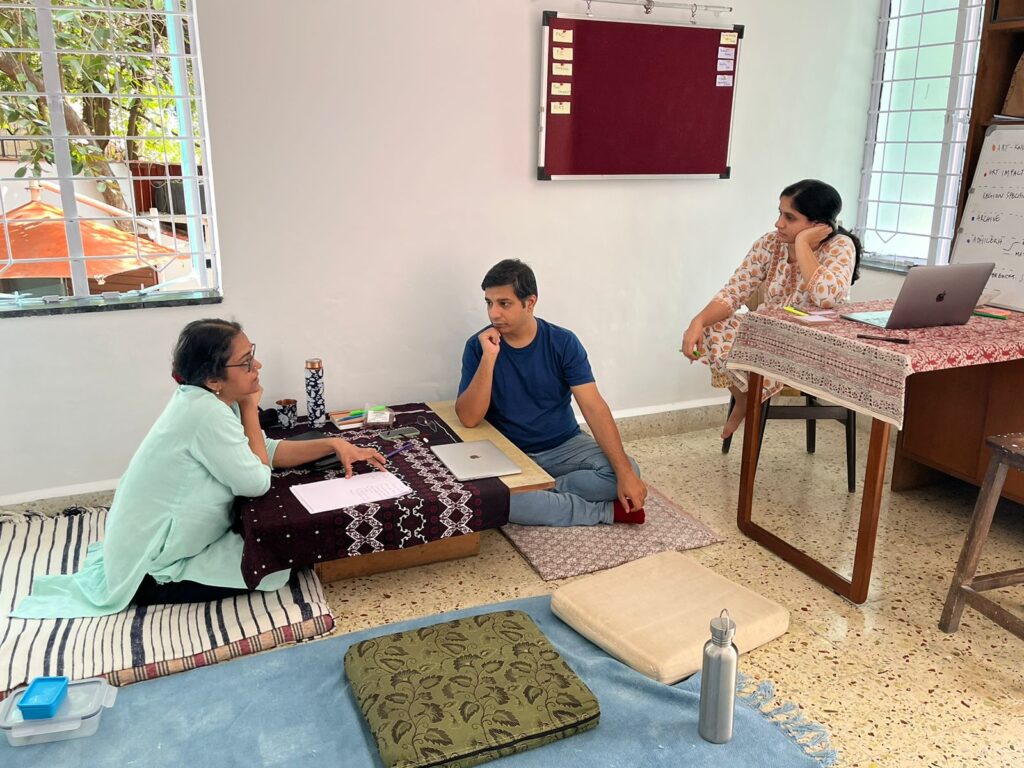
A Pre-Event Huddle At The CASP- Baithak office

How are you documenting local art forms and how far have you progressed in your work?

Documenting art forms and making databases is one kind of work. The question that we ask is how can such a database benefit the practitioners? There are government schemes that benefit a few artists but the survival of any practice depends on the sustenance given from local markets.

We have just begun a project in Solapur where in collaboration with an eminent industrial house and the Solapur University, we are enabling students to do a survey of musicians, dancers, storytellers and such art practitioners in the district. The involvement of institutions and the community at the district level, would mean that they are invested in the data that is produced there. The visibility of the project we hope would create impetus to revive the market for the artists within the district.

Another project we are starting in the Northeast, helps communities document their own disappearing art and crafts practice.

Video Excerpt of the Interview

The Cosmic Art Of Rangoli Designs And Sound Vibrations

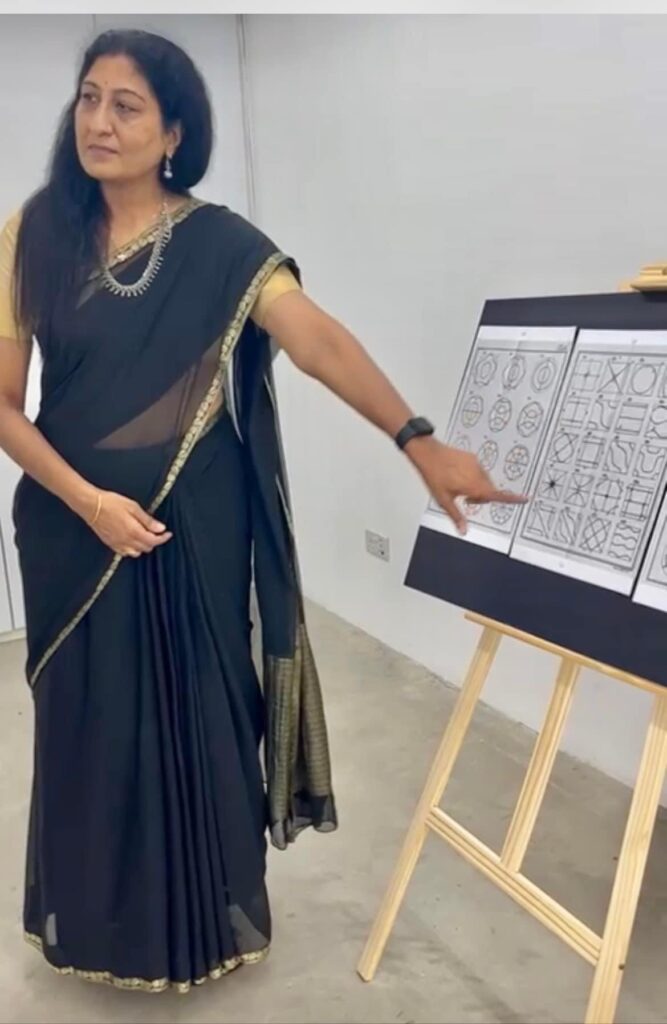
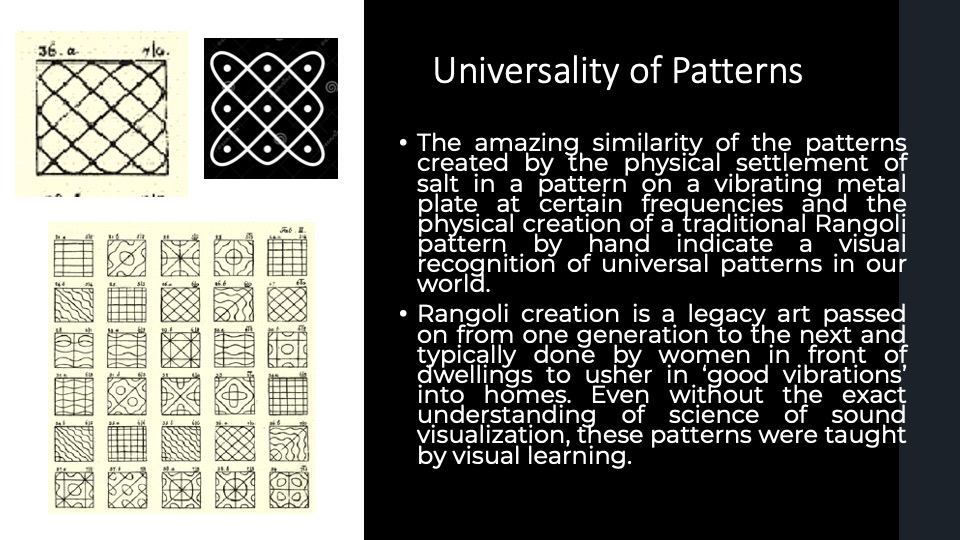
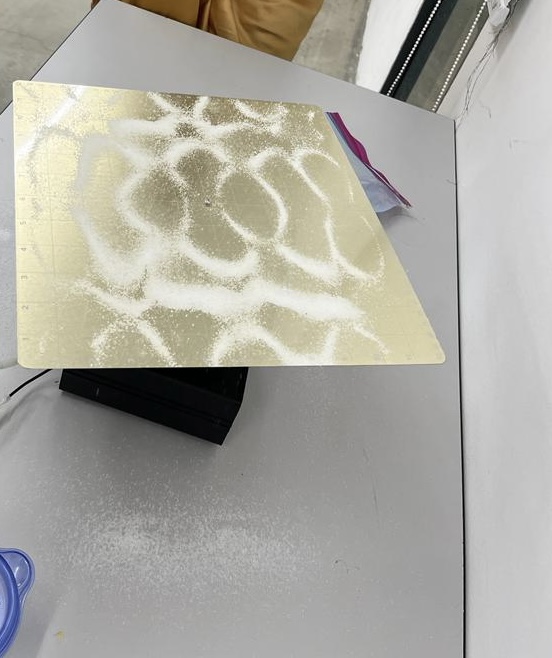
Kumuda Krovvidi is the Founder Director of Strokearts Studio Pte Ltd, Singapore, a visual arts company engaged in enriching lives through art education. Her latest project focuses on the universality of patterns, both visual and through sound. For instance, the patterns created by the settlement of salt on a vibrating metal plate at a certain frequency and the physical creation of a traditional rangoli with hand point to a universal aesthetic of symmetry and design.

Kumuda has over ten years of experience in teaching art in Singapore. She holds a Certificate in Western Art (Part Time) from Nanyang Academy of Fine Arts (NAFA).  Her vision is to create an enrichment environment of skill- based training for visual arts such as drawing, painting and sculpting in Singapore. She has a passion for painting and is an artist who encourages awareness and appreciation for visual arts – especially Indian Art such as Madhubani, Warli, Kalamkari, Pata Chitra and Gond. She has co-authored a book titled ‘Introduction to Indian Folk- Art Painting’ in Singapore.

Kumuda recently held an exhibition titled Rangoli Resonance Art: Visualisation of Sound Vibrations as Rangoli Designs, at Singapore. She says that vibrations of sound can be captured as images with the help of tools. In this interview she talks about her interest in art and culture.

What was different about your process in using sound as an artistic tool?

In my art exhibition titled Rangoli Resonance Art, I have used sound frequencies to bring attention to universal patterns that corelate to those sound frequencies. These patterns are found in all of our surroundings, in snowflakes, in nautical shells, in animal life and the plants and in our Universe.

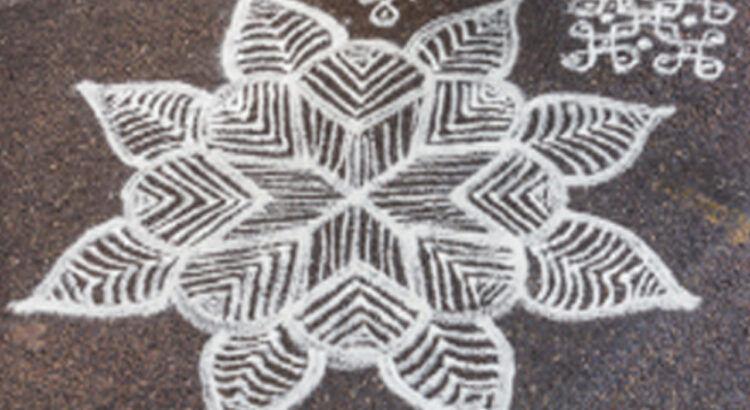
What makes my study different and unique is the corelation of sound frequency patterns with Rangoli/Kolam , a traditional legacy art of designs and patterns created by women in front of homes to usher in auspiciousness. Rangoli patterns are usually created from a graph of dots that enable the geometry to remain intact and are amazingly like the meticulous records of patterns studied by physicists.

Chladni plates make it possible to visualise sound frequencies as patterns. Physicist Ernest Chladni discovered different patterns being formed by sand particles placed on a metal plate when the plate was vibrated with sound at different frequencies. The study of visible sound is called Cymatics and it reveals fascinating truths about our universe that go unseen by the naked eye. Sounds actually have a distinct geometry, much like crystals and flowers and nautilus shells. When picked up by a special apparatus such as the sand-covered plate called a tonoscope, these vibrations reveal incredible geometric shapes that are unique and representative of universal phenomenon.


How have your studies in Western art influenced your perception of Asian art and vice versa?

I completed a Certificate Course in Western Art from Nanyang Academy of Fine Arts (NAFA), Singapore and it helped me understand a few basic principles of composition and technical skills in creating art. Still Life, Figurative painting, Landscapes and Abstraction were explored as subject matter and themes for composition.

It also helped me understand that the approach to creating Asian Art is perhaps more holistic and offers a utilitarian purpose to the creation. The process of creation must benefit the creator as well as the viewer and serve the objective for its creation.

Western art commonly utilizes the principle of creating an illusion of three-dimensionality of space whereas Asian art has linear drawings that tend to have colour filled in to give form. Western art is more about the treatment of the subject of the artwork whereas Asian art is more about the context in which the artwork is created. Asian art is usually a piece that has many elements to it and the sum of all parts is to be appreciated in its entirety.

What drew you towards art as both a career and passion? Have you always been an artist?

I am a Chartered Accountant by professional education but decided to devote dedicated time for art since many years, so that I can follow my passion for art, especially Indian Art. My mother was an artist and applied artistic creativity in almost everything she did in her daily life. This has inspired me and moulded my personality to be curious about artistic processes involved in all activities of our daily life. She has imbibed in me a love of lifelong learning. As I realised that my passion for art gave me fulfilment as well as an option for a career in art, I have founded Kriti Arts Limited in 2023, a Public Company incorporated to use art for public good. I am co-founder of Strokearts Studio Pte Ltd, a Company engaged in providing art education in Singapore.

Could you elaborate on your findings about the similarities between cave art in India, South-east Asia and China? What inspired you to study these art forms deeper and bring them to the public?

There is a strong similarity in the Fifth Century Classical paintings in Ajanta Caves, India and Dunhuang Caves in China, as well as Sigiriya Paintings in Sri Lanka. These Buddhist paintings extol the virtues of Buddha and explain the life stories associated with enlightenment of Buddha. It follows from the Silk Route across Southeast Asia where trade and spiritual ideas were exchanged in the various cities and towns dotting the route. The Buddhist monks used the Silk Route to visit many cities and spread the wisdom of Buddha through story-telling. They also created paintings as a visual aid or prop to support their story telling sessions. During the monsoon, they took shelter in caves until the season passed. The cave paintings were created as a practice of meditating and depicting the stories from the life of Buddha.

The technique of creating the cave paintings, that is painting over rock is similar in all the three locations mentioned. Surprisingly, the rock caves have similar sculpting in terms of architectural designs especially the decorative walls and ceiling carvings.

The study of these cave paintings is necessary if we need to learn about what can be referred to as the classical art of India in terms of paintings. The Western art has the concept of classicism that was derived from Graeco-Roman antiquity.

The Ajanta Cave paintings created in the Buddhist era are the earliest form of classical paintings in India that were sophisticated in technique, three-dimensional in presentation and very large in size. The process by which paint was made to adhere to the carved rock surfaces was advanced in terms of the scientific knowledge of chemical reactions of different materials such as pigment, brushes, and natural glue. They had such archival quality that they survived across centuries and can be viewed even today in its original form in many sections.

These paintings have fascinated artists, including me, to study and re-create these paintings using new materials.

How do you bring your unique perspective to both your art and to your teaching? Is it easy to communicate and document your process for students?

As a practitioner, discovering an artistic process is very satisfying and applying it to create an artwork gives immense satisfaction. Teaching students involves breaking down the process into lessons that can become a part of a curriculum. This involves documenting it in terms of written notes, live demonstrations, and video recordings.

I have come to realise that not all artists can teach and not all teachers want to become practitioners. To be able to do both requires a certain skill in presenting a complex idea into simple skills. And therefore, skill-based learning is a very good way to embark on the artistic journey.

Similar to sound as art, have you explored any other senses that are usually overlooked in art? What would you like to experiment in?

I do believe that light has always been the key to creating the illusion of the three-dimensional quality to art. Joining two dots gives a line, joining lines gives a shape, but it is the use of light and dark that gives the shape a three-dimensional form on a flat surface such as paper or canvas. This quality of light is something that piques my interest and is going to be a theme I would like to explore.

What do you find are the intersections between music and art therapy, after your work in art and sound? Is there a way to integrate the two?

There is an undeniable co-relation between music and wellness. The methods of creating art with music promotes inner perception, opens paths of access, and enables forms of expression to interact with oneself and one's environment without having to speak.

In my book published in 2021 and the accompanying art exhibition, titled Visual Melodies- Illustrated Music in Indian Miniature Painting, I had the opportunity to study Ragamala Paintings, a genre of Indian classical art. The paintings are a pictorial visualisation of musical melodies called ‘Ragas’ in the form of personified iconography. The paintings depicted characters, such as deities, having expressions of emotions that the characters experience upon the happening of a condition, for example sadness upon the condition of parting of lovers, joy on seeing the arrival of a beloved etc.  The study revealed the fascinating truth about how the purpose of creating the paintings seemed to be to offer a wholesome approach to a natural aspect of human nature, which is to understand and appreciate the world in a condition-emotion context. Being human is to be able to experience many emotions in a lifetime and to find one’s place in the interconnectedness of things in the world. Especially in terms of human interactions and interaction with nature, birds, animals and even planets.

The integration of art and music has been in existence, and using this integration as an approach to study self-expression is one of the foundations of art therapy.