

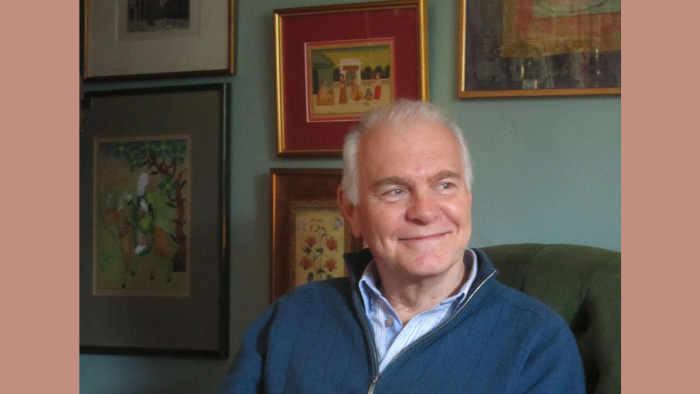
Alistair Shearer, an authority on sacred art and ritual designs, accompanies evolutionary journeys to India for his company Trishula Travel. His books include the Story of Yoga, In the Light of the Self- Adi Shankara and the Yoga of Non-Dualism, The Hindu Vision: Forms of the Formless, several others including a 2021 translation of some Upanishadic verses.
He has coined a new concept - CoVidya 2021 to “address the extraordinary circumstance of the Covid pandemic.” Alistair says ‘Covid’ itself is a term with only negativity attached to it, “so I thought it might be useful to turn a much-used word around and adapt it to a positive and energising message. CoVidya, in other words: Knowledge (vidya) that is conducive to coherence, co-operation and compassion. The series of talks I gave under this title in 2020 is still ongoing, on every other Sunday, and there is an archive for those who cannot make the live session (see https://alistairshearer.co.uk/online-meetings/).”
He believes there is a worldwide thirst for spiritual teachings that are pragmatic and can be of direct and daily use in everyday living. “We are living in a time of incessant activity and very narrow focus of attention, what TS Eliot described with extraordinary prescience back in the 1940s: as:
Distracted from distraction by distraction
Filled with fancies and empty of meaning
…in this twittering world.”
In an interview with CSP he says to be able to periodically step out of habitual boundaries, “and then return to live them in a more expanded way, is the need of the time, whatever your language and culture. But the classical model of yogic renunciation is applicable to only a very, very few. Whether we like it or not, we have reincarnated to live out a householder destiny this time around and we have enough to do just in fulfilling that obligation. On the other hand, yoga should not be secularised out of its original context, and turned into a banal but lucrative fitness regime so we can post ‘looking good’ selfies showing off our flexibility. There is yoga beyond the body as all the original sources tell us.”

How has the pandemic helped to turn us inwards towards finding meaning amidst chaos?
When the habits of extraverted attention are frustrated, we have to turn inwards. The pandemic has closed off so many normal types of outreach – work, socialising with friends and family, entertainment, travel – even to the point of being locked down at home. So something that the wise have always advised us to do, look within a little and consider deeply, has been forced on us, whether we like it or not. In the long run, this may turn out to be a benefit of this otherwise terrible situation, as we have been made to reconsider our priorities, learn to live with loss and solitude, value other people and find what we can do to help them. We have had to focus on what is in front of us a little more. Compulsory mindfulness, if you like.
How are the teachings of Shankaracharya and other Indians seers of great comfort and relevance today?
Well, Shankaracharya was an extraordinary historical figure who dedicated his life to spreading Truth. Even if we disregard some of the biographical detail and many of the books ascribed to him, and just focus on his commentaries on the Gita, Upanishads and Brahma Sutras, prasthanatrayi , we have a wonderfully rich intellectual and spiritual confession. The trouble is most of are not that deeply into metaphysics, so his teachings are too subtle and abstract to have much appeal or relevance to the normal person. But his life can be seen as an inspiration, all his practical achievements in setting up the many maths, establishing monastic orders, reforming householder worship and so on. Actually, his teaching has been consistently misunderstood. Those who dismiss him for teaching maya – the idea that world is just an ‘illusion’ – should pause and consider that if he really did think the world was an illusion, why on earth did he expend such tremendous energy in travelling, teaching and cramming so much into his short life of thirty-two years? Surely if he really had been a mayavadin he would just have sat uncaring under a banyan tree and watched the illusory world go by? Nonetheless, laying aside all the controversies and debates about his message aside, many successors in his line have been guiding lights, compassionately helping ordinary people face the extraordinary challenges of their ordinary lives. Personally, I was always very drawn to Swami Jayendra Saraswati, the late pontiff of the Kanchi math as being a fine exemplar of the Shankaracharya tradition in action on an everyday level.
All the great Indian seers speak in their own ways of something that is greater than the limited self, something that unites and binds us all together in a greater whole that is more than the sum of its infinite parts. There is only one song of this divine unity but the singers and accents are many, appealing to different types and personalities, hence the richness of the Indian spiritual scene. I see our life task as working towards that unity, in whatever way we can.
Your books involve great research and insight....what inspired you to delve deep into the history and source of Yoga.
My interest goes back to learning to meditate in my early twenties. Part of my teaching work over the last few years has been to present the philosophy and psychology of yoga to UK yoga groups. Over time I was struck by how much yoga has changed in its journey West, how an ancient spiritual path has become part of the secular wellness industry. That, plus my long-time interest in Indian spirituality and history, especially the interaction with the West in the post 1800 period, culminated in my book ‘The Story of Yoga’ . I’m happy to say it is finally coming out in paperback next Spring 2022, so it will be more affordable for impecunious yogis!

You mention the many translations of the Yoga Sutras of Patanjali - and their importance. As a meditation guide, what is the message from the Sutras for you on the purpose and mandate of Yoga?
Well, the essence is right there in those wonderful four opening verses:
'And now the teaching on Yoga begins. Yoga is the settling of the mind into silence. When the mind has settled, we are established in our essential nature, which is unbounded consciousness. Our essential nature is usually overshadowed by the activity of the mind.’ That is the beginning and the end of yoga. In between of course lies all the rest, the disciplines of purifying our body, energy and attention habits, understanding of our responsibility to others and the wider environment, developing benign motivation and all the other aspects of living that constitute the ‘path’. But everything begins with the mind – our intention, actions and reactions – so we have to incorporate the practice of meditation into our yoga practice. To stop at the asanas and take yoga as only a physical fitness or cosmetic regime is to keep on eating the starter while ignoring the main course.
How did the Upanishads guide you towards an understanding of India? Did you learn under a guru?
My own very personal feeling is that the moment you land in India, you walk into a subtle atmosphere that is indefinable, but it is there. Something different wraps itself around you; it is a peculiar spirit of place. I hesitate to call this energy ‘spiritual’ because that could be taken to sentimentalise a country where, just as happens everywhere, some very unspiritual things go on. But there is an enveloping energy in India that has been generated by thousands of years of active worship and practice of puja and yajna, as well as so much specialised focus on higher truths, such as we find in the Upanishadic tradition. A place holds the energetic residues of what has gone on there and all over India, unlike most of the world, much of that benign type of bhav is still being generated today in households, temples and shrines.
My own guru was Maharishi Mahesh Yogi. I studied with him in the 1970s, and all my subsequent life has been guided by that, even if I don’t think consciously about it. I have also been very fortunate to have met several other great beings who embodied the ancient wisdom, such as the incomparable Anandamayi Ma, for example.
What are the pitfalls of translations where translators don't go to the source text but extrapolate from other translations?
Someone once said that ‘every translation is an act of murder’. Well, that may be a bit strong, but every translation is inevitably an interpretation to some extent. How much is the question, and every translator has to police their tendency to project onto the text, it seems to me. I have just published a translation of some Upanishad extracts with a UK publishers called White Crow. Previous translations of these lovely texts have generally fallen into two camps. The respected academic versions follow the letter of the law but can often miss its liveliness of spirit, and so can come across as rather dry. They are often distanced from the reader by copious explanatory footnotes. On the other hand, the numerous poetic renderings available today may sacrifice linguistic or conceptual accuracy in favour of lyrical feeling and flow. This danger increases the further from the original text you wander, of course. And if you work from other translations, there is always the possibility of the Chinese whisper syndrome. You rapidly end up with the translator, not the sage who authored the text.
Not infrequently such loosely accurate works contain interpolations which, while being a well-intentioned attempt to make a difficult subject more comprehensible, are quite unjustified by the original text. This is an old story. The most celebrated of the nineteenth century Sanskritists, Max Muller, cautioned those who approach Indic thought ‘through the dark mists of imperfect translations.’ This is especially a problem with translations from Sanskrit, where each word may have several different meanings. If this wasn’t bad enough, despite having by far the largest vocabulary of any language, modern English is impoverished just where Sanskrit is richest: in terms that describe finely graded levels of awareness and the higher orders of reality they reveal. The renowned historian of Indian art and traditionalist thinker Ananda Coomaraswamy was very aware of this. He once commented ‘For every psychological term in English there are four in Greek and forty in Sanskrit’.

In your travels and experience in India, could you tell us some of the main draws of a non-Indian traveller to India. Is the Indian tourist-ecosystem geared to meet this demand?
Friendly people, extraordinary pulsating life-energy, vibrant colour, wonderful food. These are the traveller’s initial impressions. Behind them lie all extremes of human possibility. India is like walking straight into the unconscious mind, everything is there right in front of you with all its beauties and possible terrors. You see things here that you won’t see anywhere else on earth; Europe seems very quiet and drab after time spent in India. Some people are frightened by the sheer shakti of India, others fall in love with it. I feel fortunate to have been one of the latter.
I would say that sadly India does not value her tourist potential. Did you know that the tiny island of Cyprus gets more tourists a year than the whole subcontinent? The trouble is that the tourism portfolio is not very high on the list, so politicians don’t want to stay in the post long but move on and up. There is so much of beauty and interest to see here, but more money should be invested in the sector to soften what can be arduous travelling over long distances. And there should be a much more rigorous eco-policy. One little example: all plastic water bottles could be banned in hotels, with in-house filtration systems installed instead. That alone would save mountains of indestructible waste each year. Generally, there seems little official interest in presenting culture to visitors, look how long the reorganisations of the Mumbai and Delhi museums have taken. Of course, it is always a question of financial priorities, but tourism could be a huge earner here for many different sectors of society if it was encouraged more.
Did Neeleshwar Hermitage arise out of your desire to offer a better India experience? What makes it different?
In a way you could say that. If I had to pin it down succinctly, I would say we have redefined ‘luxury’ into a form that meets contemporary needs. What we offer is not the standard luxury experience of sanatorium-white marble and plush fluffy carpets, endless tv channels and gadgets in your room bleeping and tooting to close the door and open your curtains, and flowers flown in from Bangkok every morning at who knows what carbon footprint. Our view is more minimalist and more essential: to us luxury is having silence, space, uncluttered time and the chance to profit from the benign energies generated by beautiful natural surroundings, which is our case includes an unspoilt empty beach and the caress of the Arabian ocean. So, we are a retreat but not an ascetic one. I remember when I first suggested the phrase ‘retreat hotel’ to the marketing people they were horrified ‘Oh no, that sounds far too religious, no one will go for it’. Well, time has proved them wrong. If you want a tough retreat, India is full of ashrams and yoga centres, and that’s fine, but we believe in refinement, rather than control or enforced abstinence. We have an in-house yoga teacher, and when I am at the hotel, I teach personalised meditation classes and offer guests cultural lectures in the evenings. Our clinic offers good health and lifestyle diagnosis from a qualified Vaidya, and personalised and authentic Ayurvedic wellness treatments. Our food is predominantly, but not exclusively, vegetarian, and it is all locally sourced and freshly prepared. All this nurturing is overseen by our large family of staff who surround the guests with a genuinely friendly atmosphere of mamta. All our staff are locals and we see ourselves as embedded in the local community, rather than some exclusive spaceship that has suddenly landed in the midst of their village.

How does one develop an entrepreneurial aesthetic that appeals to both the Indian seeker and the Westerner?
An interesting question. Generally speaking, when Indians go on holiday, they want to have fun. Big groups, lots of kids and activities to keep everyone happy. Westerners are more likely to be looking for a place to chill out, just relax and not do much, though it’s partly a question of age of course. But those who are looking for a more inward experience tend to have similar needs and expectations, irrespective of where they come from.
How did your tours segue into the Hermitage? How did travelling to spiritual and holy shrines help in, as you quote the Upanishads, "teaching and learning, teaching and learning"?
I spent many years in the world of cultural travel, working for a prestigious UK company as a guest lecturer, an academic guide accompanying groups of intelligent and interested travellers. We would visit many temples and museums, focussing on the history, art and architecture of India. That, of course meant focussing on the spirituality as well. For me, it was a wonderful extended yatra , as I got to travel all over India and South East Asia visiting sacred sites, learning and doing my own research and also teaching my fellow travellers along the way,. We stayed in some beautiful places too, so I was unwittingly being schooled in the hotel industry at the same time, learning what works and what doesn’t. Then I set up my own tours along the same lines, developing some very adventurous itineraries all over India. On one we would be camping at 11,000 feet near Badrinath en route to visiting the Valley of Flowers way up in Uttarakhand, on the next circumambulating the sacred mountain Arunachala at Ramana’s Thiruvannamalai ashram. Luckily, all of this was before many people were doing these things.
My Indian ground agent for these trips was my old friend Altaf Chapri who now runs ABC Journeys in Delhi. I first met him through his father Yusuf who was organising a camp at a beautiful Buddhist site in Ladakh called Alchi. I got to know Yusuf through trips to his native Kashmir, and then also his son Altaf, who began helping to organise my tours. Anyway, after a few years working together the idea came up that we should open a hotel. Actually, it arose initially as a joke as we were getting bumped off by regular hotels when there was a scramble for available rooms. Then after the laughter died down we thought some more and the idea began to take shape and gradually materialised.
What made you choose Kerala for the Hermitage?
Off the beaten track, unspoilt, beautiful and in those days, affordable. It was a gamble because that part of India – Malabar - was not so used to foreigners then and Keralites are a very proud and independent people, of course. To build a hotel from a coconut grove was a huge undertaking. Basic construction materials were largely available locally, but we had to source almost all our fixtures and fittings from all over the country. Roof matting came from Assam, electrical fittings such as lights had to come all the way from Delhi. It was an extraordinary project; we were officially classed as a local subsection for electricity, we designed the furniture and had it made locally. I sourced the artworks from local artists and stocked a large library for the guests and so on. But we had some great local support, workmen and staff, without whom it would not have been possible.
Can you share your love for ancient Indian art? What would you say are your most precious collections?
The Indian artist has traditionally had the ability to express the essence of its subject from the inside as it were, the feeling value, the ras or life sap. This is particularly so in sculpture and elevates it to quite a different level, to my mind, than the ancient Greeks or Renaissance sculptors so valued in the West. Much Indian art is ‘otherworldly’ in that it eschews everyday realism in its search to depict a rarified and subtle reality, the realm of the gods in Hinduism or of inner and ultimately transcendental values in Buddhism. So it leads the mind inwards and upwards, it is an aid to meditation, to expansion of the spirit. In this way all Indian art serves as a yantra , which is not just the geometric forms we know by that name.
Collections? Oh, there are so many great ones. In India there are the museums in Delhi, Mumbai, Calcutta and Chennai, though they could often do with some tlc. London is very fortunate to have both The Victoria and Albert and the British Museum collections, then there is the small but lovely collection in the Ashmolean Museum in Oxford. Then there are the extraordinary American galleries, the Sackler and Freer collections in Washington, that not long ago created the wonderful Yoga: The Art of Transformation exhibition. On the other coast is San Franscisco’s Asian Art Museum, with six galleries of permanent exhibition. It also works to introduce the richness of often overlooked ‘folk art’, such as its 2018 exhibition of Mithila Madhubani artists.
But in the end, my favourite ‘collections’ are the living museums of the sites themselves: Ajanta, Khajuraho, Mount Abu, Alchi, Elephanta, Dungapur, Konarak and so many, many more. There the art is still alive in its natural, intended setting, imbued with the spirit of place that has accumulated over centuries.

What can be done to introduce Indian art appreciation in institutions and among the general public?
It’s about exposure and explanation. The art market is a strange and secretive world, run primarily for money and investment opportunities rather than any inherent quality in the art itself. Historically, Indian art has not generated big financial returns in the international sale rooms – unlike Chinese and Japanese works, for example. This is beginning to change now, as many wealthy Indians, as well as returnees from the diaspora, are starting to value their own culture and want to own examples of it. This is great, but it opens up the ugly pandora’s box of art smuggling; it is tragic that temple sites are being looted by dealers greedy to supply the growing international demand.
Museums of course are a different story; there have been good collections outside of India (leaving aside the politics of acquisition) since the end of the nineteenth century. But even if there is exposure there, where is the education? Almost non-existent, in the UK at least, unless you take specialised and private courses at various prestigious institutions such as the British Museum or the auctions houses Christies and Sothebys. The future doesn’t look too hopeful as there is a general trend at all levels to decrease education all across the humanities, in favour of a focus on the ‘practical’ left-brained subjects of science, technology and economics. So Indian art is sinking even lower down the list!
The West’s general lack of interest is partly because Indian art is visual theology, you need to understand a little what is going on in an Indian piece. Not necessarily ‘believe’ in its message but at least have a handle on what story or teaching is being conveyed. The subjects are usually not of this world, but of the subtle or divine realms. The initial impact of aesthetic beauty may attract – someone might be drawn to the sheer visual/emotional impact of a tenth century Chola bronze, or a Gupta stone Buddha or the vibrancy of a Rajasthani miniature – but the secondary impact of context and meaning will usually be missing. There are exceptions. Increasingly, more people can appreciate, say, a Shiva Nataraj as a manifestation of the whirling dance of cosmic energy, or a representation of Durga Ma as the embodiment of feminine shakti, but these are very much the exceptions. The ability to express the vital inner ras is there in all sorts of examples, in even the humblest and secondary figures, not just in the iconic ones.
 How is the yoga scene in your country? Are there are a lot of followers for the authentic tradition?
