
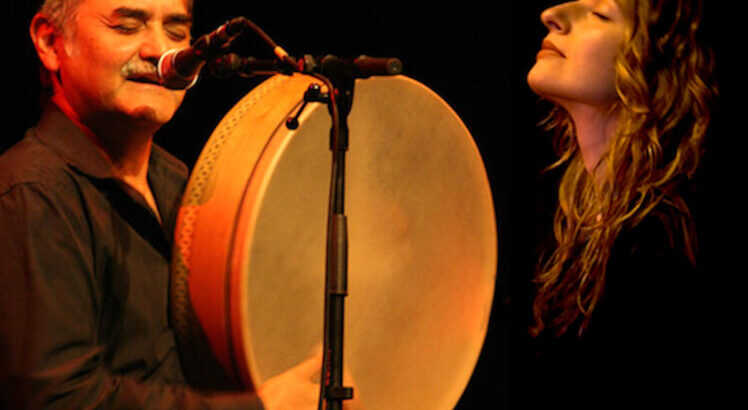
A Festival to Celebrate Dikshitar and Beethoven, Raga and Harmony

Carnatic composer Mutthuswamy Dikshitar and Western classical music’s Ludwig van Beethoven were born just five years apart. While the world celebrates the 250th birthday of Beethoven, Indian musician Chitravina N Ravikiran has put together the 10-day Dikshitar-Beethoven Melharmony Festival from Dec 26, 2020 to Jan 4, 2021 bringing together Grammy and other Award winners as well as scores of emerging talents from several countries.

Tune in to https://shaale.com/live/melharmony to catch the music. Like the festival’s previous editions since 2013, this year’s event features works of two master composers who scaled the peaks of creativity in the worlds of melody and harmony.

Indian music is largely melodic using a succession of notes, lying within the framework of ragas. Western music focuses on harmony and counterpoints creating multiple layers.

 Melharmony, proposed by Ravikiran explores chords and counterpoints anchored on melodic progression of evolved systems such as Indian Classical, in sharp contrast with the traditional Western approach centered on harmonic progression.

Melharmony has also been developed significantly from a Western standpoint by American composer Robert Morris of the Eastman School of Music. Speaking on the similarities in the music sensibilities, approaches and contributions of Beethoven and Dikshitar, he says “Both are pivotal and unique composers in their respective traditions. Both had supreme control over the technical and learned aspects of their musics. Both have a strong sense of the spiritual potentials for healing and release from suffering as posited in their respective religions. Both advanced new, unique and influential forms of musical continuity and expression.”

Professor Morris adds that learning music from two or more cultures provides the same benefits as being able to understand and use different verbal languages. One gains new ways of expressing human values but within a different world view and sensibility. This provides diversity in one’s musical understanding, something that is a very important requirement for peaceful human interaction in today's global situation. More specifically, Indian music musicians can learn about features of Western music such as texture, instrumentation, harmony and counterpoint. Western musicians can learn about the sophisticated aspects of Indian music such as melody, ornamentation and rhythm. And classical western musicians who do not improvise will learn much about that form of musical spontaneity from studying Indian music.”

He adds that since melharmony is harmonic development using music melodic structure as a guide, there is no limitation to the types of forms, improvised or fixed, that can be lend themselves to such collaborations.

Four time Grammy winner Glen Velez and vocalist Loire Cotler speak about how learning the two systems can enhance the music. "The rhythmic principles in South Indian music has benefits for every musician. It's an extensive exploration of rhythmic possibilities. The forms and legacy of the great compositions of Western music can certainly give any musician from any tradition an inspirational insight into the nature of music.”

“We believe Melharmony has a wonderful creative potential to transcend the imaginary barriers between the different kinds of music around the world,” they add.

Over the years, several frontline orchestras, ensembles and celebrity artists of diverse cultures have presented Melharmony shows in various countries including USA, Canada, UK, Germany, Switzerland, India etc.

One of the pieces, Snow Princess, is being presented by celebrity artists joined by scores of students from American Schools, trained by Middleton High School Orchestra Director Steve Kurr and Memorial High School Band Director Ben Jaeger. This piece, to be presented on 27th Dec focuses on climate change.

Carnatic composer Dikshitar was the first composer in the world to explore an East West fusion in the late 1700s when he composed Sanskrit songs based on Western orchestral melodies. His younger brother, Baluswami Dikshitar was the first to introduce the Western violin to Indian Classical music and today it is one of the most prominent solo and supporting instruments in Indian music, especially in the South Indian Carnatic tradition.

 Ravikiran says the spirit of Melharmony is to bring peoples of diverse cultures closer, musically and socially. I'm most heartened to see legendary artists and ensembles presenting my creations and I am equally thrilled to attempt to interpret Beethoven on the versatile Chitravina.”

Indeed it is a coincidence that three of India's greatest composers were born just a few yards from each other in Thiruvarur in Tamil Nadu at the same time as Beethoven and Motzard across the shores. A celestial happening that has given us the greatest music the world will ever hear.

Interview with Jeffrey Armstrong, Author of The Bhagavad Gita Comes Alive: A Radical Translation

Jeffrey Armstrong or Kavindra Rishi as he is known has brought out a new translation of Gita - The Bhagavad Gita Comes Alive - A Radical Translation. He dedicates it “Shrila Vyasa Deva who originally compiled the Bhagavad Gita, to Adi Shankaracharya who restored it, to Ramanuja Acharya who revived it, to Madhwacharya who reawakened it and to Chaitanya Mahaprabhu who revealed it to Bhaktivinode Thakur who envisioned it going out to the world and to Bhaktivedanta Swami who delivered it to the world.”

In a quote by eminent scholar David Frawley, he says that the Bhagavad Gita is India’s most “mistranslated book, subject to every possible misinterpretation.” He adds that it has been assaulted with inappropriate terminologies, dichotomies, and theologies of western thought that cannot properly capture the essence of the Gita.

In this interview with CSP, Kavindra Rishi shows a deep understanding and abiding respect for Indian Knowledge Systems. He has worked on this translation for over a decade, but his immersion in India goes back much further.

Australian Band Coco’s Lunch Finds its Groove With Misra Chappu

Australian band Coco’s Lunch has come up with its new album Misra Chappu (https://cocoslunch.bandcamp.com/album/misra-chappu) beautiful music for an extraordinary year. It is an album which combines many genres and traditions, among them Australian, African and Indian rhythm. In this interview Lisa Young speaks about her fascination for odd metres and Carnatic music. 

Why Misra Chappu? What is its appeal for you?

As a singer and composer interested in a wide variety of musical traditions, I am constantly exploring ways of bringing creativity to rhythmic expression.   I’ve always engaged with odd metres and enjoyed exploring various configurations and sub-divisions of the musical pulse.

As a longtime student of maestro Guru Kaaraikkudi Mani in Chennai, my compositions and vocal language integrate the art form of konnakkol.  So I have long been attracted to the Misra Chappu Talam and also I’m very fond of Kanda Chappu Talam and Sangeernam.

Many of my compositions often combine Western and Carnatic concepts.  You can hear the use of the traditional intoned konnakkol and also the solkattu language forms the basis of vocal riffs, bass lines, melodies.  So pitched and intoned konnakkol are heard as a fully integrated vocal and musical expression.

Many iconic Carnatic krithis as well as folk songs are in Misra Chappu. Have you heard any especially of Shyama Shastri?

I’ve heard some of these beautiful krithis, and before studying konnakkol I studied Carnatic vocal music for two years.

However my main dedication in the Carnatic tradition is to my konnakkol studies.  I’m very fond of Kumari V. Shivapriya's performances of Misra Chappu structures, and very inspired by her double talam recitations.

Of course I have studied many of Kaaraikkudi Mani’s Misra Chappu structures which I adore.  I also love the work of Chennai based ghatam and konnakkol artist Suresh Vaidyanathan.

Is there a culturalscape to rhythm. How is Misra Chappu uniquely Indian. Are there indigenous rhythms in Australia which resonate with this?

Whilst engagement with rhythm is heard across all musical cultures, it is developed with particular nuance and depth in different traditions.

There is an approach to metre and sub-division that is distinct and influential in Indian music. Here it is like a science, with the mathematical calculations, metric modulations and talam and nadai configurations.  There is so much material to methodically study that provides musicians with a deep, rich, rhythmic foundation and awareness.  This detailed systematic approach to rhythmic materials is generally absent in Western music pedagogy.

How does the interaction between dance and music as is seen in your video stimulate the aural and visual senses?

For the music video we wanted to connect the visual with the rhythmic grooves expressed in the song, and so it was a perfect opportunity to showcase the Bharatnatyam dance tradition, performed here by Vaishkarni Saieasan and choreographed by Narmatha Ravichandhira and Vaishkarni Saieasan.

The singers in Coco’s Lunch all love to interpret groove in performance.  They are seen here keeping the tala hand gestures and engaging with the pulse. The interaction between the dancer and singers celebrates the integration of the Carnatic tradition in this contemporary piece.  Hopefully the visual helps the listener experience the rhythms and sounds more deeply, and they can also imagine what it’s like to experience a live concert of Coco’s Lunch.

How does a non Indian artist bring in creativity to rhythm?

As an improvising singer and composer I am always exploring ways of bringing creativity to rhythmic expression.  I love using polyrhythmic layers, metric modulation and rhythmic ambiguity.  Compositionally I am often aiming to express a rhythmic conversation in my works, where ensemble members emphasise different rhythmic elements of the pulse that connect and displace within the sonic picture of the work.

It's the experience of layered rhythmic complexity that often creates a sense rhythmic depth in the music.  In most pulse generated music there is usually an ongoing eternal pulse outlining the given metre; this is ‘felt’ or experienced in conjunction with at least one internal pulse layer sub-dividing the beats.  There is also a fundamental relationship between a musician’s instinctive ability to internally subdivide a given metre, and their ability to explore and interpret rhythmic complexity and ‘groove’ in performance.

In Tha Thin Tha (https://www.youtube.com/watch?v=aC6kl549OTA), Misra Chappu and Other Plans, the harmonic and melodic material, the style of improvisation and the ensemble dialogue are strongly connected to the jazz tradition.  Both the Carnatic and jazz approach to pulse  and rhythmic metre are particularly influential forces in the works.

Could you tell us a little about the making of the video and your band.

The song 'Tha Thin Tha' integrates the art form of konnakkol with scat language to create a distinct sound-bank language as the basis for the vocal expression.  The track features Australian mridangam and kanjira artist Sai-Sarangan Ravichandhira.

For the music video we wanted to immerse the visual in the Carnatic rhythmic grooves and show the connection with Bharatnatyam dance.  

The director Lee Galea searched for performance space that would enhance the integration of these art forms and immerse them in a contemporary setting.  We were thrilled to be able to shoot the clip at Magdalen Laundry North, Abbotsford Convent.

Coco’s Lunch is Lisa Young, Nicola Eveleigh, Jacqueline Gawler, Emma Gilmartin and Gabrielle MacGregor.  We are composers and innovators of original vocal music, dedicated to an adventurous new direction in contemporary vocal music, transforming the traditional A Cappella genre with five-part South Indian vocal percussion, contemporary improvisation and complex songcraft.

The composers on the new Misra Chappu album - Lisa Young and Jacqueline Gawler - draw deeply from the rich sonic palettes of Australia, India and Africa, and between the five singers we bring the new stories on this album to life.  The compositions combine our love of complex rhythmic interplay, poetry and challenging harmonic movement to bring a rich vocal sound to the fore.