

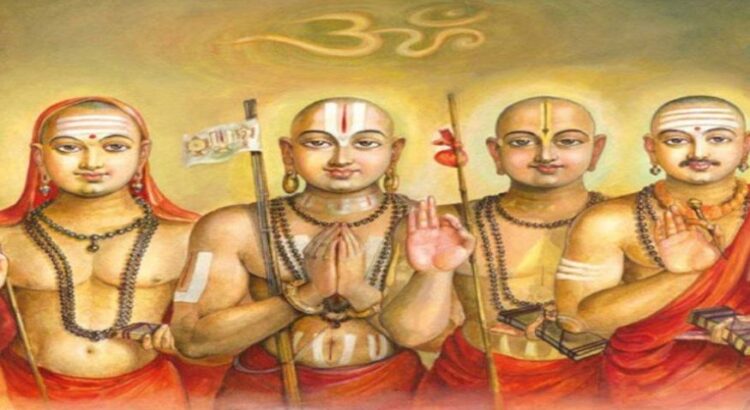
Indic Academy has an annual program titled “Grateful2Gurus” to honour authors, activists, academicians and artists of Sanatan Dharma among us today. On the day of Guru Purnima every year, Indic Academy extends it’s gratitude to them for their work in serving Dharma by felicitating them. This concept of Grateful2Gurus was introduced by Indic Academy three years ago. Local chapters of IA participate and hold their own ceremonies to felicitate our Gurus. You may read more about last year’s activities here.
Month: June 2019
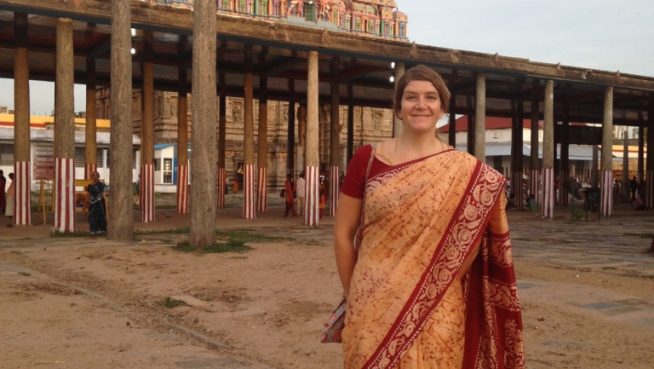
Indian Science Shouldn’t be Framed Using Western Paradigms for Thinking About What Science is: Andrea Gutierrez
Andrea Gutierrez of the Department of Asian Studies in the University of Texas, Austin, is a researcher of Sanskrit, Prakrit and Tamil. Her journey started when she came to India to learn Yoga in Mysore and soon led to her interest in Indian cuisine. Andrea speaks about her interest in the Pākadarpaṇa, the first work in any Indian language concerning the recipe tradition, which she says is a Royal text probably composed in a Royal court. She says the Pākadarpaṇa was perhaps the very first cook book to be written in India.
How did your interest in Indian, particularly Tamil, scriptures begin? And in Indian culture and tradition.
It all started when I came to India to study yoga with my guru's guru (in Mysore). I began studying Sanskrit there and became quite immersed in aspects of Indian life, including the fascinating cooking practices! I soon realized I needed a sophisticated knowledge of Sanskrit to understand the history of Indian cuisine, so I returned to the US to complete a PhD at one of the best universities for Asian Studies, at the University of Texas at Austin. I started studying Tamil language as an additional entry to the texts and early history of India, and as a way to bring South Indian traditions more fully into my research.
There is a general belief that India is poor in documenting its traditions, sciences etc unlike the West. Has your experience been contrary to this?
There are some amazing scholars in India and there is an amazing textual record in manuscript libraries, on temple walls (epigraphy), and in state and private archives. Indians continue to do this preservation work and what is also important, studying and working with the less common scripts (like Grantha). But it's an uphill battle. Places like the Sarasvati Mahal in Thanjavur (TSMMSL) have made incredible strides in conservation and preservation of their materials, and serve as role models for other libraries. Some libraries (such as Roja Muthiah in Chennai) have sought out foreign support funds and preservation tools to aid their preservation of materials (working with the University of Chicago Library). It is crucial for all of these manuscript libraries in India to continue the effort to preserve materials in spite of climatic difficulties and limited financial resources. What we're seeing now (I think) is almost a last generation of amazing scholars and pundits (some retired but still working in their manuscript libraries and archives); these people have amassed remarkable knowledge about their libraries' materials (I'm thinking in particular about a retired individual at the Sarasvati Mahal in Thanjavur and about an individual at the GOML [Government Oriental Manuscript Library] in Chennai who basically single-handedly has organized and keeps in order all materials held at that library). When these individuals are eventually too old to continue their work then a great loss indeed will be felt for scholarship in India.
To answer your specific question, India has actually been one of the historically finest examples of a culture (or better said, cultures) documenting their traditions. All of the vast textual corpus written in Sanskrit, Prakrits, and then vernacular languages of India are such a massive and stunning number of texts that no one could ever get a handle on a tenth of it. Lots of scholars in the West (if I can call it that) are studying the historical science traditions of India. There is a lot there. It just can't and shouldn't be framed using western, modern, enlightenment paradigms for thinking about what science is. What science was and how it might have been understood (were there such a term) in early India just looks very different from what it looks like in, say, 2020 or even in the 19th century in a European city.

In your research you talk about the Pākadarpaṇa. What is the role of this grantha in the history of Indian cuisine?
This text is a real mystery. The Pākadarpaṇa (written in Sanskrit and purportedly composed by Nala of Mahābhārata fame) is probably the first fully text dedicated to cooking to have been written in India. My guess is that it dates to the medieval period, probably best guess somewhere between the 11th and 15th centuries CE, based on linguistic evidence.
Before this, a lot of larger works contained sections or chapters on food with recipes for cooking, but this is the first work in any Indian language concerning only the recipe tradition, what I call "culinary writing," writing about food preparation, rather than having other priorities. It's definitely a royal text (probably composed in a royal court), and definitely a Hindu text, but the actual location and precise date of its composition remain unclear to this day, and I need to do a lot more work on it to continue to pin down terms, dishes, and sources. So it's hard to say exactly what its role has been in terms of the culinary or textual history of India. We see it cited in very late Sanskrit manuscripts on food, and we see the Nalapākaśāstra (possibly this same text or more probably a legendary text) cited and quoted on occasion in very early āyurvedic works, such as the Caraka Saṃhitā. These early works are not actually citing the Pākadarpaṇa, but it's no wonder that the Pākadarpaṇa (AKA the Nalapākadarpaṇa) was the first real cookbook to come out of India: the name was a famous one, and if you wanted a successful name for your cookbook, Nalapāka was the way to go.
Indian royal kitchens always worked with Ayurveda. What evidence have you found of this in your research?
You definitely find textual references to āyurvedic vaidyas preparing medical treatments and medical recipes in the same shared royal space as royal cooking happened in palace kitchens, but this was not always the case. In a few early texts we read that the āyurvedic doctors (and possibly food-tasters for detecting poison) were working in different spaces from the king's cooks. There was no one single norm or way to organize palace procedures, although it is certainly true that there is a great deal of overlap between royal cooking and āyurveda, mostly in terms of language and using common terms, although with very different meanings usually. The overlap is due to the same shared medium of food, although royal culinary concerns usually differed very greatly from āyurvedic priorities. Take for example the royal Cāḷukya era Mānasollāsa. The whole lengthy recipe section, the annabhoga, is all about royal eating and cooking, mostly recipes. And nowhere in the Mānasollāsa is there any interest at all in āyurveda for humans. King Someśvara III did not care at all about āyurveda, but he did care about recording the sort of cooking that went on in his palace kitchens.
What was the role of Indian Royalty in her cuisine?
This is complex. It is clear that, historically speaking, Indian kings and queens were great patrons of texts concerning food. It is also clear that certain royal modes of food preparation and of dining must have differed greatly from common people's food--for we see recipes for very complicated, very time intensive and very contrived dishes. But it is also equally sure that royal cooking must have influenced later trends in Indian cooking, although this is hard to be sure of historically speaking, since there is little actual evidence of what was being cooked on the ground outside the royal context. It's also not fair or correct to speak of Indian royalty as one thing. Sultanates and minor or lesser kingships (which I don't group together because of similarity, but because they might easily be ignored when looking at Indian culinary history) contributed greatly to the culinary heritage of India as much as great Indian emperors and empires did. Because we are left with this corpus of very elite texts describing (usually) elite practices, and because we have very little evidence of what "commoners" must have eaten, the "middling" peoples, it's hard to actually pinpoint the exact degree and role of influences from royalty on the cuisine. For sources of "middling" foods and culinary practices, we have to look to literature, religious texts, sangam poems, and so on. But the formal textual corpus is largely elite, privileged, and pertaining to either Brahmanical culture or royal culture. So we have some major gaps in the history and in our ability to write it. What is clear is that Indian royalty were by and large the only patrons of texts written on food, on culinary practices, and on food preparation for most of the history of the common era (and preceding it, as, for example, in the Arthaśāstra with its recipes for preparing alcoholic drinks). Indian kings, queens, emperors, minor kings, and sultans were obviously patronizing chefs and cooks of all sorts, and the root cause of most elite culinary practices in early or historical India. All of the cookbooks I work with (up until the 19th century) are royal texts, either composed by or for kings, or at the command or expense of kings, having kings as the obvious audience and readership. This is true across the board. And in all of the texts I work with, cooking is a "bhogic" practice. One cooks and eats for the pleasure and delights of consumption, not for health or āyurvedic motivations. This is true at least with all of the cookbooks and recipe sections from larger works (such as encyclopedias) that form the body of my research. My specialty is not āyurvedic recipe traditions, although there is obviously a little overlap. Still, overall, the culinary traditions of India that can fall under the umbrella term "pāka" are largely royal projects, with royal priorities of bhoga that leave health and āyurveda far from the picture. This is not to say that Indian kings weren't also patronizing compositions on āyurveda or that they didn't employ medical doctors who prepared preparations for them. I'm just saying that most of the cookbooks and recipe collections of India before the 19th century were royal projects mostly removed from the āyurvedic realm.

What does the body of your work include in terms of research methodology? How many visits to India, how many temples, how many cities. Was researching temple architecture difficult given the poor state of many of our temples?
I've made many visits to India, sometimes for research and study with stays as long as 8 or 9 months, often for 6 months, with a few shorter trips. I've travelled to most states in India and countless temples. I don't focus on architectural study but always make a point of visiting local temples, sampling the prasad, and observing whatever temple food service practices one can observe. While most of my research concerns ancient and medieval history and texts, I have made a point of bringing my culinary textual work up to the modern day, by interviewing temple priests on the naivedya practices they follow, interviewing temple cooks, etc.
Is there a link to your research on the lessons taught by birds in our scriptures? What can we learn from your research on India's close connect to nature?
My other main area of research focus is animal language and animal bodies in the textual traditions of early India. Right now I'm working on elephant language and elephant communication (along with their human mahouts), both historically and in the modern context. I've worked extensively on birds as they have quite a close connection and relevance in numerous Brahmanical Sanskrit texts (and a little bit in Tamil as well). But my research on animal language and animal bodies in India is quite a separate topic from my study of India's culinary history. Certainly, a close observation of fauna species has led to their relevance in a great deal of Indian texts, even in the Upaṇiṣads or philosophical texts of nyāya, for example. My work in animal studies for India is a whole complex thing unto itself; anyone interested might check my academia page for links to some publications, for example (https://utexas.academia.edu/AndreaLoreneGutierrez). This fall I'll be preparing a new set of research and a conference paper on elephant language; this is an ongoing project for me and will probably be a lifelong one, as well as my food project.
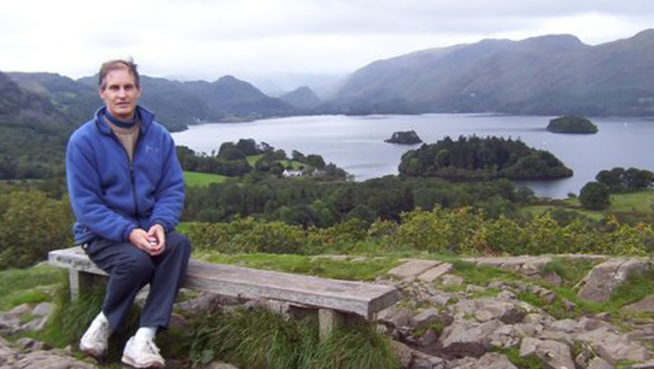
“Ayurveda can make India the world capital for curing chronic ailments – says MIT and Cambridge trained professor”
Ayurveda can make India the world capital for curing chronic ailments – says MIT-Cambridge Professor
Indian sciences can solve modern medical problems because they recognise the difference between the gross physical level, Sthula, and the more subtle, Sukshma, level(s) – Professor Alex Hankey
Aparna M Sridhar

Professor Alex Hankey
Professor Alex Hankey, a British theoretical physicist trained at Massachusetts Institute of Technology and Cambridge University, was first introduced to the power of meditation when as a 10 year old child he lost his mother and found solace in repeating a small prayer, not realising then that it became a mantra for him.
When he went to boarding school, he couldn’t cry himself to sleep as he was in a dormitory with 10 other little boys. “So I told a little prayer, ‘God bless Mummy.’ And I repeated it over and over, I didn’t know at that time, like a mantra. It took me to a level, after a year or so, of blissful silence,” he said speaking to CSP at S-VYASA in Bengaluru.
A year later, his older sister gave him a book – The autobiography of St Theresa of Avila - which described in great detail what it called the seven stages of prayer. “I could see I was somewhere near stage 3 and a half. Therefore I got the understanding that if you progressed on this path of meditation you could arrive at great things,” says Alex.
Meditation helps to tap the mind’s potential. Prof Hankey says, “We like to explain the mind as an ocean, manasa sagara if you like. It has got lots of waves on the surface, driven by information coming in through the five senses. Most people only have an access of 5-10 per cent of that. Even Einstein said he had access to only 15 per cent of his mind. So you have this vast body of mind, mental potential which is largely untapped. So how do you meditate? You do various procedures given in Patanjali to let the mind settle down. Then you have the procedure which turns the mind inwards. Patanjali terms it as Pratyahara. Once the mind is turned inwards it is actually attracted automatically to this area of inner bliss. This level of silence is the level of pure Ananda. So our understanding is that when you are given an inner direction and you have the mantra to take you there, dhyana takes place automatically.”
Prof Hankey says that one does not stay long in this state because the nature of this stage is that it energises the mind which releases stress, and once this happens you come out of this phase. “So the whole process is cyclical. You go inwards with the mantra, letting go and the system gets energised with Shakti. It worked like a dream for me. It got rid of the stress that I had been carrying for years. I didn’t need asprins.”
Deeply interested in Vedanta, Yoga, and Ayurveda, Prof Alex has played a vital role in setting up Maharishi University of Management and later on taught their first undergraduate course in Philosophy of Science. It was while studying at the MIT that he learned of Maharishi Mahesh Yogi’s Transcendental Meditation technique (TM). He appreciated the technique so much that he became a teacher of the technique immediately on graduating from M.I.T., during the year that he spent at Stanford.

Speaking about meditation and its ability to take one to higher states of consciousness, Professor Hankey quotes his colleague at TM who identified three types of meditation. “One is called Focussed Attention (Volunteering of attention on a chosen subject), and that produces a certain kind of brain waves of high frequency 30-40 cycles per second (gama waves in front of the head). Another is called Open Monitoring Technique (nonreactive monitoring of the content of experience from moment to moment) which produces Theta waves all along the midline. Then the third is called Automatic Self-Transcending Systems (transcends the steps of the meditation practice leading to pure consciousness). When you reach the transcendental phase you experience inner silence and bliss and the effect of being in that state completely transforms the pattern of your physiological functioning. Anxiety goes away, depression, much more slowly, is eased. The mind enters a state which is called Alpha. The alpha starts classically at the back of the head and then spreads all over cortex and all the main lobes of the brain are involved. We got these results very very clearly.”
Professor Hankey says that this was an area of great interest in the early 1970s. A French neurophysiologist at TM started researching the deeper aspects of meditation and got very good results. “In 1978, the Frenchman set up a laboratory in the UK and we asked the best researcher in EEG in the UK, John C Shaw to evaluate the research. When we told him we see frontal alpha, he said ‘You see what’.”
The TM team told John Shaw that they saw the alpha waves start at the back of the head and then spread forward and eventually become coherent when people get more experienced at meditation and that they saw it in all the participants.
“Even in early meditators you see this signal which is characteristic of inner peace starting in the back and becoming global on both hemispheres. When I said to him we see alpha frequency waves in the front of the head he said that he had never seen that in his life. He said he wouldn’t call that alpha if he saw it from the front of the head because alpha waves are seen only at the back of the head. So it’s very real, it is completely reliable, we see it completely reliably, and it’s apparently unique. When you ask yourself what is it that is happening you are putting your mind in a state which is fully awake in itself. But there is no informational content, there are no thoughts, there are no emotions, and there may be a feeling of bliss. It is basically what I call a state which is ‘empty’. There is no information content but you are not asleep. Some people say, rather wittily, it is rather like falling awake. It is reliable and for various reasons it is automatic.”
Prof Alex spent 30 years teaching TM and the Vedic Sciences in different countries. He returned to research in 2002, and came to Bangalore in 2007, where he met S-VYASA Vice-Chancellor, Dr HR Nagendra within two months of arriving. He joined the university five months later. His current work at S-VYASA relates to applying a combination of philosophical arguments and knowledge of Vedic sciences to solve problems in modern science, and thereby refining the foundations of physics, biology, and information theory.

EMPERICAL SUCCESS OF TRADITIONAL INDIAN SCIENCES
Comparing Indian sciences to Western practices, Prof Hankey says that Indian traditional sciences depend on the well-defined process of cognition from the Yogic state of Ritam Bhara Pragya described at the end of Patanjali Yoga Sutras Pada I. “When the applied Vedic sciences such as Ayurveda, Dhanurveda, Gandharva Veda, Sthapatya Veda, Shiksha, Vyakarana, Jyotisha, Nyaya, Samkhya, and Yoga are considered, the feedback of empirical success into the structure of knowledge and teaching are very much in evidence, also in the Arts such as Natya Shastra, Painting or Sculpture, to name but a few.”
Prof Hankey says Indian sciences can solve modern problems because “they recognise the difference between the gross physical level, Sthula, and the more subtle, Sukshma, level(s). The western sciences have almost no idea of the existence of the latter, and tend to deny evidence for it when data indicating their existence is brought up. Great scientists like Rupert Sheldrake in the UK report highly negative treatment at the hands of senior scientists who are convinced that they themselves know best – when they don’t. The power of the Sukshma levels can explain all the great results reported in ancient Indian sciences.” Prof Hankey says he has developed an authentic and powerful theory of how the Sukshma fits into the physical world.
And that theory is rooted in Ayurveda which he says has the ability to assess patients’ pathologies at a Sukshma level. His student Dr Purnima Datey in Bhopal has demonstrated cures for several chronic diseases using methods of the AYUSH systems of medicine. “Her system of Rasahara can make India a world capital for curing Chronic Kidney Disease (CKD). Our work shows that failing to follow any principle of Ayurveda Ahara-Vihara constitutes a risk factor for a corresponding pathology – also that Yoga practice systematically reduces complications of several pathologies.”
Prof Hankey says that coming from a family of great Vaidyas, Dr Poornima grew up with Ayurveda in her “blood and bones”. Describing her ability as being intuitive, he credits her with his greatest discovery in Ayurveda and Yoga. For instance, the basis of most scientific research done on diabetic drugs is to observe how much of a shift is produced in bio-chemical markers during post-prandial or fasting blood sugar. Ayurveda allows one to have a very different strategy on how drug intervention works.
Dr Poornima found that Ayurveda normalises the variants, bringing them back to their normal range. “For example if you give one of these drugs to someone with normal blood sugar it doesn’t change. But if you give it someone who is diabetic, it will reduce their blood sugar.”
While mainstream research would take an experimental group of 50 people with different values of blood sugar, and compress the whole distribution to study shifts from the mean, the Ayurvedic approach of Dr Poornima and Alex insists it is more important not to look at the shift in mean and instead look at the “shift in distribution of variants or standard deviation. If you look at the width of the distribution you find that you get extraordinary results, much more significant than if you say, how much the shift from the mean it is. This is entirely due to her research. We were able to frame her qualitative research into quantitative terms. We have verified this for yoga interventions in many different studies.”
Alex says that Vedic Yajnas and Yagas also act at a subtle level and can achieve goals that would otherwise be unattainable. “From the simplest like Agni Hotra or Graha Shanti, which can greatly protect the individual and solve personal problems, through Yagyas like Parjanya Yagya that can bring rain to drought stricken areas, and on to the Vedic Civilisation’s great performances such as the Maha Soma Yagas, which can create harmony and peace throughout a nation, and the Rudra Abhishek’s which can create a Kavach for an entire nation (Ati-Rudra Abhishek) or resolve major world crises, such as its performance in 1944 by the Shankaracharya of Jyotir Math in order to bring World War II to a timely conclusion.”
MAKING INDIC KNOWLEDGE SYSTEMS MAINSTREAM
Indic knowledge systems including Indic technology, Vedic Physics, Ayurveda, Yoga can become mainstream, says Prof Hankey, by establishing well-respected empirical validation of scientific conjectures derived from them.
“Yoga has been thoroughly validated, and the numbers of Randomized Controlled Trials conducted at such prestigious institutions as Harvard University, M.D. Anderson in Houston, Texas, and NIMHANS in Bengaluru (not to speak of S-VYASA) is steadily increasing. Similarly the number of case studies and randomized controlled trials of Ayurveda is steadily increasing. There is now a national move in India to promote AYUSH integrative medicine More work on foundations of Yoga is needed; particularly its ability to produce higher states of consciousness like those intimated in the second half of Mandukhyopanishad (vs. 6 to end) verifying the principles enunciated in Ishopanishad, Yoga Sutras etc. Decisive work has been carried out on the Sukshma Sharira, verifying such statements as Padmasana being the most effective means to energize the subtle body (its verification led to one of my Phd students being named Valedictorian of his graduating class).”
In the field of Ayurveda, Prof Hankey says South Indian cuisine with its Sambhar and Rasam emphasises replacement of mineral losses due to Swedana. “Both systems use the fundamental masalas including Haridra, Ginger, Dhanya and Black Pepper, that reduce cancer, especially in the GIT (Haridra), enhance digestion (Ginger and Dhanya) and absorption (Black Pepper). The popularisation of various Indian curry dishes, and modes of cooking such as Tandoori, around the world, does much to enhance awareness around the world of India’s culture, both historic and contemporary.”
Prof Hankey frequently catches up with his colleague from Cambridge and MIT, Nobel laureate Brian David Josephson, also a physicist and they offer each other advice and opinions on their respective programs of research and sometimes attempt collaboration. Prof Hankey’s work is well known with other members of Trinity College, and his research results in Ayurveda and Yoga has been acknowledged by Master of the College, Sir Greg Winter, the recent recipient of the last Nobel Prize in Physiology and Medicine