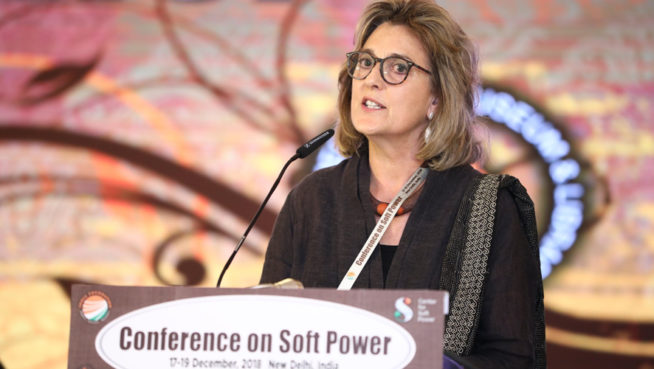
“We gradually came to understand how special, how unique each of India’s textiles were” – Dr Valerie Wilson
Dr Valerie Wilson and Sue McFall co-founded MOTI in 2001, which sells limited edition clothing, nightwear and homewares made from beautiful Indian textiles in Australia. In the midst of researching and sourcing photos for her forthcoming book – A touch of India, Valerie spoke about her experiences in engaging and working with Indians.
Valerie has familial links to India. Her mother was born and raised in Mumbai, and her grandfather was half Indian and worked as an electrical engineer for the Tatas. Valerie’s parents met in Bombay when her English father, fighting in Burma during WW2, visited India while on leave. The young couple married in 1945 and moved to Cambridge where her father’s studies had been interrupted by the World War. Valerie was born in Cambridge two years later. She visited her grandparents in Mumbai when she was was 6 years and again, for 6 months, when she was 10. They family lived in Panchgani where her grandparents lived after retirement.
Dr Valerie Wilson Valerie’s love for India and her desire to know more about her heritage lead her to take a year of Indian Studies as part of her BA and over the years she says she has read many great Indian writers and novels mainly, but also general reading about India.
It was during her third visit to India, much later, that Valerie was truly smitten. “There is such a lot to see and do. Just being in India, anywhere, is to immerse yourself in a wondrous new world, landscapes, religions, colours, monuments, textiles, people of all sorts!! All the obvious touristy sites are unmissable. But there is so much else besides. It’s fascinating, exasperating, exhausting, addictive!”
Valerie worked as a consultant for many years before plunging into Moti. And a lot of what she learnt in her earlier profession helped her to navigate through India. “In a general way I think that, as a qualitative researcher, I was used to asking questions and always seeking greater understanding. I was used to being self-employed, to working things out for myself. For several years I had worked in marketing research so I had a good understanding of consumer attitudes. And I had a very good partner (Sue McFall) in the enterprise who is a self-employed architect, familiar with design and production processes.”
Initially they were attracted by the cotton from Mangalgiri and even visited the town of Mangalgiri to watch the various processes in action. “We used to order multiple meterages of different colours. We loved it. We usually ordered through an intermediary in Hyderabad or Delhi. We also came to love Maheshwari, Khadi and numerous other fabrics. There are so many!”
While Valerie says they did not have a lot of direct contact with the weaver themselves, their various suppliers taught them a lot about “the differing techniques of weaving and of block-printing so that we gradually came to understand how special, how unique were each of these textiles. And how humbling. That’s what struck me the most. A garment that we might casually throw on has been through so many time-honoured processes, has taken so much time and dedication to produce.”
She
describes an incident with a bangle producer and how they became impatient with
a supplier who seemed to be taking a very long time to provide some resin
bangles for them. “We hadn’t realized that they were being painstakingly carved by hand and
he could only do two a day.
So we often had reality-checks of this sort and learned patience and
humility!”
Having said that, there were issues with quality and
consistency as is wont to happen in handmade goods. “Our business liked the
fact that handmade goods are a bit inconsistent because that is what lends
character, what differentiates hand-made goods from factory or
machine-processed goods. Our customers were often surprised to learn that every
thread of fabric in a garment we sold had been woven in by hand. We had to
remind them, to educate them. Especially as we often used plain colours and a
lot of plain black! (I’m afraid people in Melbourne like to wear black.) So it
was even more surprising in a plain fabric to realise each thread was hand
woven in. But they were also pleasantly surprised by how hard-wearing such
fabrics can also be. However the idiosyncrasies of hand weaving meant that we
didn’t ever consider wholesaling our garments. We needed it to be a personal
business, where we could tell the stories, educate our customers. Then they could
see, as we did, that the idiosyncrasies were charming! (Sometimes however,
idiosyncrasies were simply faults and were less charming!)”
Once they ordered 200 metres of black silk-cotton
and when it arrived in Melbourne it was grey. “Not even dark grey, but a
mid-grey. When we protested we were told “it’s the Indian black”!!
Valerie says that Indians and Australians share a
similar sense of humour, and often humour helps to deal with situations. “We
see the funny side in things that others may perceive as problems. We enjoy
good-natured banter. We can all use humour to defuse difficulties. And there
are quite a lot of difficulties for foreigners trying to do business in India:
we have to learn to deal with heat, dirt, noise, disease (tummy bugs), indirect
conversations (e.g. people not wanting to say ‘no, we can’t do that for you’),
power shortages, lengthy delays in Indian traffic, lengthy delays receiving
ordered goods….and more! But it’s worth the effort: the rewards are both
tangible and intangible, the pleasures, the gradual understanding, the
insights, the friendships...”
And finally, one asks Valerie about Cricket. Valerie says that when
people would ask them where they were from, while walking in a market, and when
they replied Australia, it would inevitably lead to long conversations about
cricket. “Luckily I know a bit about cricket via my three children who used to
play. But sometimes we were tired and couldn’t cope with cricket-talk so when
people asked where we were from we would reply ‘Yugoslavia’. Silence. (But a
bit mean of us!!)”
In 2016 twin sisters, Marilyn and Christine Shady took
over the running of MOTI. But
Valerie says she and Sue continue the tradition of MOTI with
their love of India.
"India is the only country today that has skills of hand spinning. It is the most unique resource in the world today" – Mayank Mansingh Kaul
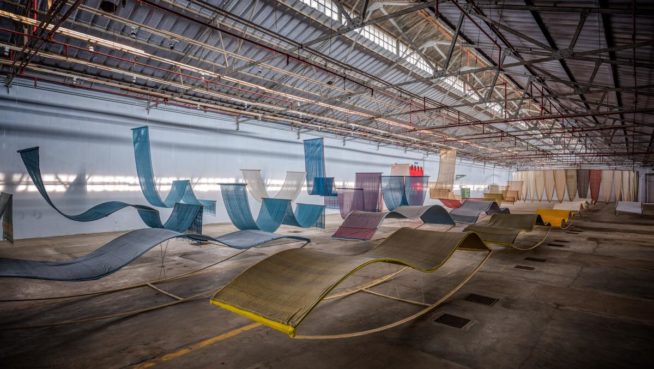
Against the background of the 150th birth anniversary of Mahatma Gandhi this year - whose call for Khadi led to the Indian freedom movement – Ahalya Matthan of the Registry of Sarees, and designer Mayank Mansingh Kaul - held the third iteration of Meanings and Metaphors in Bangalore. In a free flowing conversation they spoke about handmade textiles, the identities they impart as well as their place in contemporary design.
The sarees displayed at
Meanings and Metaphors only hinted at the diversity of textiles that exist in
India. A diversity that goes far beyond the textiles themselves.
Ahalya Matthan Director and Founder of the Registry of Sarees, a Research and Study Centre in Bangalore of handspun and handwoven textiles, is trying to create cultural capsules to find commonalities and communicate that using textiles. “I personally feel in India we have nothing in common - not food, not religion, politics, language, geography, music history, etc. And in this diverseness, it is difficult to find common ground except for in our textiles, There is a love for textiles in all of us,” says Ahalya.
Ahalya Matthan is the Director and Founder of the Registry of Sarees, a Research and Study Centre in Bangalore of handspun and handwoven textiles (All Photo Credits: Registry of Sarees)
Take for instance the
Bundi saree, which the Registry’s site says is a ‘modern day response to a
young nation’s identity’. It merges skill and craft sets from two entirely
different regions, Kancheepuram and Rajasthan. The pure cotton saree with the
silk borders specially woven using the three-shuttle ‘temple’ technique synonymous with Kancheepuram was combined with the
highly skilled block printing technique using blocks developed from
inspirations at the Bundi Fort, Rajasthan. They were merged onto the sarees,
thereby linking Rajasthan and Tamil Nadu. “A rich colour pallet that is
appreciated in both states was used to bring forth a similarity of appreciation
and culture,” says the Registry.
The Bundi saree, merges skill and craft sets from two entirely different regions, Kancheepuram and Rajasthan
For Mayank Mansingh Kaul, a textile and fashion designer, and Founder-Director of The Design Project India, the most attractive thing is that India is the only country today that has skills of hand spinning. “It is the most unique resource in the world today. Apart from that, the thing that hits people the most about our textiles when they come from outside is that it is so diverse. It is the quality of cotton, the quality of natural dyeing that does not exist elsewhere in the world. It has such an amazing variety of motifs where everything has a meaning. What draws people from outside and within it is endless, but the first thing is the sheer diversity.” With textiles changing even as one moves from one part of Tamil Nadu to another.
A lot of this fascination is articulated through the stories
from foreigners, friends of Mayank. “The Japanese are more attracted to the
material quality. They are very interested in the structure, the materiality.
Whereas in the West, people are interested in the stories. Today we think of
the Kota Doria as being synonymous with Rajasthan, but it was originally the
Mysoria Doria. It goes from the Royal Court of Mysore to Kota. I think these
are the stories that are very appealing to the West.”
Mayank has researched these stories and his writings
talk about the recent history of Indian textiles. “You have to talk about
textiles not just as a product but as a confluence of the political and the
social. Khadi was political. In the 60s and 70s when everyone wanted to wear
imported chiffon, Indira Gandhi started wearing handloom. She even had rules,
we believe, that all government offices had to buy only handloom furnishings
–curtains and sofa covers and other things. To make that shift when people wanted
to look at western references, was something,” says Mayank.
Mayank Mansingh Kaul is a textile and fashion designer, and Founder-Director of The Design Project India
When Ahalya and Mayank thought about collaborating, they found there was
a lot of misinformation about textile history. “Suddenly people were selling
Hindru sarees. There was never anything called the Hindru saree. Hindru was a
fabric woven for shervanis among the Mughal or aristocratic class,” says
Mayank.
A graduate of the National Institute of Design, Mayank says it is only in the last 10-12 years there has been an interest in the study of contemporary Indian textile. “NID is one of the oldest design institutions in the world and until my batch in 2001 we were still taught by some of the founders of the NID. NID was formed with international linkages to movements like the Bauhaus (learning by doing rather than the traditional transmission of traditional knowledge) in Europe. So we knew what happened 200 or 300 years back but we had very little understanding of what happened 100 years back or 60 years or post-Independence. I felt those histories were not in books and exhibitions. So over a period of time, my own practice looked at design, fashion and textiles in the modern period and my argument is that we have not sufficiently understood this period.”
Mayank quotes historical inaccuracies, emphasising the need to learn
more about our textiles in contemporary times. For instance, the Telia Rumal of
Andhra Pradesh was never the saree which it is today. It was a rumal that was
exported to the Arab world. “These are more contemporary histories. Another
example is the Ikat sarees which people believe have always been made in Ikat
in Andhra Pradesh. Whereas it is a much more recent phenomenon. It is only in
the 1950s and 60s that the tradition of the Ikat saree emerged. My interest is
to look at the more recent history and fill in the gaps through that between
the present and the historical.”
Mayank’s previous major exhibition at the Jawahar Kala Kendra was an
exhibition on the history of 70 years of Indian textiles since Independence
told through 70 textiles using textiles that were both art and fashion.
“Often, we don’t see the story behind these textiles, it stops with
buying and wearing them. My efforts are to do non-commercial curated
exhibitions. These collections are not about buying, it’s about being aware of the
textile, or enjoying the pleasure of looking at it - it’s an educational
process.”
At the first exhibition of Meanings
and Metaphors at Chirala in Andhra Pradesh, 5000 weavers attended the
event. The exhibitions serve as repository of the best work of weavers. In
their research Ahalya and Mayank noticed that weavers often sell the best of
what they have made. “If they cannot retain the best examples of what they make,
how can their future generations replicate that quality? So when you take an
exhibition like this they are reminded of the quality that they have made, but
that they have not been able to hold on to. In an environment where textiles
and fashion are so over articulated, we try to provide non-commercial platforms
to view and understand these traditions,” says Mayank.
At the first exhibition of Meanings and Metaphors at Chirala in Andhra Pradesh, 5000 weavers attended the event
Another collection that will be exhibited by them in 2020 – Sarees of India - will feature sarees
from the late 19th century to the 1980s. Whenever the duo gets access to a collection
they store it at the Study and Research Centre at the Registry of Sarees and
anyone can access it for research or viewing. The center has over 108 variety
of fabrics and 108 sarees of which only 51 have been exhibited.
Mayank and Ahalya see textiles as an inheritance that needs to be cherished. Every saree for them has a story as it passes through atleast twenty hands before becoming what it is. At the time when there was a move to remove reservations and subsidies for the handloom sector, Ahalya became a part of the 100 sarees pact. She and her colleagues decided to become proactive and wear more handloom sarees in order to get people to wear handloom and support weavers.
Speaking about identity and the saree, Ahalya says the Registry has seen a lot of interest from expats who are ‘interested to interact with the drape and even to know about the pieces.’ “Expats in cities like Bangalore, Gurugoan, Bombay, not so much traditional hubs like Delhi and Calcutta are adopting the saree to be able to fit into the cultural environment. It gives them an inroad not just into a new ritual or experience like going to a temple or eating from a plaintain leaf, experiences you have as someone coming to a new country, but it also gives them a sense of bonding and community and that I think is very important,” says Ahalya.
Pamela Kaplan, who headed IBM at Bangalore for two
years was an American with red hair, and so was very conspicuous among her
staff. Ahalya says she started wearing sarees to work every day. “The norm and
trend in IBM was western wear and even formals were gowns - Indo Western gowns.
And suddenly, she said, in two to three months the culture of the organisation
changed. Young women and men started feeling awkward that she was coming in
sarees and they started wearing Indian clothes. It is just conditioning.”
“Indians
are not Brand oriented but Product Oriented”
Mayank did a project last year on 50 years of Ritu
Kumar, the brand and the person. Today, Kumar owns a multi-crore company with
over 80 stores in India as well as branches Paris, London and New. Mayank is
working on a personal memoir of hers, bringing together her notes made over the
years. “Ritu says ‘what Chennai wants is fundamentally different from what
Ludhiana wants’.”
Mayank says this is not the same as big luxury brands which have over 500 stores around the world with all their shop windows looking the same, and all the products are the same. “We laugh because these stores have outlets in Delhi and other places and in August they have the woollen collection because in the West, winter starts in August. Here we still have four months of summer left. Ritu was also telling us, it is not just about handloom policy, the diversity is so much that even large companies like these who would love to have a standard format, cannot function optimally here. Sizes are different, body types are different from region to region, cultural buying is different.”
In the West, identities come from brands, because they
don’t have close family ties, says Mayank. “In India we have so many
identities, we have religious identities, geographical identities, cultural
identities, you have an identity from your father’s side, an identity from your
mother’s side, where you grew up, then your college, your professional
environment. In the West you don’t have these identities. So brands give you
identities ‘I only buy Gucci or Aesop or Forest Essentials’. In India we go for
the product. Only here, we will buy the blouse from one designer and the saree
from another,” says Mayank.
He speaks about his great grandmother who was a child
widow, and was sent by her father-in-law, to do a PhD in Cambridge and wore only
sarees. “From then onwards if you look at the history of women and clothing,
somehow the lure of the saree hasn’t gone. There is something about the saree
that provides a kind of identity which is fascinating. Even in Indian fashion,
fashion designers are always making new versions of the saree. It’s a dress
saree or a Chota saree, or a saree with Churidhars. It is something that has
consistently been observed to have given Indian women an identity and there is
no other equivalent that has given them the same kind of identity.”
Modernity versus tradition
Traditionally, the weaver in India was the designer,
but in the modern context city-based
designers have become the face of our textiles, putting the weaver lower in the
ecosystem.
Mayank has expressed his objections to the designer
being perceived as the value addition and the weaving and craft as labour. “That
is a western referenced idea. We have to remember that design came up in the
West in the Post-World War when they had to use machines. Design came up in an
environment where you didn’t have crafts people left. In the Indian context
unfortunately we have looked at design from these perspectives where the
designer is the intermediary. In the traditional systems, there’s a person who
designs, person who cuts the cloth and everybody worked together. I have a
problem with the designer being the face because in pictures you will see the
hands of the craftsman, and the face of the artist and designer. A lot of my
curatorial work challenges that. I always show art, design, textiles, craft
together.”
Mayank addressed these concerns in his exhibition ‘Fracture: Indian textiles new Conversations.’ While normally the ideas are those of the designer, with the craftspersons producing them, but here they projected the work as collaborations. “So the name of the craftsperson was mentioned alongside the designer. So curatorially, we could provide them that equality. Unless they have social status, they are producing things that someone else is claiming credit for. I think we need to move into a creative era where anyone who is involved in a creative and manufacturing process has equal credit.”
Earlier people would source the sarees from the weaver
directly. “Families that would buy from Benaras would go to the weaver’s family
directly. There was that contact. Designers have changed that because we have
given them the responsibility of training the weavers, giving them new ideas.
It’s a two way thing. Weavers are being informed by designers because they are
in a different context, cut off from things.”
However, things have improved for the weavers, says
Mayank. In the last 5-10 years many of the master weavers have done well for
themselves, so much so that their children have gone to design schools.
“In Andhra we visited two Master weavers, and now they
don’t sell their best pieces because now they want to keep a creative museum of
their own best works. There’s new found pride and there’s financial success.
But some would say that no matter how wealthy you are nobody wants to marry a
weaver’s son because of the caste and social status implications. It is a very
complex situation but I think the first step is to give them a face and a name.”
“Every
state needs its own handloom policy”
The diversity in textiles is so huge that it is not
possible to have a single marketing strategy for the whole country, believes Mayank.
What may work in Kutch may not work in Orissa. Kutch
has been an entrepreneurial community for the last 1000 years and so their
crafts are thriving. “The whole world is in Kutch, from Japan to America. But
if you take Orissa or Bengal, they are not entrepreneurial communities
traditionally. In Sambalpur in Orissa, all the uniforms in colleges and schools
are compulsorily handloom. So State government intervention has helped.”
In Kutch, where the problem is not product development
or marketing, or design, the government may have to have a different kind of
role. The Government role has to be
sensitive to these individual contexts, adds Mayank.
“The role of the government should be to provide an
ecology where workers can work with pride and have working conditions that are
human.”
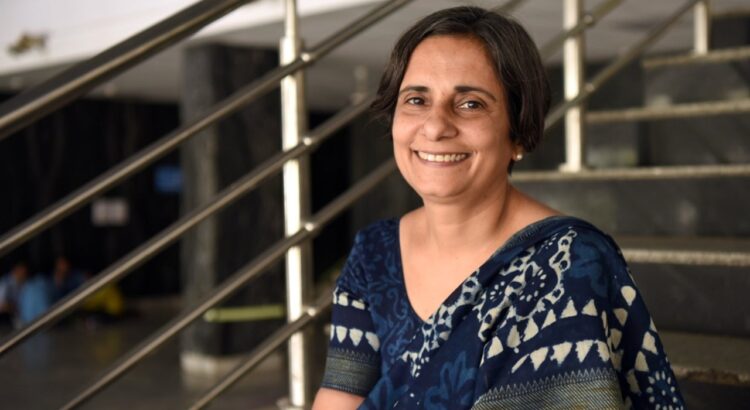
Biologist Dr Gagandeep Kang was the first Indian woman scientist to be elected Fellow to the 360-year-old Royal Society, London. Kang was part of the Royal Society of London's announcement of the list of 51 eminent scientists elected to its fellowship in the year 2019.
Dr Kang has been working on diarrhoeal diseases in children for over 30 years and has helped develop Rotavac, India’s first indigenous vaccine against the rotavirus that causes severe diarrhoea. Her research focuses on enteric infectious diseases and the consequences of intestinal infection on immune response, gut function and nutrition in children.
Over the past 20 years she has built a strong inter-disciplinary research and training program, where young faculty and graduate students are mentored before embarking on independent research careers. She leads a multi-disciplinary research team that conducts comprehensive and complementary studies in the description, prevention and control of diarrheal disease using state-of-the-art tools in the laboratory, hospital and the field. The laboratory has studied human and bovine-human reassortant rotaviruses in children with gastroenteritis in hospitals, the neonatal nursery and the community. Complementary studies on water safety, vaccines and treatment trials have evaluated interventions to effectively prevent or reduce diarrheal disease. Her work has led to practical interventions to prevent diarrhea, and continues to lay the groundwork for further interventions in the form of treatment techniques and vaccines.
Biologist Dr Gangadeep Kang
You were instrumental in India getting a vaccine once, do you think, India has the ability to do it again with Corona?
India is a powerhouse for sustainable vaccine supply in the world. With the investment and facilitation of the government there is no reason why we cannot make many more new vaccines.
How is India equipped to deal with infectious disease?
We have many vertical disease programmes for control of infectious diseases, HIV, TB, malaria, vector borne disease--these are under the Ministry of Health and Family Welfare . We also have efforts from many stakeholders in new approaches to treatment and prevention, such as the many science institutes of the Ministry of Science and Technology, particularly the Department of Biotechnology. The institute I am at, the DBT-Translational Health Science and Technology Institute, works on tuberculosis, viral infections and antimicrobial resistance.
What is the role of traditional medicine in treating this virus and other diseases?
Traditional medicine from China resulted in treatment for malaria that has hugely helped malaria control in the past 20 years. Traditional medicine has many undiscovered secrets. I do not know if we will find one for this virus, but we should certainly try. We have programs based on natural products with companies that make Ayurvedic drugs trying to find out the mechanism of action.
Ancient India had been in the forefront of science and technology and medicine. What do you think should be done to revive the scientific temper among youth?
India led the world in science and medicine because society and rulers respected and supported science and scientists. Today, we need to understand that without investments in science and technology, no nation becomes an economic power. This investment needs to be all across the spectrum, including encouraging curiosity and exploration among our young people. Training of teachers, well equipped facilities and time set aside for exploration are important for school and college students, but society as a whole would benefit from high quality museums.
What does becoming Fellow to the Royal Society, London mean to your work?
I think this is an important recognition of the importance and impact of the work that we have done for children’s health in India. Too often, Indian media denigrates work done in India and ascribes all kinds of ulterior motives to researchers.
My team and I have worked hard for over two decades to build relationships with the communities we work with and for, and this recognition of the quality of the work we have done together makes us feel good that our contributions are being recognised.
As a very influential Indian scientist, what is your message to the rest of the scientific community in India.
Work together for protecting and promoting health. We need to focus on ambitious, high quality research in whichever field we choose and where we are in the spectrum from discovery to impact on society. Scientists need to communicate outside their own circles and speak up and stand up for science especially when there are nay-sayers who capture public attention.
Bangalore can lay claim on internationally renowned chef Anthony Huang who in his own words is a ‘thoroughbred Bangalorean’. His parents moved to Bangalore when he was one year old and he has grown up, studied and worked here, heading the kitchens of some of the top brands in the city including The Sheraton Grand, JW Marriott, Hyatt and The Oberoi. In this interview he speaks about his influences and his passion for Indian cuisine and culture
His parents moved to Bangalore when he was one year old and he has grown up, studied and worked here, heading the kitchens of some of the top brands in the city including The Sheraton Grand, JW Marriott, Hyatt and The Oberoi
Growing up in Bangalore and become a chef here, did you feel
it was big enough for someone with your talent?
Anthony
Huang: Bangalore has always been exceptionally kind to
me. My first exposure to hotels was in Bangalore at a time where everyone
called Bangalore a Tier II city and that I needed to move out of the city to
really learn. My career took me in and out of the city and I came back to head
some of the most prestigious kitchens. Guests in Bangalore are well travelled,
unassuming (and in many cases as knowledgeable as you are). This obviously
keeps you on your toes all the time, constantly innovating and making sure you
are relevant.
You have made a name for your signature dishes with coffee.
Did that idea take root here?
Anthony
Huang: Having grown up in Bangalore, coffee is
something that I take very personally and whose flavours I understand
reasonably well. I am a huge crusader of trying to use locally available
produce as far as possible and try and do my bit for the environment. There is
no doubt in my mind that locally sourced raw materials are always the best
option.
This along with a desire to do something different and an opportunity to keep escaping from hotel life into a plantation got me started.
"I am a huge crusader of trying to use locally available produce as far as possible and try and do my bit for the environment. There is no doubt in my mind that locally sourced raw materials are always the best option. "
How was it working with Oberoi, Hyatt, Marriott and now
Elior? How would you describe each of these experiences? How are they
different?
Anthony
Huang: Well my experiences with Hotels as a Chef gave
me a lot of exposure, taught me new things and gave me the platform to try
different things all the time.
Elior now gives me the platform to do similar
things but on a much larger scale. I wanted to take a little break from hotels
and try out something different. This job gave me the opportunity to set up a
new facility, handle huge volumes and I am gaining from it personally in the
form of learning something I have never done before.
You have mentioned in earlier interviews that you missed a
lot of classes while at college. What is the role of Hotel Management schools
in producing international standard chefs in India? Is work experience of more
value?
Anthony
Huang: Hotel Schools have progressed a lot ever since
I have passed out of college. They are today supported by easier access to data,
information and infrastructure. There were many things that we heard for the
first time like Pasta and cheese. Today’s kids enter college having already
tried at least 15 varieties of each, so they start of at a much higher platform
so to speak. I have visited my Alma Mater “Christ College” and I must say that
I am pleasantly surprised to see the progress that they have made and the
quality of students they produce.
Work experience and academic qualification go hand in hand for me. There are just so many things for a professional to learn besides just learning how to hold a pan and cook a few dishes.
Anthony Huang with His Holiness the 14th Dalai Lama
You have cooked Chinese, Vietnamese and French food.... and
also Indian. What is it about Indian food that appeals to you?
Anthony
Huang: Well I am an Indian at heart and an Indian in
my head. I have grown up eating some of the best Indian food in my friends’
houses and have always wanted to learn how to cook it myself at home. The
memories of Indian food is something that reminds me of my growing years, of my
friendships and bonds that I will cherish forever.
Food for me is an emotion and that emotion is
Indian. The day I don’t feel it I just don’t enter the kitchen. Only happy
chefs can make food that talks to you.
How does one create a clientele who will come back again and
again for food in a luxury hotel?
Anthony Huang: Clientele in a luxury hotel looks for that one extra touch of luxury in a plate that a free standing restaurant cannot provide him. Today the gap has become narrower but still has some catching up to do. It could be simply sourcing the best and responsibly grown lettuce or getting your desserts made with the best chocolate. Everyone’s perception of luxury is not the same, the key lies in identifying that perception.
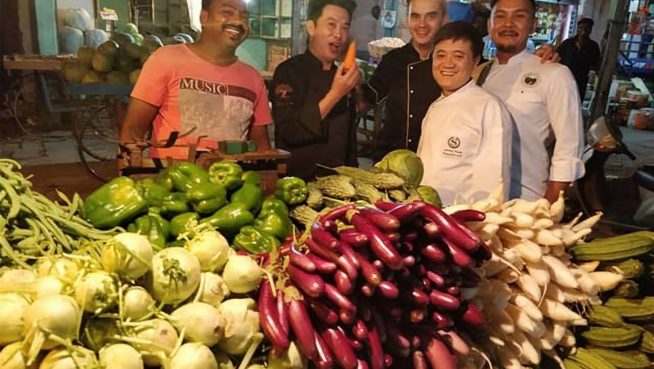
"Sometimes it really makes me feel that these street vendors are the True keepers of our culture. We were completely blown away by the fact that she refused to take a penny for the vegetables that Chef Kuan picked up because she considered him as a guest to her country. I'm sure that these are the memories that he is going to take back!! So proud of her."
What about your family. Do they like Indian food?
AnthonyHuang: My family loves Indian food
as much as I do. In fact my 15 year old daughter’s favourite food is “Ragi
Mudde”. That says a lot I guess.
How much of food is authentic to cultures. We have 'Gobi
Manchurian' being more famous than any other Chinese dish, but it is not
authentic Chinese food. What are your thoughts on this?
My thoughts are very simple. Some intelligent guy was able to identify what the masses wanted and made sure everyone went home rubbing his tummy. What’s the harm? I believe that a Chefs primary job is to keep the people he is cooking for happy.
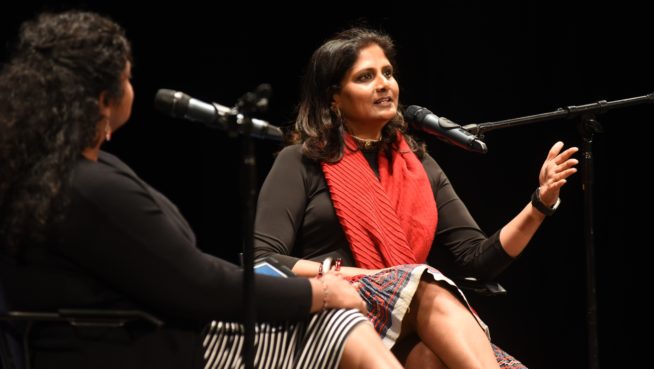
For astrophysicist Priyamavada Natarajan, both science and music help us reach out to the sublime, and music is as much about moods and emotions, as modes of thinking.
Music, mathematics, and
science have always gone together, not just in the physics of sound and the
mathematics of pitch and frequency, but in the lines of inquiry that open up to
cognitive scientists, evolutionary biologists, and the like.
Take a top scientist
tackling the most advanced problems in astrophysics -- like the mysteries of
dark matter and the true nature of black holes -- and a deep passion for
classical music, with its notes, sounds and rhythms resonating and echoing with
the most elemental forces of light, mass and energy over the vast infinities of
space and time, and you get Priyamvada Natarajan, professor of Astronomy and
Physics at Yale University, Connecticut, one of America’s most prestigious,
“Ivy League” institutions, and the very first woman to receive a Ph.D in
astrophysics from Cambridge University, UK.
“Music is very much part of my life. I can’t
really describe it,” says Priyamvada from the US.
“There isn’t any real time aside from when I am in
my office, when I don’t listen to music. If I am meeting students, colleagues,
or reading, I actually don’t like to listen to music as background. But music is
something that I am involved with when I am actually working on problems, it is
very powerful to me. And I listen to everything and anything. I am always living
with music.”
Priyamvada has role
models not just from her immediate genetic pool (both her parents are
scientists) but also from the pool of music, past and present. She is inspired
by the personal lives of musicians whose genius and accomplishment equal the
best in science.
As a consequence, she has a dominant musical
self which she believes is as integral to her as her love for science.
Music streams
ideas into her all the time, segueing into science seamlessly. And she firmly
believes that in the brain they are connected.
“The kind
of neural activity that you can see in the brain when you do mathematics and
when you play an instrument are very similar. And I think there is some real connection
beyond just the general patterns. There is a deep connection with the level of abstraction
that you have with mathematics and music -- possibly more broadly with science,
but definitely with Mathematics,” she says.
At the age of 17, after
finishing schooling in New Delhi, Priyamvada went to the Massachusetts
Institute of Technology (MIT) – itself a rare accomplishment for a young girl
in 80s India.
Priyamvada Natarajan is a professor of Astronomy and Physics at Yale University, Connecticut, one of America’s most prestigious, “Ivy League” institutions, and the very first woman to receive a Ph.D in astrophysics from Cambridge University, UK.
Before the move to MIT, at a time when “American
global culture was not as prevalent in India as it is today,” Priyamvada, with
her good singing voice had learnt not only Karnatic and Hindustani music, but also
dance.
“When I was growing up I was very much rooted in
Indian traditions. I loved MS Subbulakshmi, whom I worshipped. I listened to
ghazals, I listened to Farida Kahnum, one of my favourite singers,” she says.
After landing at MIT, she made time for music,
even as she gained rapid strides in the field of astrophysics. If, even today, women are rare in science,
they are even rarer in astrophysics -- her professors and peers recognised
early her facility for large numbers and abstract problems, her succumbing to
the “allure of the night sky,” and the unique yearning to enquire into the deep
mysteries of outer space, far away from the conflicts and drudgeries of mundane
existence.
She enrolled for a music appreciation class and
also started to learn to play the piano. Life at MIT was also about adjusting
to a very different culture. She coped with the transition by getting into Western
classical music and opera.
“I landed in an extremely high-brow culture with
these deeply intellectual people. So I had to find out -- what were the bones
of this culture, what it was about. I believe music is a cameo of any culture. And
so I dove into Western classical music.”
Modes
and moods
Today, depending on the work she is doing,
Priyamvada picks the music. She is comfortable in dealing with phenomena
involving large time scales and distances that cannot be apprehended by the
senses. Frequently, the calculations she is tackling are the mechanical kind, a
series of never-ending steps, where she knows what the next step is but not the
final answer. In such cases she listens
to music that is “very agitato, very brisk.”
Then there are the bigger challenges, where en
route to discoveries and new answers, the problem has to be first set up.
“You don’t even know if you can solve this, and
you don’t know how to pose it -- and that’s where, for a lot of the work that I
do, there’s creativity.” At such times,
she gravitates to more measured, reflective, music.
“So for every mood when I work, or when I am
thinking, there are particular kinds of music, I almost use music as a priming
cue for myself not just in terms of mood but beyond that -- into a mode of
thinking.”
Priyamvada is being
noticed for her key contributions to two of the most challenging problems in
cosmology -- mapping the distribution of dark matter and tracing the growth
history of black holes. Dark matter and dark energy dominate the universe, but
we know very little about it, beyond seeing its effects and influences. It
has a lot to do with going beyond what we can deal with directly. Just like in
music.
“Music has the ability to
transport one, to transcend your day to day life and to feel and live in a way
that is beyond the mundane. I feel music of every kind is very sublime,” she
declares.
And so is work, when one is deeply connected to
it. “I have the same sensation when I do the work that I do. Part of the
motivation for the things that I do… like working with these large numbers in
the cosmos, is that I like to be transported away from the earth. I don’t like
the world the way it is -- inequitable, unjust, messy. One of the attractions
is that my work offers an escape from this sort of messy, conflict-ridden
world, to this sublime place, with the numbers that I deal with. To me music
does something very, very similar. It transports me to different realms and
definitely affects my state of mind.”
She decided very early
not to get confined by traditions, which abound even in science, and instead went
on to be among the few women to “map the detailed distribution of dark matter
in the universe, exploiting the bending of light en-route to us from distant
galaxies”.
Musically she has tried to imbibe and learn from
every form she has come into contact with. When she moved from MIT to
Cambridge, UK for her PhD, she again went into a very traditional culture.
“That was when I got started in opera. Earlier,
I had gone to Europe as an undergraduate and I went to all the opera houses, I
went to La Scala and listened to Pavarotti. I went to every opera house in
every city I went to as I had a Euro rail pass.”
After coming back to America, she got into jazz
in a big way, because there were a “lot of things happening in jazz.” One of
the fresh new voices in jazz, pianist Vijay Iyer, whose music she enjoys, is both
a friend and fellow physicist.
Despite the moving around… all the flux, she
says there are some pieces of music that will always stay with her. One is raga
Hamsadhwani, “a ragam whose very meaning - sound
of the swans- is as beautiful as its sound. It is the same ragam in both
Hindustani and Karnatic traditions. That to me is part of the appeal. Plus it
is one of the most sublime ragams I have ever heard. It sounds beautiful in the
voice. It sounds beautiful in any instrument that you play.”
Then there is Bach’s Chello suite. “If I am ever
really really down all I have to do is to really play that. It lifts my mood.”
Scientists need to question the status quo all
the time …that makes for progress. In music, classical music, tradition is a
sacrosanct.
“Science by its very nature is a very different
beast. Science is provisional. Science isn’t fixed in the way sampradaya and traditions are for either
musical traditions or dance. Our state of understanding of any phenomenon in
science really depends on data and empirical observations. With more accurate data
your current understanding is likely to shift. It can either refine your
current understanding or it may completely upend a theory… show the need for a
completely new theory.”
In some ways, she believes however, music is
similar.
There are some things about sampradaya which are “worth continuing and keeping alive obviously
and probably there should always be a set of proponents who are guarding
traditions. But at the same time you need variations; you need room for
improvisation, because in an art form, as we have seen with a lot of art forms,
if there isn’t room for improvisation, the art starts to die out. It’s hard for
the next generation to feel no room for creativity because every time you perform
that is a creative act, even though the notes are enshrined, the ragam is
specified and all of that. Your rendition is a creative act, but to not have
room beyond that, to improvise, I think is restrictive. “
Allowing for improvisation will also change
audiences. “One of the things that I find, when I come for concerts to India in
the winters, is that a lot of the younger people are not there in the audience.
I think we need to reclaim them, get them back.”