Pete Lockett’s Indian Rhythm Features in 5 Bond Movies

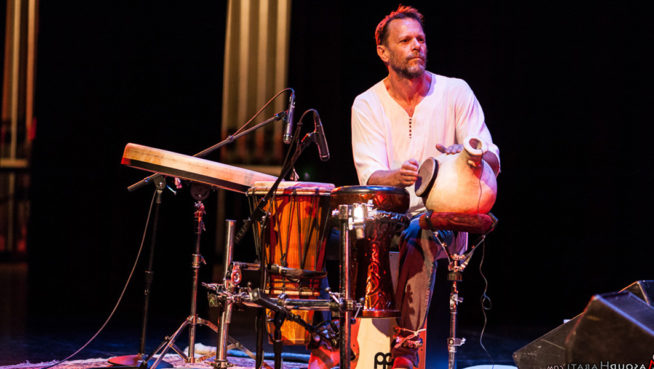
British multi-percussionist Pete Lockett was introduced to Indian rhythm when he heard Zakir Hussain play at a concert in the UK when he was 21 years old.  Constantly thinking about his music, he has invested a lot of time working in traditional Carnatic and Hindustani music as well as traditional Japanese taiko drumming. He believes cultures are healthy only when they cross-fertilise, learning from one another.

His ethnic percussion has been heard in the last five Bond movies. He has also recorded with AR Rahman on the 2007 blockbuster, Sivaji. In this interview, he shares his love for Indian music and percussion.

At the international level is it artistes like you who are showcasing Indian percussion to the largest and most discerning audiences as compared to Indian percussionists who on many occasions, especially in the South, are mainly accompanists to singers?

Many great Indian percussionists are, and have been for a very long time, touring worldwide and spreading the exposure of classical Indian percussion to a wider audience.  In the North and the South of India there are so many percussionists playing solo and developing their own projects.  Maybe fifty years ago what you say may have been true but nowadays percussionists worldwide are making their own projects, playing solo and leading performances with their excellence. The future is bright and I feel blessed to be able to go out there and share some of these amazing traditions with an audience that otherwise might not get exposed to it.  

Do you see an increase in interest and an openness towards Indian rhythms and is there an increase in the number of students wishing to learn Indian percussion?

With the advent of the internet and YouTube, exposure for everything is on the increase.  For me when I learnt 30 years ago, information was very hard to come by.  The best resource was the local library which was an hour away by bike.  Just to look up ‘Ghatam’ or ‘Kanjira’ would be a whole afternoon endeavour. Now, people can find out on their phone in three seconds.  However, one of the extremely attractive things about Indian music is that you then need to spend years and years, even to understand the very basics. This remains an obstacle to the adult enthusiast who looks into the subject for the first time.  However, all that said, the interest and enthusiasm around Indian percussion is growing year on year.  My book, Indian Rhythms for the Drum Set, on Hudson music does very well and I get a lot of letters and reactions to that worldwide.  The great thing about it is that these responses come from every avenue of the musical world, from composers to heavy metal drummers and from jazz players to pure percussionists.

Do you incorporate a lot of Indian sounds in your playing and vice versa do you find Indian musicians learning from you?

It’s not just about sounds.  It is about the whole musical system.  Once you learn the Indian way of developing the rhythmic timeline then your approach to rhythm is expanded exponentially. There is so much to help expand your musical horizons.  Of course, this works both ways.  Composing and improvisation have very different approaches as you travel across the world.  Sharing in each other’s musical systems is one of the most magical things you can imagine.  There are so many treasure troves uncovered when you explore each other’s musical worlds.  Most of the Indian musicians I have worked with are as excited to explore this as me.


Is there a greater audience pleasure in hearing sounds from different streams coming together?

There are audiences for everything.  Many people are comfortable with a specific idea, Be-Bop, Rock, Karnatic, Taiko, Orchestral etc.  There are also people who tire easily of hearing similar approaches over and over again.  They are more into the musical explorers and the creators of new musical horizons.  These are the people that want to hear Zakir with an Irish group or a heavy metal drummer with a group of Taiko drummers.  This type of audience is getting more and more as far as I can tell.  It is great to have all these people with minds wide open, waiting for the next amazing collaboration where they can witness musicians from different cultures speaking with one voice. 

How would you compare a completely percussion ensemble vis-a-vis a typical Indian concert.

There are so many ways of percussion groups playing together.  Indian classical music has a very thoughtful intellectual approach.  Western classical music does so similarly, albeit is a very different way. Neither of these musics are for dancing, in the sense of folk dances or community gatherings. (Classical Indian dance and Ballet are of course dance but, also on the intellectual path). Dance musics have a necessity to create pulse and rhythm for groups of people to dance to.  Therefore, these musical styles are incredibly far apart in their basic function and starting place. That said, it is obvious that they have very different formalities in the structure of their ensembles.

The next thing to consider is that Indian music and rhythm is very linear, in that only one voice is focused on.  Even with groups of string players or groups of percussionists, they often tend to play in unison, or one after another.  Other percussion from around the world, such as Cuban or African, has many drummers playing different interlocking parts which make up one whole voice, or rhythmic melody.  This creates such a different approach that the structure of the music is completely different.

From this follows, in all your collaborations and journeys around the world do you see a rhythmic pattern or are cultures too varied to be bridged?

There is no gap that cannot be bridged.  As I mentioned earlier, we can clearly see how some traditions differ. The task is to be able to meet with another tradition in the middle.  For both parties to explore and come to some understanding of the musical intent of the other.  Once you understand what they are doing and why, then you can find a common ground for exploration and creativity together.  Keeping the integrity of your own music and musical voice is incredibly important as well in this process.  The question is, how do you explore each other’s cultures and musics to the point where you can create together and all parties keep their integrity intact.  This is my life quest.


What inspires you most about the playing of Zakir Hussain?

After that last question, this is the perfect follow up.  Zakir is one of very few Tabla players who plays completely comfortably outside of his own idiom but, retains 100% of his dignity and integrity.  He is a master of the Tabla but he knows how to work within a Jazz setting or a Western Pop setting or within the structures of a classical orchestra or traditional Irish group. A total genius, I am certain was beamed down from a planet a lot more advanced than ours!

Is Indian music enhanced or is it distorted if one were to use modern apps? Is your DrumJam app a possible future for Indian music too?

Indian classical music is Indian classical music.  The instrumentation and musical formalities are absolutely set.  Centuries ago they might have been changed very slowly and minutely over the decades but now, with the digital age I think it will stay set.  Any music that classical musicians play outside of the idiom of course can involve electronics, apps, technology, other musical styles and different instrumentation. I have seen many performers do this.

Do you think Indian recording studios have the technology and the expertise to produce music for Western films?

They already do.  AR Rahman has a studio in Chennai.  Bollywood is the biggest creator of music for films anywhere in the world.  The technology at the top end in India is, if anything, superior to many places in the west.
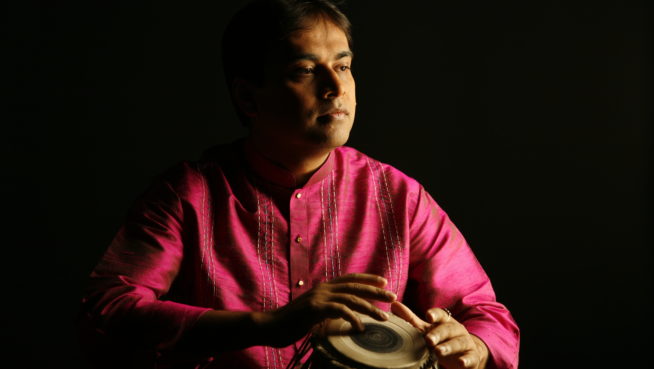
Percussion Players Are a Very Needed Aspect of Indian Music: Sandeep Das

Indian tabla player Sandeep Das wins prestigious Guggenheim Foundation Fellowship for Music Composition for 2019

SANDEEP DAS considered one of the leading Tabla exponents in the world today, has been awarded the prestigious Guggenheim Foundation fellowships in the category of Music Composition for 2019.

The Guggenheim Foundation was founded in 1925 in honour of John Simon Guggenheim to support the projects of artists and scholars in any field or discipline who have "demonstrated exceptional capacity for productive scholarship or exceptional creative ability in the arts".

Roughly 3,000 candidates were in the running this year and of those 168 were selected to receive fellowships across disciplines, with 11 awards being granted in the field of music composition. Amongst the other awardees are Nobel Prize Winners, Poet Laureates, members of the National Academy of Sciences, and many more distinguished individuals! You can view more on the Guggenheim Foundation website via this link. 

Sandeep’s collaboration with the Silk Road Ensemble for “Sing me Home” won the Grammy Award for the Best World Music Album. Prior to this win, he was nominated for the Grammy Award in 2005 and 2009. A professional career spanning 23 years has seen him composing and playing with the Legendary Cellist Yo-Yo Ma and The Silk Road Ensemble, String quartets and Orchestra’s such as The New York Philharmonic, The Chicago Symphony Orchestra, and the The Boston Symphony Orchestra to name a few.

International Cellist Yo Yo Ma says about Sandeep:

 “Sandeep transcends his instrument- when he plays the Tabla he is a creator of myths, a master communicator and an orchestra, all in one. In my decades of collaboration around the world, he is easily one of the greatest artists I have ever met. Not only is he one of the best artists I have met but he is also once one of the best teachers I have met. I believe there is no one he cannot engage!” 

It all started with a complaint that Sandeep’s father got from Sandeep’s school teacher.  “Sandeep has been disturbing the class…asked to stop tapping the desk with his hands, he starts tapping with his feet. Please take him to a doctor!” On reaching home that day, instead of being taken to a doctor Sandeep was gifted his first set of Tabla and taken to his first guru Shiv Kumar Singh where he spent one year in training.

Being a big fan of Pt. Kishan Maharaj of the Benaras Gharana, his father K.N.Das, sought and requested the legendary tabla maestro to teach his son. The Maestro proceeded to test his skills in various ways. At the end He was very happy and said –‘He has tabla in his blood and I will teach him.’

Sandeep learnt tabla under his Guru for 11 years in the Guru-Shishya parampara. Sandeep proudly mentions how everything he learnt was taught to him orally and thus all those years of learning live with him every second of his life and he doesn’t have to flip through any written diary of any sort.

For the first few years, he would travel from Patna to Benaras every Friday evening, stay overnight at his guru’s home and then return on Sunday. He would never spend a single vacation at home. Later his father took a transfer to Varanasi, so that his musical education could continue unhindered.

Under Pt. Kishanji Maharaj, Sandeep not only learnt tabla but also valuable lessons in life.


“When I was 9 or 10 years old, we were practicing in a room and Guru ji got very mad at us. He said why don’t you people clean the room before you sit down to practice and he asked me to clean the room. I had never done it at home so I couldn’t sweep the floor nicely. He took the broom from my hand and taught me how to sweep the floor and mentioned to me that if you sweep the floor nicely you can also be a good tabla player. Words which at that time didn’t make sense to me. How did sweeping the floor relate to tabla but as I grew up I realized that the other things he was teaching us to do, even doing the smallest jobs perfectly, taught us discipline, focus, attention to details and made the toughest jobs seem easy and that would also spill over in our playing.”

Pt. Kishanji Maharaj always discouraged his students from copying him. He would say, “As long as you are a Xerox you’ll never have any value. The moment you start playing, everybody should know which gharana you come from, but you must always have your own personality, your own thoughts imbibed in what you are playing.” Unlike many others, he advised his students to listen to every tabla player, but said, “Even if you like something, don’t try to play like them. Make it your own. It should sound that its Sandeep Das playing and not Sandeep Das copying or mimicking somebody else.”

Under his Guru’s guidance, Sandeep debuted on stage with legendary Sitar maestro, Pt. Ravi Shankar. He also won the national drumming championship thrice and became the youngest drummer ever to be graded by All-India radio.

One of the biggest turning points in his career came with his meeting the world famous cellist Yo-Yo Ma who invited him to play with the Silk Road Ensemble.

Interview with Sandeep Das:

Indian percussion is so well appreciated abroad, how can it be supported in India?

The major factor is that the percussion players have to understand that they are a very needed aspect of Indian classical music and stand up against exploitation. They have to believe in their hard work and realise that it is the quality of the playing that gets them concerts and not just by being subservient to someone, who in return will exploit them. They themselves have to stand up.


Is the domination of one or two great maestros distracting attention from a whole lot of young talented percussionists? Why do we always talk of only one or two great musicians for every instrument?

As you must have noticed, where are the art and culture pages or focus on anything of our own heritage and culture in today’s media, be it print or television. Whereas you pick up any media from the west and you will see dedicated critics and pages for the same. That is a very unfortunate situation in our country now that the media will only cover people who are already well known or people who can pay for PR.


What is the most important change happening in Indian percussion today?

There is no dearth of great individual talent in our country so we have talented younger players but the majority in a rush to get popular are ending up mimicking the west. That is where we are going wrong. I would say learn one this well enough and deeply first and be proud of your own music and culture.


What is it about the Indian tabla that makes it so universally popular?

When I think about it I am amazed at how smart and intelligent our predecessors were. Even one instrument like Tabla has such a vast repertoire that is unmatched with any percussion from anywhere in the world. It is an instrument that with the right training and application can be played with almost any kind of music. Thus I am playing with the biggest western classical orchestras of the world to String quartets and Jazz musicians.

Russian Designs A Cool Veena

(This article first appeared in the Times of India on 13th April, 2019)

Russian pianist, mandolin player and guitarist Denis Petrov is a DIY musician who has the curiosity of an engineer but the heart of a musician. When he met his wife vainika Vijaya Kris, he was first introduced to the soulful sound of the Veena, but also observed at close quarters its limitations.

Denis wanted to gift his wife a beautiful, durable and handy Veena which would overcome the problems of limited portability, sensitivity to humidity and temperature changes, and tuning issues. It took six years of research and 100 hours of actual execution, using the craftsmanship he learnt from his grandfather in Moscow, to design the Shiva Veena, a Veena which fits into a guitar bag. The fretboard has regular guitar frets.

Denis’s initiation into Indian culture and fascination with Shiva began with his colleague in the US who was from Mumbai. “My friend introduced me to Indian culture, food, music and Hinduism. We have a large Ganesh temple in New York City which has Ganesha, Shiva, Subramanya and other deities. We go there every Saturday morning and watch the Shiva abhishekam. I cannot claim that I am a disciple of Shiva in a traditional sense. Someone told me that everyone is a Hindu and it’s just that not everyone knows about it. So that’s how I approach it.”

Denis began creating his version of the Veena as a gift to his wife

Denis says that while the initial inspiration was to gift Vijaya a Veena, as he started researching it became something deeper. “I realised that many people feel that playing the Veena is not a cool thing to do. Cool kids don’t play the veena, they play the electric guitar. Now, I can say that the instrument that I have created can be seen as a cool instrument for young kids.”

Most Veena instrument makers as well as Veena players tend to be conservative, but there have been a few innovators. Bangalore based Radel has one version of a modern Veena, and vainika Dr Suma Sudhindra has designed the Tarangini Veena.

Dr Suma Sudhindra says her intention of making the Tarangini Veena was to address the issues that Veena players face mainly while travelling. “It took me several years of research and experimentation to come up with a concert worthy (the sound has to be pleasing and as close to the sound of the Saraswati Veena as possible) and yet durable version. The Shiva Veena added the stand which made the Veena playing comfortable and it was also fitted with a magnetic pick up made exclusively for the Veena. Ofcourse all of these innovations will help in keeping Veena traditions alive.”

His aim in designing the Veena was also to make it more attractive to younger people by making it cool

There have been criticisms of bending tradition but Denis quotes a 2014 study of violins conducted by Claudia Fritz, a musical acoustician in Paris, and Joseph Curtin, a leading violin maker from Michigan, who reported that in a double-blind test with modern instruments and Old Italian violins, elite violinists preferred the new violins to the old.

Says Denis, “To me this is the favourite story that indicates that knowledge of the non-musical aspects of musical instruments biases the listener. So if you know that the veena was made from the jackfruit tree in a temple, it will sound good to you if you are from that tradition. It may be a cynical way of looking at things, but this is the way a western scholar thinks, where one has to prove things rather than accepting everything as given.”

It is a known fact that that the Western audience for pure Carnatic music is very small, as it requires prior ground work. This can be changed, says Denis who is a self-taught tabla player. “I am sure anyone who has studied music would be very interested in Carnatic music if it was explained to a Western musician in a way that made it accessible. Western musicians are very technique oriented. Based on my own experience I would rather have a plain explanation on the practical aspects, whereas most of the descriptions throw a lot of words at you which have no frame of reference.”

Indian Music Has Shaped My Sense of Rhythm and Time: Greg Ellis

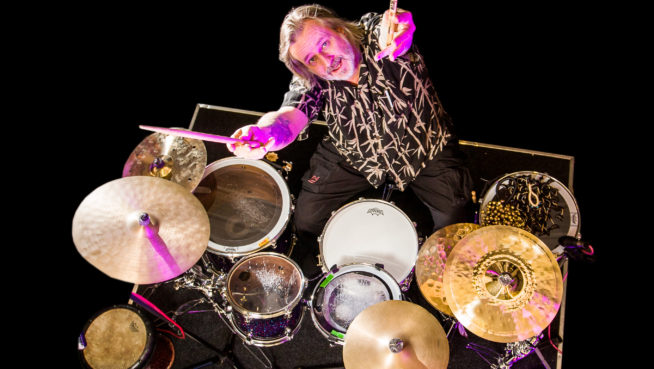
Los Angeles based drummer Greg Ellis is working on a documentary film called the ‘The Click’ looking at the effects of digital technology and mechanical time on drumming, music and culture. Named after the term used for the digital metronome, or ‘click track’, that virtually all recorded music is controlled by, ‘The Click’ delves into relationship between the drum and the clock.  He will be coming to India as well to do more interviews with musicians and scientists for the film. He says that Indian culture and music has shaped not just his sense of rhythm but also his sense of time. He wants to explore the more esoteric side of these two things so he says he will be coming back soon!

Ellis believes that all new recorded music sounds the same because of this technological invention, and if not used judiciously, it is not long before people will begin to see spontaneous, creative music as being ‘unnatural’.

Based on your film ‘The Click’, could you tell us how technology is impacting spontaneity and creativity in music?

I do think creativity remains intact as long as there is still a human using the technology. There is still a creative element in putting loops, programs and samples together but I believe the modern music making process has all but killed spontaneity. To me spontaneity is a property of organic interaction. Technology allows one to be clever rather than spontaneous. How many times as musicians have we hit a ‘wrong’ note or slipped from the rhythm only to turn it into something we have never played before?! Spontaneity cannot be programmed. It is one of the things I miss most in contemporary music.

Despite the ease of access that technology creates as a mediator, does the real power of music lie in listening to music live?

Definitely. But it's not just listening to music live, it's also listening to live music. We hear so much about fake news here in America. What about the fake music we have been hearing for years? I feel the lack of resonant frequencies in digital music diminishes the real power of music you're referring to. Everything including the resonance of the tuned string or skin, the resonance of the instrument itself, the resonance of the musician playing the instrument and the resonance of the studio or auditorium. All these things occur before the sound even reaches the listeners ear and I believe it's in these frequencies where the feel and soul of music lives.

Without live musicians playing live instruments, the music lacks what I call its nourishment. It becomes like fast food. It no longer has that thing that feeds a musician to want to play better every day or offer a listener a transcendent experience. The feeling we get from feeling music played live is something that has nourished our bodies and souls for millennia. That shared moment between the audience and musician should be a sacred space that unfortunately has been tampered with through modern music technology.

You have played with many Indian drummers (table artistes). How do you think an ancient Indian drumming system be impacted by technological intervention?

I've had the honour of playing with some of the best. I worked with Zakir Hussain as part of project with Grateful Dead drummer Mickey Hart. Bikram Ghosh has been a colleague and dear friend of mine for two decades, since his first Rhythm Scape album. I also became close with his father, Pandit Shankar Ghosh. We would discuss this issue often. Pandit Ghosh felt this ‘technological intervention’ as you say, began with recording technology. He was there 60 years ago as the first recordings of Indian music were being made commercially available. He felt that once musicians began hearing recordings of themselves, it altered their playing completely because the music was no longer an offering to the moment.

I wondered if it offered too much a reflection and was the onset of making it more about the musician rather than the music. Fast forward 60 years and it seems that's definitely the case. Now we have the ability to edit recorded performances and auto-tune to absolute digital perfection. This is creating generations of musicians who are missing the beauty of imperfection. I see incredible technique in younger players but that connection to the essence of the music seems lost due to all the digital distractions. Indian rhythm is a language and like many other languages and dialects in India, it is in danger of obsolescence due to modernization. It's one thing to know all the words there are to know but then you're just a dictionary that doesn't express anything. How you put those words together... that's the artistry.

Does using low-end technological recording tools creative negative impressions on music listeners where they learn to expect less from music?

It does seem that listeners today in general seem oddly content with less fidelity in their music. We've allowed mp3's, ear buds, phone and computer speakers as acceptable deliverers of music. I also feel the low-end digital recording platforms like garage band and others has allowed access to those who just want to make music but don't want to become a musician. So if that is the level of music that is being offered by the artist, it would make sense that the listener wouldn't care as much about the fidelity of what they're hearing. Again, it's similar to the fast food analogy in that it merely satisfies a hunger without offering any real nutritional value. Without the ability to both deliver and listen to music in its full dynamic range, listeners have had no choice but to expect less and be surprisingly okay with that.

Is there a kind of music that is of the best kind? Should there be a music that one must aspire to play or listen to, not just in terms of content but also the quality of delivery?

It really depends on the instrument. As a drummer I would say the four styles of music that pretty much encompass the full rhythm spectrum would be American Jazz, Indian Classical, African and Arabic. Just find the best of as many genres and cultures as you can. The best musicians I've worked with have a deep understanding of many kinds of music so I wouldn't want to generalize one kind of music as the best kind in terms of genre or style.

All I listened to through high school was Rock and Roll and taught myself drum kit playing along to Led Zeppelin and Rush. I didn't really hear Indian music until well into my 20s. When I did it blew my world apart. I had never experienced that kind of journey musically. But there was so much I recognized in the rhythms and it made perfect sense to me in a way I don't think it would have at anytime before then. It set me on a path to find and listen to the best music of every culture. I started collecting drums from all over the world and developed a technique of hand drumming that has put me on stage with artists from more than 30 countries. But my entry point was Rock and Roll which really shouldn't have brought me to the music and instruments I now play. What's important is to find the best artists in whatever style you're into. Masters are recognizable in whatever form they take.

How can musicians play a role in creating better quality recordings and listening experiences?

After all the tech talk this one is very simple. Every time we are on our instrument, our sole purpose should be to remind the listener or audience of why music exists in the first place. Leave the rest up to the moment.

Could you share a few thoughts on The Click, its production and what the project means to you?

The film looks at the effects of mechanical time and digital technology on our music, our lives and our sense of time itself. As we go from the clock, to the metronome, to automation, to the click track, to the drum machine and now AI and robotics, we see a systematic conditioning to mechanical time in all aspects of our lives. We now live our life to a click track. I'm still in production and fund raising mode but I hope to finish it up this year. It's my first film but it's the best way to tell this story and to reach people who have no idea how much their music is processed and how mechanical time has shaped our lives. I want to eventually show it as part of a live performance featuring drummers from different cultures in performance and discussion after the film. I'm also writing a companion book on these concepts as well.

(Ellis is a drummer and multi-instrumentalist born and bred in the Bay Area. He has recorded and performed with some of the greatest musicians and drummers in the world. As composer and session musician for film and television, his drum-set and percussion beds can be heard in the major motion pictures The Matrix: Reloaded and The Matrix: Revolutions, Fight Club, Lara Croft: Tomb Raider, Dawn Of The Dead, Dukes of Hazzard, The Devil’s Rejects, Brave Story, 300, Watchmen, and Argo, among many others.

He has performed and recorded with artists from almost every continent, including Zakir Hussain, Airto, KODO, Mickey Hart’s Planet Drum, Juno Reactor, Billy Idol, Sonu Nigam, Sussan Deyhim, Hamed Nikpay, Bickram Ghosh, Chiwoniso Maraire, Sugizo and many more.)

Grateful2Gurus 2018-19

Indic Academy organised its annual Grateful2Gurus award ceremony across the nation, commemorating the exemplary contributions of authors, activists, academicians and artists of Sanatan Dharma among us today.