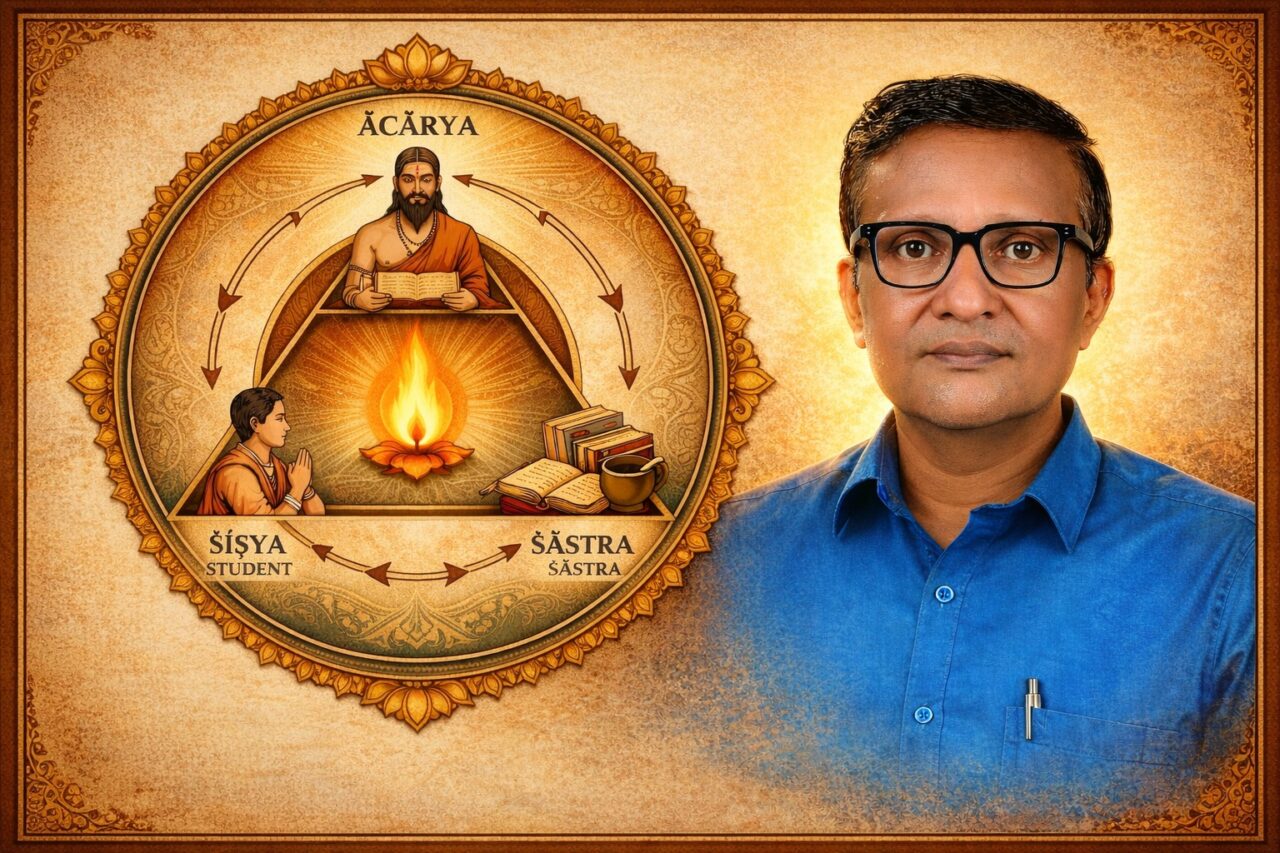


Dr Shruti Krishna Bhat’s exploration of Sri Vidya, astrology, mantra and Advaita reveals the extraordinary intellectual architecture within Dikshitar’s krithis
Dr. Shruti Krishna Bhat’s philosophical inquiry spans Indian epistemology, philosophy of mind, consciousness, logic and aesthetics. Her research has explored questions ranging from first-personal ignorance and self-knowledge to the nature of consciousness and experience in suṣupti, the epistemology of sukha and duḥkha, the Śākta understanding of bhukti-mukti, and the phenomenology of rasa.
Her work is marked by a sustained engagement with the Indian philosophical traditions as rigorous systems of inquiry into knowledge, experience and consciousness. It is this philosophical lens, combined with her training in Hindustani classical music, that informs her current exploration of Muthuswami Dikshitar’s compositions. Looking closely at the Navagraha and Navāvaraṇa krithis, Shruti finds that their musical and lyrical structures open into a far wider world of astrology, astronomy, Sri Vidya, mantra, Sanskrit grammar and ritual practice. For her, Dikshitar emerges not merely as a composer of extraordinary musical sophistication, but as a scholar and, above all, an upāsaka, whose compositions were designed to be experienced as much as performed.
Muthuswami Dikshitar’s krithis have long been celebrated for their musical sophistication, lyrical richness and intricate engagement with rāga and tāla. Yet beneath their familiar melodic contours lies another world - one populated by the vocabulary of astrology, astronomy, Tantra, Sri Vidya, mantra, Sanskrit grammar and Vedanta.
For Dr Shruti Krishna Bhat, this hidden architecture offers a different way of approaching Dikshitar. A scholar of Indian philosophy and a Hindustani classical musician, Shruti has been examining the words of his compositions not simply as poetic expressions, but as repositories of knowledge. Her research, particularly into the Navagraha and Navāvaraṇa kritis, has led her to trace individual words and phrases across astrological texts, ritual traditions, Tantric sources and Sri Vidya literature.
The deeper she goes, the more convinced she becomes that Dikshitar must be understood first as an upāsaka. “I must confess that I am not a Carnatic musician,” she says. “I looked at Dikshitar’s krithis from a scholar’s point of view, because I am into Indian Philosophy. But because I am a Hindustani classical musician, I had some kind of an idea and appreciation of how he did it.”
It is this intersection of scholarship and musical sensibility that informs her approach. Shruti is less interested in treating the krithis as compositions to be admired from the outside than in understanding what Dikshitar intended them to do to the person who sings them.
“He must be looked at as a great Upāsaka,” she says. “First and foremost, he is an Upāsaka.” For Shruti, this changes the fundamental way in which Dikshitar’s music ought to be understood. A krithi is not merely something to be performed before an audience, nor is its purpose exhausted by aesthetic pleasure. The act of singing can itself become a form of spiritual practice.
“He would like the person who learns these krithis and sings to be doing Upāsana,” she explains, “and not just sitting and performing a krithi for some group of people and having some live tune and people will clap. I don't think that is the aim of any of his krithis.”
The krithi as a vehicle of knowledge
This conviction becomes particularly evident in her study of the Navagraha krithis. She found that Dikshitar’s descriptions of the nine planetary deities contain terminology drawn from specific traditions of graha worship, astrology and ritual practice.
Why, she asks, would Dikshitar incorporate the language of kavachas and ritual manuals if the kritis were simply intended as musical compositions? “The details which he puts in Navagraha kritis are so much in the Upāsana part,” she says. Otherwise, why should he call some grahas in that way, and include so many terms which are used in kavacha in the Navagraha kritis?”
The implication is significant. Even when a singer does not consciously recognise the textual source of a particular word, the word is still being uttered. In the traditional understanding of mantra and ritual language, sound itself has efficacy.
Shruti draws a parallel with Vedic chanting. “We chant the VedaEven if you don't understand, if you adhere to the exact tone, it has its impact on you. That's why it is tonal. At the same time, if you know the meaning, it has a very different impact.”
The same principle, she believes, operates in Dikshitar’s compositions. Musical precision matters, but so does an engagement with meaning. “If somebody is a singer who is only into correcting the note and being accurate with the tuning part of a krithi, and is not really bothered about any meaning, then that person will also get some impact,” she says. “But it will not be complete.”
Her argument is not that every Carnatic composition must necessarily be approached in this way. Rather, she makes a specific claim about Dikshitar. “My conviction is that Dikshitar kritis are meant for some change in you. Some impact on you.”
She compares the compositions to sustained forms of upāsana such as the recitation of a Sahasranāma or a kavacha over a prescribed period. “You do feel some impact after that. At least, if you believe, if you do, you can see that. I think Dikshitar krithis are like that.”
A scholar who did not flaunt his scholarship
The paradox at the heart of Dikshitar’s compositions is that the scholarship is enormous, yet the scholarship does not appear to be the point. Shruti’s research has taken her through works such as the Bṛhat Jātaka and other astrological texts to understand terms that, on the surface, appear simple but acquire an entirely different meaning within their traditional context.
One example is the description of Budha. A term such as kumkuma might easily be translated according to its familiar meaning as saffron or vermilion. But that interpretation does not fit the traditional astrological description of Budha.
Shruti therefore went back to the textual sources. “I had to really look deep into Bṛhat Jātaka, Kāla Devika and all these astrological texts to figure out what is Budha exactly,” she says.
The traditional description points towards a colour resembling the tip of durvā, a yellowish-green shade associated with the emerald. The word in Dikshitar’s composition, therefore, cannot simply be treated as decorative poetry. It participates in a precise descriptive vocabulary. “These are the things where I realised that he has imbibed all these texts,” Shruti says. “He knows all these texts.”
This, she believes, is an important distinction. Dikshitar was a scholar, but he was not composing in order to display his erudition. “He was a scholar who gave - but he didn't want to show his scholarship that way. He was more into making you an Upāsaka.” His learning becomes the infrastructure of the composition rather than its subject.
When one word opens an entire universe
The density of Dikshitar’s language becomes even more striking when individual compounds are examined closely. In the krithi on Ketu, for instance, Dikshitar uses the expression Koṇa-dhvaja-patākinam. Why describe Ketu in precisely these terms?
Shruti’s investigation led her to the astronomical and astrological understanding of Ketu as a comet-like body. Its fiery appearance and tail-like form evoke the imagery of a banner. “My point is, look at the beauty,” she says. “He included this. He could have included any other description of him in his krithis. But when Dikshitar was kind of imagining Ketu, maybe he was imagining it this way, and he wants us to imagine that.”
The word is therefore not merely informative. It becomes visual. The same process occurs in the Rāhu krithi, where Dikshitar describes him as Śurpa-āsana-sukhakaram. The unfamiliar term śurpa refers to the traditional winnowing basket, and this was not simply an unusual poetic metaphor.
In certain ritual contexts, the śurpa is prescribed as the āsana for Rāhu. “He is given in the astrological and ritual details - Rāhu, during pūjā and all, he is given śurpa as an āsana,” she explains. “That is why he has Śurpa-āsana-sukhakaram.” A detail that might pass unnoticed in performance therefore becomes evidence of a much deeper textual and ritual knowledge.
Why is Sūrya called Karma Sākṣī?
Perhaps the most revealing example Shruti’s research is the expression Karma Sākṣī, used by Dikshitar for Sūrya. At first, the phrase appears obvious: the Sun is the witness to human action. But Krishna's instinct was to question precisely that obviousness.
“What about in the night?” she asks. “What about the karmas which I am doing in the night? Is he not Sākṣī? Then he is Sākṣī for only daytime? That doesn't make sense.” The question led her into the astrological concept of Kāla Puruṣa. In the traditional astrological framework, different grahas are associated with different aspects of the cosmic person, and Sūrya is associated with the ātman. The ātman, in turn, is the witness.
This creates another connection: karma cannot be separated from kāla. “If there is no time, there is no action. If there is no action, there is no karma,” Shruti says. “So karma and kāla can be equated.”
Sūrya becomes Karma Sākṣī, therefore, not simply because he physically sees our actions, but because of his deeper relationship with time. There is an astronomical dimension to this as well. The movement of the Sun provides the framework through which the positions of the nakṣatras become meaningful. What might otherwise appear as a random arrangement in the sky is organised through the movement and light of Sūrya. “Even that way, he is the one who is actually like the person who is throwing light on, giving them their identity,” Krishna says.
What appears to be a single poetic epithet thus opens into astronomy, astrology, metaphysics and the philosophy of time.
The grammar beneath the poetry
The investigation does not stop with astrology and ritual. Shruti has also examined the Sanskrit grammar of the compositions. “One of the first steps was to see the vigraha-vākya,” she explains. “What type of vigraha-vākya we can do for all samāsa-padas. Because without that it makes no sense.”
The compound words of Dikshitar therefore become another layer of investigation. To understand what he has encoded, one has to understand how the words themselves have been constructed. This is what makes the exercise so intellectually satisfying for Shruti. A single krithi can require one to move between Sanskrit grammar, textual interpretation, astrology, astronomy, Tantra, Sri Vidya and music.
“There are phenomena that are so intellectually complete and satisfying,” she says. “We can say, look, this is how it is, and because of this it seems like this comes from here - and look at the genius of Dikshitar and how he included all these details.”
From Guru Guha to Sri Vidya
The Sri Vidya dimension becomes particularly visible in Dikshitar’s use of names and epithets such as Guru Guha and Divyaugha. These, too, are not random choices. Within Sri Vidya, there are specific categories and lineages of gurus, including Divyaugha, Siddhaugha and Mānavaaugha.
“When he uses Divyaugha, Guru Guha, these are very typical to Tantra again,” Shruti says. “There are three types of gurus in Sri Vidya.” Once again, Dikshitar’s vocabulary points towards a larger doctrinal world. This is why she resists the idea of treating his compositions simply as devotional poetry. The devotion is inseparable from a sophisticated body of knowledge.
Music, ritual and the disappearance of distance
The question of music as upāsana leads naturally to a larger question: why can music be such a powerful vehicle for spiritual experience?
Shruti sees an important distinction between ritual and music. “In ritual, not everybody can relate to it,” she observes. “The person who is doing it will feel it, but if we are sitting as an audience, we get distracted. We are not the doer.”
Music alters that relationship. “In music there is no distance,” she says. “Even the listener will be elevated to the same level because of the power of music.” This becomes particularly significant in the context of traditions where compositions are integrated into ritual practice. The performance of Oottukkadu Venkata Kavi’s Navāvaraṇa Kamakshi kritis in the Kodungallur Sri Vidya tradition is an example.
“If they are doing this, there must be a reason why,” she says.
For her, the reason lies partly in music’s ability to remove the distance between the ritual performer and the listener. The listener may not be performing the ritual, but through music, the experience can become participatory.
From rasa to Advaita
This understanding of music also connects with Krishna’s philosophical work on rasa. Her doctoral research included an entire chapter on the philosophy of rasa, drawing upon the philosophical discourse surrounding rasa-anubhūti.
For Shruti, the deepest question is not merely what emotion an artwork evokes, but what happens to the sense of self during profound aesthetic experience. “After everything such a journey, I feel that is the final experience,” she says. “If you feel that kind of dissolution of self, or rather merging of self, then everything is true. Otherwise, all of this doesn't stand.”
It is here that her interest in Advaita Vedanta becomes especially significant. “Right now, as a philosopher, I respect all the schools,” she says. “But Advaita seems to me the most logical. It answers many, many questions of mine.” What attracts her is the philosophical completeness of the system and its willingness to pursue its logic to its ultimate conclusion.
Advaita, she points out, can describe even Īśvara as Māyā-upahita - the Absolute appearing through the limiting adjunct of māyā. “Who has this daringness to say what Advaita has?” she asks. The radicality of the position lies in the fact that even the highest conceptual distinction must eventually be transcended. As long as there is a distinction between “I” and something else, one remains within the domain of duality.
This leads to another fundamental Advaitic question: what does it mean for something to exist? The fact that something appears to us cannot by itself establish its absolute existence. The classic example is the rope mistaken for a snake. The snake appears, but the snake does not have the same ontological reality as the rope. “So you can't simply say, ‘I see this cup, that is why it exists,’” Shruti says. “I see a rope-snake, but it doesn't exist.”
Advaita therefore distinguishes different levels of existence and ultimately identifies the truly existent with that which does not undergo change. “What is existence?” Krishna asks. “That which is unchanging, which is one, which is always there.”
Towards a new way of documenting Indian music
The implications of Shruti’s research extend beyond Dikshitar himself. She sees the possibility of developing a richer methodology for documenting Indian performing arts - one that does not isolate music from the intellectual and philosophical traditions that produced it.
Such an approach would require more than biographies and historical narratives. It would bring together textual analysis, musical scholarship, Sanskrit grammar, ritual studies, philosophy, temple traditions and lived practice.
A documentary based on Dikshitar’s work, she suggests, could therefore move between the temples associated with his compositions, musical performances, scholars and practitioners, while using visualisation to make abstract concepts such as Kāla Puruṣa accessible.
The documentary, however, would have to be carefully scripted. “Without that, it is not at all complete,” she says. “It should include depictions from the temples where Dikshitar lived, some musical details, because without that it is not complete.”
She is also clear that scholarship must remain visible within such a project.
“For a person like me, who always wants to know, I wouldn't simply agree if someone came and told me, ‘Dikshitar used Karma Sākṣī and karma is all your work.’ I would first ask, like a child, ‘Why?’” That simple question- why? - may be the most appropriate way to approach Dikshitar.
Why this rāga? Why this word? Why this epithet? Why this image? Why this grammatical construction? Why this ritual reference? Why this particular deity? And what happens when all of these layers are brought together through music?
The answers lead into a vast interconnected world in which nothing appears entirely accidental.
The genius of the doorway
What emerges from Shruti Krishna’s research is not simply a new way of decoding Dikshitar’s krithis. It is a different way of understanding what a composition can contain.
The krithi can be poetry and music, but also mantra, philosophy, ritual memory and encoded knowledge. Its words can point towards an astrological text; a grammatical construction can reveal a philosophical nuance; a musical performance can become an act of upāsana; and the aesthetic experience of rasa can lead towards questions of consciousness and the self.
Dikshitar’s genius, in this reading, lies partly in his ability to hold all these dimensions together without making the composition feel like a scholarly treatise. He knew, Shruti believes, but he did not burden the listener with everything he knew.
Instead, he embedded the knowledge within the composition. “He was a scholar with an Upāsana background,” she says. “He was more into making you an Upāsaka.”
Perhaps that is why the krithis continue to reveal new dimensions centuries after they were composed. The information is there, but it does not announce itself. It waits for the listener who is willing to ask the next question.
And perhaps that is the real invitation contained within Dikshitar’s music: not merely to listen, but to enter.