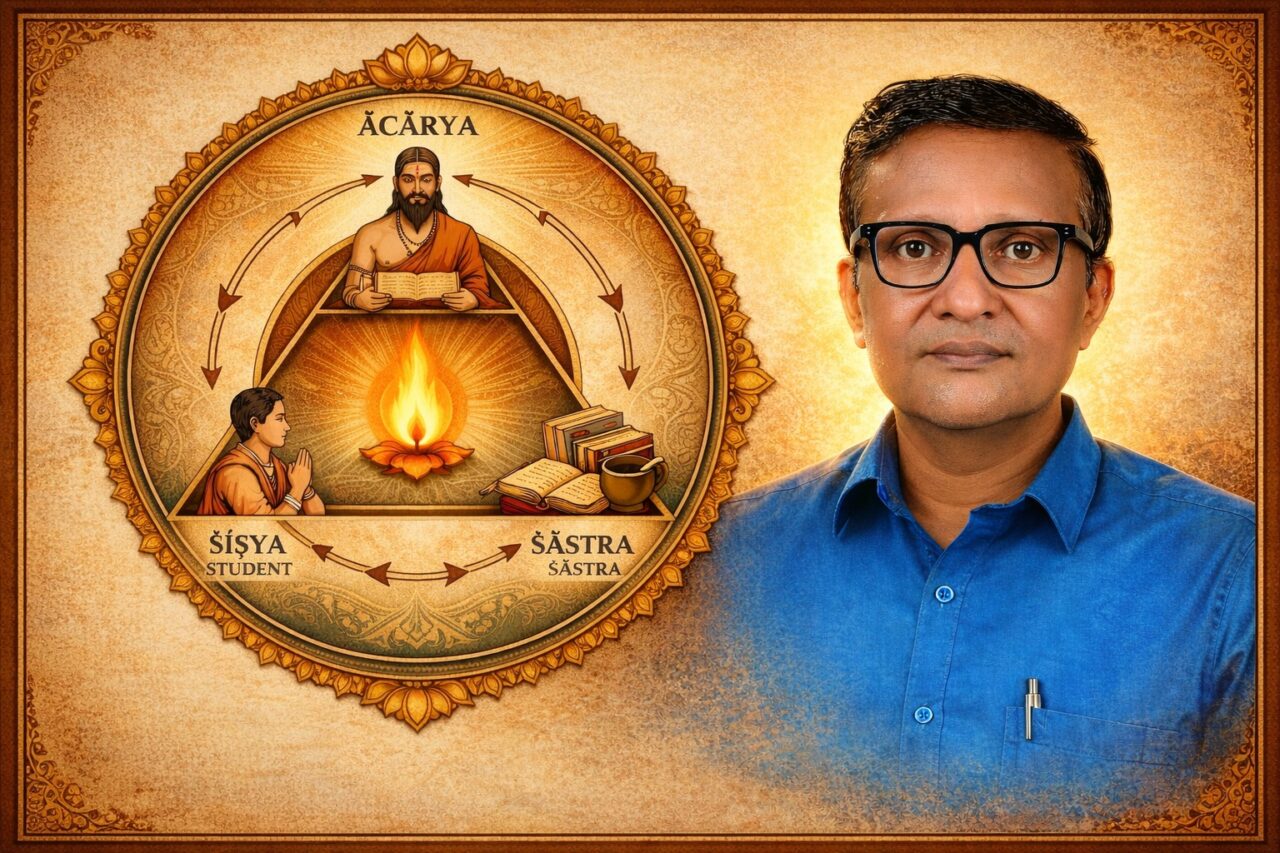


Saathwik Yadavalli is a talented artist, singer and composer who has a unique ability to cut through noise and arrive at the core of whatever interests him. In this interview we speak about his experiences in creativity.
How does a thought arrive? Where does it come from, and how much of what we create can we really claim as our own? For Saathwik Yadavalli, these are not merely philosophical questions. They lie at the heart of his understanding of creativity and of the artist’s relationship with what eventually takes form through him.
“We play the medium in most cases,” he says. The distinction between source and medium is important to him. An artist may be the one through whom an idea takes shape, but that does not necessarily make him the absolute source of what emerges. When there is no distortion between what is received and what is expressed, the source and the medium can appear to merge. Yet there is still a difference. His analogy is characteristically simple: “How much ever ink you have in the pen, there will be a drop left in the refill. Everything won’t come out.”
This understanding also informs his reading of Pothana’s humility in the Telugu Bhagavatam. Rather than claiming absolute ownership of what he has written, Pothana presents himself as one through whom something has come. For Saathwik, this older understanding of authorship offers a useful counterpoint to the contemporary emphasis on originality and individual ownership. “The amount of respect we show towards the medium somehow blurs our understanding of what the medium and what the source is.”
The question becomes even more interesting when applied to knowledge itself. Can a person arrive at an insight without having encountered the text in which that insight has already been recorded? Saathwik believes that it is theoretically possible. Across time, space and place, people have arrived at similar conclusions and practices, suggesting that some forms of knowledge may be discoverable rather than merely transmitted. “The only way of knowing that something is true is that in every repeated case, you get the same answer.”
Perhaps his own early life offers a glimpse into this instinct for discovery. Saathwik describes himself as a child who read what interested him, played, painted, danced and sang, while the conventional academic route held little attraction. He remembers himself as someone for whom things took time to settle. “Most things, for me, take time for me to get it. But once I get it, I don’t think you can beat the clarity that I will have in that.”
At home, music and art were already part of his everyday environment. His mother, father and other family members sang, while his grandfather was an artist. Music and visual art were therefore not foreign disciplines that he encountered later in life; they were woven into the atmosphere in which he grew up.
Painting, however, became intense during his teenage years. Around the eleventh and twelfth standards, he began to produce work that surprised even his family. What started as an instinctive activity became increasingly consuming. He recalls periods in which he would sit for as long as eighty hours at a stretch, without consciously registering the absence of food, water or sleep. He recognises now how extreme that was, describing it as “borderline inhuman”, but from within the experience it felt strangely smooth.
One incident from this period became particularly significant. His family followed a few spiritual teachers, although Saathwik himself says he did not pay much attention to them. One of these figures looked at something he had painted and asked him whether he knew what he had painted. The teacher then pointed out that Saathwik had matched every line of a particular set of sixty-four lines. Saathwik’s response was characteristically understated: “Odds are low.”
But the experience unsettled him. He did not know how he had arrived at what he had painted. “This is strange. I don’t know how this happened,” he recalls. It became one of the moments that pushed him towards exploring different formats of painting, music and other forms of expression.
The significance of the episode lies less in claiming anything miraculous than in the question it raised about conscious authorship. If he had not consciously known what he was painting, where had the form come from? The experience brought him back to the distinction between the source and the medium. The hand was his, the canvas was his, but the process by which something appeared on the canvas was not always entirely available to conscious explanation.
That quality of absorption remained with him. Even later, when he would return from college and decide to paint, his family knew that it was an event. His mother would become anxious, his father would move into “situation management”, and everyone else would wonder what was happening. Saathwik would shut himself away, often without knowing how long he would remain inside. “I am confused with what usually comes out,” he says.
This is one reason his relationship with an audience has always been complicated. His first painting in the more recent phase of his practice was around 2015 or 2016, but it took years before he agreed to put the work before an audience. The paintings were not made because somebody was waiting to see them. “The idea was to paint. If they see, cool. I’m glad.” The distinction is important to him because he believes the audience should witness and engage with the work, rather than become the reason for its existence. “If you are actually doing it because you have an audience, are you truly doing it because it is expression?”
His paintings increasingly became a space in which his engagement with traditional knowledge could also unfold. He approaches the yantra not merely as an image but as a structured form with its own internal logic. There are limits to what can be altered while retaining the quality of the form. His interest is therefore not simply in making something beautiful, but in understanding why something works.
Music is another important expression of that same impulse. Music was always around him, but Carnatic music was not something he immediately embraced. Before Carnatic music, he had some Hindustani training, and he grew up listening to his mother, father, aunt and sister sing. Yet he admits that for a long time Carnatic music was, in his words, “a painful motor grind” to listen to. Then, at some point, something changed. “This is also not that bad,” he remembers thinking. He began to enjoy singing it and learning it.
His first serious Carnatic teacher was someone he had become fascinated by because of the way he sang. Saathwik’s mother was already learning from him.
The teacher did not begin with the usual sequence of Sarali Swara, Janta Swara, Dattu Swara and Gitam. Instead, he began directly with a kirtana. And then he imposed his own condition: Saathwik was not to ask him what he should teach.
For Saathwik, this was liberating. The conventional seriousness surrounding Carnatic pedagogy did not intimidate him. “Most Carnatic musicians… have this rigor,” he says. “I have come from, probably, a club on the Panipuri stall.” The irreverence, however, did not mean a lack of discipline. Quite the opposite. He sang for eight hours at a stretch. For six or seven months, he practised with such intensity that he believes he learnt in six months what most people would ordinarily take five or six years to learn.
The distinction is important: lack of solemnity did not mean lack of seriousness. He could approach the tradition playfully while working at it intensely. That combination would later become central to the way he approached music on Instagram.
His Instagram music deliberately breaks the conventional boundaries around how Carnatic music is expected to be presented. He does not approach the platform as though every performance has to carry the weight of an entire classical concert tradition. He understands the medium for what it is: people are scrolling through reels at night, looking for something that catches their attention. If Carnatic music can reach them there, become accessible and make them curious, that is enough. “These people, like Carnatic, make it accessible for them. That’s all.”
The accessibility does not mean dilution. Rather, it changes the point of entry. He collaborates with dancers and other artists, experiments with different formats and uses Instagram to bring classical music into a space where people may not ordinarily encounter it. He also has a refreshing attitude towards collaboration: he simply reaches out. “The job is to DM. Insta is made for that.” What he discovered was how many artists are willing to collaborate once the process is stripped of unnecessary formality.
This is perhaps one of the more interesting aspects of his Instagram persona. He is not trying to reproduce the formal concert platform inside a reel. He is allowing Carnatic music to inhabit another cultural space and another vocabulary of communication. The traditional form remains, but the frame around it changes. In doing so, he challenges the assumption that classical music has to be presented with a particular degree of solemnity or distance in order to retain its integrity.
His own formulation is telling: “Being simple and being profound are synonyms.” For him, intricacy should not be confused with complication. “Most art form is very detailed. It’s not complex.”
The same principle appears in his understanding of mantra, yantra and tantra. Tantra, for him, is fundamentally technique— the way something is approached. It does not have to remain confined to an esoteric realm. Keen observation can reveal technique in the most ordinary things. This emphasis on observation becomes even more powerful when one considers the lesson he received from his guru.
Saathwik describes having encountered teachers who taught him to recognise the guru not simply as a person but as a principle. Some people he admired deliberately kept him at a distance. They wanted him to learn to recognise when the guru principle itself was communicating rather than becoming dependent on a particular individual.
One of the most memorable lessons began with japa. His guru explained that a repeated hum or vibration could become a mantra as long as one learned to observe it. When Saathwik asked where he could try this, his guru asked whether there was a cooler at home. There was. Did it make a sound? Yes. Then came the instruction: spend two hours listening to it and tell him how it felt.
Saathwik did exactly that.
In the process, he realised that the cooler had been running for fourteen hours. What had previously existed as background noise had become something he was actually listening to. There was no temple, no elaborate ritual and no dramatic spiritual occurrence. “The cooler is sufficient.”
The lesson was not really about the cooler. It was about attention. How often do we search for a symbol when the thing itself is already sufficient? “I think symbol is distracting us. The cooler is sufficient.”
That was when his guru told him, “Saathwik, don’t ask me. Just learn to listen.”
The instruction went far beyond listening to sound. If knowledge is always expected to come from a person, a book or an institution, one becomes dependent upon the source rather than developing the ability to recognise knowledge oneself. “Because if your answer is not evident listening to the world, what do you think all the other sages and all of these guys heard? Nobody came and gave textbook to them.”
Then came the joke, because Saathwik’s guru knew his academic record well enough to add: “Anyway, you’re used to not reading textbooks, so it’s fine.”
The teaching has remained central to his understanding of knowledge. His guru also taught him to recognise the answer rather than the person giving it. Saathwik has encountered people he dislikes who have nevertheless said things profound enough that he has had to accept them. The truth does not become less true because it comes from an inconvenient source.
This is also how he approaches Krishna. “You can’t pinpoint who this fellow is.” Krishna is friend, lover, politician, statesman, entertaining child, profound yogi and Jagad Guru. In different people’s eyes he can be deceptive, cunning, gracious, divine, foolish or arrogant. The plurality is not a contradiction to be resolved; it is part of what makes him fascinating.
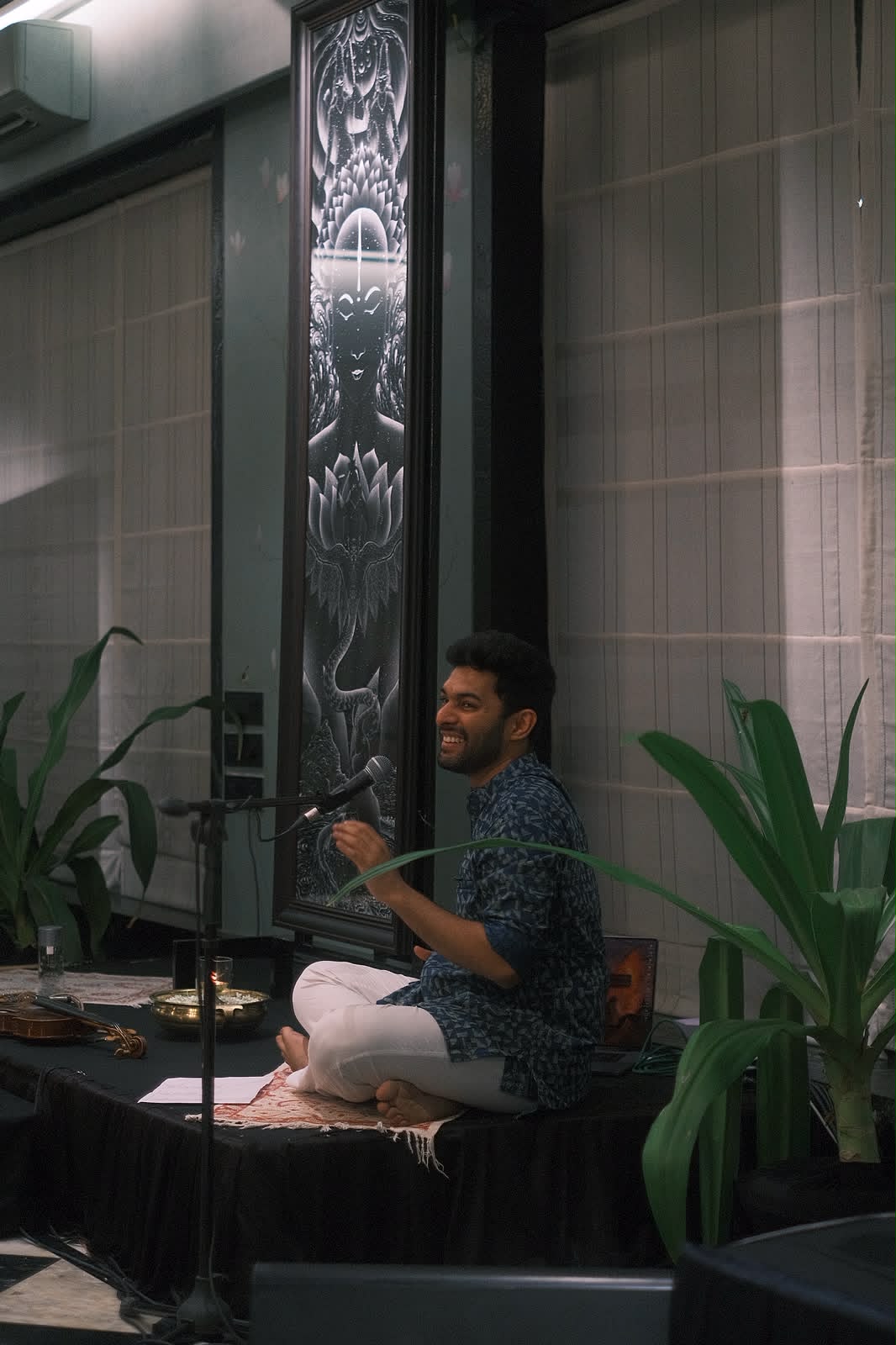
The idea of multiple personas resonates with Saathwik’s own creative life. The painter, musician, designer and thinker need not be collapsed into one fixed identity. They are different ways of expressing the same person. His Instagram music is therefore not a departure from his visual work but another manifestation of the same impulse—the willingness to move across forms without becoming imprisoned by the boundaries traditionally assigned to them.
This also explains his resistance to excessive seriousness. “The greatest of the sages who have walked on the earth were so gentle. They didn’t make it serious, they made it beautiful.” He does not believe that profound subjects have to become inaccessible. The ability to make something simple does not necessarily make it shallow. In his formulation, simplicity and profundity can exist together.
There is a similar practicality in his understanding of Dharma. He reduces the question of whether an action is one’s Dharma to three filters as articulatedby his guru: are you being sensible or sensitive while making the decision; are you acting willingly or compulsively; and will the action set you free or entangle you? “If the answer is the former in all the three cases, that is called Dharma.” He says it took him six years to recognise the depth of that sentence.
Across these seemingly different subjects, a pattern begins to emerge. The unexplained appearance of the sixty-four lines, the long periods of painting in his teens, the yantra and its internal structure, the six-month immersion in Carnatic music, the willingness to place classical music in the informal space of Instagram, Krishna’s plurality, the guru as principle and the Havells cooler as an object of contemplation all return to the same question: how does one become receptive enough to recognise what is already present?
This is perhaps where Saathwik’s engagement with INDICA acquires a larger significance. For an artist who moves naturally between painting, music, design and traditional knowledge, the need is not simply for a platform on which finished work can be displayed. It is for spaces in which artists can explore, experiment and encounter one another without being forced into a single category.
His own practice demonstrates the possibilities of such encounters. In Series 2, music and art came together to explain composition, idea, possibility, painting and yantra. He describes the experience as bringing together “all forms of knowledge, with a mix of jokes.” The same spirit appears in his digital work, where musicians, dancers and other artists can meet without the formal barriers that often separate classical disciplines.
Creating such spaces for artists is therefore as important as creating spaces to exhibit their work. They allow artists to bring different parts of themselves into conversation, to collaborate across disciplines and to discover possibilities that may not emerge within the boundaries of a single practice. INDICA can provide precisely such a space - a place where artists, scholars and practitioners can meet, where traditional knowledge can encounter contemporary creative expression, and where the artist is not merely presenting a finished object but participating in a larger cultural conversation.
In the end, Saathwik’s journey is less about defining what an artist is than about remaining open to what an artist can become. The painter can become a musician; the musician can enter the world of the yantra; the designer can engage with traditional knowledge; the classical vocalist can enter Instagram and collaborate with dancers; and the seeker can learn from a cooler.
None of these identities has to cancel the others.
The artist remains both participant and medium, creating intensely while remaining aware that what emerges may not belong entirely to him. And perhaps the most important lesson he carries from his guru is also the simplest:
“Just learn to listen.”
Listen to the teacher, but do not become dependent on the person. Listen to the tradition, but continue to observe. Listen to the work as it emerges. Listen even to the ordinary hum of a Havells cooler. Listen to the person you disagree with when, despite yourself, they say something true. And listen to what becomes possible when artists from different disciplines are given the freedom to meet.
Perhaps creating such spaces is itself another form of listening.