
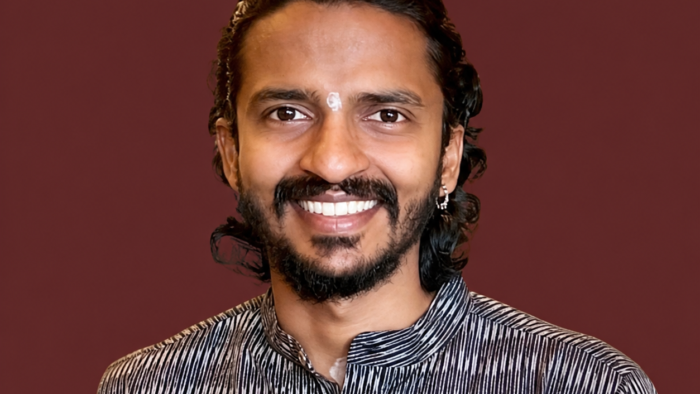
Guru Tarun Kumar, Founder Swasthya Holistic Wellness, is conducting a 3-day Kalaripayattu Residential workshop between May 13th and 16th at Rithambara Retreat, INDICA Yoga. Details: https://indica.events/event/kalaripayattu-basics-strength-grace-and-focus-3-day-residential-workshop)
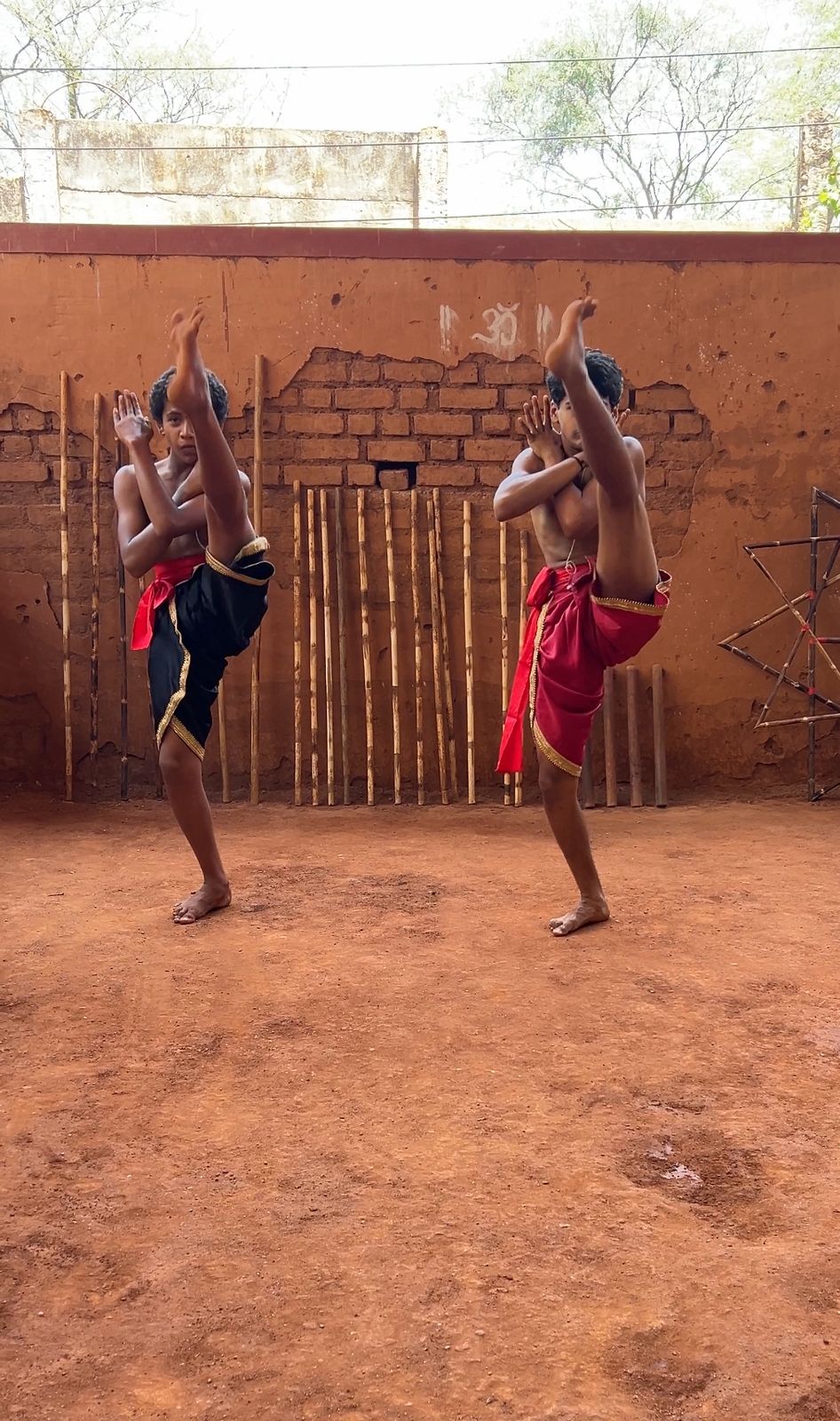
The class was on the fourth floor in urban Bangalore. Three young boys were already deep in their Kalari practice, moving with a quiet alertness that filled the space. The mud floor reflected back their foot prints in the afternoon light. The first question they asked me, without hesitation, was whether I was joining as a student. In that simple moment, age and gender lost their usual weight. The space did not read identity in conventional terms - it read intent. One entered not as an observer or outsider, but only as a participant in practice.
Such is the quiet logic of Kalaripayattu, where convention dissolves in discipline and presence matters more than position.
In the traditional Kalari pit, the space is carefully oriented and treated as a consecrated ground rather than just a training hall. Typically, the Kalari is a rectangular pit, usually around 42 feet by 21 feet, with the entrance facing east. This eastern orientation is considered important because it aligns the practice with the rising sun and natural cycles of energy and light. The floor is made of compacted mud, which allows the body to stay grounded, absorb impact safely, and remain in direct contact with the earth during practice.
Within this space, each direction carries significance. In the southwest corner, the Kalari deity, often Kalari Bhagavati, is installed. This presence is considered the protective and energising force of the Kalari space. It is not treated as a ritual in a narrow sense, but as a way of consecrating the environment so that practice happens in a supported and focused field, says Kalari practitioner and teacher Tarun Kumar. Depending on the lineage, other designated spots like Guru thara or lineage-specific markers may also be present, but the central idea remains the same - the Kalari is structured with directions, space, and deity as an integrated system where practice begins with reverence, alignment, and awareness of space itself.
It was in such spaces that Guru Tarun Kumar, trained within the ecosystem of the Isha Yoga Center in his early exposure years, first encountered a wider public curiosity around traditional movement practices. His own journey later deepened into classical Kalari training under traditional gurus in Kerala, eventually leading him into a sustained engagement with the discipline as both practitioner and teacher.
His path into Kalari did not begin as a linear continuation of fitness or sport. Before entering the tradition, his orientation toward the body was shaped by conventional physical culture - gym training, bodybuilding, and competitive physique events during college years. Representing his university, he won multiple medals - silver, bronze, and occasionally a gold. The body, at that time, was something to be built, measured, and displayed. Over time, however, a different question began to surface: what does strength mean when viewed against the broader realities of human life? That question slowly shifted the direction of inquiry.
Kalari re-entered his life around 2016, not as performance but as exploration. Training began under Anthony Gurukkal, within a lineage rooted in Kerala’s traditional systems. What unfolded was not simply martial training, but an immersion into a layered discipline that integrates body, mind, ecology, and attention.
Guru Tarun situates Kalari within a living continuum of traditions that evolved in Kerala, broadly referred to as Vadakkan, Thekkan, and Madhya Kerala sampradayas. While often described historically, he emphasises that their real distinctions lie not in narrative but in the structure of embodied practice itself.
In the Vadakkan tradition that informs his training, the journey begins quite literally with the legs. As human beings, everything begins from the fact of being bipeds. Movement, balance, and coordination are rooted there. Foundational practices such as Kaalukal Peridal - systematic leg conditioning - are not merely exercises but ways of refining the nervous system. The system includes sixty-four variations, forming the base upon which everything else rests.
From there, Kalari unfolds as a multi-dimensional system. There is Mei Murai, the physical discipline that builds strength and flexibility; Yuddha Murai, the martial application that once had direct relevance in warfare; Jeevana Murai, the life-science dimension involving healing practices, herbs, and marma knowledge; and Upasana Murai, where the practice becomes a means of inner inquiry and, ultimately, liberation. Like the growth of a tree, each layer emerges from the previous one - roots first, then trunk, branches, and finally flowering expression.
At the centre of this entire structure lies humility. Every session begins with Vanakkam - bowing to the space, to the directions, and to the guru. It is not symbolic decoration but an orientation. Without this grounding, the system becomes unstable, says Guru Tarun even as the young boys touch his feet. “The practice alone is not enough. The way one approaches the practice is more important.”
This becomes especially relevant in contemporary settings where traditional disciplines are often fragmented into shorter formats or performance-oriented modules. Historically, Kalari required deep immersion within a gurukulam system - often twelve to fifteen years of sustained practice, several hours each day, under continuous guidance. What is commonly accessible today is often only a fragment of that larger ecology.
Yet the relevance of Kalari today appears sharply when viewed against the conditions of modern life, particularly among children in urban environments. Increasingly, patterns of anxiety, hyperactivity, and attention-related challenges are observed. Guru Tarun frames this not as isolated clinical categories, but as signs of disconnection. “The child has lost touch with the elements,” he observes.
In contrast, children growing up in closer proximity to nature - barefoot on the earth, exposed to sunlight, interacting with animals and varied terrain in villages and rural areas - carry a different kind of baseline stability. Kalari, in its traditional form, attempts to recreate aspects of this elemental contact. Practised barefoot on mud floors, the body re-enters a direct relationship with earth. The stimulation of nerve endings in the feet and palms, combined with structured movement sequences, gradually regulates excess nervous energy.
Another integral dimension is the use of oil before practice. Rooted in Ayurvedic understanding, oil application supports the balance of doshas, particularly vata, which tends to increase through intense physical movement. It nourishes tissues, supports joints, and prepares the body for sustained practice. The ecological logic extends to the practice space itself - mud floors that absorb sweat, respond to impact, and maintain a direct connection with earth. Even simple elements like turmeric water are sufficient for maintenance, reflecting a system designed in harmony with natural processes.
Food, too, is approached not as prescription but as awareness. The emphasis is not on rigid dietary rules but on observation - understanding how different foods interact with different bodies. The same food does not produce the same effect in every individual. Over time, the practitioner develops sensitivity to what supports clarity and what leads to dullness. Eating becomes a conscious act rather than an automatic one.
At deeper levels, Kalari reveals itself as sadhana. Guru Tarun describes moments in practice where the sense of “I” recedes, and movement continues without interruption from thought or self-reference. Action happens, but without the interference of identity. These moments are not framed as achievements, but as natural consequences of sustained intensity.
A recurring reflection in his articulation concerns transmission. “Kalari does not need us,” he says. “We need Kalari.” The concern is not disappearance of the system, but dilution of its depth. Kalari cannot be fully contained in documentation or reduced to fragments of technique. It survives only through lived transmission, through practitioners who commit to its full arc.
Even in contemporary times, there are parallels drawn between Kalari and other martial traditions such as Kung Fu. However, global recognition of such systems has often been shaped by cultural amplification through media, storytelling, and iconic representation - figures such as Bruce Lee played a defining role in that process. Kalari, by contrast, remained largely within its own ecosystems of practice, shaped more by continuity than visibility.
Yet for Guru Tarun, the question is not recognition but integrity. What matters is whether the practice remains intense, embodied, and transmitted in its fullness.
Kalari, in its essence, is not simply a martial art. It is a structured engagement with the human system - physical, psychological, and subtle. It begins with movement, but gradually points toward something less visible: a state where action continues without the weight of the self.
Not mastery of the body, but the possibility of moving beyond it.