

Samyuktha Gorrepati is an independent textile designer and development professional based in Hyderabad, widely recognized for her sustained engagement with the handloom and handicraft sector, particularly the revival and documentation of fine-count handspun Khadi. Her work has focused intensively on Patnulu - also known as Ponduru Khadi - a specialized cotton textile tradition from Srikakulam district, Andhra Pradesh. She has worked closely with Pattusali spinning and weaving communities, supporting ethical production systems and documenting the technical nuances of their practice. Formerly Head Designer at Chitrika, she contributed to building sustainable business enterprises for weavers. She is also the author of Learning the Heart Way: From Cotton to Cloth – Sustaining a Hand-Spun Tradition. We caught up with her at the Mysore Kissan Swaraj Sammelan.
For centuries, India’s identity as a textile civilization rested on hand skill. Long before mechanized mills transformed production in Europe, Indian cotton fabrics traveled globally. Roman writers observed that their desirability drained Roman wealth. Every yard of that cloth was spun and woven entirely by hand. What survives in Ponduru today is not a simplified craft relic, but the visible surface of a complex ecological, agricultural, and social system.
The process begins with desi short-staple cotton cultivated in pockets near Ponduru. Unlike hybrid and Bt cotton monocultures, this indigenous variety is pest-resistant, low-input, and frequently grown alongside food crops. Its limitation is yield per-acre output is significantly lower than Bt cotton. Its survival depends not on scale but on a functioning textile ecosystem that values its specific fiber qualities.
Modern spinning systems, designed during and after the Industrial Revolution, were optimized for long-staple varieties such as Gossypium hirsutum. Short-staple desi cotton performs poorly in those mechanized frameworks. In effect, the fiber resists industrial standardization and remains aligned with manual processing.
Transformation from raw cotton to yarn is laborious and materially inefficient by industrial metrics. Cotton is first brushed using a fish jawbone tool to loosen clumps, remove leaf matter, and separate weaker fibers. Seeds are removed manually and often returned to farmers for replanting, reinforcing a circular agricultural relationship. From one kilogram of raw cotton, approximately 200 grams ultimately become yarn; the remaining 800 grams consist of seeds and discarded material. This 20 percent conversion ratio explains why yarn constitutes nearly 80 percent of the cost of a meter of finished fabric.
After seed removal, the fiber is repeatedly drawn through smooth rollers without teeth. Unlike mill carding machines, which aggressively comb and parallelize fibers using toothed cylinders, these rollers aim at gradual alignment. With each pass, the cotton becomes thinner, flatter, and more coherent. Natural bends in the fiber diminish, and a faint sheen appears as light reflects more uniformly. A bow strung with a taut cord is then used to vibrate and further open the cotton, removing weak strands before it is rolled into small cylindrical slivers prepared for spinning.
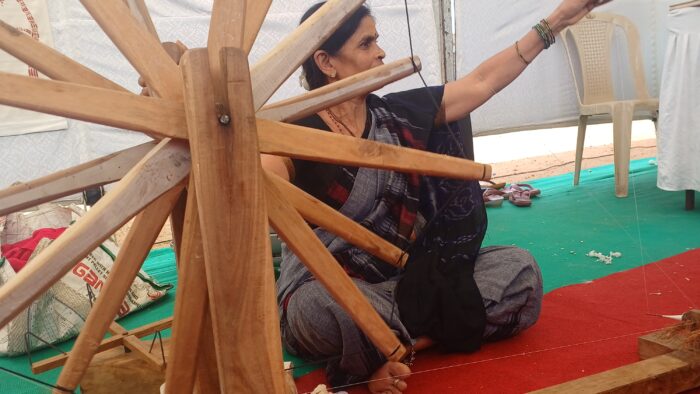
Spinning is the central act of transformation. It requires drafting (attenuating the fiber), twisting (imparting tensile strength), and winding simultaneously. The spinner must maintain precise equilibrium: insufficient twist produces weak yarn prone to breakage; excessive twist creates kinks and snapping. Fine yarn production demands years of embodied training, coordination between eye and hand, and continuous micro-adjustment.
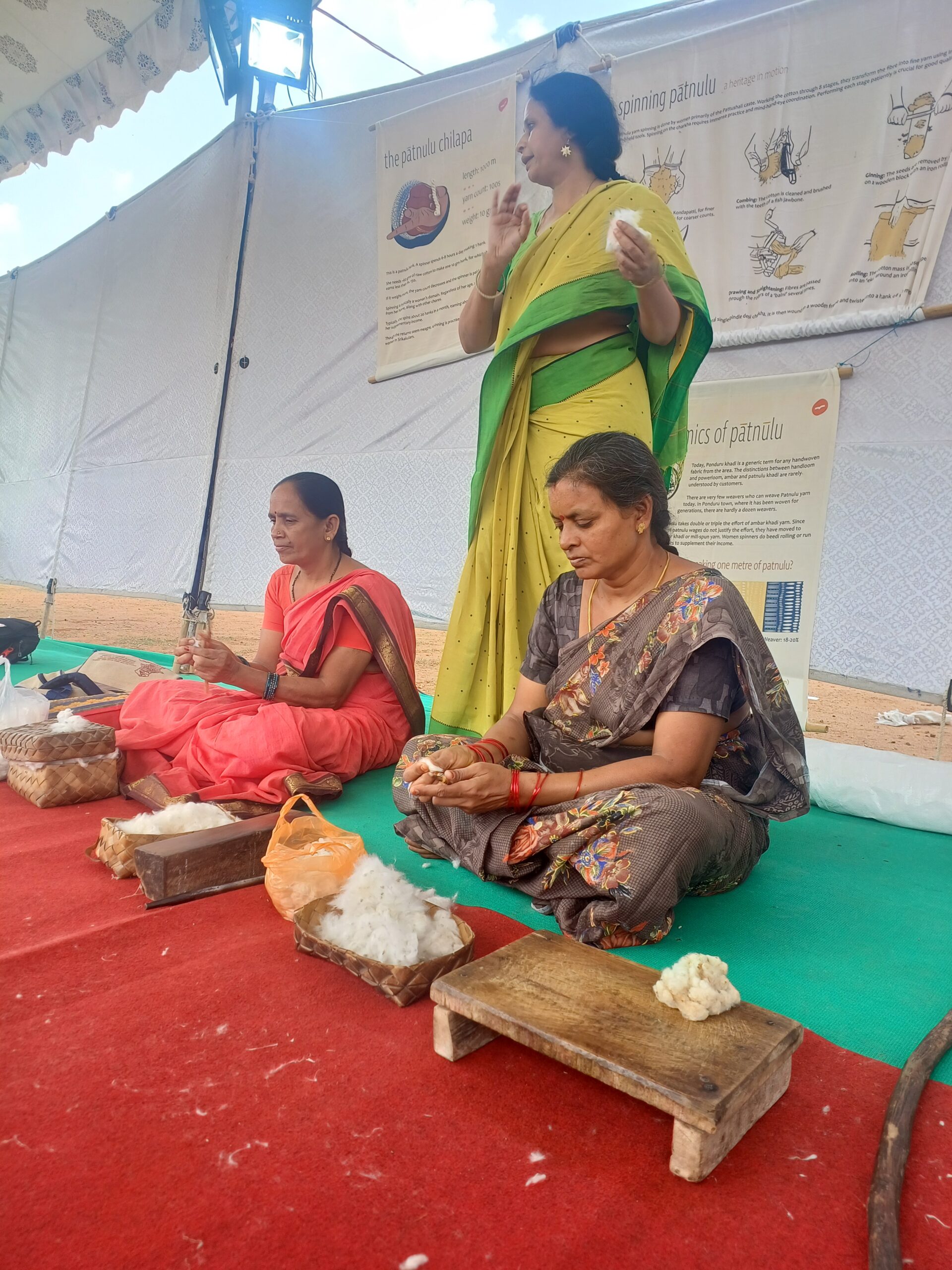
Women in this cluster spin 100-count yarn - where one thousand meters weigh just ten grams. By comparison, many contemporary mill-spun textiles range between 30s and 40s count. Achieving 100s count by hand requires extreme consistency and rhythm. Many spinners describe the repetitive motion as quietening, even meditative. It is within this context that Mahatma Gandhi positioned spinning as both economic resistance and disciplined spiritual practice.
Yarn is measured into standardized hanks of one thousand meters. A spinner balancing household responsibilities may produce twenty-five to thirty hanks per month. Wages per hank remain modest relative to the labor invested. The economic structure reveals a key fact: nearly eighty percent of fabric cost lies in the yarn, reflecting the time and skill embedded prior to weaving.
Weaving introduces structural complexity. Cloth consists of warp (longitudinal threads under tension) and weft (cross threads interlaced through them). Because handspun yarn is delicate and uneven compared to mill-spun thread, many weavers today use Amber charkha or mill-spun yarn for warp stability while retaining handspun yarn for the weft. Fully handspun warp-and-weft textiles are increasingly rare. The Amber charkha, with multiple spindles and higher productivity, represents a negotiated compromise between productivity and tradition.
The system survives through interdependence: farmer, spinner, and weaver form a fragile chain. If weavers reject handspun yarn, spinners lose livelihood. If spinning declines, farmers abandon low-yield desi cotton. Each node sustains the others.
Notably, this cotton-to-cloth system operates without electricity. Every stage—from seed preservation to spinning—relies on embodied knowledge transmitted across generations. Tools are simple and locally maintained, yet the technical output - fine-count, breathable, durable cloth - is sophisticated.
Workshops and demonstrations now supplement artisan income and build urban awareness. They render visible the intelligence embedded in what may appear to outsiders as “simple craft.” Holding a hank of 100-count yarn is encountering accumulated agricultural practice, manual dexterity, time investment, and inherited skill.
Samyuktha Gorrepati’s contribution lies in documenting this ecosystem in its full complexity - fiber science, agricultural ecology, tool use, skill transmission, economic fragility, and social interdependence. Patnulu is not merely fabric; it is a living continuum between land, labor, and cloth. Its survival depends less on industrial efficiency and more on cultural valuation. Once such embodied knowledge systems disappear, they cannot be reverse-engineered from machinery.