
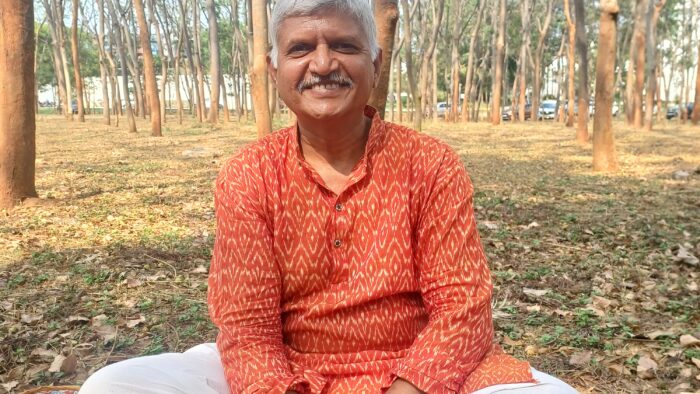
Revivalist Ramanadham Ramesh does not begin the story in Cheriyal, a town in Siddipet district, Telangana. He begins in Hyderabad.
In the early years, the work was simple. Old but usable clothes were collected from known families in Hyderabad and carried all the way to Rampachodavaram. They were not distributed for free. Shirts were sold for fifty paise, trousers for one rupee. Whatever money was collected in a hamlet was not brought back. If ₹20 -30 was collected from each hamlet, depending on the requirement ₹ 30 - 100 more was added and returned to that very hamlet. “It was their power,” he says. “We were only facilitators.”
That money lime-coated temples, painted blackboards, bought half bags of cement - small, practical interventions. Then came the floods near Kurnool. Two truckloads - one and a half of clothing, half of food - and one vehicle of medicines moved through flowing water. Chlorine tablets were used to purify water for an old woman surrounded by floodwaters. Relief turned into rehabilitation. And somewhere in that phase, revival crept in.
At first, it was handloom. Around 2007-8, in the then undivided Andhra Pradesh, many possibilities were considered - Venkatagiri among them. After three to four years of thought, the focus settled on khadi, specifically naturally coloured cotton. Then came handicrafts. Kondapalli was considered, but the Lanco group was already investing heavily there. Etikoppaka was examined. Nirmal for a while. And then, almost unexpectedly, Cheriyal.
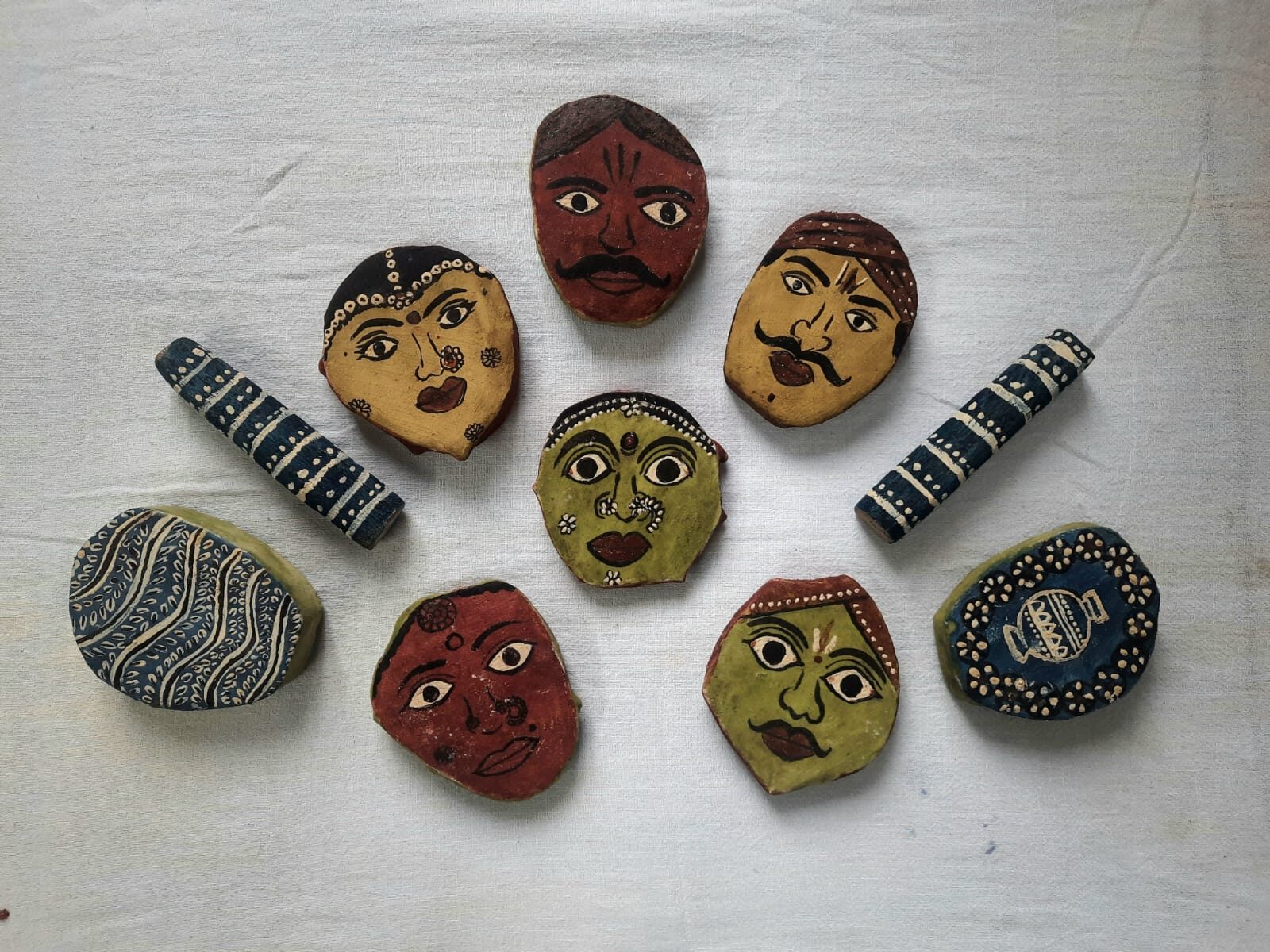
Traditionally handcrafted Cheriyal mask is an artifact of the village by the same name. The craft has three dimensions - Dolls, Scrolls, and Masks. All three have social relevance in their respective customary practices. They are not decorative objects; they are narrative instruments. “These are not toys,” Ramanadham Ramesh says. “They are part of the Katamaraju Katha.”
Katamaraju Katha is a 13th-century Telugu historical ballad detailing the conflict between Katamaraju, a Yadava chieftain associated with the Kanigiri region, and the Nellore Chola ruler Manumasiddhi II. Oral traditions place the confrontation in the mid-1200s, often around 1260 CE. The cause was drought. Katamaraju migrated with his cattle toward Nellore in search of grazing lands. There was a covenant regarding pasture rights. When that understanding broke, conflict followed. What began as a dispute over cattle became a matter of duty, honor, and warfare.
In the narrative, Katamaraju is portrayed as a righteous leader and an amsam of Shiva, guided by dharma. The opposing forces are described as formidable, led in different versions by powerful warriors. Because the epic travelled orally across Palnadu, Nellore, Telangana, and beyond, details vary from place to place. The climax is remembered as a fierce battle near the Paleru River, often associated with Panchalingala. For the Yadava community, this is not simply history; it is identity.
Many refer to the entire cycle as a “Yadava Bharatam” - vast in scale, lasting forty-one or forty-two days in performance. It is traditionally sung by community bards such as Suddugollalu and Kommula varu, while in Telangana the Mandhechu, Terachira, and Kommu traditions carry it in different formats. But everywhere, one constant remains: it is narrated only to the Yadava community, and Gangamma is central.
The dolls are used primarily by the Mandhechu narrators in Telangana. The Terachira use their large eight-by-twenty-foot screens. The Kommu use wind instruments. The Mandhechu sit inside homes and narrate with dolls; when performing for the entire village, they stand and narrate without them. The scrolls function differently, unfolding story across painted panels. The masks carry yet another dimension, embodying characters in ritual and performance. Together, the three forms hold the social structure of storytelling. “As a craft,” Ramanadham Ramesh explains, “it builds society. It includes people across different social practices. They narrate stories using these to specified sects of the society.”
Today, the Culinary Academy of India in Hyderabad has exclusively commissioned handcrafted Cheriyal masks from him. He has been working on this revival for more than 15 years - studying, restoring, reconstructing. Only seven families were officially listed as Cheriyal artisans. A few more were identified who had once made dolls, masks, and scrolls, but most were no longer fully engaged.
The commissioning of dolls is never commercial. When a narrator needs a new set - perhaps because villages are divided between sons - he takes the Yadava head and visits the doll maker. An advance is given ritually. On the return journey, advances are symbolically offered to nine artisan communities - bamboo workers, cloth weavers, carpenters, silversmiths, blacksmiths, leather artisans, porters, members of the Kuruma community, and Jamakkalam weavers.
At the heart of the process is the Puniki tree. Before wood for Gangamma is cut, the designated person visits the tree on a fixed day and performs a small ritual. He tells the tree why he has come and says he will return the next day. On the following day, he returns, cleans the area, and once again seeks consent. Only after that does he cut it. The tree is cut one foot above the ground. Puniki has very low germination; if cut at ground level, it dies. If cut one foot above, it regenerates. Ritual holds ecology inside it. The wood is dried and handed over ceremonially to the doll maker. Before carving begins, a puja is performed at home. Only then does shaping start.
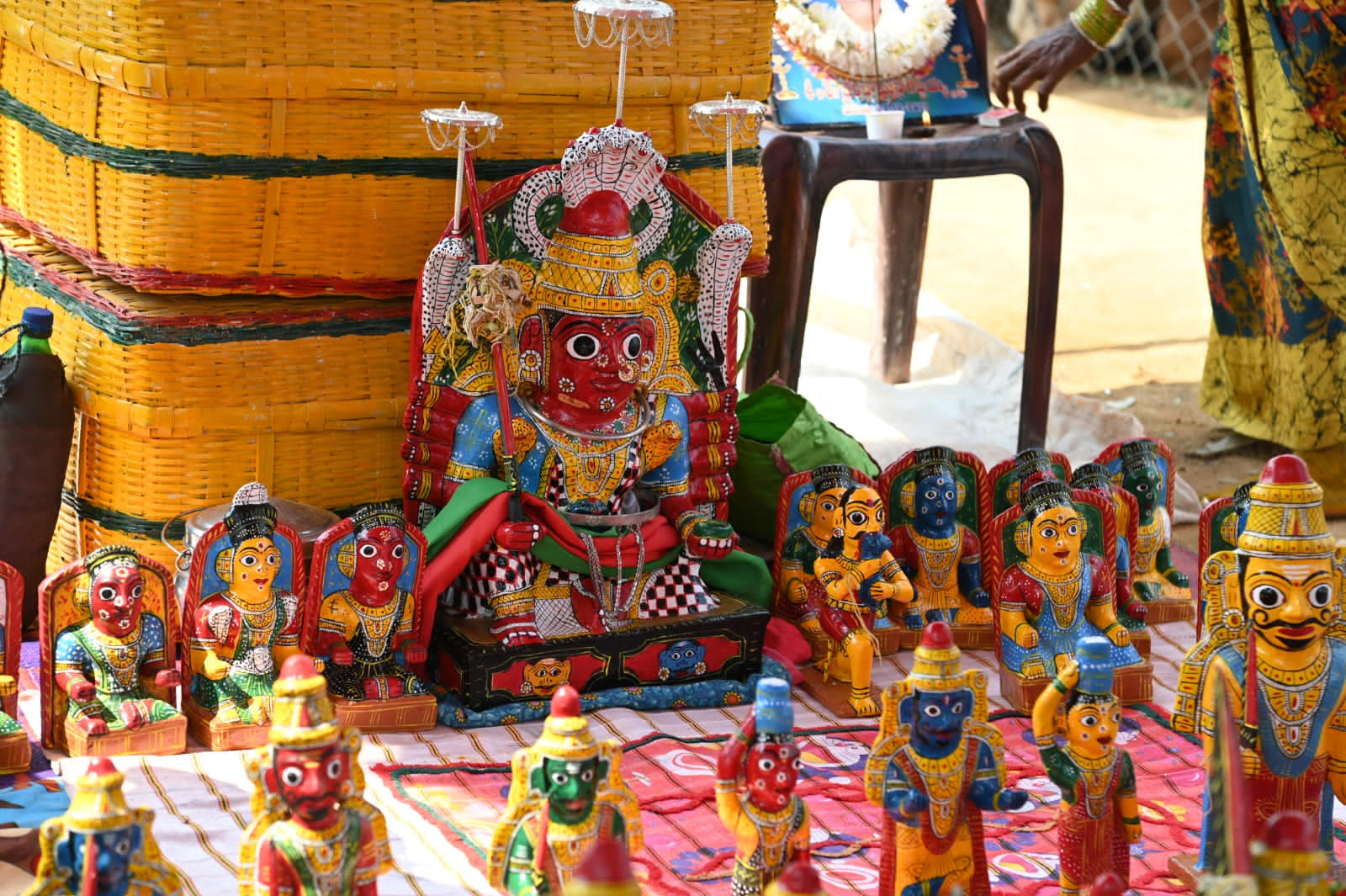
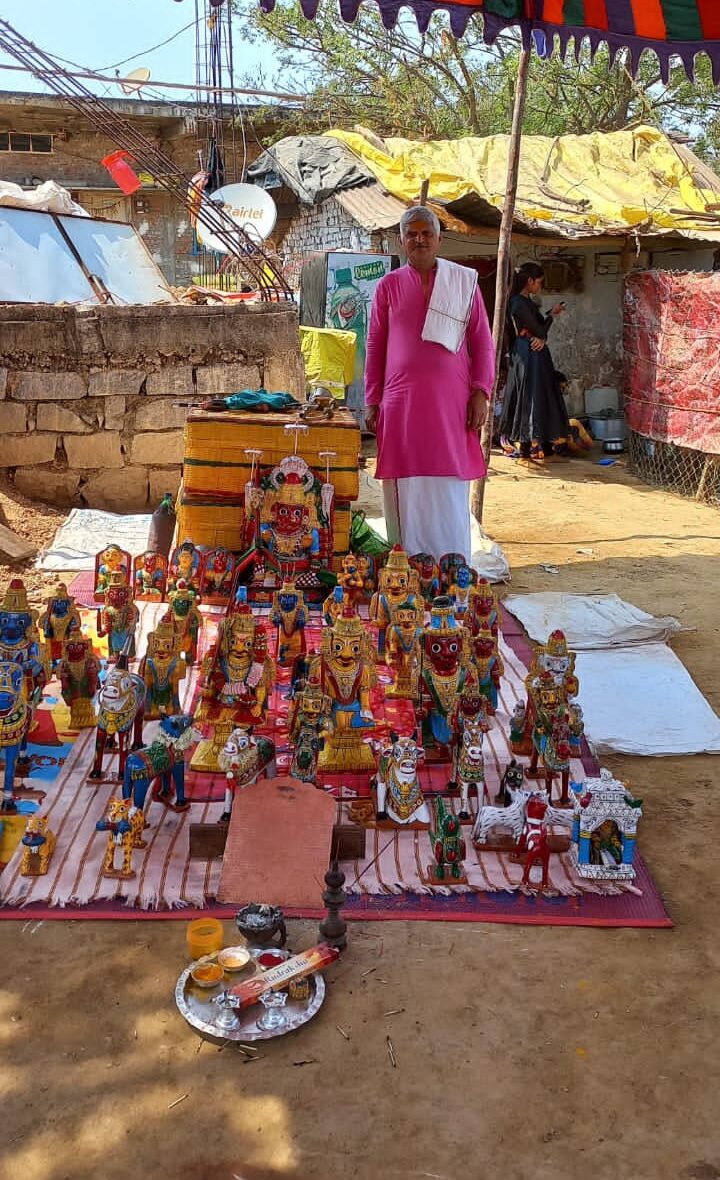
When the dolls are completed, they are not casually collected. Baskets, cloth, and instruments are assembled. Two baskets are prepared, each holding a saree. The dolls are arranged carefully - practical for transport, but ritual in execution. Clothes are offered to the doll maker and his wife. A feast follows. The dolls are treated like daughters leaving home. Music begins. In procession, they are taken back to the village. At the entrance, Yadava elders receive them. They are taken first to the temple. Only then are they integrated with the existing set. If a doll is damaged beyond repair, funeral rites are performed. The doll is placed in a bamboo tray, carried around the village, and songs recount the character’s lineage and greatness within the divine narrative. Then it is immersed in a nearby water body.
Over time, size and shape changed. Stone pigments gave way to synthetic paints. Polish altered. The revival seeks restoration - studying four-generation-old dolls, reinstating traditional proportions, reintroducing natural stone-based reds and yellows, ensuring all pigments are natural, and returning to natural wood polish. The full set - fifty-six dolls, including missing figures, pedestal, and sacred storage box - is being recreated. Parallel to the dolls, twenty-six of the 32 ballad narratives have been collected from Palnadu scholars and archival material from Andhra and the state archives in Madras which had six stories. Telugu literature scholar Shri Tamgirala Venkata Subbarao garu has been the main person who has worked on the stories and brought 19 to the limelight. Six remain untraced. A Telugu prose volume is being prepared to help narrators reconnect with coherent storylines. It will be an abridged volume with reference to 26 to 32 stories An English volume will explain the ballad, the doll-making process, and the science embedded within the rituals.
“We are not reviving an object,” Ramanadham Ramesh says quietly. “We are reviving relationships.” Between Hyderabad and Rampachodavaram. Between Cheriyal and Palnadu. Between Vijayawada and the Godavari belt. Between Srikakulam, Rayalaseema, Chittoor, Odisha, and Tamil Nadu. Between tree and artisan, artisan and storyteller, storyteller and community. The tree must consent, the wood must regenerate, the doll must be welcomed, and if it must leave, it must be honored. This is not preservation. It is continuity.