
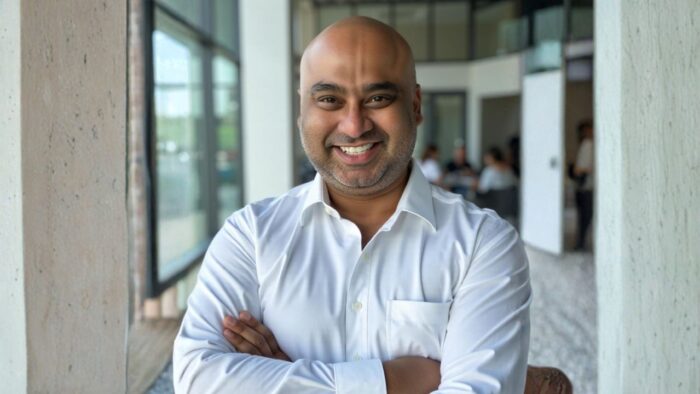
Dr. Raj Balkaran is a scholar of Sanskrit narrative literature whose work probes the ethical architecture of India’s great epics and Goddess traditions. Trained in the study of the Vālmīki Rāmāyaṇa and later the Mahābhārata, his research explores the enduring tension between worldly duty and spiritual renunciation—a polarity he terms the “dharmic double helix.” His scholarship engages themes such as just war theory, ahiṃsā, and the narrative encoding of dharma, with published work in the Journal of the American Academy of Religion.
Bridging rigorous philology with public-facing discourse, Dr. Balkaran brings ancient Sanskrit texts into contemporary ethical conversation, demonstrating how story—more than treatise—serves as the primary vehicle through which Indic civilization transmits its deepest insights.
What first drew you to Sanskrit narrative literature, and how did that shape your scholarly path?
I was a fourth-year undergraduate at the University of Toronto, taking a course on the Vālmīki Rāmāyaṇa. The tension between kingship and asceticism — between worldly and otherworldly concerns — innate to the text and embodied in the very personage of Rāma, was utterly compelling. This powerful narrative trope, and the ethical intrigue it entailed, compelled me to pursue a Master's degree on the Vālmīki Rāmāyaṇa to make sense of it.
As daiva would have it, I had been in touch with a professor of defence studies at the Royal Military College of Canada who was impressed with an undergraduate paper I had written on the Bhagavad Gītā. He offered me a research assistantship investigating the ethics of war and peace in the Hindu world, and introduced me to the Just War framework, which I applied to the Rāmāyaṇa. The first half of my thesis demonstrated that all elements of Just War theory were present in the Rāmāyaṇa — work later published in the Journal of the American Academy of Religion. The second half argued that, through the ascetic lens of ahiṃsā, violence is never fully justified. Rāma is happiest in the forest, as a pseudo-sage it seems. And Vālmīki was no stranger to nonviolence — he allowed a colony of ants to colonize his very body rather than harm them. The birth of verse itself emerges from a nonviolent sage cursing a wanton hunter; violence's accursed hue exists in tandem with the royal justifications of force.
I completed my Master's part-time while working and studying with a spiritual master. I call those years "the Masters and the Master." Among the many wisdom texts he initiated me into was the Caṇḍī Pāṭha, also known as the Devī Māhātmya. Intrigued that the glories of the Goddess, too, were framed by a king in exile — like Rāma, and so many others — I pursued a doctorate at the University of Calgary to make sense of this pattern.
My original goal of resolving Rāma's tension is ongoing, insofar as I now see clearly that this tension is purposefully preserved across Sanskrit literature. I have a name for it now. I call it the dharmic double helix: two strands — one royal, worldly, outer; the other ascetic, otherworldly, inner — which are structural opposites, never meet, yet somehow embrace to form the same structure. That structure is the DNA of Hinduism. Its essence finds most exalted expression in the Bhagavad Gītā, where Kṛṣṇa advocates being a soldier with your hands and feet and a sage with head and heart. I now find myself exploring the Mahābhārata, and the extent to which this great epic revolves around this very tension — embodied in celibate sagacious kings such as Bhīṣma, warrior brahmins such as Droṇa, and the Pāṇḍavas themselves, who must first enter the forest and learn their lessons before they return to rule. It is through the study of such works that I discovered Sanskrit narrative literature to be the prime vehicle whereby Indic culture encodes and transmits its abiding insights — not in treatise, but in the SUV of story. Stories teach you when you least expect it, and that's why they're so effective.
What is the “dharmic double-helix,” and why is it central to Indic thought?
Classical Hinduism hails from a dual heritage. The Vedic world is one of affirmation — ritual action, prosperity, progeny, sovereignty. The gods are propitiated through yajña so that the rains come, the cattle multiply, the kingdom thrives. This is a tradition that says yes to the world.
Beginning with the earliest Upaniṣads, a countercurrent emerges: renunciation, interiority, the recognition that all compounded things are impermanent and that liberation lies beyond the world of action. The ascetic ideal — tapas, vairāgya, ahiṃsā — pulls in the opposite direction. It says: the world is not enough.
The great achievement of the epic period is the integration of these two. The Mahābhārata's primary task is to weave the dharmic double helix — to hold pravṛtti and nivṛtti together without collapsing one into the other. Its plot and characters everywhere encode this tension. Bhīṣma is a celibate on a throne. Droṇa is a brahmin commanding armies. The Pāṇḍavas must retreat to the forest before they can return to rule. Yudhiṣṭhira wants to renounce; the world will not let him.
Hinduism must remain a world-affirming tradition — hence the valorization of kings, of dharmic governance, of the householder's obligations. But it cannot dispense with its philosophical crown jewel: ahiṃsā, and the recognition that this world is not ultimate. The duty of the first strand is blood-soaked, while the second remains unstained. One can dispense neither with concerns of this world, nor the next. The Bhagavad Gītā therefore offers a most brilliant, profound synthesis whereby one may draw blood as needed, yet keep one's hands unstained [BG 2.47–48]. One is called to the performance of actions in the stillness of equanimity and therefore incur neither karmic waves nor splashback upon the actor. Sagacity is redefined as a state of consciousness, not vocation. Act fully in the world, but with the interior disposition of one who has renounced it. Be a soldier with your hands and feet; be a sage with head and heart. Embody both strands of the dharmic double helix.
This tension abides in all religious traditions — the contemplative and the active, the monastic and the civic — but Indic thought has had the opportunity to reflect deeply and deliberately on the synthesis of the two across millennia of sustained literary and philosophical production. From the epics onward, the integration persists: not as resolution, but as a living, generative structure. The double helix ever replicates, inspiring untold millions to be in the world but not of it.
How can the tension between world affirmation and world denial guide modern life?
The modern world is awash in stimulation and starved of meaning. Anxiety, depression, addiction, alienation — these are not new afflictions. The sages warned about everything we now enshrine culturally: the relentless pursuit of sense pleasure, the inflation of ego, the confusion of acquisition with fulfillment. Humans have always been humans. The Kaṭha Upaniṣad distinguished the pleasant from the good thousands of years ago. We have simply industrialized the pleasant.
Dispense with the inward dimension and you produce the dysfunction we see everywhere: burnout, compulsion, lives of frantic activity signifying nothing. Dispense with the worldly and you produce withdrawal, irrelevance, spiritual bypassing. A chariot needs two wheels. The creative tension of integrating the two is the only safeguard against the dysfunction of dispensing with either.
What is missing is inwardness — a sense of meaning, connection, sacrality. Not religion in the institutional sense, but the recognition that there is an interior dimension to existence that requires cultivation, and that without it the outer life, however successful, remains hollow. We are matter and we are spirit. Our culture has mastered the physical body such that this knowledge eclipses the spiritual self. Even āsana without inwardness is merely posing; with inwardness it becomes awareness.
And it is not denial of the world that the tradition advocates. It is denial of relating to the world in a self-destructive manner. A denial of ego, a tempering of the sense objects that inflate it. Vairāgya is not vacancy — it is the clearing of space so that something deeper can be heard. To hear the calling, we need to quell the noise.
Ironically, when one is connected to one's soul, one's calling, one's purpose, one's higher power — one's work in the world is not diminished but empowered by that connection. It is about the work, not the worker; what needs to be done, not the doer. The Gītā's karmayoga is not a philosophy of resignation. It is the most radical form of engagement — action performed from stillness, effort liberated from ego, duty executed with the precision of one who has nothing personal at stake.
Hundreds of one-on-one life guidance sessions, thousands of students, and dozens of retreats across four continents teach me that all of these experiences are variations of the same theme: invoking and cultivating the inner life so that the outer may be illumined by the spiritual light of awareness. The dharmic double helix is not an artifact of ancient India. It is a diagnostic for modernity and a prescription for anyone trying to live a life that is both effective and awake. The change needed isn’t the absence of action, but the presence of awareness.
As a public intellectual, how do you balance academic rigor with accessibility?
Once upon a time, opaqueness was conflated with erudition. But true mastery of material and its relevance amounts to computing complexity while rendering it accessibly. Otherwise consciousness is coagulated with jargon, conditions, gatekeeping. Study the trees well, but don't forget to raise your gaze to the majesty of the sky and see where you are in the forest.
It is also a question of code-switching — understanding whether the inquiry is academic or spiritual. Good fences make good neighbours, and trespassing creates friction. Questions about historical reality, moral reality, emotional reality, and spiritual reality are continually conflated. Awareness is required regarding the register of the inquiry. One needs to keep in mind the position of the questioner: how much background material is needed? What are they asking? What are they really asking? And why?
If doing scholarship, do it well. If doing spirituality, do it well. Narrowed arteries need a cardiologist, and a broken heart needs healing of a different sort. But in either case, an accessible account is possible. And storytelling straddles both worlds — it renders complex ideas wholly legible, even subconsciously. A well-told story doesn't ask you to meet it at a certain level of expertise. It meets you where you are and teaches you before you realize you're learning.
How do your online courses and retreats translate epic wisdom into lived transformation?
The courses create a structured container — a safe space where ancient teachings can land in the lives of contemporary seekers. Structure and boundaries create safety. Compassion creates comfort for sharing. Students are seen, heard, held. Each course is built around story and the philosophical architecture it encodes. But the material is never left in antiquity. Teachings are applied to real-world scenarios — personal, professional, relational, spiritual — so that the wisdom becomes operative, not merely informational. The words land differently when the ground has been prepared — not just intellectually, but energetically. This is something the tradition has always understood: the teacher does not merely inform, but transmits. The community, the sustained attention — these create the conditions for something beyond the conceptual to be received. It is not enough to learn what the Gītā says; one must feel where it speaks to one's own life.
Retreats are sustained, focused, more contained versions of this same process — amplified by inspiring settings, expansive spaces, and the presence of kind community as a vessel for transmission. In a retreat, the usual noise falls away. The teachings are not competing with the inbox. There is an energetic field that builds when sincere seekers gather with shared intention, and within that field, transmission is empowered. The setting, the silence, the sustained immersion — all of these prepare the ground more deeply.
In both formats, the role is the same: to hold space for student transformation by offering the teachings with precision, with story, and with the energetic presence that animates them. The epic wisdom does not need to be modernized. It needs to be met — fully, honestly, in the conditions of one's own life. The riverbed is established for the lineage to flow. The courses and retreats provide the space for that alchemical encounter.
What role does mythology play in an age shaped by technology and secularism?
Mythology plays the role of filling exactly the gap left in the wake of an age shaped by technology and secularism. What that age has displaced — enchantment, meaning, morality, upliftment — mythology restores. It offers spiritual nourishment without dogma, without institutional gatekeeping. It meets people where they are.
And we can't get enough of it. The modern mythologists know this. Tolkien built a world that millions inhabit more deeply than their own. Game of Thrones commanded global attention for a decade. And George Lucas famously used the groundbreaking work of mythologist Joseph Campbell to complete the script for A New Hope — he reverse-engineered a modern mythology. These stories speak to the core experiences of the human condition, and those experiences stem from the inner life. An age obsessed with the outer is in desperate need of the inner. Mythological storytelling is precisely the way in.
I first encountered Star Wars and Lord of the Rings at the age of thirty and immediately saw the connections to ancient myth. It was only while researching for lecture preparation that I discovered the Star Wars–Joseph Campbell connection. My eye sees the story in every situation. My job is not to tell people what I think, but to show more clearly how the story works and what it means. Once you see it, you can't unsee it.
I taught a course called "Myth and Meaning" at the University of Toronto School of Continuing Studies for a decade. Enthralled adult learners spent the first half immersed in ancient mythologies and the second half in modern ones. The revelation — minds blown, semester after semester — was the recognition that what we now call "entertainment" is the repackaging of what was once called "religion." The throughline is mythological storytelling at scale. The medium has changed. The function has not.
What is happening, in other words, is education trojan-horsed as inspiration and entertainment. The content is philosophical, moral, spiritual — but the delivery is narrative, and so it bypasses the defenses that secularism erects against overt religious instruction. A story does not ask you to believe. It asks you to listen. And in listening, something shifts. Stories are a safe space for spiritual experience, and beloved avenue of life learning.
What enduring insight from the epics do you believe the modern world most urgently needs?
There is no single insight — the epics are too vast and too honest for that. But several speak with particular urgency to our moment.
Dharma must be discerned, not merely applied. The Mahābhārata refuses formulaic morality. Every situation demands fresh seeing — what is right here, now, for these people, under these conditions. The modern appetite for ideological certainty, for rules that absolve us of the burden of thinking, is precisely what the epic warns against. Dharma is not a code. It is a practice of discernment.
You are not your body, your role, your circumstance. The ātman teaching is not metaphysical abstraction — it is liberation from the tyranny of identity politics in the deepest sense. Śikhaṇḍī moves between genders. Bṛhannalā teaches dance in the women's quarters. The epic treats these not as aberrations but as expressions of a self that exceeds any single form. The modern world desperately needs this — not tolerance, but a framework in which the self is understood to be larger than any category assigned to it.
The world is not to be escaped but engaged — from a place of awareness. Action without ego is the highest form of engagement. The Gītā's karmayoga does not ask us to withdraw. It asks us to act from stillness, to serve what needs to be done rather than what the doer craves. This is the most radical instruction the epics offer: it is about the work, not the worker.
And the Rāmāyaṇa sounds its own warnings about engagement with the world. Rāmarājya — the reign of Rāma — is held up as the ideal of righteous rule. And yet the epic is unflinching about its cost. Even when God is on the throne, society remains a trap. People gossip. Rumour circulates. Sītā is exiled not because Rāma doubts her, but because the populace does. The ideal king sacrifices his own happiness to uphold the appearance of dharma. This is not utopia — it is a subtle dystopia, and the epic knows it. The Rāmāyaṇa's honesty on this point is devastating: even perfected governance cannot cure the human condition. This is the way of the world. Ours is the way of wisdom.
The ego in power — unchecked, unaccountable, surrounded by enablers — is the single most destructive force the epics identify. Rāvaṇa is no brute — he is a scholar of the Vedas, a devotee of Śiva, a master of governance. His downfall is not ignorance but ego: erudition without ethics, power without humility. The modern world is full of Rāvaṇas — brilliant, accomplished, and self-destructing because knowledge unmoored from dharma consumes its host. And Duryodhana is not evil in the cartoonish sense. He is a man who cannot bear to see others thrive. That is enough to destroy a civilization. The Mahābhārata is, at its deepest level, the story of institutional collapse — the unraveling of an entire age, a yuga-sandhi, precipitated by the accumulation of unchecked egoism at the seat of governance. It is a mirror for any society watching its institutions erode.
War is a last resort, not a first — and its devastation is total even when just. The Pāṇḍavas exhaust every avenue of negotiation before taking up arms. Kṛṣṇa himself goes as an envoy of peace. When war comes, it is because every alternative has been refused. And yet: the Pāṇḍavas win and inherit ashes. The epic never lets you forget the cost. Nothing is morally cost-free. This is not pacifism. It is moral realism. One must fight for what is right, but one must never pretend that fighting comes without devastation. And genocide — the annihilation of an entire people — is never sanctioned. Aśvatthāman's night massacre of the sleeping Pāñcāla camp is treated as the single most heinous act of the war. The epic's judgment is unequivocal.
Intergenerational trauma is real and traceable. Śāntanu's desire leads to Bhīṣma's vow. Bhīṣma's vow deforms the dynasty for generations. The consequences cascade through Dhṛtarāṣṭra's blindness, Duryodhana's entitlement, the war itself — all the way to Parīkṣit, who finally ends the cycle. The epic maps, across thousands of verses, how a single unchecked desire at the top of a lineage can poison everything downstream. The modern world, reckoning with systemic injustice and inherited trauma, has much to learn from this architecture.
The epics do not offer comfort. They offer clarity. And clarity, in an age of noise, is a most urgent gift.
How do you interpret the ethics of war and peace in the Mahabharata and Ramayana?
The ethics of war and peace in the epics are inseparable from the dharmic double helix. Both the Mahābhārata and the Rāmāyaṇa legitimize and regulate the use of violent force while simultaneously preserving non-violence as a paramount moral virtue. They do not resolve this tension. They hold it.
The Rāmāyaṇa encodes this tension from its very outset. The mā niṣāda śloka, the birth of verse, is itself born from the encounter between a hunter and a sage. A sarus crane is slaughtered for sport. The sage Vālmīki, overwhelmed with grief, spontaneously curses the hunter. That curse becomes the first line of poetry. Śloka from śoka — verse from sorrow, sorrow from violence. The double helix is not merely the thematic content of the Rāmāyaṇa; it is the generative mechanism of Sanskrit verse itself. And Vālmīki is no ordinary sage — his very name means "anthill," from the legend that he allowed ants to colonize his body rather than harm them. The most nonviolent being in the tradition produces the first poem, and that poem is a curse against violence. The sage enacts violence — the curse kills — to birth the tradition. Creation from destruction. Nonviolence preserving itself through a violent act.
The Rāmāyaṇa then repeatedly collapses the distinction between the warrior and the wanton hunter. Daśaratha, hunting a deer, kills a boy — and is cursed to die grieving for his own son. Rāma, chasing a golden deer, loses Sītā to Rāvaṇa's trap. Rāma, killing Vālin from a place of hiding, defends himself by invoking a hunter's right. In each case the warrior is revealed as hunter — the face of vice in Indic culture — and in each case disaster follows. The text consistently blurs the line between sanctioned and wanton violence. And Rāma himself is happiest in the forest. He explicitly rejects the kṣatriya code. He insists on bark-cloth garments voluntarily. He tells Sītā he would live in exile forever without grief. Every return to sovereignty brings suffering. The ideal king is a man who does not want the throne.
The Mahābhārata carries this tension into the domain of statecraft and total war. An entire book — the Udyogaparvan — is devoted to the exhaustive attempt to avert conflict. Kṛṣṇa himself goes as an envoy of peace. War comes only after every alternative has been refused. And once war is joined, the epic prescribes an elaborate code of combat ethics: matched combatants, immunity for non-combatants, prohibition of treacherous weapons and weapons of mass destruction, protection of the surrendered and the sleeping, respect for envoys, care for the families of the fallen. These are not stated as abstraction — they are encoded in narrative. Celestial beings cry out when Abhimanyu is encircled and slain by six warriors. Yudhiṣṭhira rebukes Bhīma for trampling Duryodhana's fallen body. And Aśvatthāman's massacre of the sleeping Pāñcāla camp is treated as the single most heinous act of the war.
Even wholly sanctioned violence provokes moral anxiety in the Indic world. The Pāṇḍavas win and preside over utter devastation. The heroes end up reborn in hell — not permanently, but as a consequence of violence enacted however righteously. The law of karma cannot be suspended even for just warriors. This is why the Dharmaśāstras declare that rebirth as a warrior, for all its worldly benefits, is unfortunate.
The Bhagavad Gītā offers a path through this impasse — not around it. Kṛṣṇa does not tell Arjuna that violence is good. He tells him that action performed without attachment, from a place of equanimity, does not bind the actor in the way that desire-driven action does. The warrior's duty is necessary. The moral burden is heavy. And the inner disposition with which one meets that cost is where dharma lives.
I have explored these convergences with modern international humanitarian law in a peer-reviewed study with Professor A. Walter Dorn, published in the International Review of the Red Cross. The findings demonstrate that classical Hindu provisions on the conduct of armed conflict not only parallel but in several respects exceed the humanitarian bar set by the Geneva Conventions.
The Sanskrit epics are morally complex -what do they teach us about dharma in times of conflict?
Several teachings are addressed in detail in my responses to other questions in this interview. The epics insist that all alternatives to force must be exhausted before conflict is engaged, and that even righteous violence carries karmic consequences from which no warrior is exempt (see my response on the ethics of war and peace). They teach that unchecked ego is the most destructive force in governance, and that the consequences of moral failure cascade across generations (see my response on the most urgent insights from the epics).
Beyond these, the epics teach us a great deal about dharma itself — and what happens to it under pressure. Dharma, from the root √dhṛ, means "that which holds." It is not ethics alone. It is structural coherence — the principle that stabilizes reality in its proper function. The question the epics pose is therefore not "what is the right thing to do in conflict?" but "what holds — and what breaks — when everything is falling apart?"
Conflict reveals whether dharma was real or performed. Duryodhana declares: "I know what dharma is; I cannot practice it." Knowing is not holding. The crisis does not produce his flaw — it exposes it. Every character in the Mahābhārata enters the war already formed. What the war makes visible is what was always there.
The outer conflict is a vehicle for resolving an inner one. Arjuna's crisis on the battlefield is internal before it is military. The Gītā is delivered not to resolve the war but to resolve the warrior. The epic, at its deepest level, teaches not how to win but how to stop.
Dharma erodes incrementally. The dice game is not one event — it is an accumulation of binding. Each silent assent, each unchallenged transgression, each deferred confrontation adds weight until catastrophe becomes structurally inevitable. The sabhā breaks dharma long before the war does. By the time armies gather at Kurukṣetra, the fracture is already complete.
Silence is itself a breach of dharma. Bhīṣma — the most powerful man in the room — watches Draupadī dragged by her hair into the court and says nothing. His is not neutrality but adharma: the failure to act when action is precisely what coherence demands. Institutions collapse not when evil acts, but when the capable remain silent. The sabhā's silence is the failure to adjudicate — and the epic traces the destruction of the entire dynasty to that moment.
At the peak of conflict, the epics confront us with dharmasaṅkaṭa — the moral impasse where every available action involves cost. Yudhiṣṭhira's lie about Aśvatthāman. Arjuna shooting Bhūriśravas while he is engaged with another. Kṛṣṇa himself sanctioning violations of the warrior code. The epic refuses to offer a morally costless option. There are no clean hands. Even the righteous accumulate karma. And every act of vengeance in the epic is paid for — fully, terribly, without exception.
Loyalty itself becomes a site where dharma fractures. Karṇa knows he fights for the wrong side. His loyalty to Duryodhana — the one man who showed him dignity when the world denied it — overrides his knowledge of dharma. Social binding and ethical clarity pull in opposite directions, and he chooses the bond. What dharma demands in a given moment — which dimension of coherence must be embodied now — is not always legible. That, too, is the teaching.
Grief teaches what dharma costs. Dhṛtarāṣṭra's blindness is moral before it is physical — he cannot see what his sons have become. Gāndhārī blindfolds herself in solidarity and cannot see what her household has become. The Strī Parvan — the Book of Women — is where grief finally speaks with full authority. The epic distinguishes two kinds of hearing: hearing that inflames, which justifies violence, and hearing that arrests, which prevents repetition. Grief, fully received, arrests. And timing matters: the same teaching delivered before catastrophe functions as justification; delivered after, it becomes restraint. This is why the Gītā appears before the war, and the Śāntiparvan after.
Dharma, ultimately, is a function of consciousness, not code. The question the epic poses in conflict is not "what should I do?" but "what consciousness am I bringing to this moment?" The architecture of dharma is eternal — what it demands is contextual. Adharma is not the violation of a rule but a dimension of reality colonizing where it does not belong: rigidity where openness is needed, passivity where action is called for, force where restraint would hold. When consciousness is aligned, dharmic action follows without deliberation.
And the tradition offers practical strategy as well. The epic prescribes the four upāyas: sāma (conciliation), dāna (gift), bheda (creating division), and daṇḍa (force). Force is explicitly the last resort, deployed only after the first three have been exhausted. Kṛṣṇa himself models all four as envoy before the war. The tradition insists: exhaust every alternative before you draw blood. And even then, know that the blood will cost you.
The Mahābhārata's final teaching on dharma in conflict is embodied not by a warrior but by a listener. Janamejaya, the great-grandson of Arjuna, inherits the full cycle of vengeance. He is conducting a sacrifice to annihilate the serpent race in retaliation for his father's death. He is owed this vengeance. He has heard the entire epic — every vow, every violation, every consequence. He sees the pattern. He is the pattern. And he raises his hand and stops. Not forgiveness. Not weakness. Recognition. Victory is ash. Force cannot end cycles. Only stopping can. Life must be allowed to complete itself so that it does not have to repeat itself. And when everything else dissolves — the armies, the kingdoms, the heroes, heaven itself — dharma persists. Yudhiṣṭhira refuses heaven for the sake of a dog, and the dog is dharma in disguise. That which holds, holds to the end.
How should contemporary readers approach morally troubling episodes in sacred texts?
It depends on the episode and the person. But irrespective, the answer is awareness.
First, understand the text on its own terms. Is moral provocation the goal of the passage? Draupadī's disrobing is meant to disturb. The epic wants you outraged — your outrage is the mechanism by which the scene teaches. Aśvatthāman's massacre of sleeping warriors is meant to horrify. The horror is the point. These are not failures of moral imagination on the part of the authors. They are deliberate provocations designed to force the reader into ethical engagement. Before judging a text, ask what it is doing and why.
Second, approach morally troubling episodes the same way one encounters morally troubling individuals or situations in life — with self-awareness. What is triggering you, and why? The reaction often reveals more about the reader than about the text. Sacred literature, like life itself, holds up a mirror. What disturbs you is data about your own conditioning, assumptions, and attachments. That discomfort is not a reason to look away. It is the beginning of inquiry.
Third, approach with humility. Different cultures, locales, and histories think differently about morality. What is self-evident to a modern Western reader is not self-evident to an ancient Indian poet, and the reverse is equally true. The assumption that one's own moral framework is universal is itself a form of ignorance the tradition would name avidyā. Read with the recognition that you are entering a world with its own coherence, its own logic, its own centuries of reflection — and that this world may have something to teach precisely where it unsettles you.
The sacred texts are not comfortable. They are not meant to be. There are two kinds of pain: the pain of breaking a bone, and the pain of resetting it. The morally troubling episodes in sacred literature are not the fracture. They are the resetting. Growth necessarily occurs beyond one's comfort zone, and sacred texts are designed to take you there.
Why do the myths of the Indian Great Goddess remain so compelling and culturally vital?
Feminine faces of the divine are exceptionally rare across the world's religious traditions — and a Great Goddess figure, supreme and self-sufficient, is rarer still. India hosts the only thriving veneration of a Great Goddess, numbering in the hundreds of millions. This alone makes the tradition extraordinary. What if God were a She? What would that mean for how we understand ecology, creativity, receptivity, sovereignty, the feminine itself? These are not hypothetical questions in the Indic world. They are answered daily in worship.
The myths of the Great Goddess find their most potent expression in the Devī Māhātmya, chapters 81–93 of the Mārkaṇḍeya Purāṇa. This text has been self-circulating for over fifteen hundred years — stable across South Asia, transmitted continuously without the need for institutional enforcement. It is intoned liturgically as part of the massive Nine Night Goddess festival, Navarātrī, throughout South Asia and now globally across the Indic diaspora. Its hymns are chanted separately from its myths, as independent objects of great veneration. The text is not archaic. It lives, perpetually breathing life into Indic culture.
The Goddess is protectress bar none. In no myth is she ever defeated, for she is victory incarnate. A power beyond which no greater can exist — the principle of power itself. This power is śakti — the animating force of all reality, the energy without which nothing moves, nothing creates, nothing transforms. And power's prime purpose is protecting the imperilled. People need protection, empowerment, and sovereignty — and nowhere is this better illustrated than in the myths of the Devī Māhātmya, where the Goddess arises precisely when the gods themselves require protection, when cosmic order has been compromised, when no masculine force can restore what has been lost. She appears not as supplement but as source. Her power is not delegated. It is innate, immeasurable, and available to all.
The myths themselves compel because they enact restoration. We know all too well what it means to be fallen, imperilled, endangered, overwhelmed by the forces of adharma. These stories tell us the story doesn't need to end there. They commence where sovereignty has been stolen — a king dispossessed of his kingdom, Indra driven from heaven, the gods overwhelmed by demonic forces they cannot defeat. Against this backdrop the Goddess emerges with colossal martial prowess — driven by equally colossal compassion — dismantling the threats that the entire host of gods themselves could not. She is the force without which order cannot be restored. The myths describe cosmic restoration, sovereignty returned to its rightful holders — and we recognize, consciously or subconsciously, the pattern playing out in our own life. Have we stopped our story too soon and remained imperilled, or do we follow suit, invoke the Goddess, and reclaim our stolen power?
But she is not merely warrior. The Devī Māhātmya reveals her as abiding in all beings — as consciousness, as strength, as sleep, as hunger, as shadow, as compassion. She sacralizes the state of embodiment itself. This is not a theology of transcendence that leaves the world behind. It is an exaltation of divine immanence — the Goddess is here, in matter, in body, in breath. Her two boons at the text's conclusion honour both strands of dharma's double helix: she grants mokṣa to a merchant and sovereignty to a king. Yet she privileges world affirmation: she promises to return whenever the world is imperilled, and she promises worldly prosperity to those who invoke her. The dharmic double helix tilts, in her case, toward the strand that ensures the welfare of the world. She abides here. She is powerful. She protects. She blesses. She knows exactly how to deal with demons. And through the sacred hymns embedded in her myths, we learn how to invoke her with sacred sound — how to call that power into our own lives, our own bodies, our own circumstances.
The landscape itself bears witness to her power. The śakti pīṭhas — sacred sites of the Goddess scattered across South Asia — are powerful sites of transformation, pilgrimage destinations drawing millions. I have had the privilege of leading a pilgrimage tour of Western students visiting the śakti pīṭhas of Himachal Pradesh, witnessing firsthand the encounter between contemporary seekers and ancient sites of feminine power. The sites are not monuments. They are fields of living transmission, contact with which necessarily leaves one changed.
Śakti is not an intellectual concept lodged in the mind. It is a lived experience, coursing through one's being. It is her essence: power is something one may have, for some time, but it is something she is, in perpetuity. Devotees of the Goddess do not merely believe in her power — they feel it, receive it, are moved by it, are transformed by it. This is why the tradition endures. It is not preserved by scholarship, nostalgia or the machinations of man. It is sustained by the force of its essence, sufficient to thrive even in the midst of patriarchal paradigms.
The myths remain compelling because they continue to describe, with symbolic soundness, what devotees experience — the overwhelming, protective, sovereign, compassionate, terrifying presence of the divine feminine. No tradition has articulated this with the depth, the narrative richness, or the philosophical sophistication that India has. There is nothing else like it in the world. That is why it remains culturally vital, for India and the world.
How do Devī traditions reshape understanding of power, violence, and compassion?
This question lies at the heart of my doctoral work: "Mother of Power, Mother of Kings: Reading Royal Ideology in the Devī Māhātmya" (University of Calgary, 2015). This alongside subsequent years of reflection on the Devī traditions have fundamentally reshaped how I understand power, violence, and compassion — and I believe they can do the same for anyone willing to receive the teachings of the Goddess. Most recently, in a comparative study of Genesis and the Devī Māhātmya, I have reflected that these two texts encode structurally opposing visions of divine power — one masculine, hierarchical, and transcendent; the other feminine, holistic, and immanent — with profound consequences for how civilizations understand authority, agency, and the sacred.
The masculine model mythologized in Genesis operates through separation, hierarchy, exclusivity, and control. God is external to creation, a transcendent lawgiver who speaks the world into being and governs it from above. Creation itself is chaoskampf — the subjugation of the chaotic oceanic feminine in service of patriarchal order. The Devī Māhātmya presents an utterly distinct vision. The oceanic abyss is neither silenced nor subjugated, but is the very support of the sleeping Viṣṇu at creation. Durgā is not a deity who possesses power. She is the personification of power itself — śakti as ontological principle, not divine attribute. Her form emerges from the combined tejas of the gods, but her power does not originate from them. The text makes this explicit. Power is inherently feminine, inherently dynamic. She is paradoxical in every respect except two: she is forever feminine, and she is unmistakably omnipotent — that beyond which no greater power can exist. She collapses virtually all conceptual binaries into her matrix of possibilities: beautiful and terrifying, maternal and martial, knowledge and delusion alike.
The nature of her power is not hierarchical but holistic — not "power over" but "power with," not dominion but distributed sovereignty. When the demon Śumbha taunts her — "You rely on the strength of others to fight" — he speaks from a masculine understanding of power as autonomy and independence, the notion that relying on others represents weakness. He projects his mode into her. Her response dismantles this paradigm entirely: "I alone exist here in all the world; what second, other than I, exists?" The various goddess forms return to their source. Multiplicity emerges from and returns to unity without contradiction. She does the work of restoring hierarchy where needed, defeating the demons who have usurped cosmic order. But she herself abides in a state beyond hierarchy, whereby all beings participate in her field of power. The Devī Māhātmya reveals her as abiding in all beings — as consciousness, as strength, as sleep, as hunger, as shadow, as compassion — through twenty-one verses of sustained litany. Śakti is not hoarded at the top. It courses through all things. It is the animating force of all reality, available to anyone who invokes it. She does not sit the throne. She does not rule. She reclaims the throne for Indra to sit. Rather than ruler, she is rulership itself; rather than sovereign, she is sovereignty; beyond being powerful, she is power itself. This is a fundamentally different vision of what power is and how it operates.
The Goddess' violence is protection through destruction — the desirable destruction of undesirable destruction, in the interest of safeguarding the imperilled. She is independent and invoked in crisis, yet she acts out of compassion to restore order. She breaks the binary. Her wrath is celebrated as wholesome because it is an emanation of her motherly compassion — only the demonic incurs her fury. Her face is described simultaneously as gentle as the full moon and terrifying as the face of death. Both are true at once. Violence poses no moral quandary within the Devī Māhātmya because it is enacted by a being whose consciousness is entirely extricated from ego. She acts without self-interest, without karmic entanglement. Her battles are not demonstrations of might but acts of cosmic restoration. When the demon is slain, the universe is soothed, regaining its natural order — rivers return to their courses, skies clear, the fever breaks and cosmos is healed through her intervention. To emphasize her carnage without contextualizing her compassion is entirely inapt.
The Goddess' crushing martial prowess is subordinate to her compassionate care. Violence serves compassion, not the inverse. The fierce face of the royal warrior and the gentle face of the contented mother coexist, but the maternal is primary. The martial is episodic, for a purpose. We commence with compassion, and rightfully protect ourselves when faced with harm. Accommodation leaves room for assertion, while assertion alone quashes accommodation. Her compassion is her essential nature; her wrath is situational. She protects from cosmic threats, from natural disasters, feeding the world with her very body when necessary. And she promises to return whenever the world is imperilled — her compassion is woven into the fabric of the cosmos itself. She encompasses both shadow and light, both delusion and liberation — what I have elsewhere termed the "artful ambivalence" of the Devī Māhātmya. To be supreme, she must encompass both. The paradox is not contradiction. It is wholeness.
Goddess traditions refine our grasp of these three forces by collapsing the binaries through which we habitually perceive them. Power is not masculine. Violence is not the opposite of compassion. The feminine is not passive. The maternal is not soft. The fierce is not uncompassionate. The Devī Māhātmya dismantles every one of these assumptions — and replaces them with a vision of divine reality in which power, rightly held, protects; violence, rightly enacted, serves compassion; and motherhood, fully expressed, is the most formidable force in the universe. And the text wisely teaches us that all of us, irrespective of gender, orientation, age, station, culture, creed — have access to the state of motherhood where our consciousness is oriented towards the welfare of others. But motherhood is not martyrdom as it's so often conflated with. The Goddess, great mother that she is, serves as an exemplar of dignity, sovereignty and self-respect where she allows no harm to come to herself. Without her own welfare secured, how could she secure the welfare of the world? This is the essence of her power. It is not power that dominates but power that empowers. Not power that enforces, but power that restores. To recover the Goddess is not to denounce the God, but to rebalance cosmic order. He needs to share the sky — and what's more, he needs to honour the earth.