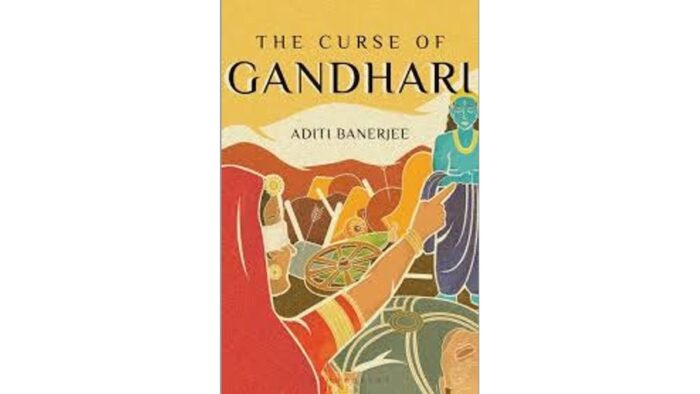
US based author Aditi Bannerjee says her maiden book - The Curse of Gandhari - is in a new genre which can be called speculative fiction, where she weaves her story around a character from India's epic Mahabharata. She is one of a recent crop of Indian women writers who are interpreting Indian texts with fresh imagination while taking care to keep the original intact.
The Mahabharata uses a familiar human habit in its narration of transferring blame. Either through self-reproach or by blaming another.
It ends with Gandhari, the mother of Kauravas, holding Krishna responsible for the war. Inanger and grief, Gandhari turns to Krishna and says (Chaturvedi Badrinath- The Mahabharata an Inquiry into the Human Condition):
You could have prevented all this from happening, but you didn’t. You let the destruction of this family take place.
If I have earned any merit in living the way I have, then with the force of that merit I curse you.
In the thirthy-sixth year from now, your sons and your relatives and your advisers will likewise die fighting each other.
You will drift in the deep woods, unseen, unknown, alone, helpless. And you will die a mean death.
As the women of the Bharata clan are weeping now, the women of your family will likewise weep over their dead.
Krishna does the unexpected. Instead of commiserating with a grieving mother, he blames herback. He accuses her of “transferring to him the accountability that properly belonged to herfor not restraining her ‘wicked-hearted, vain and jealous, cruel and arrogant, disobedient and disregarding, contemptuous son Duryodhana. How can you blame me for what you should blame yourself for? You are wholly accountable for the destruction of the Kuru clan’ (Badrinath)
Aspects of accountability, reproach, human will, Dharma and even karma are all tossed backand forth. A corporate lawyer pursuing her Executive MBA in Columbia University, Aditi Banerjee couldn’t have picked a more complex figure for her first book – The Curse of Gandhari. In the midst of her busy life, she is learning Sanskrit and has as her source BibekDebroy’s English translation of the unabridged Critical Edition of the Mahabharata. She took one year to write the book, which is engaging and brisk in its narration. Uncomfortable withclassifications into ‘mythological fiction’ or ‘fantasy’, she calls her book a ‘speculative fiction’defined by her as – “ Taking something that is true, the Itihaasa, and using one’s imagination and creative liberties to ‘speculate’ about the characters and stories between and beyond the lines of the original.”
Banerjee says the book is for “lovers of the Mahabharata who would like to see an alternative perspective of a lesser known character. For people who would be drawn to Gandhari’s story as a strong, intelligent woman who was torn between Dharma and family loyalty, who had incredible willpower and strength but struggled to rise above her own circumstances, who won the respect of the rishis and devas yet could not move past her own bitterness and regret.”
Aditi Banerjee - The Curse of Gandhari
In this interview she explains her interpretation of the complexity of Gandhari:
Is there more than one meaning to the title The Curse of Gandhari?
I suppose it is a little bit of play on words. The two things Gandhari is most famous for are her blindfold and the curse she pronounces on Krishna at the end of the war. Both are actions she chooses on her own and are evidence of a strong, powerful, wilful princess and queen. In both acts, there is an element of pathos and poignancy – a woman in a way resisting her fate with the means available to her. Rather than meekly accept her marriage to a blind prince, sheimmediately blindfolds herself in an act of devotion or spite or some mix of both. Rather than submit to her family’s defeat in the war, she rails against Krishna and curses him, a curse he accepts with a smile. On the one hand, the curse is her act of agency in defiance of her fate. On the other, she appears to be accursed, perhaps self-accursed, in finding herself again and again on the losing side of life. So, ‘curse’ is meant to refer to both sides of her personality – astonishing acts of willpower and also the recurring sense of victimhood she falls prey to again and again.
In the blame-game, do you think Gandhari was a negligent mother, because of whose act of being blindfolded voluntarily, she could not keep an eye on the misdeeds of her children, literally as well as figuratively?
I have heard that characterization as well. Certainly she is not the extraordinary mother that Kunti proves to be for the Pandavas, including the two sons of Madri she adopts as her own, setting aside Kunti’s treatment of Karna. However, I do not think the Mahabharata lends itself to black-and-white judgements of its characters. Imagine what it must have been like for Gandhari to have one hundred sons (and one daughter). While it is a traditional blessing topronounce on all wives and mothers, how difficult it must have been to rein in such strong personalities as the Kaurava boys. And what kind of influence could she wield when faced with Dhritarashthra’s own ambitions for the throne, his refusal to accept the wise counsel of Vidura, and then the wiles of her own brother Shakuni. The deck was stacked against her, even if she had not been blindfolded. It is easy to say that in blindfolding herself, Gandhari renderedherself less useful and therefore a weaker mother and queen. There is some truth to that. But the Mahabharata itself does not take such a pejorative view of her blindfold. It is because of this act of devotion, her piety, that she accumulates enough tapobala to protect her son from death, through the power of her gaze, to curse Krishna, to blacken Yudhishthira’s toenails with her mere glance.