
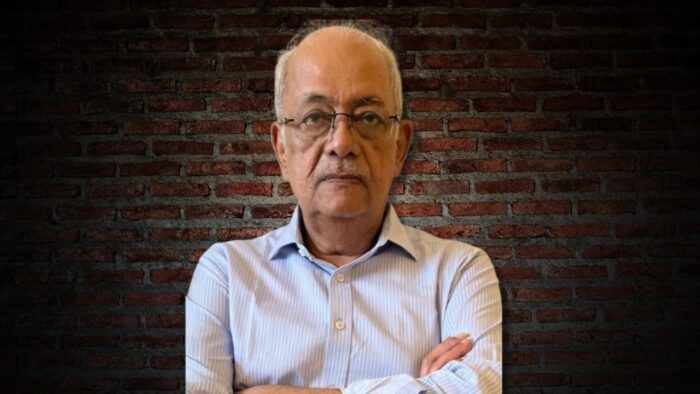
Prakash Chitre. An independent researcher and author. He is an independent researcher and author.
All his working life he was a marketing professional till he took complete retirement almost a decade back. Almost since then, he has been focused on researching the subject of the ancient Indian Knowledge Systems and the verifiable and valid evidence for the same, a subject very close to his heart.
The said research resulted in his book, “Our Intellectual Heritage: There exists a large body of evidence for the width, depth and accuracy of the ancient Indian knowledge”. It was published by Motilal Banarsidass Publishing House in March 2024.
What inspired you to take on such voluminous research on IKS?
Right since my childhood I had been aware, conscious in fact, to some extent, that our ancients had deep knowledge. But I did not know any specifics, regarding the subjects etc and as to how old was such knowledge. Even less did I know that there is plenty of evidence for the same.
Towards the end of 2019 or the early 2020, I came across information about the archaeological findings at Bhirhana and Rakhigarhi (both in Haryana) and that the old parts had been carbon dated by ASI (Archaeological Survey of India) to 9,500 and 8,500 BP, respectively. That clicked. I then started looking at other such sites in the Saraswati Sindhu Civilisation (earlier known as Indus Valey Civilisation or Harappan Civilisation, which as it turned out later, were inadequate names). This civilisation showed an incredible knowledge of Metrology, Civil Engineering, Water Management, Sanitation, Town Planning etc.
It made me aware that our ancients had deep knowledge of a large number of subjects besides Wisdom, Spirituality etc. This naturally led to research on wider scale.
This eventually resulted in my book, “Our Intellectual Heritage”, which was published by Motilal Banarsidass Publishing House in March 2024. The objective of my book is not only to share awareness of the extremely wide range of subjects in which our distant ancestors had deep and accurate knowledge, but also that, and this is very important, there exists a large body of evidence of their knowledge.
Of the many topics your book covers, which are the areas where we really need to work hard to make sure people are aware of India's work.
Simply put, to begin with, the following two points need to be conveyed as widely and convincingly as is possible:
a) Our distant ancestors, several millennia ago, had deep and accurate knowledge of a very large number of subjects such as astronomy, many branches of mathematics, the sciences including medicine and the veterinary science, metallurgy, philosophy, architecture, sculpture, painting etc.
b) There indeed exists a very large body of evidence for the width, depth and accuracy of the ancient Indian Knowledge.
In India we saw knowledge as one whole unit, interconnected and influencing one another. Should we actually accept Western categorization of knowledge into science, non science, spirituality etc?
Yes. These were interconnected in the ancient Indian Mind. However, that is not the case with the modern Indian Mind. We have been strongly influenced, and I do not exclude myself, by the Western way of thinking and assessing. If we want our fellow Indians, on a wide scale, to not only know about the knowledge of the distant ancestors of all of us, but also to accept and internalise it, and consequently develop a fact based collective pride in our past, as opposed to wishful thinking, it will involve demolishing several preconceived beliefs, skilfully inculcated in us by our erstwhile rulers and others. That is a humongous exercise and an arduous task. In my humble opinion, it will make our task a little less difficult if we go along with the categorisation or presentation of science and non-science. However, I am conscious of it that I am only a researcher and author and not an educationist or psychologist and thus I may well be wrong.
What were your primary sources while researching the book?
Firstly, I must make it clear that my research is of the secondary kind ie I have researched the primary research done by eminent scholars, which I have duly acknowledged all over my book, plus of course my own commentary, inferences etc. I have drawn from the works of 220+ scholars, representing 45 different fields of scholarship. While most of them are Indians or the Indian diaspora, a very large number of them are from 14 countries to our East and West.
I researched sources such as their research papers published in professional journals, their articles, books, lectures etc. I have also quoted from the websites of various prestigious institutions such as the IITs, Universities in India and abroad and have provided the link in each and every case.
With the help of these quotes, I have tried to build and tell my story, the story of the multifaceted intellectual past of India and the abundant evidence for the same.
Which were the facts that surprised you about India's contributions?
Actually, everything I found in my research surprised me immensely and in an equally pleasant way. Ergo, it will be difficult, perhaps even wrong on my part, to single out anything specifically. But perhaps the following struck me the most.
a) As many as 6000+ years ago our ancestors showed knowledge of subjects such as metrology, as reflected in the dimensional ratios of the bricks they made for their structures, as also in the integral ratios of the dimensions of town boundary walls, various structures in the towns and the network of roads etc. These ratios were common and standard all over the vast Saraswati Sindhu Civilisation region.
b) More than 7,500 years ago some Indian scholars were knowledgeable enough in the subject of astronomy and mathematics to work out the Solar longitudes as can be found in one of the updates of Surya Siddhant.
c) Our ancestors made several important mathematical as well as metallurgical inventions.
It is commonly known that the Zero was invented by India, but what is not commonly known is that the number system, the place value system and the method of mathematical operations, which are commonly used all over the world today, were all invented by India. This may well have been forgotten now but centuries ago, the European, Arab and Persian scholars knew it and also acknowledged it in their writings.
India made metallurgical inventions such as the Ukku or Wootz steel, a micro alloy which had the unique property of being extremely hard as well as ductile at the same time. It also invented the extraction of Zinc, on an industrial scale, from its ore. Both were exported on a very large scale. It also invented the Corrosion Resistance technology which is seen in the iron pillars, found in various parts of India as also in the massive iron beams of the surviving Konark temple and its fellow temple which collapsed some 500 to 600 years ago.
Do you see any patterns in how this knowledge evolved over time?
Not exactly a pattern of development but I did notice a very special period in our past. It is well known that the period from the 4th or 5th to the 16th century CE is known as the Classic Period of Indian Mathematics etc. However, while India’s intellectual history is several millennia old, and not just one or two, I noticed it that if one looks at any one specific millennium, the 1st millennium BCE was a Golden period of Indian Intellect. A lot happened during this period which reflected Indian genius in a wide range of subjects.
In the chapter “Brilliant Minds of Ancient India and their Works” I have written about only 72 or so of these brilliant minds. Of these 72+ there were as many as 20+ who lived in this millennium. They were mathematicians, philosophers, thinkers, grammarians, an etymologist and linguistic scholar, a scholar of prosody, physicists, meta physicists, civil engineers etc.
The six Vedic Philosophies and four non-Vedic philosophies developed during this millennium; two of the latter went on to become religions. At least three of the six Vedang were composed during this period. Many of the beautiful Buddhist paintings of Ellora and several exquisite cave monuments were made then.
The Takshashila University was founded during this millennium and went on to flourish for over 1100 years. The various Centres of Education, such as those at Kashi, Magadh, Kusumpura, Mysuru, Ujjain etc gained greater prominence during this period than earlier.
It was indeed a golden millennium when the Indian genius flourished. It does not mean that it did not happen before or after, because it did, as you will read in my book. But if you look at any one millennium, either BCE or CE, this was the millennium which was very special.
What are your thoughts on the Indian mind based on your research.
I came to know that the ancient Indian mind was always extremely hungry for knowledge. One simple fact is enough to illustrate it. The Takshashila (6th or 8th century BCE to 5th century CE) and Nalanda (5th Century to 12th century CE), both had around 10,000 students and around 2,000 teachers each. The population was so high in spite of the fact that admission was strictly on merit and only 1 out of 3 applicants was accepted.
It follows that those aspiring student who set out to these universities knew well that chances were that they may perhaps have to return the same way without being accepted. Yet they all undertook long, arduous and extremely dangerous journeys to seek admissions in these highly prestigious universities. This remained the case for centuries of existence of these universities. This could have happened, on such a large scale and for such a long time, if and only if they were extremely keen on acquiring higher education. The thirst for knowledge drove them to take such immense risks.
The subtitle of your book says that “There exists a large body of evidence for the width, depth and accuracy of the ancient Indian Knowledge. Could you elaborate please?
I found that the large body of evidence can be broadly categorised in the following groups:
The Evidence of:
01) The ancient Archaeological findings.
02) The ancient temples and cave monuments.
03) Those of our ancient treatises which have survived as copies of the originals.
04) Hundreds of correct Astronomical Observations in ancient Indian Texts.
05) India’s Mathematical Inventions and Discoveries.
06) India’s Metallurgical Inventions and Exports.
07) Ancient Indian Philosophical Thought.
08) Ancient Indian knowledge of Medicine, Surgery and Veterinary Science.
09) Ancient Indian Knowledge of Linguistics, Etymology and Grammar of Sanskrit.
10) The thousands of manuscripts of ancient Indian texts found outside India.
11) The centuries old writings of non-Indian scholars about Indian knowledge.
12) The ancient Indian Universities discovered so far and the Centres of Education.
I have discussed all these in my book.
How would you like to sum up the ancient Indian knowledge?
As you will see in this book, the ancient knowledge of India was not confined to any point of time, subject or geography. It was very widespread.
Subject Spread
The ancient Indian knowledge was spread over a very large number of subjects such
as acoustics, architecture, astronomy, civil engineering, economics and political science, etymology, grammar, mathematics, medicine and surgery, metrology, metallurgy, physics, philosophy, sanitation, veterinary medicine and surgery, water management etc etc.
It is significant that the universities at Takshashila, Kanthalloor and Nalanda taught 60+ subjects.
Spread of Brilliant Minds
I have written of about only 70+ of them in my chapter “Brilliant Minds of Ancient India and their Works”. I am certain that I must have missed out many whose names and works are known.
Besides them there were also those scholars who wrote treatises which are well known but their own names are not known. Surya Siddhant for example. There were several updates to this ancient treatise on Indian Astronomy, stretching over several thousand years Before Common Era (BCE). But the names of those who made those updates, especially the older ones, are not known.
There were unknown brilliant scholars whose knowledge of Metrology, Town Planning, Civil Engineering, 6000+ years old, can be seen in many of the Saraswati Sindhu Civilisation sites.
The same is true of the RgVed. It consists of ten Mandals, all written at different points in the ancient times, stretching over many thousand years BCE. But little is known about their authors. There are several other treatises, containing knowledge in different subjects, written by ancient scholars whose names we do not know with certainty.
Time Spread
It was spread over a very large time period, several millennia. To mention only two subjects, astronomy was as old as 7,500 years or more (ref. the Surya Siddhant and innumerable subsequent treatises), civil engineering and ship building (port of Poompuhar) as old as 9,000 to 13,000 years, etc. and continued to be there in all time slots since then.
Geographic Spread
It was not confined to any one or two parts of India but was spread all over the nation, be it North, East, South or West.
That such Indian knowledge was deep as well as accurate, can be seen in various parts of my book. I am not very familiar with the ancient intellectual history of the World but shall not be surprised if this aspect, as discussed above, happens to be quite unique to India.