
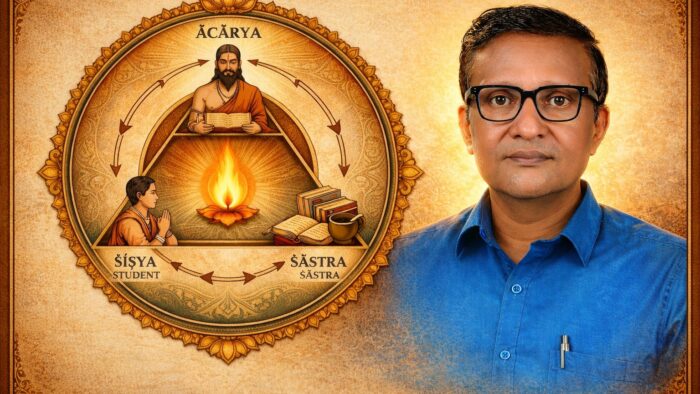
Dr. Rammanohar Puthiyedath is a Professor and Research Director at the Amrita School of Ayurveda, recognized for his work in advancing Ayurveda through a rigorous integration of classical knowledge and contemporary research frameworks. His academic contributions focus on restoring the epistemological and pedagogical foundations of Ayurveda, particularly through re-centering classical teaching methods, fostering hermeneutic competence, and promoting competence-based education.
His work emphasizes the importance of depth in learning, the integration of ethical sensitivity with clinical training, and the cultivation of internal cognitive faculties essential for responsible practice. He advocates for dialogic and inquiry-driven knowledge systems, where scholarly debate strengthens understanding, and for an educational model that culminates in practice-oriented mastery.
Dr. Rammanohar also highlights the need for context-sensitive reasoning, lifelong learning, and the development of an evolving, self-correcting academic ecosystem in Ayurveda, aligning traditional principles with global academic standards.
Addressing the Gap in Faculty Development: Your research mentions an asymmetry in faculty development where modern educational theories are prioritized over indigenous pedagogical principles. How can Ayurvedic institutions begin to reclaim this "pedagogical self-knowledge" to ensure educators teach with greater epistemic clarity?
Rejection of modern pedagogy is not the appropriate pathway to reclaim pedagogical self-knowledge. Instead, Ayurveda’s classical pedagogical philosophy must be re-centred as the foundational framework upon which modern educational tools can be judiciously applied. A necessary first step is the systematic inclusion of classical pedagogical frameworks within faculty development programmes. At present, Ayurveda is often presented as a body of knowledge requiring external validation and transmission tools; this perception must be corrected. Re-establishing internal grounding in classical approaches will cultivate hermeneutic competence - the capacity to interpret śāstra with depth and restore the role of the teacher as an ācārya: one grounded in lived experience who transforms the student, rather than merely transmitting information.
Classical Ayurvedic education began with a disciplined process of critical examination (parīkṣā) where the student, the teacher, and the science itself were all scrutinized. In what ways could this reciprocal evaluation model be adapted to improve modern student intake and teacher selection?
The classical model of parīkṣā distributes responsibility across all participants in the educational process, ensuring mutual accountability within a competence-oriented ecosystem. Translating this into the modern context requires moving beyond purely score-based student assessment toward a more holistic evaluation of intellectual disposition, ethical grounding, and motivation. Students should be enabled to assess teachers not only by academic qualifications but also by demonstrable academic performance and clinical competence. Current ranking systems rely on manipulable metrics; therefore, transparent indicators of institutional robustness are needed. Reciprocal evaluation should be instituted as a continuous, formative process guided by clearly defined, non-manipulable indicators rooted in Ayurvedic pedagogical principles, thereby shifting from procedural gateways to competence-based development.
Reflecting on the story of Nāgārjuna and his two disciples, where compassion was valued over procedural accuracy, how should modern Ayurvedic curricula balance technical mastery with ethical sensitivity?
The narrative of Nāgārjuna underscores that ethics cannot be isolated as a discrete subject but must be integrated into the entire training process. While replicating classical entry-level assessments may be difficult, students can be systematically exposed to situations requiring ethical judgment, empathy, and prioritisation of patient welfare. Instances of ethical resistance—such as a young physician refusing to participate in unethical clinical practices and resigning on first day of reporting for work—demonstrate that such dispositions can be cultivated through training. Therefore, ethical sensitivity and clinical decision-making must be embedded as core, inseparable components of medical education.
The Caraka Saṃhitā defines the means of knowledge cultivation as Adhyayana (learning), Adhyāpana (teaching), and Tadvidyasaṃbhāṣā (scholarly dialogue). How does the addition of "scholarly dialogue" specifically transform knowledge into "firmness and certainty"?
Scholarly dialogue (tadvidyasaṃbhāṣā) functions as a critical mechanism for transforming knowledge into firmness and certainty. While learning (adhyayana) and teaching (adhyāpana) generate understanding, it is rigorous intellectual exchange through structured debate that refines, tests, and stabilises knowledge. Such dialogue ensures that Ayurveda remains a self-correcting epistemic system and fosters independent thinking. In its absence, knowledge risks stagnation and degeneration into dogma.
Classical pedagogy often privileged depth in a foundational text before expanding to other domains, whereas modern curricula often prioritize early multidisciplinary exposure. What are the risks of "exposure without depth" for an aspiring Ayurvedic physician?
Prioritising breadth over depth leads to fragmented understanding and impairs the student’s capacity for autonomous knowledge advancement. As indicated in classical sources, deep engagement with a foundational discipline cultivates the ability for self-directed learning. This approach does not restrict the learner but defers broader exposure until sufficient cognitive maturity is attained. Premature multidisciplinary exposure compromises the development of depth, ultimately limiting intellectual competence across domains.
Can you explain the significance of the Pāṭha–Avabodha–Anuṣṭhāna (study-understanding-practice) sequence and why the sources argue that learning is incomplete if it does not culminate in Anuṣṭhāna (enactment)?
The Pāṭha–Avabodha–Anuṣṭhāna sequence reflects the essential progression from study to understanding to application. Ayurveda, being inherently practical, requires that knowledge culminates in effective action. Mere memorisation or theoretical comprehension is insufficient. As stated, actions must be undertaken with proper knowledge (jñānapūrvakaṁ hi karmaṇāṁsamārambhaṁpraśaṁsantikuśalāḥ), and knowledge devoid of application remains incomplete. Mastery arises through repeated practice (abhyāsa), which refines perception and enables successful execution. Thus, anuṣṭhāna represents the indispensable culmination of training, involving observation, assisted practice, and independent performance with proficiency.
Classical texts use a "hermeneutic ladder" (Vākya, Vākyārtha, Arthāvayava) to move from literal sentences to deep analytical reasoning. Why is this structured interpretation vital for a system whose foundational knowledge is preserved in dense Sanskrit?
The hermeneutic ladder—Vākya, Vākyārtha, Arthāvayava—is essential for interpreting the dense, codified knowledge embedded in Sanskrit texts. Literal reading yields only superficial comprehension, whereas structured interpretation enables progression toward deeper meaning and analytical reasoning. This process activates the cognitive faculties necessary for application, transforming textual knowledge into functional clinical insight.
The sources link the impairment of Dhī (intellect), Dhṛti (self-control), and Smṛti (memory) to prajñāparādha (transgression of wisdom), which is seen as a root cause of disease. How should Ayurvedic pedagogy train these internal cognitive faculties to ensure responsible clinical practice?
Training in Ayurveda must consciously cultivate the internal faculties of dhī, dhṛti, and smṛti, as their impairment leads to prajñāparādha, a fundamental cause of disease. Education must therefore shape both intellectual capacity and ethical conduct. By strengthening these faculties, the physician becomes an embodiment of awakened prajñā, reducing the likelihood of both technical and ethical errors in clinical practice, which may otherwise have serious consequences for patient care.
Using the example of Jīvaka’s exit test, where he found no plant without medicinal value, how does this illustrate a "mature Ayurvedic worldview" regarding context-dependent reasoning (yukti)?
Jīvaka’s exit test illustrates the maturation of yukti-based reasoning and the development of an integrated Ayurvedic worldview. His recognition that no plant is devoid of medicinal value reflects a context-sensitive, non-reductive mode of understanding. This signifies the culmination of training, wherein the physician develops prajñā—the capacity for independent reasoning—enabling the generation of new knowledge (anukta), innovation, and contextually appropriate application beyond textual limitations.
Since Ayurveda is described as having "no complete or final end," the sources argue that the world itself is a teacher to the intelligent. How can modern institutions foster this habit of continuous engagement (śaśvadabhiyoga) in practitioners after they graduate?
The assertion that Ayurveda has no final end positions the world itself as a continuous source of learning for the discerning practitioner. Modern institutions can foster this orientation by presenting Ayurveda not as a closed system but as an evolving body of knowledge. Educational processes should cultivate enquiry, reflection, and intellectual openness as intrinsic dispositions. Lifelong learning must emerge as an internalised habit, rather than being externally imposed through formal mechanisms such as CMEs or FDPs.