
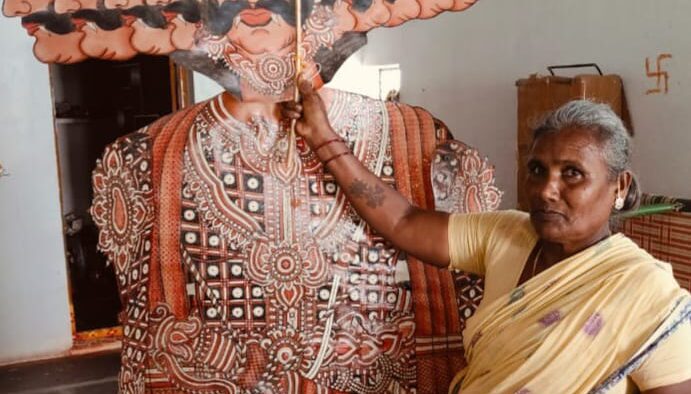
During a visit to the Ananthapur district of Andhra Pradesh with the Onamaalu team, which was researching local culinary traditions, we met Shivamma, recently honored with the title of Shilpa Guru by the Government of India. Shivamma is an artist of Tolu Bommalata, an ancient shadow theatre tradition known as the "dance of leather puppets." She and her son trace their art's origins to Maharashtra, migrating south centuries ago, with their family’s artistic lineage spanning over 10 generations.
Shivamma’s family has been performing this leather puppet art for more than 1,500 years, telling stories from the Ramayana and Mahabharata. This art form spread to Southeast Asia, where it was adapted to local cultures. We met her in her open workspace in Dharmavaram, where she was receiving congratulatory calls for her prestigious award. For the Shilpa Guru title, Shivamma created an artwork depicting the life of Shri Krishna, featuring scenes from his birth to adulthood, with Radha and Krishna at the center, reminiscent of Ardhanareeshwara. Devout in her spirituality, she takes her workers on an annual pilgrimage to the Arunachaleshwarar shrine in Thiruvannamalai to honor the spiritual side of their work.
Shivamma explains that their forefathers came from Pinguli in Maharashtra, and over time, many artists migrated to regions like Ananthapur, Karnataka, and Vishakhapatnam. Despite these migrations, they continue to speak Marathi, even though this art is no longer practiced in Maharashtra. The tradition is closely linked to Pinguli Chitrakathi, practiced by the Thakar community of Maharashtra, who performed various art forms, including Panguel Bael (storytelling with decorated bulls), Gondhal (group singing and dancing), and Fughdya (dance during Ganeshotsav). The Thakars practiced 11 art forms, including painting-based storytelling, leather shadow puppetry, stringed wooden puppets, and bullock art shows.
However, Tolu Bommalata is now in decline, and puppetry occupies only 1% of their time. Since the 1970s, reduced interest and economic hardships have forced the family to diversify into crafts like lampshades, wall hangings, and torans, which has helped them survive. Today, this art form is mainly seen at special events, international festivals, and exhibitions. For the past 10 to 15 years, they have traveled to exhibitions in cities like Delhi and Mumbai, showcasing their work and creating new designs.

Traditionally, performances were held outdoors near temples during festivals like Maha Shivaratri. Puppeteers traveled between villages, crafting and repairing puppets and instruments like the mukhaveena, mridangam, and kartal during the day and performing at night. The leather puppets are intricately crafted with vibrant colors and multiple joints, allowing for expressive movements.
Shivamma has been deeply involved in making small dolls and puppets since her childhood. She describes the meticulous process of preparing the leather, which once included deer skin but now uses goat and buffalo skins. Their work focuses mainly on themes from Indian epics, selecting small segments from the Ramayana or Mahabharata to create detailed characters, each cut with intricate patterns and painted in vivid colors. The performances often center on single episodes like Sundarakandam, Balakandam, or Sugreeva Patabhishekam, with a full presentation of the Ramayana taking up to 45 days.
Despite the hardships, the region has earned significant recognition, with 14 to 15 national awardees, including a Padma awardee, and now Shivamma herself receiving the Shilpa Guru award. She notes that focusing solely on puppetry would not have been sustainable, as live performances have lost their audience. Diversifying into other crafts has allowed them to create a viable market for their work.
As we watch Shivamma meticulously paint her crafts, it is clear that this is more than just a livelihood—it is her heritage and her life, a deep connection to the stories and songs of her ancestors. "And so, we continue," she says, "carving leather, crafting stories, and preserving an ancient tradition in our modern world."