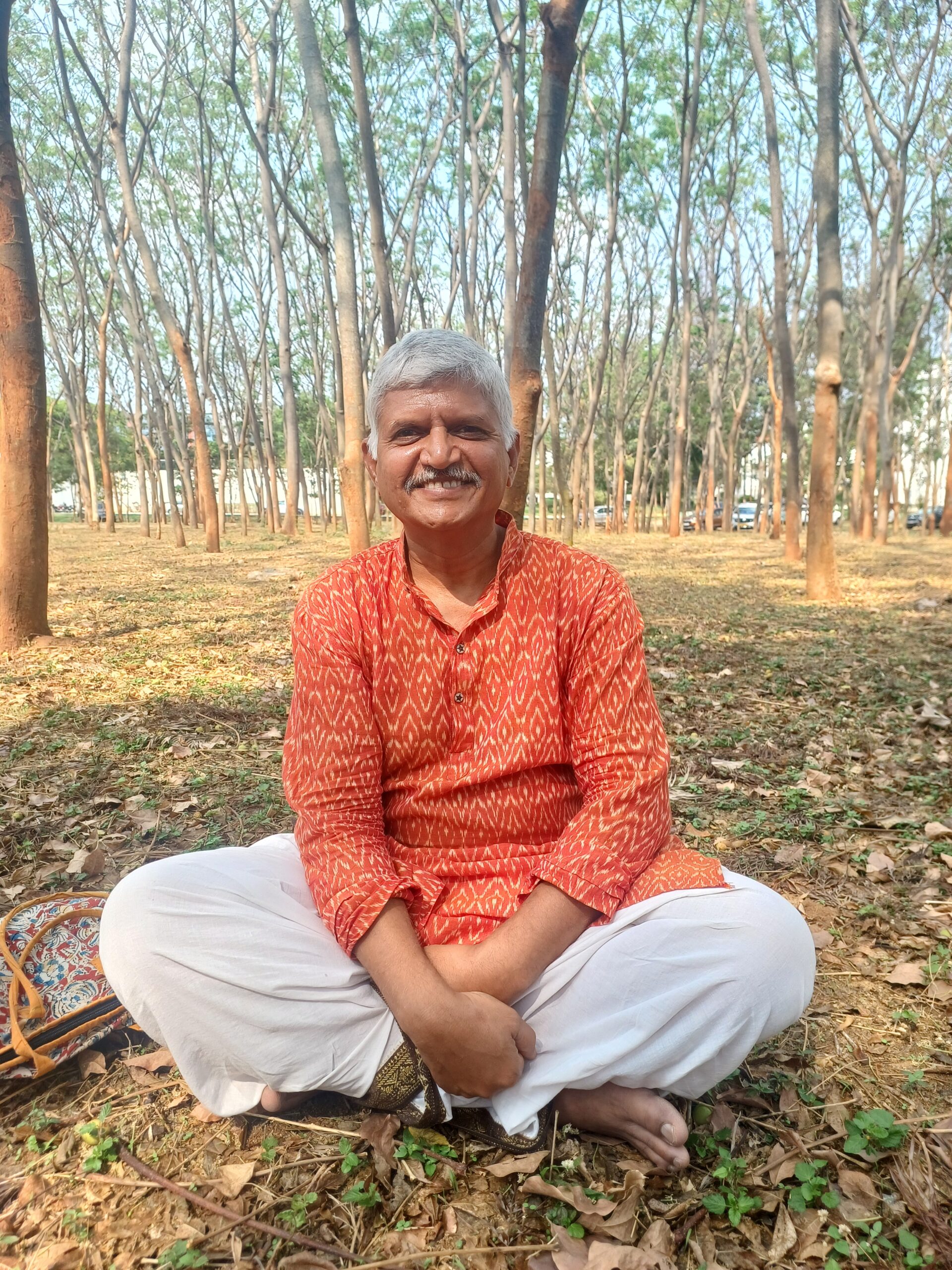


Adheer Som has a family tradition of Devi worship, but it was only when he started his work as a researcher that a series of "coincidences" (as he terms them) nudged him towards inquiring about the connection between humans and the divine. He shares a picture of a 10,000-year-old Devi sitting upside down. She is Baghor Kali, and her form is of a stone. The Devi was found during excavations in 1982, and Adheer says the site is one of the most pristine Shakti places he has been blessed to visit.
He shares a video of the site, located in Sihawal tehsil at the feet of the Kaimur range in Sidhi district of Madhya Pradesh. She is overlooking her beautiful kingdom, flags fluttering in the wind, devoid of human inhabitants. Just behind this shrine, he found his own Kula Devi, fully Yoni-formed, on a mountain. The vigrah has triangular striations all over, only hinted at when the flame flickers over her in the dark.
He also has another favorite: a Baglamukhi Sachal vigrah, who accompanied him once to Haridwar where he felt he needed her protection, but it turned out that he didn’t. She is crane-headed and all-seeing. In a recent post, he says, "the Goddess of Political Power goes by many names but Baglamukhi or the Crane-headed-one, is probably a corruption of ‘Valga Mukhi’ - She who has a bridal face." Among her numerous names is Adheera, now isn’t that a coincidence?
He shares a picture of her unadorned form and also of her decked up in yellow finery. He says she is also known as Pitambari because of her fondness for yellow and is the go-to Goddess for Raj-Satta, as she is Shatru-naashini. “Her classic iconography depicts her holding the demon Madan’s tongue while she’s about to hit his head with her mace.”
In case you are wondering why I am telling you all this instead of starting the interview, it is only to show how Adheer chanced upon his logical interpretation of Shakti peethas when she chided him into seeing the facts from a different perspective. “She said look at it in a particular way and that was that. The rest was easy to figure out and verify.” This started a long journey of following her trail, both external and of the Antaryami. Before that, he says it was a case of…“kahaan Matangi, kaun Matangi” (his isht devi).
What is the role of the Kuladevi in Tantric worship? Could you share a bit about your kuladevi and how your family has been worshipping her over generations?
Tantric worship can be a single act, a life-long individual pursuit or a Clan or ‘Kula’ tradition. In the latter case, she is the focus of the worship, whereas an individual sadhak might or might not have a Clan Goddess, and the ‘Isht-Devi’ or personal deity is the focus of the sadhana, done either for worldly gains, ‘siddhis’ or powers, identification with the deity or all of these purposes.
My Kula Devi is Shri Kali Mai. We have been worshipping her for nine generations, ever since an ancestor brought back a natural stone ‘Vigrah’ of Maa from somewhere in the region adjoining Rewa in MP. This ‘Vigrah’ was placed deep in the hollow of an old Neem Tree outside our home in my paternal village Isipur, in Pratapgarh, UP. It is not touched or seen. The daily worship ever since has been simply offering obeisance, flowers, water, ghee lamp and dhoop incense. Goat sacrifice was offered during Navratri till some years ago, but now only the ear is nicked and the animal spared.
I was very lucky to find a natural stone ‘Yantra’ Vigrah of Ma as well, during an expedition to the Baghor site in Sidhi district in MP, while researching the 10,000 B.C. dated ‘Baghor Kali Stone’, about which I have written in the Times of India. This Vigrah is established in my Lucknow home, with Ma’s blessings.

Did your heritage spark your interest in researching Shakta and Shaivite traditions?
No, I was born and brought up in Lucknow so did not have much exposure to daily Kula Devi worship. In College I studied Philosophy and developed an interest in Theoretical Physics, much of which was very strange. Right after college I joined the Times of India, Delhi, as sub-editor on the then-newly established Philosophy Desk. However, the work was more spiritual than philosophical and not my cup of tea at the time so I quit in a month. But one day my then boss Swati Chopra had told me about a place called ‘Gyanganj’, when we were discussing the fictional idea of ‘Shangri-La’ based on the Hindu-Buddhist legend of ‘Shambhala.’ She knew of a book on it by the eminent Tantric scholar Gopinath Kaviraj, so I went looking for it in Indology book shops like Chaukhambha, Motilal Banarsi Das etc. I found it, and along with it also found a large number of Shaiva-Shakta texts. It was only much later that I could start making any sense of it all, of course.
Our glorious Tantric texts are accompanied by compendia and commentaries. Which are the most respected and commonly referred to in your region?
Unfortunately, many if not most of the published editions of the texts suffer from flaws and errors. The traditional compendia are the best to refer to in case manuscripts or clean Sanskrit editions are not available. These compendia include ‘Brihat Tantrasaar’, ‘Mantra Maharnava’ and ‘Mantra mahodadhi.’ For some specific deities, such as Lalita Ji of the Ten Mahavidyas, there are individual texts that have excellent commentaries, like ‘Kamakala Vilas’ and ‘Parshuram Kalpsutra’ but these are of the highest level of sadhana. Some pure commentaries such as ‘Shaktananda Tarangini’ are also quite marvelous. And I must mention ‘Chandi’ Patrika, a wonderful magazine on Shaktism being published from Prayagraj for decades. It has been an excellent, high quality source of commentary and clarification for me. Ritusheel Sharma ji is the current editor and a thorough gentleman scholar of the Tantric tradition.
Some say that Tantric traditions focus on sadhana paddathi rather than philosophy, unlike other traditions. What is your experience? Can rituals come without philosophy?
It is entirely possible to succeed at Sadhana without knowing any of the philosophy, as Sadhana is ‘Bhavna-pradhaan’ i.e. it is the depth of feeling, emotion and faith that counts. There have been many cases, RamKrishna Paramhans and VamaKhepa being the most famous, of unlettered adepts of the highest order. However, just the philosophy without the sadhana is no better than knowing Sankhya and Advaita Vedanta as intellectual concepts. Actual mystical experience and realization of any sort, or accomplishment of a spiritual goal, usually requires sadhana, although it can also happen entirely by the Devi’s grace, without any effort. In my own case for example, whatever I know of the Sri Vidya was made known to me as an act of grace. I had no interest in it whatsoever and always considered it way above my pay grade, so to speak. Yet, for reasons best known to her, I was made the recipient, so I guess she must have some plans regarding it.
In my opinion, the ritual itself is a prop to be quite honest, meant to focus one’s own thoughts on the deity and the goal. At high levels, all Puja can be done in the mind, as ‘Manas Puja.’ This is not to say that outward rites are futile. Far from it, they are essential. Interiorized worship can only be perfected after external ritual has been perfected. Knowing the Philosophy helps develop and induce the proper ‘Bhavna’ but is not necessary. Devotion is quite enough for Devi.
You have researched and written about the Aghori tradition. When we talk about Aghoris, what Agamas do they follow? Shaiva Dualistic, Raudra Dualistic and Non Dualistic or Bhairava non-Dualistic?
As far as proper Tantric Sadhana is concerned, the first objective of all sadhaks regardless of path is to transcend ‘Pashu Bhaav’ ie the default human condition of being bound in eight ‘Paash’ or fetters: Anger, Disgust, Shame, Fear, Caste, Creed, Modesty and Hatred. (Some lists have a few differences.) It is only once these are cut through training or practice that the Sadhak acquires the Vira Bhava or heroic temperament. It is in Vir Bhava that Vama Margi Tantric practice is prescribed, which involves the use of substances such as alcohol and meat etc amongst other things. The Aghori training is the fastest, most aggressive and also most dangerous way to achieve this transcendence. It is for this reason that Aghoris dress the way they do and live the way they live, not because they are crazy or dirty people as such. They’re trying to not care about being thought of as crazy or dirty and also trying not to think of anything as dirty or terrible or ‘Ghor’ so to speak.
The origins go as far back as the Rudra of the Atharva Veda As for texts, Aghor is one of Shiva’s five faces and the texts believed to have been revealed by that face are the ideal texts, but there is no consensus on which texts these are. The Rudra Yamala and Bhairava Yamala are popular. The ritual worship can be both dualistic or advaitic. It can also be of the ‘Shaabar’ or folk kind. Texts such as ‘Viveksaar’ by the great Aghoracharya Baba KInaram, who revived the Aghor tradition in Kashi during medieval times, are devoutly studied as repositories of Aghori philosophical thought. I am not familiar with the Girnar Aghor tradition but Dattatreya is of common High Guru-Founder status in both streams.
When people refer to Tantra or Aghoris today, they talk about 'black magic" or 'cannibalism'. However 2/3rds of our religious rites are Tantric, and half our medicines too. You have seen the magic at times. Could you describe a few things that become possible through this practice?
‘Black Magic’ is any ritual act done or rite performed with the intention of causing harm. The same exact rite can be done with good intentions. Shakti is ethics-neutral. One must face the consequences of one’s actions, good or bad. Every tantric text warns against malpractice and guarantees a terrible downfall if malpractice is indulged in because no amount of ‘magical power’ will stop the wheels of Karma from grinding on. Shakti will not intervene on your behalf, because Shakti is herself the wheels of Karma. That said, a whole lot of people, uneducated, educated and highly educated, indeed indulge in these low-level acts of sorcery. Thankfully much of it is utter nonsense and has zero effect.
As for Cannibalism, there is certainly ritual acceptance of human flesh on specific occasions during training, typically some small bit left over from a corpse after cremation. This too is done to eradicate thoughts of disgust or fear or impurity regarding the dead. It is not exactly a dietary choice :) Also, I don’t think it grants any magical power whatsoever. It just removes a sort of conditioning from the Mind, and only a soul with a mind entirely free of conditioned response becomes the truly autonomous self, Shiva-like. Healing of course is a specialty of the Aghoris. They are reputed to be able to reverse even death, and cure the incurable by taking the disease upon themselves and sublimating it. However, I have never seen an Aghori perform a miracle at all. The genuine ones are least bothered about miracles etc.
Amongst the miracles I have witnessed, the best one was done by a small, school-going girl in Kashi, who I met by coincidence at a temple. I believe this child, Vaishnavi, has an ‘ansh’ of the Devi whose temple she lives in. She can vanish at will, in broad daylight. I have seen it myself, as have others in the area. Sounds awesome, right? But it’s quite unsettling when this sort of thing happens. One is left astounded and a little scared too!
You describe places of importance to Aghoris. Does the energy come from the sadhana done within these spaces, or are these spaces constructed to harness energy like pyramid structures do.
Typically such places are primordial Shakti sites or Swayambhu Linga sites, identified centuries ago by the ancient masters, who then did their sadhanas there, thereby energizing the space ritually. This buildup has continued across various places and Shakti Peethas. The construction as such is unimportant, but the geography and lore of the site might well be of tremendous significance, as is the case at Kamakhya for example.
How do the Aghori view their place in contemporary Indian society? What is their relation to dead people, especially ancestors?
Traditional, old school Aghoris of the sanyasi kind don't care about society as such. They might help someone on occasion but they are not altruistic. There is however a relatively new school within the Kinarami lineage. This new line was founded by the Aghori Master BhagwanRaam, who was to ascend the ‘Gaddi’ at Krim Kund in Kashi but was excommunicated by his guru for his reformist tendencies, primarily his view that ritual human flesh consumption should be replaced by service to lepers, as both accomplished similar overcoming of disgust. After excommunication, Baba BhagwanRam set up an Ashram in the Padao area of Varanasi, which continues to run under Baba Sambhav Ram, his successor. It carries out various social works etc.
There is no relation with the living or the dead for Sanyasi Aghoris. There might be interaction, dealings, but no relation. Householders must of course carry out all worldly responsibilities, including those towards ancestors.
What do you see as the future of Aghori practices in an increasingly modern and globalised world?
I think the established seats and the practice will continue as it has. The Aghori way is really not for everybody. Most people would balk at the very first step. It is not meant to be a popular path. It is ‘Ugra’ and ‘Teevra’ and is best avoided!
From 1955 to 1985, a strange holy man lived secretly, namelessly, in various parts of Uttar Pradesh. When he died, they named him ‘Gumnami Baba’—The Unnamed Saint. You, a Logic tutor and writer, have authored a book on the secret life of this mystic. The forward of the book carries a deposition by Jayanti Bose Rakshit, who states the nameless saint may have been none other than Netaji Subhash Chandra Bose.
Could you tell us how Gumnami Baba came to be? Are there explanations to many historical mysteries that our spiritual practice can uncover?
Gumnami Baba also happened by coincidence. I was visiting Faizabad-Ayodhya for a day trip back in 2014 and was given a special tour by the local administration. In the course of this I went to his Samadhi and thereafter to the house where Baba breathed his last. The landlord told me of the High Court case in the matter and of the judgment that had come in 2013 but was not implemented by the State government. I got involved in said implementation and then just kept getting deeper. It was all standard research work though, I did not employ any mystical means for it. There was no need even for it, given the sheer amount of documentary evidence that was available, as I have chronicled in my book.
How has your research on the Aghori, Tantra and Gumnami Baba influenced your understanding of spirituality and asceticism?
Hahaha I have zero understanding of both, and hardly any understanding of anything other than Logic, which I teach for a living. My entire so-called spiritual journey so far, since 2006, has been guided and led by totally coincidental events and wondrous if scary occurrences. Even the people who helped, came along totally by chance. My Isht Devi understands everything of course, and occasionally reveals some stuff which I end up writing about. That’s pretty much it.