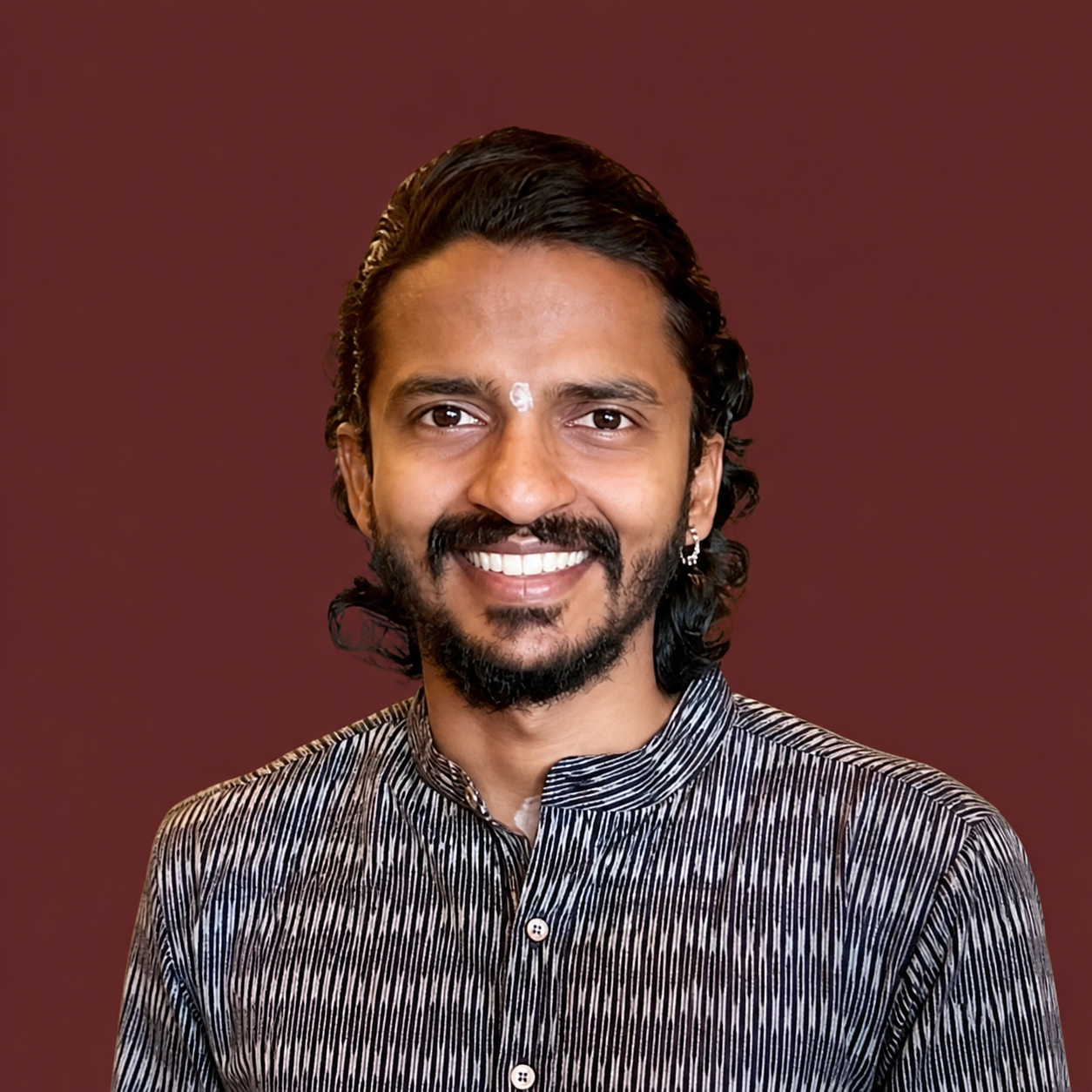

Maragatham returned to Bharat after earning an engineering degree in the US. He moved to a farm in rural Madurai District. Working with rural communities in both farming and construction brought him face to face with the untruths of universalist Western education resulting in his conscious ghar wapsi to Dharma, Hinduism, and the ways of his ancestors. His self-published books include, “Light In The Forest: A Dharmic Landscape for Hindu Kids and their Parents,” and “It's Not For Nothing That We Stand For Something: Basic Intellectual Self-Defence for Hindu Parents”. He tweets at @bhoomiputraa, and writes under a pseudonym to protect his family from left-liberal attacks. In this interview he explains the process of return and commitment to Dharma through his writings.
How has your journey to the West and back shaped your thoughts and your writings on Sanatana thought vis a vis Western ideas?
I will credit the West with enabling two important personal transformations – one, awakening me from unconsciousness and forcing me into self-reflection, and two, introducing me to the political complexity of the world we live in. Of course, it is not necessary that such transformations can happen only in the West, they can happen anywhere given the right alignment of stars, but they did alert me to a peculiar dullness of mind that we Indians have inherited due to our long encounter with colonial forces.
I took a familiar route out from that colonized state of unquestioning acceptance of the status quo –> Anti-Capitalism, Socialism, Progressivism, New-Ageism, Environmentalism. I see now that these are all vaguely connected and the impulse that connects them is ironically a conservative impulse – the need and desire to cope with the unacknowledged sense of loss that Industrial Modernity has brought upon many of us. When looked at from this psychological point of view, all of these reactionary movements are, in their own ways, aiming to recover the one thing that has been lost to us with the coming of this new world – a sense of being connected (through purpose and/or community)… and with it, they hope to recover a sense of belonging and meaning.
Two understandings emerged,
- At the psychological level, it is this sense of meaninglessness (born from the fall of the old connected, meaningful world) that is the driver of all these “isms” and their revolutionary, never-to-be-satisfied agendas.
- At the sociological level, the template that all of them end up adopting is the Christian template - a belief in the possibility of a perfect future (Heaven-centrism) and the righteousness that their point of view should be foisted upon the whole world (Universalism).
Of course, all of this I can only say in hindsight. For decades all I did was put skin in the “ism” game and it was pure life experience and purva-janma punyam that helped slowly pull back the onion skins of illusion that Western thought processes had thrown over my eyes.
My final return to Sanatana was a slow and subtle process that was catalyzed by my life in rural India among the amazing still-rooted villagers of the myriad jaatis who continue to represent (however imperfectly) the dying light of classical Bharat.
The ideas that I have broached above became crucial bridges by which I could understand the Sanatana point of view –
- The individual is only made whole within Community and therefore Liberty in a communal world has a very different meaning from what it is commonly understood to be in an individual-centric world.
- Our personal deliverance is not in the elsewhere-afterward of a “Heaven”, but in the radical present – The Here and Now.
- Our communal deliverance lies not in Universalism but in Purusha Consciousness – The simultaneous recognition of the One in the Many and the Many in the One.
Sri Aurobindo says, "In order to see you have to stop being in the center of the picture." This is a maxim journalists try to follow. Are your observations as a 'social commentator' looking in from the outside or from inside looking out into the future or past?
There are two answers to this question. My peculiar life journey has indeed made me an outsider everywhere. I was an outsider in the West and I am an outsider in rural Bharat. In that sense, I do believe that I have a reasonably detached point of view that is simultaneously illuminating because it comes from an unusual angle.
At the same time, I personally do not aim for detachment. Attachment is the one thing I have aimed for through-out my adult life. I have desired and searched for belonging at every stage. It is the prime mover of my life… my search for authenticity through belonging. And because of this, I have put skin in every game I have played in. I have felt attachment to every “ism” I have embraced (rather un-Sanatani, I know). I don’t know if twenty years of life in rural Tamil Nadu qualifies me as an honorary villager. I will probably die some sort of jigsaw puzzle man.
As far as the past and future go, it’s been many years since I thought in those terms. There are things and processes that are beautiful and humane and sustainable and there are processes that are not. It appears to me that the industrial-world is moving away from beauty, nobility and sustainability, so when I question these processes it may appear that I am “regressive” and that I want to bring back the past etc, but that is not the point. The point is what configuration better serves the interests of beauty, nobility, sustainability, and ultimately, well-being? If the answer to that question can be found in 3000 BCE, so be it; if it lies in 2200 CE, so be it; if it lies in a mix of the old and new, then so be it; but I can only respond to the evidence that is available, and the evidence that Elon Musk will deliver to us beauty, nobility, sustainability and well-being on Mars or Alpha Centauri or wherever, is very thin indeed.
You mention Gods, Prakriti, Community and Traditions as Indian society's cornerstones. Are the first principles on which our society is based a good basis for achieving samata towards communities that are both different from and inimical towards us? Is Samata a desired quality today?
These are the manifest cornerstones of our society, but they emerge from certain principles which indeed can be applied universally once the world is ready to accept Sanatana. It is in the service of that uplifting harmonic vision that our religion has given us the telescopic tools of Purushaarth (for individuals), Samskaaras (for families), Rna (for communities), Tirtha (for the Rashtra) and Purusha (for the wider world).
Purushaarth enmeshes us within transcendence, duty and nishkaama karma. Samskaaras enmesh us within continuity, tradition and beauty. Rna enmeshes us within gratitude and inter-relationships. Tirtha enmeshes us within a sacred landscape lending us belonging and place. Purusha enmeshes us within the idea of unity in diversity and mutual respect.
The Gods, Prakriti, Community and Traditions are what made up all human life all over the world since the very beginning of human time (historiographically speaking). I believe that a time will come when the peoples of the world will tire of their dalliance with political ideologies masquerading as religions and with human-eroding (and nature-eroding) technologies and systems of Western Modernity, and they will return once again to reverence and natural religion (what goes by the name of “paganism”). It is then that Sanatana will take its rightful place in the world as the steward of the top-down principles for the management of bottom-up natural religions, and we will see the global spread of the eternal principles of sustainability, collaboration, mutual respect and well-being.
As far as samata goes, I do not see that happening anytime soon. We await the day when the peoples of the world recognize the beauty of Sanatana as the beauty that lies within themselves. Current efforts at inducing samata include the export of Yoga, Buddhism, Advaita and Vaishnavism. But, I’m afraid the true globalization of our principles will only happen post-collapse, after the final defeat of the cult of techno-optimism and progressivism that currently grips the world.
Samata is always desired, but history has shown that even though the Christian idea of “love thy enemy” has ironically found life only here in Bharat, it has not resulted in samata. That the inimical forces can be won over is an optimistic and naïve dream of a people who think the world will reciprocate good faith with good faith. There is no possibility of samata. Having said that though, I do have a soft corner for our continued collective innocence… I see it as evidence that one thousand years of strife has failed to harden our hearts with a cynicism so all-pervading that we lost our essential Hinduness.
You point out that ideas of God, Divinity or the Divine have little place in societies that emphasise the individual over community or tradition. We believe Brahman is the only absolute Truth. How has the idea of Brahman being the process of offering and that being offered and being attained by those who see Brahman in every action shaped our aspirational identity.
I am not sure we have an aspirational identity. If you are referring to the idea of Vishwaguru, it requires us to first radically over-haul our modern mindset and offer ourselves as an example of how a nation can be designed differently. For that we can start with tangibles such as the Traditions, or with principles such as the Pancha Rna, or with metaphysics such as Brahman as you have indicated.
How each of these routes will manifest in the design of a Dharmic nation that strives to be a light to the world is yet to be theorized. Seeing Brahman as the offerer, offering and the offered-to requires us to embrace an all-encompassing reverence and nishkaama karma. In classical Bharat, the discipline for this came from the sacralization of work. With the collapse of our Kula-Jaati structures, and the consequent desacralization of work in the Western market-place, we no longer have a daily route for this sadhana. Now it's up to individuals to use dhyana as a means to manifest this ideal. But, being a private process, this dhyana is arguably hard to harness for nation-designing purposes.
[caption id="attachment_24440" align="alignnone" width="1024"] Pic by Vinay Kadaba Srinivas[/caption]
How do we train the next generation to know What is a Right Life, a planned and discriminative life, where being honourable is the both a means and an end? How can parents learn from your writings on Hindu parenting?
In my book for Hindu parents, I’ve tried to offer people all kinds of analogies and models to understand why we are where we are today. I have also offered some minimal advice on how to overcome these systemic anti-Hindu biases. I’m sorry, but there is no easy way out. Bringing up Dharmic kids in today’s westernized environment requires a lot of intent, will and discipline. The other ingredient missing is knowledge. People who have the intent may not know what needs to be done given that they themselves are deracinated. Approaching a Dharma-Guru as a guide is one of the obvious ways forward, the other is to rally around and organize classes under the tutelage of a knowledgeable teacher. Perhaps the parents can join the classes too. Chinmaya Mission seems to have disappeared from our cities, but alternatives need to be created by parent groups themselves. Equally important is for parents in the education sector to think of how more and more Hindu-friendly schools can be opened in our cities and villages. The idea of the “NGO” that till now was the exclusive preserve of communists needs to be commandeered by devout Hindus and directed towards ordinary Hindu-friendly work, and this should be done openly and explicitly.
Relations with the West have dominated the Indian scene in such a way that first Europe and now the United States constitute natural frames of reference for a comparative self-understanding of what it means to be a feminist in India. You have juxtaposed what our shastras say with Western Feminist ideology (whose ideas of Equality among genders is contradictory to its own beliefs). However, we, Indian women are also falling in the same trap of trying to be equal biologically, professionally and psychologically. Are Bharatiya ideas of Honour, Duty to Family and Children, seeing women as protectors of the flame strong enough to withstand Western notions of emancipation?
My essays on this particular topic explored three or four major ideas
- That Feminism and Modernity are linked. We cannot have the former without the latter. Feminism was birthed by the inherent inequalities and power structures of the industrial economy, and as such its emergent morality cannot be used as a stick to beat non-industrial communities. This is something that most people don’t understand. But given that most people who believe in “progress” unconsciously credit the industrial world with having a higher morality than the pre-industrial world, it makes sense that they would also credit Feminism as having a higher morality than traditional paradigms. You will notice how strangely and unthinkingly we associate increasing material complexity with higher morality.
- That the peculiar reading of the ideals of liberty and equality upon which Feminism defined itself, when extrapolated, ultimately lead to the destruction of not just family but coherent community and personal identity itself as we are seeing today. All of these disintegrations allow for the greater and greater take over of our lives by the centralized Tech-State.
- That in order to uphold these feminist principles, one logically needs to support the hidden principles of Industrial Modernity (given that it is the parent of Feminism). Feminists will inevitably therefore subconsciously stand against their traditions and the Gods while unthinkingly standing with the Market and the Machine (which, being the hidden principles of Industrial Modernity, are the actual forces that create the liberty and equity they so dearly covet). Ultimately, the consumer-ification and android-ification of the human condition become inevitable. Simply extrapolating their own internal logic will lead them to that dystopian impasse.
- That in order to avoid this dystopia, we, as Hindu men and women of honour have a simple solution. The solution consists of keeping our eyes on what is true. Our archetype is Ardhanareeshwara, which represents complementarity between man and woman (Equivalence, and not Equity), and our working principle is the upholding of the Samskaaras. There are no explicit proscriptions within an individual Hindu marriage, there is only the question – “Will this act of mine aid or hinder the upholding of the samskaaras, not only in our lifetimes but in our children’ lifetimes as well?”. This question is posed to both men and women.
The modern urge of men demanding more liberty than women, and women responding by demanding more equality than men, has to be resisted, and our focus returned to the true and eternal purpose of our union.
Abigail Shrier in her book: Irreversible Damage, The Transgender Craze Seducing our Daughters, paints a grim picture where social institutions have greater power than parents over children. Schools, psychiatrists and even children have a larger say in children's rights than caring parents. I see it happening in India in the near future. As Sai Deepak said recently when this kind of individualism gains critical mass, should the law support community or parents or the misguided individual?
I have not read this book in particular, but I have been following the course of Western governmental over-reach for over a decade, even from the days before I returned to Sanatana. From a pure Western Liberal perspective itself, what has been happening in the West is Orwellian. Children being taken from their parents by “child care services” is a case in point. Why, we can even go all the way back to the establishment of public schools and compulsory education. When looked at carefully, these phenomena (that we take for granted today) are an unacceptable over-reach of centralized authority. What is the relationship between the state and our children? None! Why then should the state take it upon itself to “educate” our kids? All of this points to the fact that tacitly, we, as parents and communities, have handed over “ownership” of our children to the state. We are mere guardians. If the state had more capacity, we can rest assured that it will both birth our children in extra-corporeal wombs and bring them up to be ideal citizens in state-run “homes”. If this all sounds insane to us, it is only because we have failed to connect the dots. Once we connect the dots, then the trajectory of change will become clear to us.
What JSD says is correct, individualism is one of the major problems of westernized society. In the absence of a community-enforced limits, individuals have to be controlled in more and more invasive ways by centralized authority. External law starts to replace internal culture.
It is clear that Community does half the work that states do, all without an ounce of effort or centralized policing or punishment. That is why a Dharmic State prefers to govern over communities rather than individuals. But the Western State with its focus on the Machine and the Market, prefers individuals who can be controlled and manipulated instead. Healthy community life (incentivized by law) is an essential component of an ethical state.
How does a Hindu social commentator escape the 'elitist minority' label. Sanatani values have been the glue holding this land together but when articulated succinctly by English speaking intellectuals it's invalidated. How does one counter the shallow, mass followed populist, secular narratives that have colonized the young Indian?
The advantage that we have is that Hinduism is an ortho-praxy, so regardless of how we articulate our ideas, my return to Hindu ritual practice does qualify me as a Hindu. It is not just that I understand and articulate the anthropological significance of traditions, but that I also simultaneously take part in those traditions. It is the practise that validates, not my words or the language they are articulated in.
The other ironic side of the coin is that unless I write in English the audience for this kind of discourse is limited. The non-English speakers are already traditional and so they do not need me except to function as a canary in the coal mine. The English speakers, on the other hand, in all likelihood are facing erosion of their traditions and a discourse such as this can serve as an important means for them to understand the modern world, its inherent biases and how to avoid its pitfalls if one intends to retain one’s Hindu identity and pass it on to one’s children.
Strategically speaking, we need more literature, more movies, more music and more art steeped in the Hindu worldview. Not merely talking about the worldview (as I do), but actually set in that worldview. At the higher level, we need to regain control over the news and the educational curricula. There is no other way to counter this tsunami that is already upon us and it will only get more destructive as the hundreds of millions of rural youth graduate from the westernized schooling system for the first time this generation.
While we celebrate Sri Rama's return to Ayodhya, can we say the same of the idea of Adi Purusha. What are the values that are slowly getting eroded and how do we make sure they are reinstated too?
Not sure if Adi Purusha here means Ishwara or Narayana or Brahman :). I use the word Purusha Consciousness to refer to our innate understanding that though the world is made up of diversity, all of that diversity is a manifestation of a higher unity. It is this consciousness that helps us manifest Mutual Respect in our daily lives. Unlike Africa or Europe or Papua or the Americas, we never had inter-ethnic or inter-linguistic war. All of our kingdoms were home to multiple ethnicities and languages. This is one of our great strengths and characteristics. It is also one of our weaknesses in the face of groups that aim to take advantage of this open architecture.
Every single one of our traditional values is being eroded. I usually look to the Pancha Rna as the equivalent of the preamble to our civilization. Though vast tomes of philosophy have been written by our rishis, intellectuals and gurus, it is these five debts, in my opinion, that serve as the most concise, succinct and yet extensive description of the lived Hindu universe. The reinstatement of our values in our families can happen when Hindu children are exposed to the Pancha Rna early on as a framework to understand both the inner Hindu world and the outer non-Hindu world.
Ultimately though, it is through our awakening and the offering of our awakened consciousness to the fields of education, media, law, politics and public policy, that will pave the way for a civilizational rebirth. The first step in that process is the awakening of Hindu consciousness to the nobility innate within it. Colonial consciousness has not just put us to sleep, but it has actively turned our minds against ourselves. It is this tide that has to turn through an honest appraisal of both the past and the possibilities for the future from within an indigenous framework.
My writings, then, are an offering to that vision of an authentic Bharatiya future. They are also a eulogy for the best of what our ancestors embodied and an appeal to all people of Sanatani heritage to use an indigenous understanding of the past to end Hindu self-hate.
Maragatham is the author of two books - “Light In The Forest – A Dharmic Landscape for Hindu Children” and “It’s Not For Nothing That We Stand For Something – Basic Intellectual Self-Defence For Hindu Parents” which can be found at https://tinyurl.com/yckky6j4)